Jump to HeaderJump to Main ContentJump to Footer
Michigan State University
  • Browse Stories By

    Topics

    Explore stories by subject area

    • Arts and Culture
    • Business and Economy
    • Climate and Environment
    • Education and Learning
    • Engineering, Science and Technology
    • Government and Society
    • Health and Medicine
    • Media and Communications
    • MSU Leadership and Impact
    • Sports and Recreation
    • Student and Campus Experience
    View All Stories

    Collections

    Curated story series

    • Turfgrass
    • Ask the Expert
    • Big Ideas
    • Climate solutions
    • Water at MSU
    • Mobility
    • Spartan Perspectives
    • Student views
    • Graduate voices
    • Faculty voices
    View All Collections

    Featured

    Editor's picks

    • The Spartans behind your favorite Michigan golf courses

      July 22, 2026

      The Spartans behind your favorite Michigan golf courses

    • MSU in the 1990s: 10 Spartan milestones

      July 14, 2026

      MSU in the 1990s: 10 Spartan milestones

MSUTODAY
  • Browse Stories By

< Browse Stories By

Topics

Explore stories by subject area

  • Arts and Culture
  • Business and Economy
  • Climate and Environment
  • Education and Learning
  • Engineering, Science and Technology
  • Government and Society
  • Health and Medicine
  • Media and Communications
  • MSU Leadership and Impact
  • Sports and Recreation
  • Student and Campus Experience
  • View All Stories

Collections

Curated story series

  • Turfgrass
  • Ask the Expert
  • Big Ideas
  • Climate solutions
  • Water at MSU
  • Mobility
  • Spartan Perspectives
  • Student views
  • Graduate voices
  • Faculty voices
  • View All Collections

Featured

Editor's picks

  • The Spartans behind your favorite Michigan golf courses

    July 22, 2026

    The Spartans behind your favorite Michigan golf courses

  • MSU in the 1990s: 10 Spartan milestones

    July 14, 2026

    MSU in the 1990s: 10 Spartan milestones

  • For Media
  • Experts
  • Releases and Statements
  • Sign Up
  • Update Information

Resources

  • A to Z Index
  • Find People
  • Maps
  • Email
  • Student Information System (SIS)
  • D2L
  • Libraries
  • Tech Support
  • MSU Misconduct Hotline
  • Social Media Directory
  • Events Calendar
  • For Media
Michigan State University
MSUToday
  • For Media
  • Experts
  • Releases and Statements
  • Sign Up
  • Update Information
MSUTODAY
Engineering, Science and Technology

Jan. 10, 2023

Ask the expert: Breaking down the discovery of an Earth-sized planet

MSU has helped discover a planet outside our solar system that could be capable of supporting life

By: Matt Davenport

Working with data from NASA’s Transiting Exoplanet Survey Satellite, or TESS, Michigan State University has helped discover an Earth-sized exoplanet — a planet outside of our solar system. 


This planet, named TOI-700 e, falls within its star’s habitable zone, meaning the newfound planet could be capable of supporting life as we know it. The research team announced the finding Jan. 10 at the American Astronomical Society meeting in Seattle. 


Michigan State University Assistant Professor Joey Rodriguez, who helped spearhead the project that discovered the Earth-sized exoplanet TOI-700 e

Astronomers believe that many such planets exist in our galaxy and across the universe. The discovery of TOI-700 e, along with the earlier confirmation of its host system, could provide unique opportunities to better explore exoplanets going forward.


“Even with more than 5,000 exoplanets discovered to date, TOI-700 e is a key example that we have a lot more to learn,” said Joey Rodriguez, an assistant professor in the Department of Physics and Astronomy at MSU, who helped make the discovery.


Rodriguez was one of the senior researchers on the project, led by Emily Gilbert, a postdoctoral fellow at NASA’s Jet Propulsion Laboratory in Southern California. The duo is also part of the original team that confirmed the TOI-700 system in 2020, finding it had at least three planets (named TOI-700 b, TOI-700 c and TOI-700 d).


With the new discovery, the team showed that the TOI-700 system has two Earth-sized planets within its habitable zone.


“This is one of only a few systems with multiple, small, habitable-zone planets that we know of,” said Gilbert. “That makes the TOI-700 system an exciting prospect for additional follow-up.”


Gilbert, Rodriguez and Andrew Vanderburg, an assistant professor of physics at the Massachusetts Institute of Technology, spearheaded the current project, which included researchers from dozens of
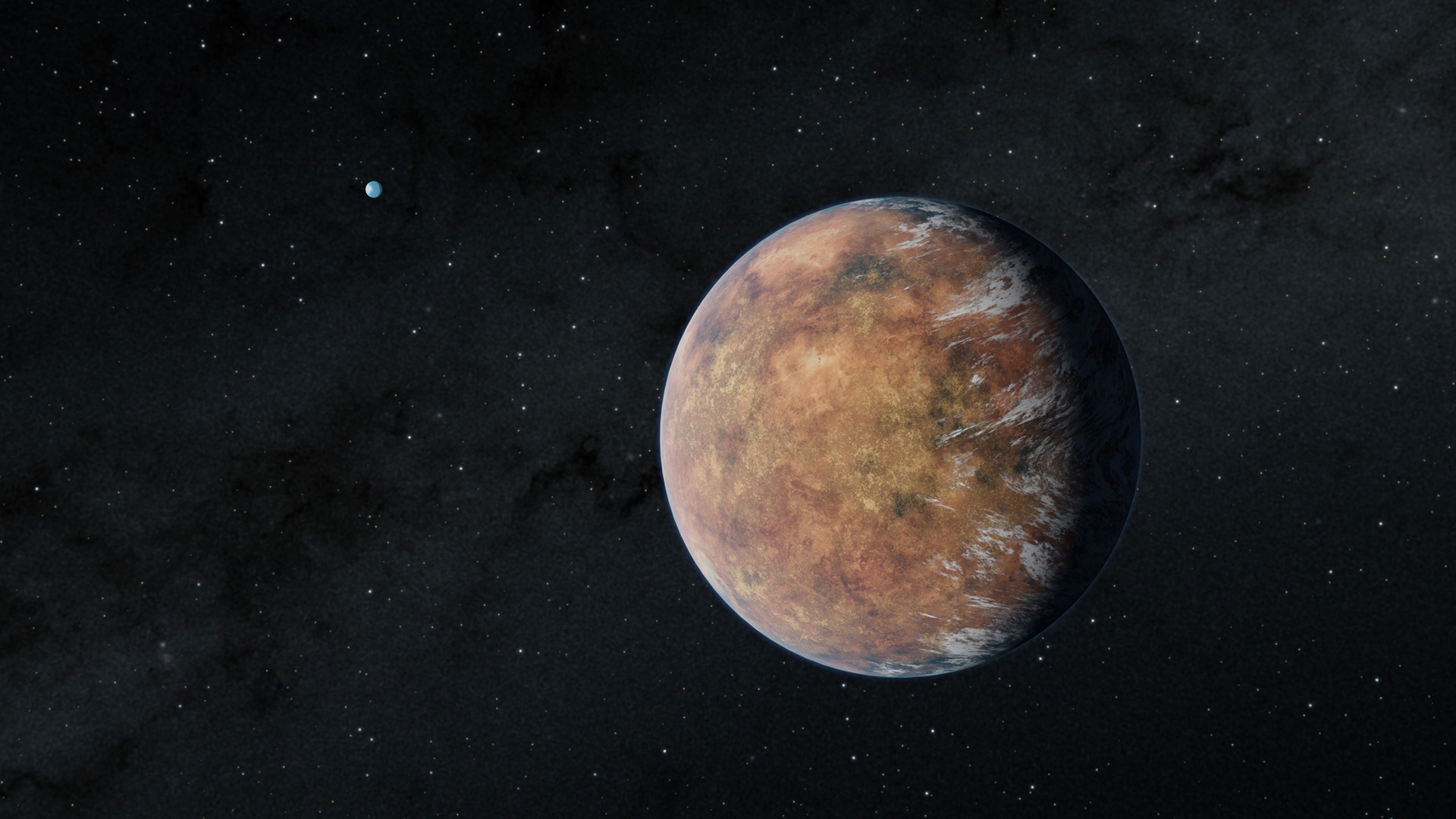
An illustration shows what the newly discovered planet TOI-700 e may look like — a brown, rocky orb sitting against the black of space. That black background is dotted with stars and a small blue sphere in the distance representing planet TOI-700 d.
Newly discovered Earth-sized planet TOI-700 e orbits within the habitable zone of its star in this illustration. Its Earth-sized sibling, TOI-700 d, can be seen in the distance. Credit: NASA/JPL-Caltech/Robert Hurt

institutions.


Rodriguez, an exoplanet expert at MSU, sat down to answer some questions to help explain this discovery and the research behind it.


What makes this discovery special?


The discovery of TOI-700 e provides a valuable opportunity for detailed follow-up studies, as it is one of the only systems known with two small planets in the star’s habitable zone. The host star, TOI-700, is well-suited for these characterization efforts.


This system is very accessible in comparison to other candidates or TESS Objects of Interest, TOIs. Some of those other systems are farther away and their stars are fainter. TOI-700 is really close to us — about 100 light years away.


Having a close and bright host star allows us to achieve the sensitivity needed to measure key aspects like the mass of the planets and the composition of a planet’s atmosphere.


How does one go about discovering an exoplanet?


With TESS, we are observing more than 100 million stars across the night sky. When we look at one of those stars, we can also see if a planet moves between the star and the satellite, blocking out just a little bit of the star’s light. We use the analogy of a fly moving in front of a spotlight.


You were also part of the team that originally confirmed the TOI-700 system in 2020. Can you share a little bit of the background there?


There are almost 10,000 exoplanet candidates, but those aren’t all going to turn out to be planets. A large fraction will be, though, and it’s our job to confirm them. 


In 2020, there was a series of three papers that came out at the same time that confirmed the TOI-700 system. Emily Gilbert, who led this current effort, led one of those studies. That one looked at the star, its three planets known at the time — b, c and d — and the dynamics of the system.


I led another paper, which also used data from the Spitzer Space Telescope to confirm the system had a habitable-zone, Earth-sized planet. That was planet d.


At the time, we had some hints that there might be another planet, planet e, but on the outside of the system — like way, way outside. After we got in another year of observation with TESS, though, we discovered that planet e was actually inside the habitable zone, in between the orbits of planets b and c.


So TOI-700’s planets aren’t in alphabetical order?


No, and there’s a little bit of an easter egg in our new paper where we say, “Sorry, they are not in order.” But this demonstrates the power of something like TESS and the reason to continue observing systems with already discovered exoplanets. It shows that we have a lot more to learn and there may be surprises as we keep observing.


Can you talk about the names: planet b, c, d and e? Are those final or will you get to pick different ones?


I get this question all the time. People will ask if I can name an exoplanet “Joey-1 b” or if I could name one after my wife. I tell them I could call them that, but nobody else would.


There’s actually a convention and I don’t want to get too far in the weeds, but it is a combination of the discovery instrument or telescope and a catalog number. In the case of TOI-700, before they were confirmed, the candidate planets were designated TOI-700.01, TOI-700.02 and TOI-700.03. As we confirmed them, they became TOI-700 b, TOI-700 c and so on. The “a” gets reserved for the star, even though we just call it TOI-700.


Watch to learn about TOI-700 e, a newly discovered Earth-sized planet with an Earth-sized sibling. Credit: NASA/JPL-Caltech/Robert Hurt/NASA’s Goddard Space Flight Center

What’s next for you and your research?


I was asked this question in 2020 and at the time I said, “TESS will observe the system again and we’ll see what happens.” I can say the same thing again this time since TESS is going to reobserve TOI-700.


We can also use other instruments to study the system. For example, we’re working to use another telescope, the JWST, to characterize the biggest planet in the system along with a large effort to measure the mass of all four planets through spectroscopic measurements. But I also have my hands in a bunch of different projects for TESS. For example, I do a lot of work with Jupiter-sized exoplanets that are very close to their stars. 


When I came here in 2021, MSU provided me the opportunity to build an exoplanet-focused research group, opening new, exciting research opportunities for MSU students. And not only graduate and doctoral students, but undergrads as well. We are doing exoplanet studies with our on-campus observatory to help confirm new planets from TESS, not systems like TOI-700, but planets more similar in size to Saturn and Jupiter. 


We started off talking about habitable zones. What will it take to go from saying an exoplanet like TOI-700 e is capable of supporting life to showing that it does?


That’s a question that’s going to be debated for decades. The reason is that one of the ways we think we’ll be able to do this is by identifying biological signatures in the planet’s atmosphere. Those are really hard measurements to make. 


I expect over the next decade or so we may have the first detections of possible biological signatures in a planet’s atmosphere, but since many can also be explained by nonbiological sources, there will be a lot of debate. So, we’ll need to measure multiple observables and decide which of them — or which combinations of them — are actually indicative of life. All of that will be complicated and, I think, will be hotly debated.


That being said, I would argue that, even if we do find something, we are trying to force our understanding of life into a box. What I mean by that is we have one data point for how we think about life and that’s Earth: It’s us and what we see around us. Who’s to say that’s what all life looks like?

MEDIA CONTACTS

Joey Rodriguez
Engineering, Science and TechnologyNuclear ScienceEngineering

Collection

more content from this collection

Ask the Expert

Latest News

MSUToday Weekly Update

The MSUToday Weekly Update email showcases how Spartans are making a difference through academic excellence, research impact and community outreach. Get inspired by these stories of innovation, collaboration and determination. Plus, enjoy photos and videos of campus and more MSU content to help keep you connected to the Spartan community.

Sign UpUpdate My Information

Connect With Us

Visit our Facebook pageVisit our page on XVisit our Instagram pageVisit our LinkedIn pageVisit our YouTube pageVisit our TikTok page

Health and Safety

  • MSU Police and Public Safety
  • Olin Health Center
  • Counseling & Psychiatric Services (CAPS)
  • University Health and Wellbeing
  • MSU Health Care
  • Civil Rights and Title IX
  • Our Commitment
  • Center for Survivors
  • Security & Fire Safety Report
  • University Policy on Relationship Violence and Sexual Misconduct
  • Notice of Non-Discrimination, Anti-Harassment and Non-Retaliation
  • Health Care Non-Discrimination Notice

Support Services

  • Disability Resources
  • Supportive Services
  • Learning Resources

Working at MSU

  • Human Resources
  • EBS Login
  • Job Postings
  • Employee Assistance Program

Reports

  • CARES Act Funding
  • Student Achievement and Outcomes

Contact us

517-355-1855

Address

Michigan State University 426 Auditorium Road East Lansing, MI 48824

Follow Us

  • Visit our Facebook page
  • Visit our page on X
  • Visit our Instagram page
  • Visit our TikTok page
  • Visit our LinkedIn page
  • Visit our YouTube page

If you're having accessibility issues, please let us know.

Know More: Campus Safety Information and ResourcesTransparency Reporting: Budget & Salary/Compensation
  • Contact Information|
  • Site Map|
  • Privacy Statement|
  • Site Accessibility|
  • Call MSU: (517) 355-1855|
  • Visit: msu.edu|
  • Notice of Nondiscrimination|

SPARTANS WILL|© Michigan State University|