Jump to HeaderJump to Main ContentJump to Footer
Michigan State University
MSUToday
  • For Media
  • Experts
  • Releases and Statements
  • Sign Up
  • Update Information
MSUTODAY
  • Browse Stories By

    Topics

    Explore stories by subject area

    • Arts and Culture
    • Business and Economy
    • Climate and Environment
    • Education and Learning
    • Engineering, Science and Technology
    • Government and Society
    • Health and Medicine
    • Media and Communications
    • MSU Leadership and Impact
    • Sports and Recreation
    • Student and Campus Experience
    View All Stories

    Collections

    Curated story series

    • Alumni stories
    • Turfgrass
    • Ask the Expert
    • Big Ideas
    • Climate solutions
    • Water at MSU
    • Mobility
    • Spartan Perspectives
    • Student views
    • Graduate voices
    • Faculty voices
    View All Collections

    Featured

    Editor's picks

    • 9 reasons to love being a Spartan

      Aug. 28, 2026

      9 reasons to love being a Spartan

    • NIH awards multi-university team over $4M to improve women’s health

      Sept. 15, 2026

      NIH awards multi-university team over $4M to improve women’s health

MSUTODAY
  • Browse Stories By

< Browse Stories By

Topics

Explore stories by subject area

  • Arts and Culture
  • Business and Economy
  • Climate and Environment
  • Education and Learning
  • Engineering, Science and Technology
  • Government and Society
  • Health and Medicine
  • Media and Communications
  • MSU Leadership and Impact
  • Sports and Recreation
  • Student and Campus Experience
  • View All Stories

Collections

Curated story series

  • Alumni stories
  • Turfgrass
  • Ask the Expert
  • Big Ideas
  • Climate solutions
  • Water at MSU
  • Mobility
  • Spartan Perspectives
  • Student views
  • Graduate voices
  • Faculty voices
  • View All Collections

Featured

Editor's picks

  • 9 reasons to love being a Spartan

    Aug. 28, 2026

    9 reasons to love being a Spartan

  • NIH awards multi-university team over $4M to improve women’s health

    Sept. 15, 2026

    NIH awards multi-university team over $4M to improve women’s health

  • For Media
  • Experts
  • Releases and Statements
  • Sign Up
  • Update Information

Resources

  • A to Z Index
  • Find People
  • Maps
  • Email
  • Student Information System (SIS)
  • D2L
  • Libraries
  • Tech Support
  • MSU Misconduct Hotline
  • Social Media Directory
  • Events Calendar
  • For Media
MSU Economic Impact

Nov. 30, 2022

SHARE

MSU researchers part of $15M NASA grant to help US farmers

A team from Michigan State University will leverage Earth observation technology to support climate resilience in agriculture.

By: Emilie Lorditch

Farmers across the country are increasingly concerned about the impact of climate change on their farms and are looking for ways to prepare for the future. 

Researchers at Michigan State University are part of a team of more than 30 researchers and stakeholders nationwide who will use a five-year, $15 million grant from NASA to strengthen U.S. agriculture as it faces climate threats.

“In the U.S., there are more than 20 million jobs related to farming,” said David Roy, interim director of MSU’s Center for Global Change and Earth Observations and a professor of geography in the College of Social Science. “This grant will empower sustainable, productive and resilient agricultural decision making and policy.”

Roy is joined by Lin Yan, an assistant professor with the CGCEO, representing MSU. The grant, known as NASA ACRES: A Climate Resilient Ecosystem Approach to Strengthening U.S. Agriculture, will begin in January 2023. The goal is to help farmers use NASA earth science data to make their farms more productive, adaptable and sustainable. 

“This work fits very well with our mission to utilize the latest geospatial technologies to characterize ongoing changes in climate and land, understand the forces leading to these changes and their impacts, and help provide solutions to problems to improve human and societal well-being,” said Roy.

Under a previous NASA-funded grant, Roy and Yan developed an automated computational method to extract the locations and boundaries of crop fields from satellite imagery, which will be useful to this project. 

“People think it is pretty easy to identify crop fields from space, but it’s not,” Yan said. “We get around that by using images acquired over the year to take advantage of the temporal differences between fields and their surroundings, and using computer vision algorithms to recognize field shapes and delineate boundaries.”
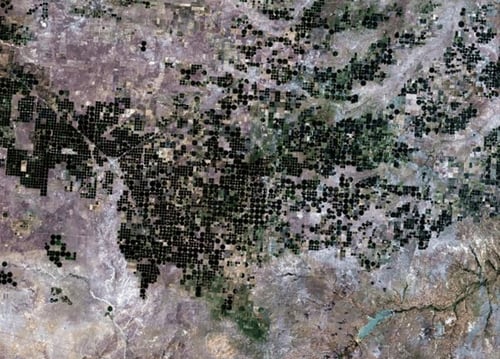

Landsat data of Northern High Plains Texas

Extracted data from Northern High Plains Texas

Top shows Landsat imagery of crop fields over a 150 x 110 km area in the northeastern Texas Panhandle; bottom shows the crop field extraction results (individual crop fields are colored).  Credit: Lin Yan and David Roy.

This earlier work provided evidence that U.S. crop fields are increasing in size — an important factor in understanding changes in agrarian activity. 

“We have always wanted to know how, where and why crop field sizes have changed,” Roy said. “Twenty years ago, more farms were family owned and operated and now, they are more mechanized, and the farms tend to be larger.”

For this new grant, Roy and Yan will refine their methodology to analyze about 20 years of Landsat data from 2008 onward for the contiguous U.S. to trace variations in agricultural capital investment, mechanization and labor intensity. The results will be used by consortium members to model the changing agricultural landscape and examine the relationship between crop field size and climate resilience.

“The hope is that in the future, this data can be used to help farmers improve the climate resilience of their farms,” Yan said.


 
MSU Economic ImpactMSU Leadership and ImpactClimate and Climate SolutionsClimate and EnvironmentSocial SciencesGovernment and Society

Collection

more content from this collection

Climate Solutions

Latest News

MSUToday Weekly Update

The MSUToday Weekly Update email showcases how Spartans are making a difference through academic excellence, research impact and community outreach. Get inspired by these stories of innovation, collaboration and determination. Plus, enjoy photos and videos of campus and more MSU content to help keep you connected to the Spartan community.

Sign UpUpdate My Information

Connect With Us

Visit our Facebook pageVisit our page on XVisit our Instagram pageVisit our LinkedIn pageVisit our YouTube pageVisit our TikTok page

Health and Safety

  • MSU Police and Public Safety
  • Olin Health Center
  • Counseling & Psychiatric Services (CAPS)
  • University Health and Wellbeing
  • MSU Health Care
  • Civil Rights and Title IX
  • Our Commitment
  • Center for Survivors
  • Security & Fire Safety Report
  • University Policy on Relationship Violence and Sexual Misconduct
  • Notice of Non-Discrimination, Anti-Harassment and Non-Retaliation
  • Health Care Non-Discrimination Notice

Support Services

  • Disability Resources
  • Supportive Services
  • Learning Resources

Working at MSU

  • Human Resources
  • EBS Login
  • Job Postings
  • Employee Assistance Program

Reports

  • CARES Act Funding
  • Student Achievement and Outcomes

Contact us

517-355-1855

Address

Michigan State University 426 Auditorium Road East Lansing, MI 48824

Follow Us

  • Visit our Facebook page
  • Visit our page on X
  • Visit our Instagram page
  • Visit our TikTok page
  • Visit our LinkedIn page
  • Visit our YouTube page

If you're having accessibility issues, please let us know.

Know More: Campus Safety Information and ResourcesTransparency Reporting: Budget & Salary/Compensation
  • Contact Information|
  • Site Map|
  • Privacy Statement|
  • Site Accessibility|
  • Call MSU: (517) 355-1855|
  • Visit: msu.edu|
  • Notice of Nondiscrimination|

SPARTANS WILL|© Michigan State University|