Jump to HeaderJump to Main ContentJump to Footer
Michigan State University
  • Browse Stories By

    Topics

    Explore stories by subject area

    • Arts and Culture
    • Business and Economy
    • Climate and Environment
    • Education and Learning
    • Engineering, Science and Technology
    • Government and Society
    • Health and Medicine
    • Media and Communications
    • MSU Leadership and Impact
    • Sports and Recreation
    • Student and Campus Experience
    View All Stories

    Collections

    Curated story series

    • Turfgrass
    • Ask the Expert
    • Big Ideas
    • Climate solutions
    • Water at MSU
    • Mobility
    • Spartan Perspectives
    • Student views
    • Graduate voices
    • Faculty voices
    View All Collections

    Featured

    Editor's picks

    • The Spartans behind your favorite Michigan golf courses

      July 22, 2026

      The Spartans behind your favorite Michigan golf courses

    • MSU in the 1990s: 10 Spartan milestones

      July 14, 2026

      MSU in the 1990s: 10 Spartan milestones

MSUTODAY
  • Browse Stories By

< Browse Stories By

Topics

Explore stories by subject area

  • Arts and Culture
  • Business and Economy
  • Climate and Environment
  • Education and Learning
  • Engineering, Science and Technology
  • Government and Society
  • Health and Medicine
  • Media and Communications
  • MSU Leadership and Impact
  • Sports and Recreation
  • Student and Campus Experience
  • View All Stories

Collections

Curated story series

  • Turfgrass
  • Ask the Expert
  • Big Ideas
  • Climate solutions
  • Water at MSU
  • Mobility
  • Spartan Perspectives
  • Student views
  • Graduate voices
  • Faculty voices
  • View All Collections

Featured

Editor's picks

  • The Spartans behind your favorite Michigan golf courses

    July 22, 2026

    The Spartans behind your favorite Michigan golf courses

  • MSU in the 1990s: 10 Spartan milestones

    July 14, 2026

    MSU in the 1990s: 10 Spartan milestones

  • For Media
  • Experts
  • Releases and Statements
  • Sign Up
  • Update Information

Resources

  • A to Z Index
  • Find People
  • Maps
  • Email
  • Student Information System (SIS)
  • D2L
  • Libraries
  • Tech Support
  • MSU Misconduct Hotline
  • Social Media Directory
  • Events Calendar
  • For Media
Michigan State University
MSUToday
  • For Media
  • Experts
  • Releases and Statements
  • Sign Up
  • Update Information
MSUTODAY
Engineering

Nov. 16, 2022

Michigan State science returns to space with NASA

The Brandizzi Lab at MSU is sending seeds to space aboard NASA’s Artemis I mission to explore how humanity can sustain itself outside of Earth

By: Matt Davenport

A version of this story was published on Aug. 23, 2022, before the mission's originally scheduled launch date of Aug. 29.


After years of preparation, NASA's Artemis I mission launched on Nov. 16, a first step toward the agency’s future goal of establishing a “long-term human presence on the moon.”

 

A black-and-white photo of Federica Brandizzi is shown with a collage of green leaves, microscope images of plant cells and chemical structures.
MSU Foundation Professor Federica Brandizzi

Although no humans will be aboard this mission, it’s carrying experiments that will help address important questions that humanity needs to answer as our spacefaring missions become longer and more ambitious. There’s one question that Michigan State University’s Federica Brandizzi has been particularly interested in solving: How is that long-term human presence going to feed itself?


The short answer is that space travelers will need to grow their own food, said Brandizzi, an MSU Foundation Professor in the College of Natural Science and the MSU-DOE Plant Research Laboratory, or PRL. There are no grocery stores on the moon (yet) and launching care packages of food to astronauts simply isn’t sustainable.


But plants grow differently in space than they do on Earth. Over the past few decades, scientists have been working to compensate for those changes by getting a better understanding of plant biology and development away from our home planet.


“In space, there are so many variables, so many things that plants have never experienced before,” Brandizzi said. For example, without Earth’s gravitational pull, plants are weightless in space. And without Earth’s shielding atmosphere, plants encounter higher doses of cosmic rays.

Federica Brandizzi (left) speaks with a coworker while examining plants in a greenhouse.Learn more about the work Federica Brandizzi and her team do at MSU in this video.

From previous experiments, scientists have learned that plants grown in space make lower levels of protein building blocks, or amino acids, that keep their seedlings strong on Earth. The same amino acids would also be nutritious for people who eat the plants.


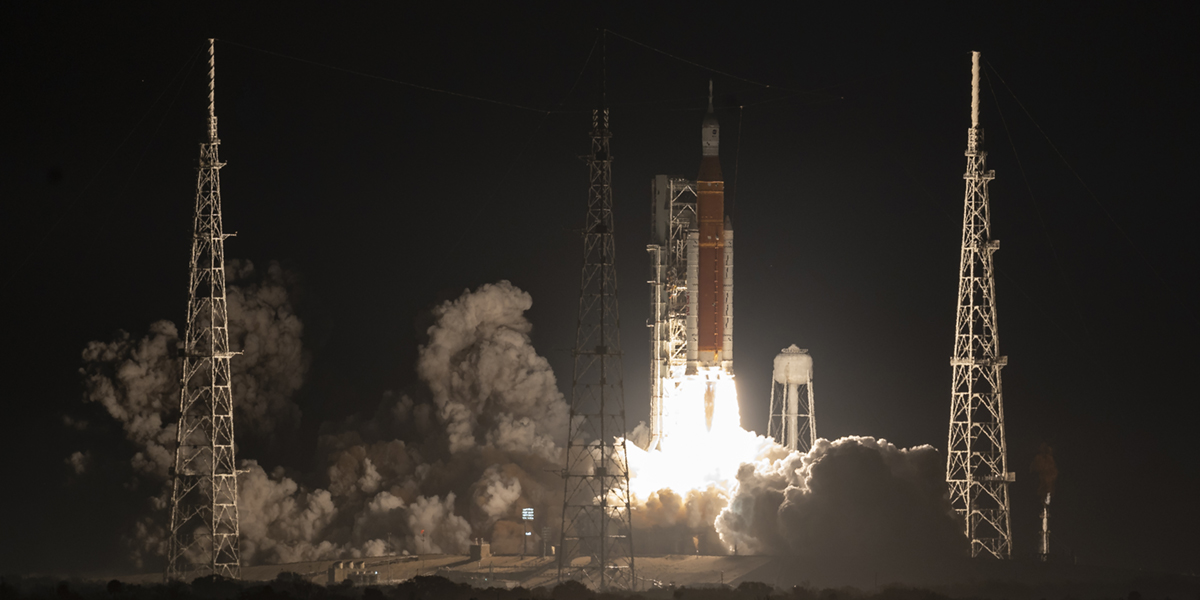
The Artemis I launch stage is illuminated against a black sky at Kennedy Space Center in Florida. NASA’s white Orion spacecraft is fixed to the top of the tall, cylindrical orange and white Space Launch System rocket. Bright yellow plumes are gushing from the bottom of the rocket as it begins its launch.
NASA launched its Artemis I mission carrying a Michigan State plant science experiment designed to help future astronauts better grow food in space. Credit: NASA/Bill Ingalls

So Brandizzi’s lab has selected seeds that are enriched with those amino acids and it’s sending those into space along with regular seeds. This experiment will allow the MSU team to see if fortifying the seeds on Earth could create a more sustainable path to growing healthier plants — and food — in space.


“This is really about understanding how we can establish and sustain life outside of this planet,” Brandizzi said. “We need to have plants that can survive long-term space travel for generations.”


Brandizzi’s team is sending up seeds of what’s known as thale cress, orArabidopsis thaliana, one of science’s most popular plant model species. Although the plant is not a food crop itself, what the researchers find can be translated to plants that are usedas produce.


The team’s experiment is one of four selected by NASA’s Space Biology Program to better understand how deep space affects terrestrial biology. Accompanying MSU’s seedlings aboard Artemis’s Orion spacecraft will be a yeast experiment led by the University of Colorado-Boulder, a fungus experiment led by the Naval Research Laboratory and an experiment with photosynthetic algae led by the Institute for Medical Research, a nonprofit research corporation.


This will also be the Brandizzi lab’s third experiment aboard a NASA mission.


“I’ve always been fascinated by NASA. It’s just amazing what they’ve been able to do with space flight,” Brandizzi said.


Her team’s earlier work focused on understanding how plants responded to the unique stresses of space. The projects have been different but their goals are all related to one day growing plants that are suited to thrive on missions to the moon and beyond.


Working with NASA on these experiments has been a dream come true and an incredible opportunity to introduce her team to a different way of conducting research, Brandizzi said. Unlike her team’s more conventional projects, the team can’t adjust on the fly or make changes to the experiment after it launches, in this case literally.


“You only get one shot, so everything has to be perfect,” she said. “I’ve lived through this two times already, so I know it’s going to be a mix of emotions. The preparation is intense, it’s tiring, but it is so rewarding.”

MEDIA CONTACTS

Federica Brandizzi
EngineeringEngineering, Science and TechnologyNatural SciencesNatural Sciences

Latest News

MSUToday Weekly Update

The MSUToday Weekly Update email showcases how Spartans are making a difference through academic excellence, research impact and community outreach. Get inspired by these stories of innovation, collaboration and determination. Plus, enjoy photos and videos of campus and more MSU content to help keep you connected to the Spartan community.

Sign UpUpdate My Information

Connect With Us

Visit our Facebook pageVisit our page on XVisit our Instagram pageVisit our LinkedIn pageVisit our YouTube pageVisit our TikTok page

Health and Safety

  • MSU Police and Public Safety
  • Olin Health Center
  • Counseling & Psychiatric Services (CAPS)
  • University Health and Wellbeing
  • MSU Health Care
  • Civil Rights and Title IX
  • Our Commitment
  • Center for Survivors
  • Security & Fire Safety Report
  • University Policy on Relationship Violence and Sexual Misconduct
  • Notice of Non-Discrimination, Anti-Harassment and Non-Retaliation
  • Health Care Non-Discrimination Notice

Support Services

  • Disability Resources
  • Supportive Services
  • Learning Resources

Working at MSU

  • Human Resources
  • EBS Login
  • Job Postings
  • Employee Assistance Program

Reports

  • CARES Act Funding
  • Student Achievement and Outcomes

Contact us

517-355-1855

Address

Michigan State University 426 Auditorium Road East Lansing, MI 48824

Follow Us

  • Visit our Facebook page
  • Visit our page on X
  • Visit our Instagram page
  • Visit our TikTok page
  • Visit our LinkedIn page
  • Visit our YouTube page

If you're having accessibility issues, please let us know.

Know More: Campus Safety Information and ResourcesTransparency Reporting: Budget & Salary/Compensation
  • Contact Information|
  • Site Map|
  • Privacy Statement|
  • Site Accessibility|
  • Call MSU: (517) 355-1855|
  • Visit: msu.edu|
  • Notice of Nondiscrimination|

SPARTANS WILL|© Michigan State University|

