Peter Gulick, a professor in the Michigan State University College of Osteopathic Medicine, has been studying HIV/AIDS since the epidemic began in the early 1980s.
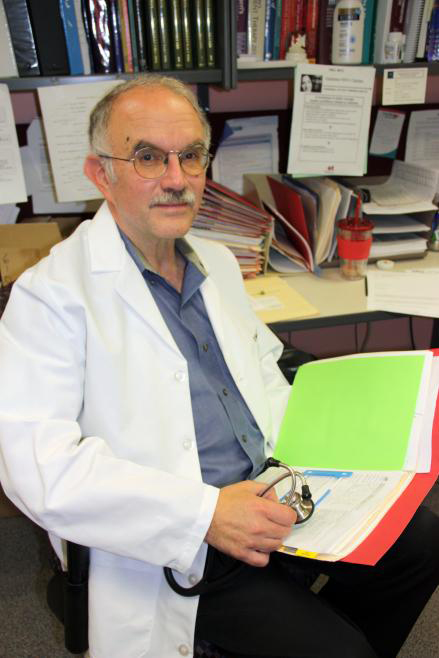
Ahead of the 34th annual World AIDS Day on Dec. 1, Gulick discusses the progress the scientific community has made over the past four decades in research and treatment of the illness, and the challenges and opportunities that remain.
Can you briefly explain the difference between having HIV and AIDS?
HIV means that you have tested positive for the human immunodeficiency virus, but your immune system is still functional, and it can fight off a lot of infections. AIDS, or acquired immunodeficiency syndrome, means your immune system declines to a point where it no longer can protect you and where exposure to infections, bacteria and fungi would cause serious illness that could shorten your lifespan.
You’ve been working on HIV/AIDS for four decades. How have treatments and prognosis changed?
I could have retired years ago, but the reason I’m still doing this is because I’m so excited about the advances in HIV treatments and what's to come. In the 80s, if you had AIDS and you got an opportunistic infection, you would die within one to two years after that first infection. Now, a person can come in with AIDS and we can get them on therapy and get their immune system built back up to normal so their lifespan is like somebody without HIV. It’s incredible.
It gives me a lot of hope when I can tell a person who’s newly diagnosed that they can have a normal lifespan, they can have children, they can have families.
What does HIV look like in Michigan in 2022?
According to the latest data from the Michigan Department of Health and Human Services, there are 17,870 people living with HIV in the state, which has a population of almost 10 million. In terms of prevalence of HIV patients (number of cases per 100,000 people) Wayne County, Oakland County, Kent County, and it goes down from there. Ingham County is 6th in prevalence in the state.
Every year, we have another 37,000 new cases in the United States. Something to note is that the prevalence rate has been going up because more people are getting infected with HIV, but they’re not dying. They’re living full lives.
The majority of new cases are in young African American males, ages 16-30, who have sex with men. In Michigan, we do see a concentration of cases in urban settings, but there are cases in rural Michigan as well.
You run four clinics in Michigan, three of them in urban centers and one in Harrison, a rural community. Are their challenges different?
Yes, I run four clinics, which currently treat about 1,000 patients. The largest one is in Lansing, with about 650 patients. We also have one in Saginaw, one in Flint, and the rural clinic in Harrison, about 20 miles north of Mount Pleasant.
In the urban communities, there are a lot of facilities and support systems. We have support groups that are funded by Ryan White grants, a federal program that provides financial support for the treatment of uninsured or underinsured HIV/AIDS patients.
In Lansing, we have a support group called Lansing Area AIDS Network, which is a group of case managers and social workers who provide individuals either newly diagnosed or living with HIV with housing, food and social services support as well as mental health and substance use disorder services. And those are very much needed.
Rural communities and communities that don’t have Ryan White grants can struggle because many of them will see HIV patients, but if these patients don’t have insurance, then they can’t be helped long term. HIV patients need a lot of support, and you need a strong network to provide this support holistically.
What specific challenges do you see in those populations?
For patients, just getting to the clinic can be a challenge because they may live miles away and transportation can be an issue. And in rural clinics, where the numbers are much smaller, there is a fear that someone might identify them, so that’s why I do get patients who travel all the way from Traverse City and from Petoskey to see me because they don’t want to be identified in those communities as being HIV positive.
I’m also part of the Michigan Center for Rural Health network, and we provide education to primary care doctors, which is greatly needed. I’ve had patients come into my clinic crying because they were given an HIV diagnosis and were told their life would be cut short. We have treatments, and we need to make sure our primary care physicians understand that.
And we need to make sure we’re testing those at high risk. I just saw a 22-year-old patient who had never been diagnosed with HIV. He had yeast in his mouth, which is a real warning sign. The condition implies there’s a problem with the immune system. He was diagnosed and treated by a primary care doctor and a dentist, but nobody bothered to ask, “Why did he have that? A young man, otherwise healthy, has this kind of yeast in his mouth?” He either has cancer or he has HIV, but nothing was done for a year to work with him further.
Do you have any plans or changing strategies to reach more of the Michigan population?
Something we’ve considered but haven’t yet accomplished is a mobile clinic so we can come to some of these rural areas to make treatment more accessible. We would have a lab, medications, things like that. It would be a very, very effective way of getting hepatitis C under control. The area where I work in northern Michigan is probably one of the state’s hotbeds for hep C. If we could provide care with sterile needles, needle exchange programs, medical-assisted treatment for drug use, that would really be helpful, especially with a mobile clinic.
Do you foresee a future in which we can actually say there’s no HIV?
Maybe we can’t cure it, but we can control it. The leading world health organizations and the Centers for Disease Control have plans for this. The CDC has three main goals called the 90/90/90 rule: to have 90% of the individuals with HIV diagnosed; 90% of patients with HIV linked to a physician who can handle HIV, treat HIV and put them on therapy; and then 90% of individuals suppressed on therapy, meaning there's no viral load detected, because undetectable means nontransmissible.
The other way we’re trying to control new cases of HIV is through PrEP, or pre-exposure prophylaxis. So a person who is at high risk of infection — whose partner, for example, is HIV positive — goes on a medication similar to the drug used to treat HIV, which is 95% effective in preventing that person from getting HIV.
If we can prevent new cases by using PrEP and by totally suppressing other individuals, we will eliminate new cases.
There’s ongoing research to develop vaccines but right now we can really accomplish more by preventing new cases by getting all these patients identified, those identified on therapy and suppressed, and then preventing high-risk individuals from getting it.
What makes you so optimistic about the future?
There are new therapies being developed in which patients can get their HIV treatment by getting a shot every two months instead of pills. And there’s another product that’s going to be released within a year that allows you to come in for one shot every six months. The fact that patients may not have to take daily medications to control HIV is huge.

