A Michigan State University graduate student is celebrating a major award and first-author publication.
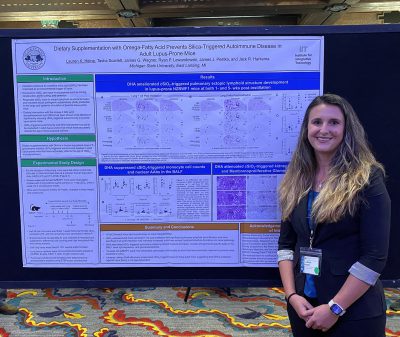
Lauren Heine received first place for her student poster presentation at the 13th International Particle Toxicology Conference, a highly recognized conference held every three years at venues across the globe. Her poster, “Dietary Supplementation with Omega-Fatty Acid Prevents Silica-Triggered Autoimmune Disease in Adult Lupus-Prone Mice,” is a project from the laboratory of Jack Harkema, University Distinguished Professor, Albert C. and Lois E. Dehn Endowed Chair in Veterinary Medicine, and director of MSU’s Laboratory for Environmental and Toxicologic Pathology and the Mobile Air Research Laboratories AirCARE 1 and 2.
Heine, who attended the conference in-person in Santa Fe, New Mexico, notes the value of her experience. “It was a great experience for many reasons. It was the first small conference I had been to, so I was able to make some valuable connections. The conference also had an impressive lineup of different seminars on relevant topics to our research—a lot of environmental exposures that we’re all really interested in and how they impact human health.”
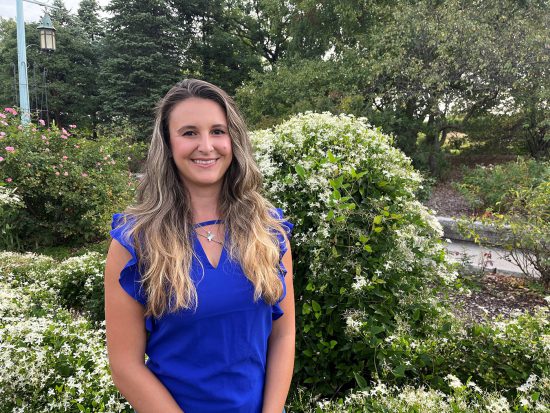
Heine also enjoyed a personal benefit of the conference location. “It was a fun experience because this international conference was in my hometown, which is unique considering Santa Fe is a pretty small city. My undergraduate mentor, Matthew Campen from the University of New Mexico, was the one who was asked to host the conference in Santa Fe. It was a really great feeling, having that connection of being home while being able to present research that I’m really passionate about in my hometown, in my community.”
“I also got to spend time with family,” recalls Heine. “It was a unique feeling–the full-circle feeling—because in my community, not very many of us go into the STEM field or go into higher education. It was meaningful to go back to my hometown, present our research, be surrounded by both leaders in the field and talented colleagues, and be there to do that.”
In addition to her conference victory, Heine’s “Comparative effects of human equivalent low, moderate, and high dose oral prednisone intake on autoimmunity and glucocorticoid-related toxicity in a murine model of environmental-triggered lupus” has been accepted for publication in the journal "Frontiers in Immunology" (impact factor: 8.786). This will be Heine’s first lead-author, peer-reviewed publication.
After she completed an undergraduate summer research internship at UNM, Heine transferred to the University of Hawai’i for an exchange program. She stayed there and completed her BS in biology. Today, she is a fifth-year Ph.D. candidate in MSU’s Department of Pharmacology and Toxicology, who will complete her studies in spring 2023. She plans to defend her Ph.D. thesis in late winter and spend the remnants of her semester wrapping up papers and projects, as well as supporting ongoing training for Harkema’s laboratory team.
Science wasn’t Heine’s first choice. In high school, her passion was art. “I did not really have a scientific bone in my body, in part, I think, because of the classes available at my high school. My art teachers were always exceptional, but I just didn’t have anyone who instilled a passion for science in me until I took AP Psychology my senior year.”
Heine notes, however, that she always had been intrigued by marine biology, which she credits with the kindling of her interest in science. “When I was registering for my classes freshman year of college, I remember just scrolling between studio art and biology as a major. I thought, ‘Well, I would like to pursue biology and see where this goes, and if anything, I always have art to fall back on.”

Tragedy struck for Heine during her freshman year. Her aunt was diagnosed with pancreatic cancer. Heine says this drove her to consider research as a career. “I wanted to help people like her, and like my mother who is in remission for breast cancer.”
Almost immediately, Heine found herself researching PhD preparation and pathways. She matched with Campen, a toxicologist at UNM, for an undergraduate summer research program. Heine recalls that, at the time, she had no clue about toxicology. “He was such a great mentor and I really enjoyed the field, so that prompted me to pursue a graduate degree in toxicology, specifically,” says Heine.
Heine went on to complete a research internship at Oregon State University with Susan Tilton. There, she delved further into toxicology by way of Tilton’s research, which focused on lung biology. Heine says this experience solidified her decision to pursue a PhD at MSU, where Heine first worked with James Luyendyk, professor of Pharmacology and Toxicology. Upon getting to know Heine, he and Anna Kopec, one of Luyendyk’s previous laboratory members, connected Heine with Harkema.
“Dr. Kopec thought we would be a good match because of my research interests, personality, and preferred mentoring style. She thought Harkema and I would be a good fit.”
Kopec was correct. Harkema steered Heine toward a collaborative project with James Pestka, University Distinguished Professor and Robert and Carol Deibel Family Endowed Professor. From there, Heine began to delve further into research.
“We’ve done a lot!” beams Heine. “Now that I’m in my fifth year, I have mostly completed all my research projects required for my dissertation. All of these projects fall under the overarching goal of determining how different inhaled toxicants can trigger autoimmunity, and are complemented by our understanding of how dietary interventions can alleviate inflammation and autoimmunity triggered by these environmental exposures.”
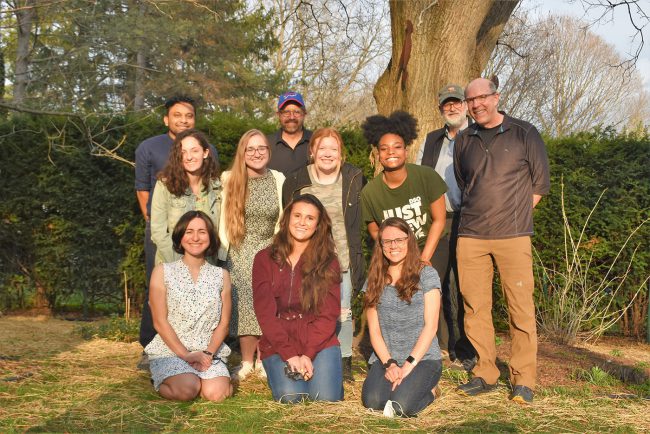
To date, Heine’s favorite collaborative project with Harkema and Pestka focused on prednisone, a steroid commonly used to treat lupus. According to Heine, the steroid has toxic side effects associated with its long-term use. Her objectives were to study how the drug alleviates autoimmunity and establish a threshold for toxicity.
“It was a lot of hard work and long hours, but I feel like the response we got from that project was really meaningful. When people ask me about my research and I tell them about this project, I often receive a response like, ‘Oh, I know someone who has lupus and is on prednisone!’ and they want to know more. It’s nice to know the research we’re doing can have a positive impact on other people and their loved ones.”
Heine’s most recent and award-winning research focuses on the mitigation of prednisone’s negative side effects experienced by lupus patients. She’s doing this using dietary intervention, namely omega-3 fatty acids.
“We’re really interested in omega-3 fatty acids, such as those found in fish oil supplements, and how they can be used to reduce the amount of steroids lupus patients have to take. In this, we hope to ultimately improve the quality of life of these patients through symptom relief and avoiding unwanted toxicity.”
“It’s great because it’s cost effective and easy to take, just like prednisone, and is potentially less toxic for these patients, “ Heine adds.
She also admits that, while she doesn’t have lupus, her research has impacted some of her own nutritional choices.
“I never took fish oil supplements before I joined this lab!” Heine laughs. “Many people at conferences always asks us, ‘Hey, do you take omega-3 fatty acids?’ And yes, we do! My mom even does. I told her, ‘You should really take fish oil. The research from our lab is really promising in addition to what is in the literature.’ She would take one pill a day, which based on our research might not be enough to see the beneficial effects. I told her, ‘You should take two pills a day per the recommended dosage.’ She was skeptical for the longest time, until this time when I came home for the Particle Conference. She had me whip out my poster in front of our family and give them all the same run down of my poster I gave at the conference. Once she saw images of the lungs and kidneys and how much DHA [a specific omega-3 fat] reduced inflammation in our model, she’s been taking three pills a day ever since, just for good measure.”
“When I first entered MSU’s Ph.D program, I was all about academia and I really wanted to pursue an academic research track,” recalls Heine. “But over time, with the allure of industry and everything that comes with it, I had started leaning more toward industry. I am currently interested in government because it offers a nice combination of the things you see in industry and academia.”
Heine has her sights set on a few possibilities, still centered on her research passion. “I would like to do a post doc at Los Alamos National Labs. It’s such a great government research facility that’s close to Santa Fe, near my family. I’m also looking at different academic post docs in the southwest area or at research hospitals like National Jewish Health. Overall, I would like to remain in the field of pulmonary toxicology.”

