Jump to HeaderJump to Main ContentJump to Footer
Michigan State University
  • Browse Stories By

    Topics

    Explore stories by subject area

    • Arts and Culture
    • Business and Economy
    • Climate and Environment
    • Education and Learning
    • Engineering, Science and Technology
    • Government and Society
    • Health and Medicine
    • Media and Communications
    • MSU Leadership and Impact
    • Sports and Recreation
    • Student and Campus Experience
    View All Stories

    Collections

    Curated story series

    • Turfgrass
    • Ask the Expert
    • Big Ideas
    • Climate solutions
    • Water at MSU
    • Mobility
    • Spartan Perspectives
    • Student views
    • Graduate voices
    • Faculty voices
    View All Collections

    Featured

    Editor's picks

    • The Spartans behind your favorite Michigan golf courses

      July 22, 2026

      The Spartans behind your favorite Michigan golf courses

    • MSU in the 1990s: 10 Spartan milestones

      July 14, 2026

      MSU in the 1990s: 10 Spartan milestones

MSUTODAY
  • Browse Stories By

< Browse Stories By

Topics

Explore stories by subject area

  • Arts and Culture
  • Business and Economy
  • Climate and Environment
  • Education and Learning
  • Engineering, Science and Technology
  • Government and Society
  • Health and Medicine
  • Media and Communications
  • MSU Leadership and Impact
  • Sports and Recreation
  • Student and Campus Experience
  • View All Stories

Collections

Curated story series

  • Turfgrass
  • Ask the Expert
  • Big Ideas
  • Climate solutions
  • Water at MSU
  • Mobility
  • Spartan Perspectives
  • Student views
  • Graduate voices
  • Faculty voices
  • View All Collections

Featured

Editor's picks

  • The Spartans behind your favorite Michigan golf courses

    July 22, 2026

    The Spartans behind your favorite Michigan golf courses

  • MSU in the 1990s: 10 Spartan milestones

    July 14, 2026

    MSU in the 1990s: 10 Spartan milestones

  • For Media
  • Experts
  • Releases and Statements
  • Sign Up
  • Update Information

Resources

  • A to Z Index
  • Find People
  • Maps
  • Email
  • Student Information System (SIS)
  • D2L
  • Libraries
  • Tech Support
  • MSU Misconduct Hotline
  • Social Media Directory
  • Events Calendar
  • For Media
Michigan State University
MSUToday
  • For Media
  • Experts
  • Releases and Statements
  • Sign Up
  • Update Information
MSUTODAY
Biodiversity and Wildlife

Aug. 19, 2022

Forecasting the future to protect monarchs

Michigan State researchers have forecast monarch butterfly population sizes throughout the Midwest to show where conservation efforts could have the most impact in the face of climate change

By: Matt Davenport

The outlook for monarch butterflies isn’t great right now. In fact, the International Union for the Conservation of Nature, or IUCN, just added North America’s monarchs to its list of endangered species. 


With news like this, it can be easy to overlook the reasons to be hopeful that we can protect these iconic insects from extinction. But those bright spots are there if people know where to look.
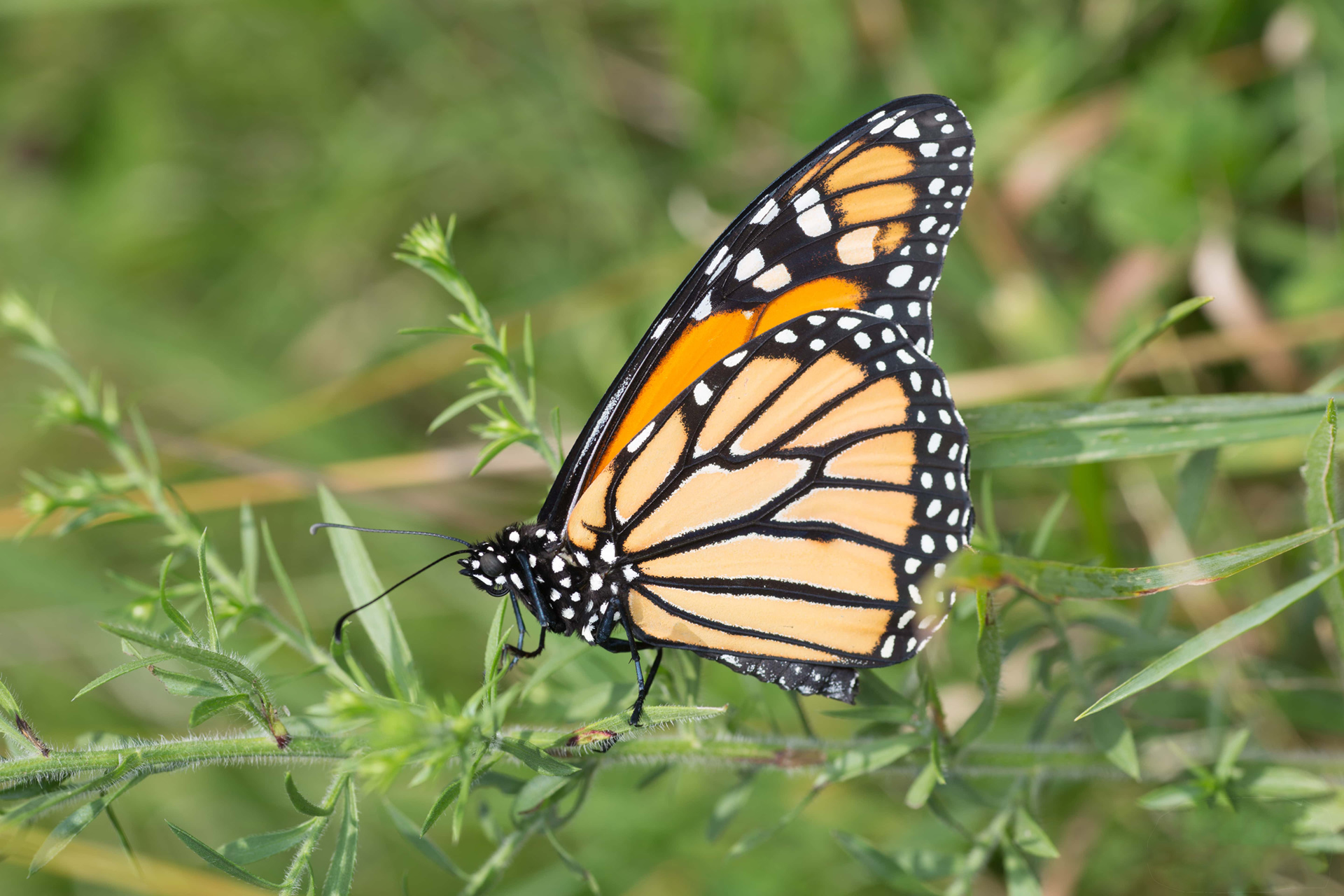
 

A stunning orange-and-black monarch with white spots rests on a green plant.
Monarch butterflies were recently added to the IUCN Red List of Threatened Species, but Spartan researchers are developing new approaches to help protect the insects. Credit: Dave Pavlik

Now, there are forecasts to help guide conservation, thanks to Michigan State University’s Elise Zipkin and her colleagues.


Working with extensive data sets and established models, the team has forecasted which counties in the midwestern U.S. and Ontario, Canada, are most likely to offer the most hospitable breeding grounds for monarchs in the face of climate change. These forecasts, published Aug. 19 in the journal Global Change Biology, can help identify where the greatest opportunities to support monarch conservation may be.


“These projections let us look at how monarch populations will change across the Midwest and say, ‘Here’s where they’ll likely do a little better, here’s where they might do a little worse,’” said Erin Zylstra, the first author of the new report and a former postdoctoral researcher in the Zipkin Quantitative Ecology Lab.

 

MSU Associate Professor Elise Zipkin

The Midwest is an important summer breeding area for eastern monarch butterflies. Over the course of a year — and four generations — monarchs migrate between central Mexico and parts of the U.S. and southern Canada east of the Rocky Mountains.


But between 1996 and 2014, the eastern monarch population has decreased by more than 80%. Last year, Zylstra, Zipkin and their colleagues published a paper showing that climate conditions were the major driver of recent declines.


Building on that 2021 study, the team took its understanding of how climate influenced monarch populations since 2004 and used that to forecast what could happen over the next 80 years under a range of climate change scenarios.


“Climate change is a huge global problem that requires nations working together to solve. When we talk about conservation, though, we tend to want to know what we can do in our local communities,” said Zylstra, who is now a quantitative ecologist with the Tucson Audubon Society in Arizona. “If we can find the places where the impacts of climate change aren’t expected to be so bad, those could become the areas where we invest our resources.”
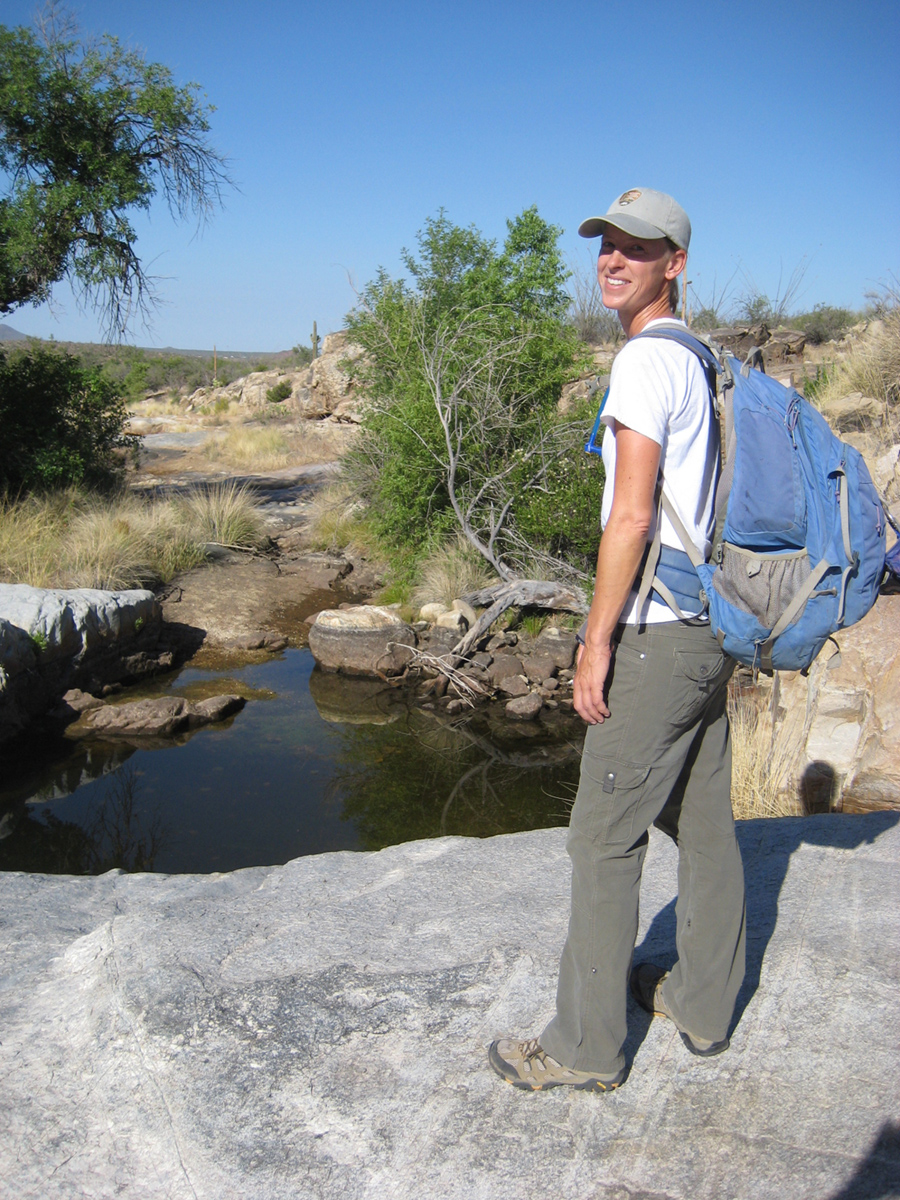
 

Erin Zylstra, a quantitative ecologist with the Tucson Audubon Society

“In general, our research is informed by asking what are the conservation needs,” said Zipkin, the senior author of the study and an associate professor in the College of Natural Science’s Department of Integrative Biology. She’s also the director of the Ecology, Evolution and Behavior Program, a pillar of MSU’s overall ecology program, which was recently ranked No. 32 globally.


Zipkin and Zylstra’s latest work was supported by the National Science Foundation and U.S. Geological Survey’s Midwest Climate Adaptation Science Center, which facilitates partnerships between scientists, community leaders and natural resource managers.


“We’re answering scientific questions that we think are important, but we are also working with on-the-ground individuals and agencies that can use our work to implement strategic conservation,” Zipkin said. “The Midwest Climate Adaptation Science Center helps us get our research directly into the hands of those people who are thinking about next steps.”


Another unique feature of the work is how it considers sources of uncertainty and provides quantitative estimates for those, the researchers said. This approach — which explicitly considers what is unknown about the future — can help the research community better understand and utilize the team’s results and models. It also helps researchers identify what’s needed to improve the precision of future forecasts.
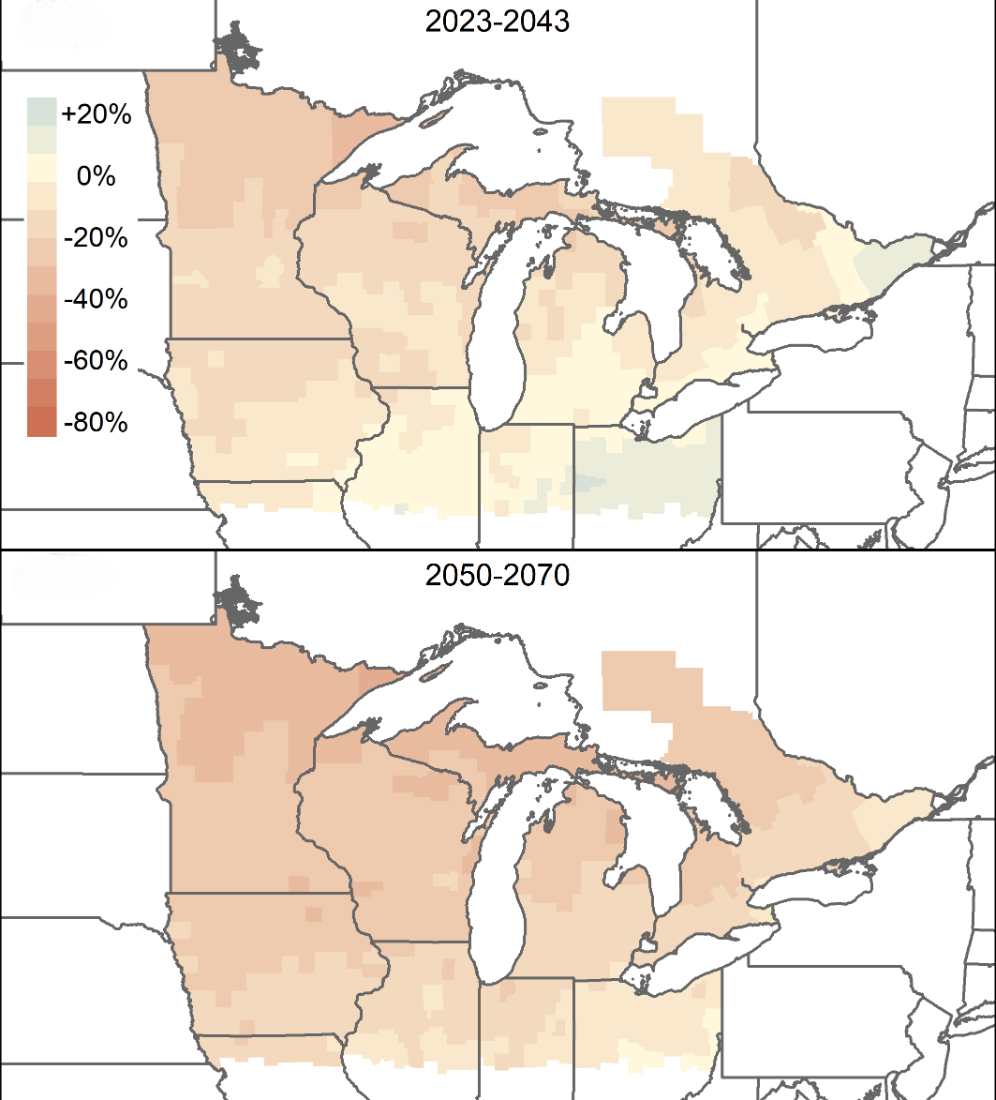
 

Two maps stacked vertically of the northern U.S. and southern Canada show projected changes in monarch butterfly populations. The top map is for 2023 to 2043 and the bottom is for 2050 to 2070. In the top map, areas of Ohio and Canada feature counties shaded green, indicating population growth up to about 20% from 2004 to 2018 levels. Pockets of southern Michigan, Indiana and Illinois contain yellow counties, indicating no change. The remaining areas in the Midwest feature orange hues, showing decreases of about 10% to 20%. In the lower map, most counties are darker orange, indicating greater declines in monarch abundance.
Researchers have projected that climate change will continue driving monarch populations down. However, the areas that are least affected in the Midwest, such as northern Ohio and southern Michigan, can become targets to slow or reverse that trend. Credit: Global Change Biology

For example, unknowns about future climate are the largest source of uncertainty as the team forecasts what monarch populations will look like at the end of the 21st century. But in the immediate future, uncertainties about exactly how specific climate variables influence local monarch population abundances loom large. Collecting more robust, targeted monarch data could thus improve projections in the short term.


In the meantime, Zylstra and Zipkin have presented their best and most data-informed forecasts in collaboration with Naresh Neupane, a climate scientist at Georgetown University. The team forecasted monarch population changes in counties throughout the summer breeding grounds and on the overwintering grounds in Mexico under four different climate scenarios.


In each scenario, the forecasts suggest that the eastern monarch population will continue to decline, which is not surprising given the butterflies’ current trajectory. But identifying the pockets where, locally, populations are growing or holding constant provides hope that the decline can be slowed or reversed.


And if the approach helps save monarchs, it can help with other threatened species, too.


“Monarchs are special. They’re beautiful, easy to identify, widely distributed and they get people to care about conservation in general,” Zipkin said. “Absolutely, with action, we can protect our planet, we can protect other migratory species, we can protect pollinators and we can protect monarchs.”


MEDIA CONTACTS

Elise Zipkin, Kaylie Crowe
Biodiversity and WildlifeClimate and EnvironmentNatural Resources and ConservationBiodiversity and Wildlife

Collection

more content from this collection

Climate Solutions

Latest News

MSUToday Weekly Update

The MSUToday Weekly Update email showcases how Spartans are making a difference through academic excellence, research impact and community outreach. Get inspired by these stories of innovation, collaboration and determination. Plus, enjoy photos and videos of campus and more MSU content to help keep you connected to the Spartan community.

Sign UpUpdate My Information

Connect With Us

Visit our Facebook pageVisit our page on XVisit our Instagram pageVisit our LinkedIn pageVisit our YouTube pageVisit our TikTok page

Health and Safety

  • MSU Police and Public Safety
  • Olin Health Center
  • Counseling & Psychiatric Services (CAPS)
  • University Health and Wellbeing
  • MSU Health Care
  • Civil Rights and Title IX
  • Our Commitment
  • Center for Survivors
  • Security & Fire Safety Report
  • University Policy on Relationship Violence and Sexual Misconduct
  • Notice of Non-Discrimination, Anti-Harassment and Non-Retaliation
  • Health Care Non-Discrimination Notice

Support Services

  • Disability Resources
  • Supportive Services
  • Learning Resources

Working at MSU

  • Human Resources
  • EBS Login
  • Job Postings
  • Employee Assistance Program

Reports

  • CARES Act Funding
  • Student Achievement and Outcomes

Contact us

517-355-1855

Address

Michigan State University 426 Auditorium Road East Lansing, MI 48824

Follow Us

  • Visit our Facebook page
  • Visit our page on X
  • Visit our Instagram page
  • Visit our TikTok page
  • Visit our LinkedIn page
  • Visit our YouTube page

If you're having accessibility issues, please let us know.

Know More: Campus Safety Information and ResourcesTransparency Reporting: Budget & Salary/Compensation
  • Contact Information|
  • Site Map|
  • Privacy Statement|
  • Site Accessibility|
  • Call MSU: (517) 355-1855|
  • Visit: msu.edu|
  • Notice of Nondiscrimination|

SPARTANS WILL|© Michigan State University|