Jump to HeaderJump to Main ContentJump to Footer
Michigan State University
MSUTODAY
  • Browse Stories By

    Topics

    Explore stories by subject area

    • Arts and Culture
    • Business and Economy
    • Climate and Environment
    • Education and Learning
    • Engineering, Science and Technology
    • Government and Society
    • Health and Medicine
    • Media and Communications
    • MSU Leadership and Impact
    • Sports and Recreation
    • Student and Campus Experience
    View All Stories

    Collections

    Curated story series

    • Turfgrass
    • Ask the Expert
    • Big Ideas
    • Climate solutions
    • Water at MSU
    • Mobility
    • Spartan Perspectives
    • Student views
    • Graduate voices
    • Faculty voices
    View All Collections

    Featured

    Editor's picks

    • The Spartans behind your favorite Michigan golf courses

      July 22, 2026

      The Spartans behind your favorite Michigan golf courses

    • MSU in the 1990s: 10 Spartan milestones

      July 14, 2026

      MSU in the 1990s: 10 Spartan milestones

MSUTODAY
  • Browse Stories By

< Browse Stories By

Topics

Explore stories by subject area

  • Arts and Culture
  • Business and Economy
  • Climate and Environment
  • Education and Learning
  • Engineering, Science and Technology
  • Government and Society
  • Health and Medicine
  • Media and Communications
  • MSU Leadership and Impact
  • Sports and Recreation
  • Student and Campus Experience
  • View All Stories

Collections

Curated story series

  • Turfgrass
  • Ask the Expert
  • Big Ideas
  • Climate solutions
  • Water at MSU
  • Mobility
  • Spartan Perspectives
  • Student views
  • Graduate voices
  • Faculty voices
  • View All Collections

Featured

Editor's picks

  • The Spartans behind your favorite Michigan golf courses

    July 22, 2026

    The Spartans behind your favorite Michigan golf courses

  • MSU in the 1990s: 10 Spartan milestones

    July 14, 2026

    MSU in the 1990s: 10 Spartan milestones

  • For Media
  • Experts
  • Releases and Statements
  • Sign Up
  • Update Information

Michigan State University

Resources

  • A to Z Index
  • Find People
  • Maps
  • Email
  • Student Information System (SIS)
  • D2L
  • Libraries
  • Tech Support
  • MSU Misconduct Hotline
  • Social Media Directory
  • Events Calendar
  • For Media
Michigan State University
MSUToday
  • For Media
  • Experts
  • Releases and Statements
  • Sign Up
  • Update Information
Pollution

May 31, 2022

How Spartan simulations could help get PFAS out of soil

Michigan State computational chemists are revealing how persistent pollutants interact with soil minerals

By: Matt Davenport

Michigan State University chemists are discovering new information to help remediate “forever chemicals” by showing for the first time how they interact with soil at the molecular level.

 

John A. Hannah Distinguished Professor Angela K. Wilson

The researchers, Narasimhan Loganathan and Angela K. Wilson in the College of Natural Science, published their findings May 11 online in the journal Environmental Science & Technology.


“Forever chemicals” — more formally known as PFAS or perfluoroalkyl and polyfluoroalkyl substances — earned the label because they don’t break down naturally. When PFAS pollute soil and water, they can enter the food system through plants, livestock and drinking water.


A Centers for Disease Control and Prevention report from 2015 estimated that PFAS is in the blood of 97% of Americans. Other, more recent studies have put that number closer to 99%.


What makes PFAS so ubiquitous is a combination of persistence and utility. More than 9,000 chemicals qualify as PFAS and they’re found in a wide range of applications, including food packaging, nonstick cookware, firefighting foams and many more. While time and nature can degrade certain components of these products — and of the waste generated in producing them — the PFAS lingers, accumulating in the environment.

 

Narasimhan Loganathan, MSU senior research associate

Removing PFAS from soil and water, then, is important for reducing exposure to these chemicals and the harm they can cause, including thyroid disease and increased risk of some cancers.


“When you start looking at mitigation strategies, you see a lot about removing PFAS from water, but there’s very little about PFAS in soil,” said Loganathan, a senior research associate in MSU’s Department of Chemistry.


“And some of the studies are ‘molecule blind,’” said Wilson, John A. Hannah Distinguished Professor of chemistry and a scientist with the MSU Center for PFAS Research. “That is, they’re not paying attention to the chemistry.”


Wilson and Loganathan decided to help change that by performing the first molecular-level simulations of interactions between PFAS with a soil component, kaolinite.


For the study, the duo focused on some of the most prevalent and problematic PFAS chemicals. They chose kaolinite on the soil side because it is a common soil mineral, especially in Michigan.
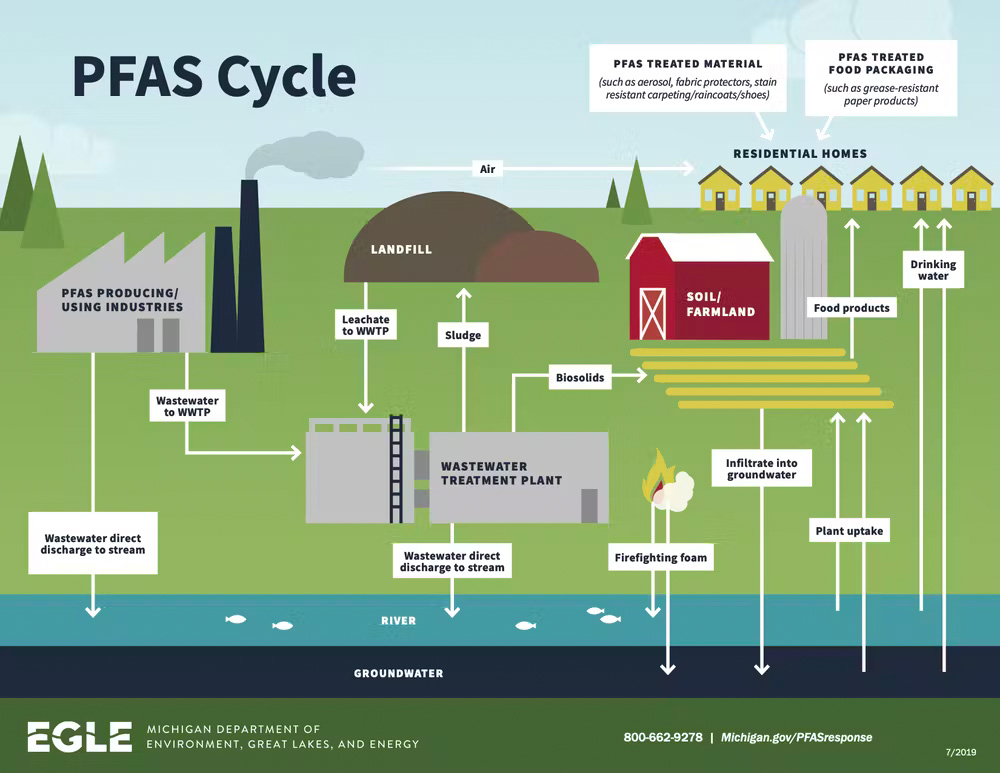
 

An illustration labeled “PFAS cycle” uses simple, colored shapes to show how PFAS moves into and out of the environment. PFAS producing/using industries, wastewater treatment plants, firefighting foams, farmland and landfills all contribute PFAS to rivers, where it can also flow into groundwater. From the rivers, groundwater PFAS can enter plants and drinking water, ultimately entering residential homes. Rivers, groundwater and farmland also let PFAS enter food products consumed in residential homes.
There are many ways PFAS can enter the environment, all of which increase the odds of finding these chemicals in our food or water. Source: Michigan Department of Environment, Great Lakes and Energy

PFAS are a concern everywhere, but they present a unique challenge in Michigan. Michigan has an abundance of PFAS, with more than 200 known PFAS-contaminated sites. On top of that, agriculture and the Great Lakes are foundational to the state’s identity. Protecting Michigan’s land and water is a shared goal of many of the state’s communities, legislators and companies.


“Even before this work, we were going to huge meetings and talking about PFAS with people from different municipalities, farms, wastewater treatment plants and more,” Wilson said. “A lot of people are looking for solutions.”


The study was inspired by a Michigan engineering firm that asked Wilson about how PFAS might spread in soil and how best to remediate the chemicals. She didn’t have the answers, but she knew Loganathan could help her start finding some.


She recruited him to join this project, supported by the National Science Foundation. The duo also had access to computational resources provided by the National Energy Research Scientific Computing Center and MSU’s Institute for Cyber-Enabled Research, or iCER.


The results of the simulations did provide some reasons for optimism with regard to remediation. For example, some of the PFAS the Spartans studied that had longer carbon chains serving as their backbones congregated on the kaolinite.
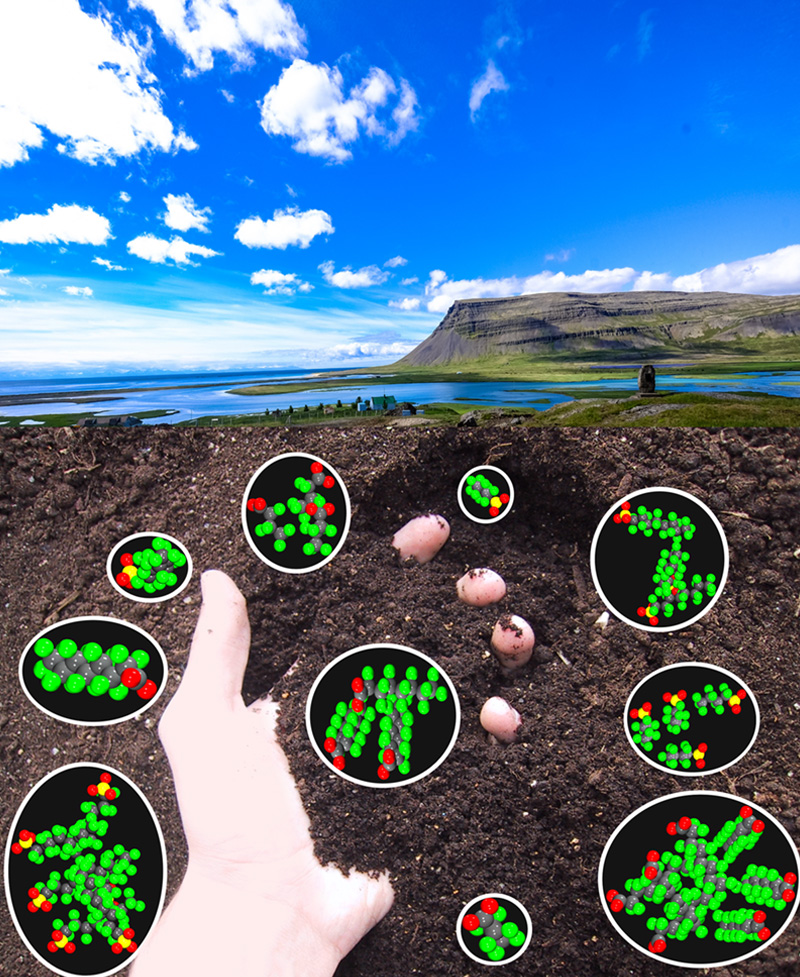
 

An image shows a hand holding soil in front of green grass and a blue stream. Around the hand, several different structures of PFAS molecules are shown, with gray, green, yellow and red orbs representing individual atoms. Some structures contain only a handful of atoms, while others have dozens.
This image rendering shows several different types of PFAS molecules the Spartan researchers examined to learn how the compounds interact with soil components. Credit: Courtesy of the Wilson Research Group

“Ideally, this is what you’d want. You’d like all PFAS just to sit in a clump so you can grab it and filter it out,” Wilson said. The flipside is that the shorter-chained PFAS were less likely to clump, remaining more mobile in soil.


“The take-home message is that not all PFAS behave similarly,” Wilson said. “And not all soils behave the same with regard to PFAS.”


“The components in the soil play a big role,” Loganathan said. “The soil composition around any contaminated site is going to be critical for how far PFAS make it into the subsurface, where they can then reach groundwater.”


Although the idea of examining the myriad combinations of PFAS and soil components is imposing, the Spartans have shown their computational approach is well-suited to tackling the diversity of problems inherent to PFAS pollution.


“The beauty of computational chemistry is that you can study so many different systems,” said Wilson, whose research team is also examining interactions of PFAS with proteins in the body. Her team is also studying PFAS in different fish species with support from Great Lakes Fisheries Trust and the Strategic Environmental Research and Development Program, which are state and federal organizations, respectively, that fund environmental projects.


The goal, in the soil and biology projects, is to reveal interactions that could help protect more people from PFAS exposure.


“Such molecular level insights are going to be incredibly important for any remediation strategy,” Loganathan said.


MEDIA CONTACTS

Angela Wilson, Kaylie Crowe
PollutionClimate and EnvironmentNatural SciencesEngineering, Science and TechnologyClimate and Environment

Collection

more content from this collection

Water at MSU

Latest News

MSUToday Weekly Update

The MSUToday Weekly Update email showcases how Spartans are making a difference through academic excellence, research impact and community outreach. Get inspired by these stories of innovation, collaboration and determination. Plus, enjoy photos and videos of campus and more MSU content to help keep you connected to the Spartan community.

Sign UpUpdate My Information

Connect With Us

Visit our Facebook pageVisit our page on XVisit our Instagram pageVisit our LinkedIn pageVisit our YouTube pageVisit our TikTok page

Health and Safety

  • MSU Police and Public Safety
  • Olin Health Center
  • Counseling & Psychiatric Services (CAPS)
  • University Health and Wellbeing
  • MSU Health Care
  • Civil Rights and Title IX
  • Our Commitment
  • Center for Survivors
  • Security & Fire Safety Report
  • University Policy on Relationship Violence and Sexual Misconduct
  • Notice of Non-Discrimination, Anti-Harassment and Non-Retaliation
  • Health Care Non-Discrimination Notice

Support Services

  • Disability Resources
  • Supportive Services
  • Learning Resources

Working at MSU

  • Human Resources
  • EBS Login
  • Job Postings
  • Employee Assistance Program

Reports

  • CARES Act Funding
  • Student Achievement and Outcomes

Contact us

517-355-1855

Address

Michigan State University 426 Auditorium Road East Lansing, MI 48824

Follow Us

  • Visit our Facebook page
  • Visit our page on X
  • Visit our Instagram page
  • Visit our TikTok page
  • Visit our LinkedIn page
  • Visit our YouTube page

If you're having accessibility issues, please let us know.

Know More: Campus Safety Information and ResourcesTransparency Reporting: Budget & Salary/Compensation
Michigan State University
  • Contact Information|
  • Site Map|
  • Privacy Statement|
  • Site Accessibility|
  • Call MSU: (517) 355-1855|
  • Visit: msu.edu|
  • Notice of Nondiscrimination|

SPARTANS WILL|© Michigan State University|