Jump to HeaderJump to Main ContentJump to Footer
Michigan State University
  • Browse Stories By

    Topics

    Explore stories by subject area

    • Arts and Culture
    • Business and Economy
    • Climate and Environment
    • Education and Learning
    • Engineering, Science and Technology
    • Government and Society
    • Health and Medicine
    • Media and Communications
    • MSU Leadership and Impact
    • Sports and Recreation
    • Student and Campus Experience
    View All Stories

    Collections

    Curated story series

    • Turfgrass
    • Ask the Expert
    • Big Ideas
    • Climate solutions
    • Water at MSU
    • Mobility
    • Spartan Perspectives
    • Student views
    • Graduate voices
    • Faculty voices
    View All Collections

    Featured

    Editor's picks

    • The Spartans behind your favorite Michigan golf courses

      July 22, 2026

      The Spartans behind your favorite Michigan golf courses

    • MSU in the 1990s: 10 Spartan milestones

      July 14, 2026

      MSU in the 1990s: 10 Spartan milestones

MSUTODAY
  • Browse Stories By

< Browse Stories By

Topics

Explore stories by subject area

  • Arts and Culture
  • Business and Economy
  • Climate and Environment
  • Education and Learning
  • Engineering, Science and Technology
  • Government and Society
  • Health and Medicine
  • Media and Communications
  • MSU Leadership and Impact
  • Sports and Recreation
  • Student and Campus Experience
  • View All Stories

Collections

Curated story series

  • Turfgrass
  • Ask the Expert
  • Big Ideas
  • Climate solutions
  • Water at MSU
  • Mobility
  • Spartan Perspectives
  • Student views
  • Graduate voices
  • Faculty voices
  • View All Collections

Featured

Editor's picks

  • The Spartans behind your favorite Michigan golf courses

    July 22, 2026

    The Spartans behind your favorite Michigan golf courses

  • MSU in the 1990s: 10 Spartan milestones

    July 14, 2026

    MSU in the 1990s: 10 Spartan milestones

  • For Media
  • Experts
  • Releases and Statements
  • Sign Up
  • Update Information

Resources

  • A to Z Index
  • Find People
  • Maps
  • Email
  • Student Information System (SIS)
  • D2L
  • Libraries
  • Tech Support
  • MSU Misconduct Hotline
  • Social Media Directory
  • Events Calendar
  • For Media
Michigan State University
MSUToday
  • For Media
  • Experts
  • Releases and Statements
  • Sign Up
  • Update Information
MSUTODAY
Natural Sciences

March 8, 2022

A ‘pilot light’ for photosynthesis

Spartan researchers reveal processes that keep a plant’s energy balance in check during changing conditions, which could lead to more efficient crops

By: Matt Davenport

Michigan State University’s Thomas D. Sharkey has a gift for exploring the intricate biochemical mechanisms of photosynthesis, the life-sustaining reactions that plants use to grow literally from thin air.
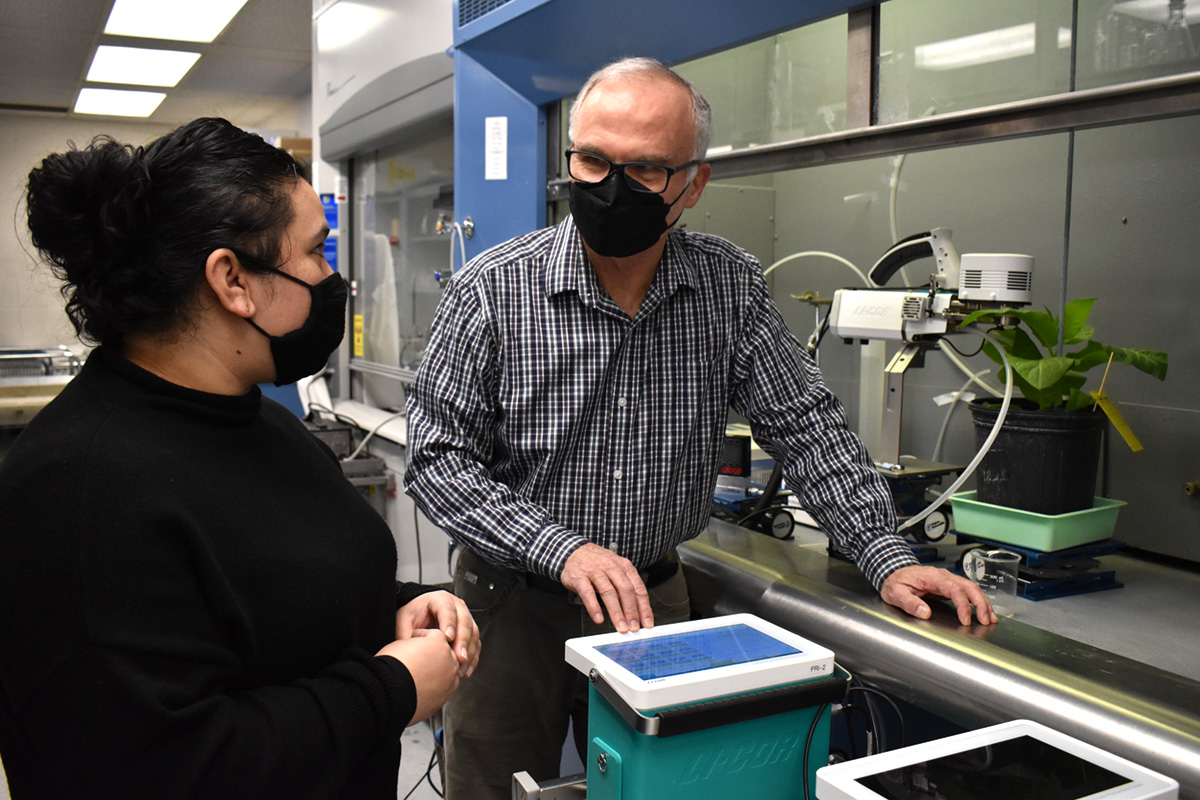
 

Bianca Serda (left) and Thomas Sharkey (right) talk in a lab in front of a fume hood with a plant growing inside.
University Distinguished Professor Thomas D. Sharkey (right) talks with graduate student Bianca Serda (left). Credit: Kara Headley

The University Distinguished Professor also has a gift for explaining those complex processes with metaphors and much simpler, more familiar machinery.


Both skills are on display when Sharkey talks about his team’s new paper, published on March 8 in the journal Proceedings of the National Academy of Sciences, describing what they call a pilot light for photosynthesis.


By understanding how plants stay primed to produce sugars in varying degrees of sunlight, Spartans are working toward a future when growers can raise more efficient crops used as food and biofuel.


“I grew up near Detroit, so I use a lot of automotive analogies,” said Sharkey, a professor of biochemistry and molecular biology in the College of Natural Science. “If you want to make a better car, it’s not just about putting in a better engine.”


If a plant’s the car, the core reactions of photosynthesis are the engine powering it. But there are also myriad processes supporting that core.


“We’ve got the engine, but we need to improve the handling, the brakes, the radiator and so much other stuff that’s essential. That’s what we’re working on now,” said Sharkey, whose group is part of the Plant Resilience Institute and the MSU-DOE Plant Research Lab, which is supported by the U.S. Department of Energy.


“Using new approaches, we’ve been able to refine our understanding of how photosynthesis makes sugars,” he said.


Many of us have popped the hood on plant biology and given the photosynthetic engine a quick inspection in science class. Fueled by sunlight, plants convert water and carbon dioxide into sugar.


This core reaction takes place inside plant cells, which have evolved all sorts of auxiliary processes and mechanisms to support it. As such, photosynthesis is a precision operation. Anything off-kilter when taking in the sun’s energy and outputting energy-storing molecules can have severe consequences for the plant within seconds.


“We’re still trying to work out how everything works together,” Sharkey said. “If the whole system isn’t completely in sync, it collapses.”


However delicate the balance, plants have somehow adapted to maintain it while relying on a fickle ingredient: sunlight. The sun’s intensity fluctuates when clouds block the sun and when wind twists leaves away from the sun’s rays. So how can a precision system cope with a fuel that goes from low-flow to full-blast without warning?
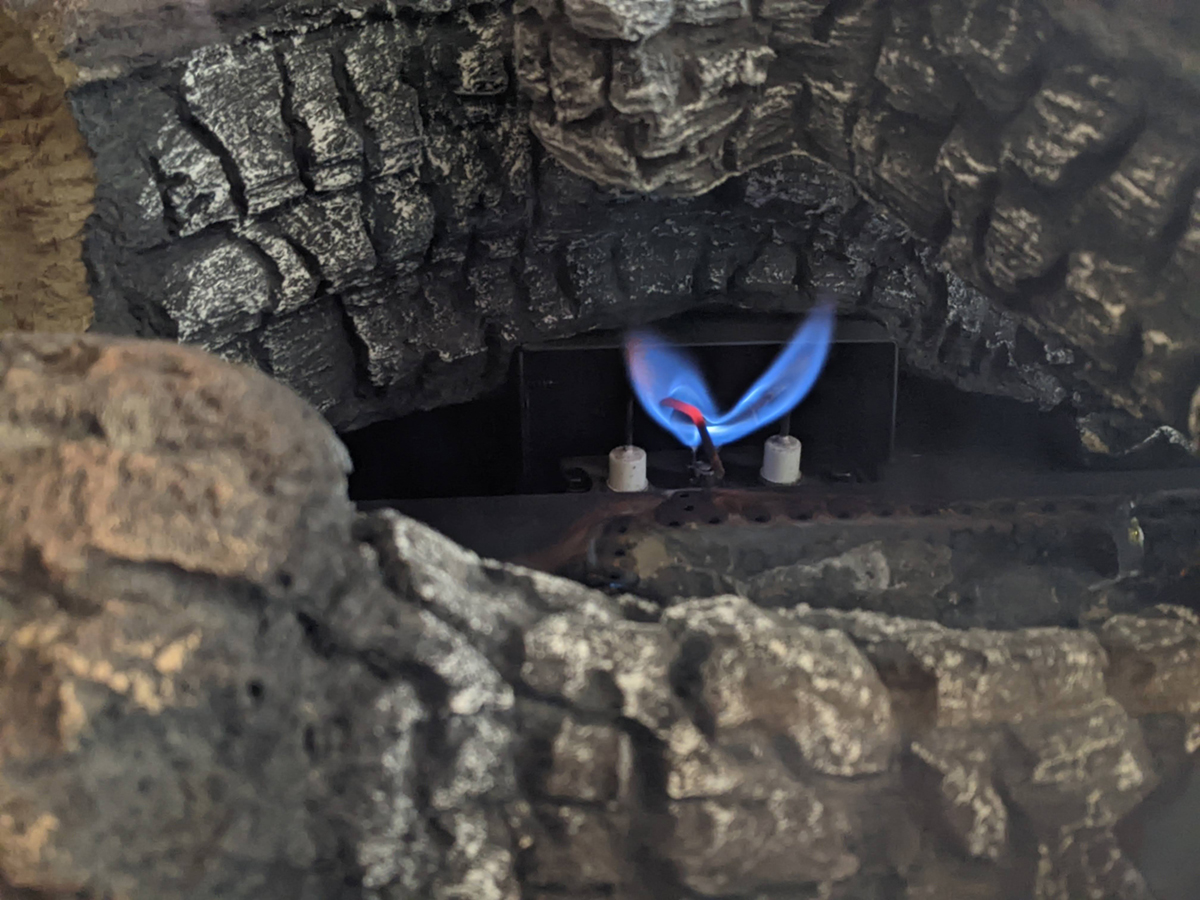
 

A small pilot light burns blue between faux logs in a gas fireplace.
The pilot light in this gas fireplace is constantly running to make sure the main burner ignites easily when needed. Spartan researchers have discovered an analogous metabolic "pilot light" that plants use in photosynthesis. Credit: Matt Davenport

That’s what Sharkey and his colleagues have found in their “pilot light,” which is actually three distinct processes in the plant. Between the processes, plants make sure that input energy goes into making harmless metabolites when conditions aren’t right for the main burner of photosynthesis to be running. When those conditions return, the processes help ignite the main system without missing a beat.


Science has known that there were two processes since the early 1990s, when Sharkey did foundational work on them. Discovering that third component of the pilot light was a complete surprise thanks in large part to acquiring what was lacking decades ago.


“We weren’t able to do much more then because I didn’t have the depth of colleagues and other essential components needed,” he said.


Joining Sharkey on this project were research associate Yuan Xu, graduate student Joshua Kaste, Professor Yair Shachar-Hill from the Department of Plant Biology and Thomas Wieloch, a researcher at Umeå University in Sweden.


The work was also enabled by the MSU Research Technology Support Facility Mass Spectrometry Core. Using the core’s technology, the team could measure very small differences in the mass of different plant metabolites to better understand how and when they were made during photosynthesis.


“I feel really lucky that we have such diverse talents at MSU in plant sciences. Each member of the team contributed something unique,” Sharkey said. “Working together allows us to do things we couldn’t do on our own.”


This work was supported by the Department of Energy, Basic Energy Sciences Division.

Natural SciencesEngineering, Science and TechnologyNatural SciencesMSU ResearchMSU Leadership and Impact

Latest News

MSUToday Weekly Update

The MSUToday Weekly Update email showcases how Spartans are making a difference through academic excellence, research impact and community outreach. Get inspired by these stories of innovation, collaboration and determination. Plus, enjoy photos and videos of campus and more MSU content to help keep you connected to the Spartan community.

Sign UpUpdate My Information

Connect With Us

Visit our Facebook pageVisit our page on XVisit our Instagram pageVisit our LinkedIn pageVisit our YouTube pageVisit our TikTok page

Health and Safety

  • MSU Police and Public Safety
  • Olin Health Center
  • Counseling & Psychiatric Services (CAPS)
  • University Health and Wellbeing
  • MSU Health Care
  • Civil Rights and Title IX
  • Our Commitment
  • Center for Survivors
  • Security & Fire Safety Report
  • University Policy on Relationship Violence and Sexual Misconduct
  • Notice of Non-Discrimination, Anti-Harassment and Non-Retaliation
  • Health Care Non-Discrimination Notice

Support Services

  • Disability Resources
  • Supportive Services
  • Learning Resources

Working at MSU

  • Human Resources
  • EBS Login
  • Job Postings
  • Employee Assistance Program

Reports

  • CARES Act Funding
  • Student Achievement and Outcomes

Contact us

517-355-1855

Address

Michigan State University 426 Auditorium Road East Lansing, MI 48824

Follow Us

  • Visit our Facebook page
  • Visit our page on X
  • Visit our Instagram page
  • Visit our TikTok page
  • Visit our LinkedIn page
  • Visit our YouTube page

If you're having accessibility issues, please let us know.

Know More: Campus Safety Information and ResourcesTransparency Reporting: Budget & Salary/Compensation
  • Contact Information|
  • Site Map|
  • Privacy Statement|
  • Site Accessibility|
  • Call MSU: (517) 355-1855|
  • Visit: msu.edu|
  • Notice of Nondiscrimination|

SPARTANS WILL|© Michigan State University|
