Jump to HeaderJump to Main ContentJump to Footer
Michigan State University
MSUTODAY
  • Browse Stories By

    Topics

    Explore stories by subject area

    • Arts and Culture
    • Business and Economy
    • Climate and Environment
    • Education and Learning
    • Engineering, Science and Technology
    • Government and Society
    • Health and Medicine
    • Media and Communications
    • MSU Leadership and Impact
    • Sports and Recreation
    • Student and Campus Experience
    View All Stories

    Collections

    Curated story series

    • Turfgrass
    • Ask the Expert
    • Big Ideas
    • Climate solutions
    • Water at MSU
    • Mobility
    • Spartan Perspectives
    • Student views
    • Graduate voices
    • Faculty voices
    View All Collections

    Featured

    Editor's picks

    • 9 reasons to love being a Spartan

      Aug. 28, 2026

      9 reasons to love being a Spartan

    • NIH awards multi-university team over $4M to improve women’s health

      Sept. 15, 2026

      NIH awards multi-university team over $4M to improve women’s health

MSUTODAY
  • Browse Stories By

< Browse Stories By

Topics

Explore stories by subject area

  • Arts and Culture
  • Business and Economy
  • Climate and Environment
  • Education and Learning
  • Engineering, Science and Technology
  • Government and Society
  • Health and Medicine
  • Media and Communications
  • MSU Leadership and Impact
  • Sports and Recreation
  • Student and Campus Experience
  • View All Stories

Collections

Curated story series

  • Turfgrass
  • Ask the Expert
  • Big Ideas
  • Climate solutions
  • Water at MSU
  • Mobility
  • Spartan Perspectives
  • Student views
  • Graduate voices
  • Faculty voices
  • View All Collections

Featured

Editor's picks

  • 9 reasons to love being a Spartan

    Aug. 28, 2026

    9 reasons to love being a Spartan

  • NIH awards multi-university team over $4M to improve women’s health

    Sept. 15, 2026

    NIH awards multi-university team over $4M to improve women’s health

  • For Media
  • Experts
  • Releases and Statements
  • Sign Up
  • Update Information

Resources

  • A to Z Index
  • Find People
  • Maps
  • Email
  • Student Information System (SIS)
  • D2L
  • Libraries
  • Tech Support
  • MSU Misconduct Hotline
  • Social Media Directory
  • Events Calendar
  • For Media
Michigan State University
MSUToday
  • For Media
  • Experts
  • Releases and Statements
  • Sign Up
  • Update Information
Nuclear Science

Dec. 9, 2021

Leaning into uncertainty

When it comes to nuclei and neutron stars, we have to account for what we don’t know, says John A. Hannah Distinguished Professor of Physics at MSU

By: Matt Davenport

Uncertainty is part of life. There’s just no escaping it, even in a science as precise as nuclear physics.

 

Witek Nazarewicz, John A. Hannah Distinguished Professor of Physics and chief scientist at the Facility for Rare Isotope Beams at MSU

While scientists work to develop ideas and experiments to minimize that uncertainty, they mustn’t forget about it, said Michigan State University’s Witold Nazarewicz. To that end, he and collaborators in Germany and Italy published a reminder of sorts in the journal Physical Review Letters.


“It’s important to remember that experimental measurements and theoretical models must be accompanied by error estimates,” said Nazarewicz, John A. Hannah Distinguished Professor of Physics and chief scientist at the Facility for Rare Isotope Beams, or FRIB. “And things can be understood better when you consider those uncertainties.”


Here, Nazarewicz is referring to many discussions following the successful outcome of the highly anticipated Lead Radius Experiment at the Thomas Jefferson National Accelerator Facility in Virginia. The experiment was working to deduce the neutron size of a lead atom’s core, or nucleus, through a measurement of a tiny left-right asymmetry in electron scattering.


This experiment — known as PREX, which rhymes with “T. rex” — looked at a lead nucleus with 82 protons and 126 neutrons. The P in PREX comes from lead’s abbreviation on the periodic table, Pb.


Scientists knew that this isotope or version of lead would have a “neutron skin” because it has more neutrons than protons. That is, the neutrons would stick out ever so slightly farther than the protons.


What the early theoretical analysis of the PREX result has suggested, though, is that this skin is a few quadrillionths of an inch thicker than many scientists had expected. And, again through the work of theorists, this teeny tiny skin can have astronomical implications: It can be related to the size of celestial objects such as neutron stars.


Neutron stars are fascinating for many reasons, including their mind-boggling density. They are incredibly massive — the “typical” neutron star has 40% more mass than our sun — and incredibly small, by star standards. You could fit about five neutron stars with the mass of seven suns between East Lansing and Ann Arbor.


And lead’s unexpectedly thick neutron skin could imply that these stars are larger than expected. Not dramatically larger, but enough to send “a psychological jolt to the community,” said Jorge Piekarewicz, a professor of theoretical nuclear physics at Florida State University, in an interview with Science magazine this April.


In the new paper, Nazarewicz has joined forces with collaborators Paul-Gerhard Reinhard, a professor of physics at the University of Erlangen-Nuremberg in Germany, and Xavier Roca-Maza, an associate professor of physics at the University of Milan in Italy. The trio has taken a step back and analyzed the PREX results through numerous lenses provided by different theoretical models.


The researchers found that when the PREX data are explained by a theoretical model, another basic nuclear property of lead, called the dipole polarizability, cannot be reproduced. Put another way, there’s not a single current model that can consistently account for what is known about properties of the lead nucleus and the PREX measurement.
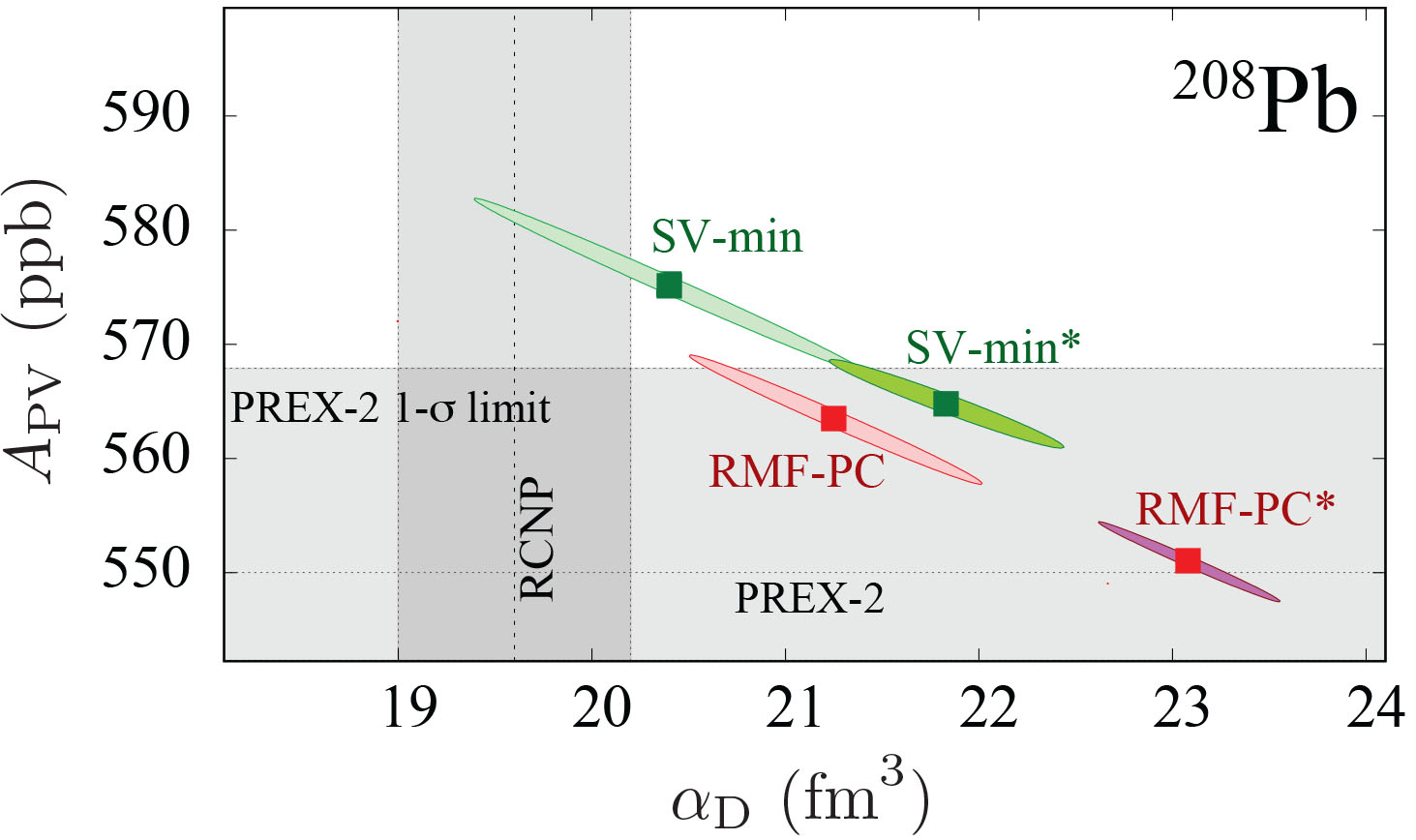
 

A figure uses dashed lines to represent the average values of the measurements from PREX at Jefferson Lab and from the Research Center for Nuclear Physics at Osaka University. The gray shaded areas show the uncertainties of those measurements. For the models, squares mark the average value and the ovals show error estimates. Three models fit within the uncertainty of the PREX experiment, with one within the uncertainty of the RCNP result. One model, SV-min, falls within the dark gray overlap of the two experimental measurements.
This graph shows the results of two experiments on the lead-208 isotope in gray along with four models used to interpret the results in red and green. The take-home message here is that no single model can reproduce both experiments.

One way of looking at this disconnect between theories and the PREX experiment is that the models are flawed or broken. But Nazarewicz cautioned against that interpretation.


“What we’re saying is ‘hold your horses,’” Nazarewicz said. “We need to understand the PREX result better before drawing far-reaching conclusions.”


That is, there’s some uncertainty.


In their new analysis, Nazarewicz and his colleagues paid close attention to the uncertainties or “error bars” that are part of the experiment and the models used to interpret it. When those error bars are considered, the picture that emerges is that the PREX result and models are more consistent than they initially may have appeared.


“We don’t have any compelling evidence at present that neutron skins and neutron stars must be bigger than predicted by standard models of atomic nuclei. Although this may not be the most exciting outcome, it takes nothing away from the importance of the PREX result. It simply shows that it’s too early to be making definitive assertions about the size of neutron skins and stars, which will require more experiments and lots of model developments,” Nazarewicz said.


With FRIB coming online in spring 2022, it will also offer new avenues to explore these problems. Indeed, studies of neutron skins and neutron stars are key components of FRIB’s science portfolio.


“The next generation of experiments will help.” Nazarewicz said. “But, considering the current data, there is no immediate need to revisit our textbooks.”


Michigan State University (MSU) operates the Facility for Rare Isotope Beams (FRIB) as a user facility for the U.S. Department of Energy Office of Science (DOE-SC), supporting the mission of the DOE-SC Office of Nuclear Physics. FRIB is funded by DOE-SC, MSU, and the State of Michigan, with user facility operation supported by the DOE-SC Office of Nuclear Physics.


The U.S. Department of Energy Office of Science is the single largest supporter of basic research in the physical sciences in the United States and is working to address some of today’s most pressing challenges. For more information, visit energy.gov/science.

MEDIA CONTACTS

Witold Nazarewicz, Karen King
Nuclear ScienceEngineering, Science and TechnologyNuclear ScienceNuclear Science

Latest News

MSUToday Weekly Update

The MSUToday Weekly Update email showcases how Spartans are making a difference through academic excellence, research impact and community outreach. Get inspired by these stories of innovation, collaboration and determination. Plus, enjoy photos and videos of campus and more MSU content to help keep you connected to the Spartan community.

Sign UpUpdate My Information

Connect With Us

Visit our Facebook pageVisit our page on XVisit our Instagram pageVisit our LinkedIn pageVisit our YouTube pageVisit our TikTok page

Health and Safety

  • MSU Police and Public Safety
  • Olin Health Center
  • Counseling & Psychiatric Services (CAPS)
  • University Health and Wellbeing
  • MSU Health Care
  • Civil Rights and Title IX
  • Our Commitment
  • Center for Survivors
  • Security & Fire Safety Report
  • University Policy on Relationship Violence and Sexual Misconduct
  • Notice of Non-Discrimination, Anti-Harassment and Non-Retaliation
  • Health Care Non-Discrimination Notice

Support Services

  • Disability Resources
  • Supportive Services
  • Learning Resources

Working at MSU

  • Human Resources
  • EBS Login
  • Job Postings
  • Employee Assistance Program

Reports

  • CARES Act Funding
  • Student Achievement and Outcomes

Contact us

517-355-1855

Address

Michigan State University 426 Auditorium Road East Lansing, MI 48824

Follow Us

  • Visit our Facebook page
  • Visit our page on X
  • Visit our Instagram page
  • Visit our TikTok page
  • Visit our LinkedIn page
  • Visit our YouTube page

If you're having accessibility issues, please let us know.

Know More: Campus Safety Information and ResourcesTransparency Reporting: Budget & Salary/Compensation
  • Contact Information|
  • Site Map|
  • Privacy Statement|
  • Site Accessibility|
  • Call MSU: (517) 355-1855|
  • Visit: msu.edu|
  • Notice of Nondiscrimination|

SPARTANS WILL|© Michigan State University|
