Jump to HeaderJump to Main ContentJump to Footer
Michigan State University
  • Browse Stories By

    Topics

    Explore stories by subject area

    • Arts and Culture
    • Business and Economy
    • Climate and Environment
    • Education and Learning
    • Engineering, Science and Technology
    • Government and Society
    • Health and Medicine
    • Media and Communications
    • MSU Leadership and Impact
    • Sports and Recreation
    • Student and Campus Experience
    View All Stories

    Collections

    Curated story series

    • Turfgrass
    • Ask the Expert
    • Big Ideas
    • Climate solutions
    • Water at MSU
    • Mobility
    • Spartan Perspectives
    • Student views
    • Graduate voices
    • Faculty voices
    View All Collections

    Featured

    Editor's picks

    • The Spartans behind your favorite Michigan golf courses

      July 22, 2026

      The Spartans behind your favorite Michigan golf courses

    • MSU in the 1990s: 10 Spartan milestones

      July 14, 2026

      MSU in the 1990s: 10 Spartan milestones

MSUTODAY
  • Browse Stories By

< Browse Stories By

Topics

Explore stories by subject area

  • Arts and Culture
  • Business and Economy
  • Climate and Environment
  • Education and Learning
  • Engineering, Science and Technology
  • Government and Society
  • Health and Medicine
  • Media and Communications
  • MSU Leadership and Impact
  • Sports and Recreation
  • Student and Campus Experience
  • View All Stories

Collections

Curated story series

  • Turfgrass
  • Ask the Expert
  • Big Ideas
  • Climate solutions
  • Water at MSU
  • Mobility
  • Spartan Perspectives
  • Student views
  • Graduate voices
  • Faculty voices
  • View All Collections

Featured

Editor's picks

  • The Spartans behind your favorite Michigan golf courses

    July 22, 2026

    The Spartans behind your favorite Michigan golf courses

  • MSU in the 1990s: 10 Spartan milestones

    July 14, 2026

    MSU in the 1990s: 10 Spartan milestones

  • For Media
  • Experts
  • Releases and Statements
  • Sign Up
  • Update Information

Resources

  • A to Z Index
  • Find People
  • Maps
  • Email
  • Student Information System (SIS)
  • D2L
  • Libraries
  • Tech Support
  • MSU Misconduct Hotline
  • Social Media Directory
  • Events Calendar
  • For Media
Michigan State University
MSUToday
  • For Media
  • Experts
  • Releases and Statements
  • Sign Up
  • Update Information
MSUTODAY
Natural Sciences

Nov. 5, 2021

Learning how nature ‘dances’

MSU researchers take an unprecedented look at how bacteria communicate and coordinate complex behaviors

By: Matt Davenport

Long ago in Earth’s history, individual cells began to communicate and coordinate with one another. Thanks to this and a few billion years of evolution, humans can now gather in lecture halls to share ideas about how to study this communication and its wide-ranging implications.


That’s how Michigan State University’s Lee Kroos and Yann Dufour came together to probe microbial processes that influence our world in myriad ways.

 

MSU Professor Lee Kroos

“My graduate student, Y Hoang, was presenting at a departmental seminar series called ‘Works in Progress,’” said Kroos, a professor of biochemistry and molecular biology and of microbiology and molecular genetics in the College of Natural Science. Hoang, who has since earned her doctorate, was discussing the group’s effort to take incredibly detailed images of bacterial communities at MSU’s Center for Advanced Microscopy. There was just one problem.


“We didn’t know how to do the image analysis,” Kroos said. “After the seminar, Yann came up to me and said, ‘I think we can help.’”


“There was a serendipity about it,” said Dufour, an assistant professor of microbiology and molecular genetics. “It was bringing the right set of skills together and the right set of people together.”


The Spartans now have a paper, published online Nov. 5 in the Proceedings of the National Academy of Sciences, in which they took a deep look at how single cells work together to choreograph collective behavior. In particular, the team looked at a bacterial species known as Myxococcus xanthus. Researchers use M. xanthus as a model to tease out the basic rules of the dances bacteria do to survive, thrive and impact humanity, for better or worse.
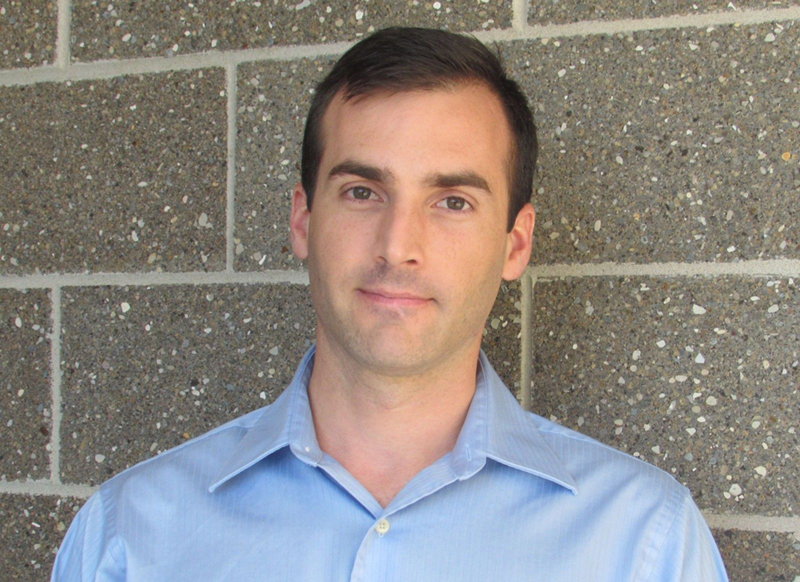
 

MSU Assistant Professor Yann Dufour

“You need to know the rules underlying the behavior,” Dufour said. “With every added detail we can see in the dance, we’re getting a bit closer to describing these elements that we really want to understand.”


“Microbial communities called microbiomes impact the life of all organisms,” Kroos said. “Limited understanding of how cells interact with each other in microbiomes impedes our ability to intervene for the benefit of society.”


With studies like this one, scientists make progress toward being able to manipulate these microbiomes to help society, the Spartans said. This could be by preventing microbial films that foul up medical devices and water treatment systems, or by encouraging microbial coordination in ways that remediate pollution, gobble up greenhouse gases and promote crop growth.


“Microbes are on the inside and outside of every living thing, so there are lots of practical applications of this work,” Kroos said. “But we have a lot of fundamental knowledge we still need to gain.”


To gain some of that knowledge with this project, Hoang worked with confocal imaging specialist Melinda Frame in the Center for Advanced Microscopy to get the most detailed images to date of the dance of the hungry M. xanthus.
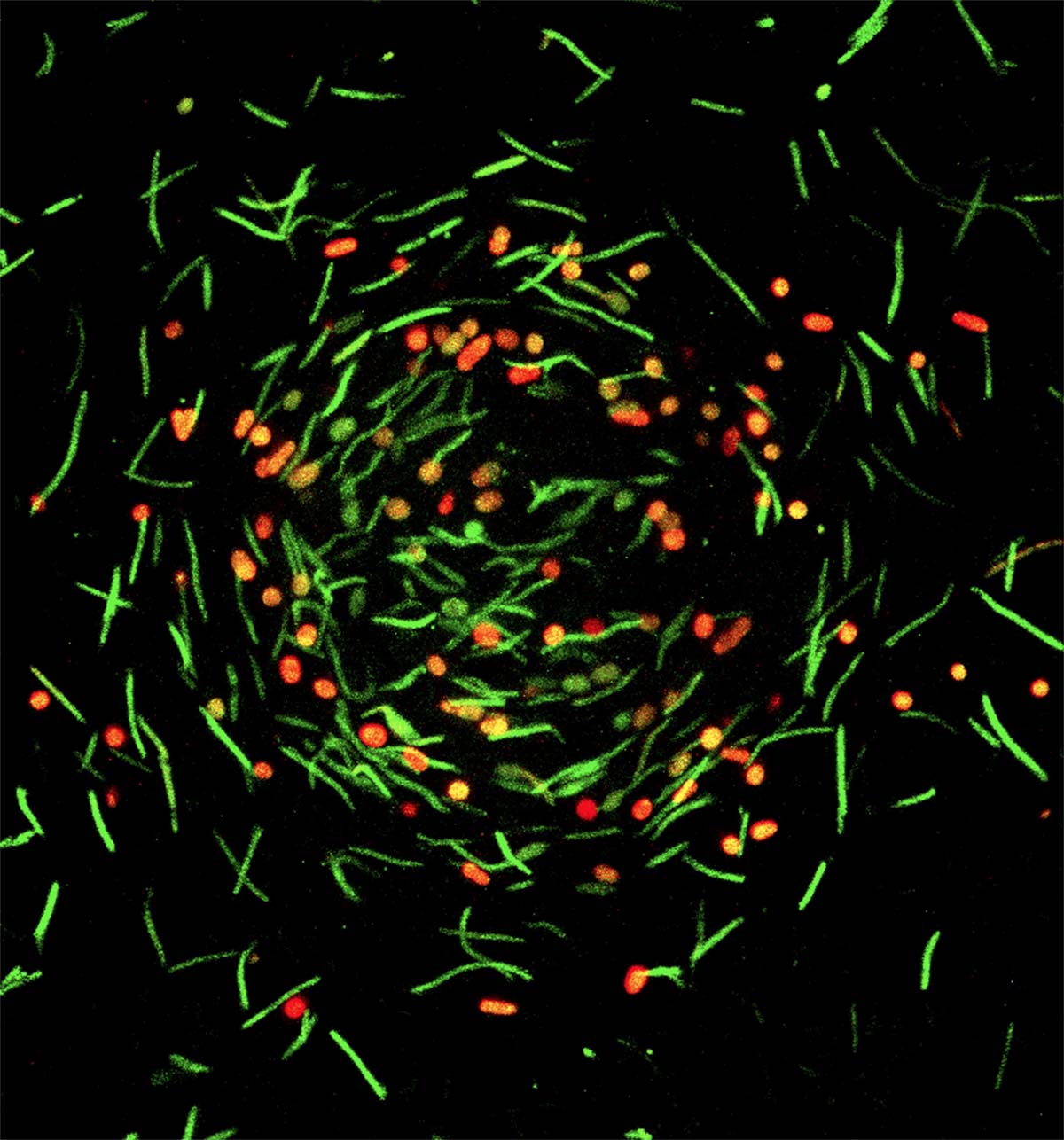
 

A microscope image shows a mound of M. xanthus cells transitioning from their normal, rod-like state (green) to orb-like spores (red).
A microscope image shows a mound of M. xanthus cells transitioning from their normal, rod-like state (green) to orb-like spores (red). Credit: Kroos Lab/Proc. Natl. Acad. Sci.

When food is scarce, these bacteria start a well-documented, but not fully understood, ritual. Roughly 100,000 cells congregate in what’s known as a mound. The rod-shaped bacteria then start squishing themselves into hardy orbs called spores that can survive in a dormant state until food becomes available again.


But this doesn’t happen willy-nilly. It’s a coordinated, collective effort. The bacteria use signals to dictate when it’s time to mound up and when to activate the genes used to make spores.


Hoang captured images of bacterial cells forming a mound and then spores with unparalleled resolution. That’s when Dufour’s team entered the picture and former graduate student Joshua Franklin — who has also since earned his doctorate — helped analyze the images to draw quantifiable conclusions supported by statistics.


“The Ph.D. students on this project deserve a lot of credit,” Dufour said. “They helped put a lot of new things on the table.”


“We had really stellar graduate students,” Kroos said. “Their creativity and their independent thinking helped make this possible.”


What the team found was that where cells were in the mound, how close together they were and how they were oriented all play a role. For instance, spore formation starts in a ring at a certain distance from the center of the mound. And rod-shaped cells tend to orient themselves a certain way where they start becoming spores.


“It’s really pretty amazing that there’s this substructure at the cellular level within the mound,” Kroos said. “I can’t say why they do that, but it’s pretty cool that they do.”


Although the Spartans don’t have all the answers yet, they do have new microscopy and data analysis techniques to continue watching and learning from the dance.


MEDIA CONTACTS

Lee Kroos, Yann Dufour, Caroline Brooks
Natural SciencesEngineering, Science and TechnologyNatural SciencesNatural Sciences

Latest News

MSUToday Weekly Update

The MSUToday Weekly Update email showcases how Spartans are making a difference through academic excellence, research impact and community outreach. Get inspired by these stories of innovation, collaboration and determination. Plus, enjoy photos and videos of campus and more MSU content to help keep you connected to the Spartan community.

Sign UpUpdate My Information

Connect With Us

Visit our Facebook pageVisit our page on XVisit our Instagram pageVisit our LinkedIn pageVisit our YouTube pageVisit our TikTok page

Health and Safety

  • MSU Police and Public Safety
  • Olin Health Center
  • Counseling & Psychiatric Services (CAPS)
  • University Health and Wellbeing
  • MSU Health Care
  • Civil Rights and Title IX
  • Our Commitment
  • Center for Survivors
  • Security & Fire Safety Report
  • University Policy on Relationship Violence and Sexual Misconduct
  • Notice of Non-Discrimination, Anti-Harassment and Non-Retaliation
  • Health Care Non-Discrimination Notice

Support Services

  • Disability Resources
  • Supportive Services
  • Learning Resources

Working at MSU

  • Human Resources
  • EBS Login
  • Job Postings
  • Employee Assistance Program

Reports

  • CARES Act Funding
  • Student Achievement and Outcomes

Contact us

517-355-1855

Address

Michigan State University 426 Auditorium Road East Lansing, MI 48824

Follow Us

  • Visit our Facebook page
  • Visit our page on X
  • Visit our Instagram page
  • Visit our TikTok page
  • Visit our LinkedIn page
  • Visit our YouTube page

If you're having accessibility issues, please let us know.

Know More: Campus Safety Information and ResourcesTransparency Reporting: Budget & Salary/Compensation
  • Contact Information|
  • Site Map|
  • Privacy Statement|
  • Site Accessibility|
  • Call MSU: (517) 355-1855|
  • Visit: msu.edu|
  • Notice of Nondiscrimination|

SPARTANS WILL|© Michigan State University|