Jump to HeaderJump to Main ContentJump to Footer
Michigan State University
  • Browse Stories By

    Topics

    Explore stories by subject area

    • Arts and Culture
    • Business and Economy
    • Climate and Environment
    • Education and Learning
    • Engineering, Science and Technology
    • Government and Society
    • Health and Medicine
    • Media and Communications
    • MSU Leadership and Impact
    • Sports and Recreation
    • Student and Campus Experience
    View All Stories

    Collections

    Curated story series

    • Turfgrass
    • Ask the Expert
    • Big Ideas
    • Climate solutions
    • Water at MSU
    • Mobility
    • Spartan Perspectives
    • Student views
    • Graduate voices
    • Faculty voices
    View All Collections

    Featured

    Editor's picks

    • The Spartans behind your favorite Michigan golf courses

      July 22, 2026

      The Spartans behind your favorite Michigan golf courses

    • MSU in the 1990s: 10 Spartan milestones

      July 14, 2026

      MSU in the 1990s: 10 Spartan milestones

MSUTODAY
  • Browse Stories By

< Browse Stories By

Topics

Explore stories by subject area

  • Arts and Culture
  • Business and Economy
  • Climate and Environment
  • Education and Learning
  • Engineering, Science and Technology
  • Government and Society
  • Health and Medicine
  • Media and Communications
  • MSU Leadership and Impact
  • Sports and Recreation
  • Student and Campus Experience
  • View All Stories

Collections

Curated story series

  • Turfgrass
  • Ask the Expert
  • Big Ideas
  • Climate solutions
  • Water at MSU
  • Mobility
  • Spartan Perspectives
  • Student views
  • Graduate voices
  • Faculty voices
  • View All Collections

Featured

Editor's picks

  • The Spartans behind your favorite Michigan golf courses

    July 22, 2026

    The Spartans behind your favorite Michigan golf courses

  • MSU in the 1990s: 10 Spartan milestones

    July 14, 2026

    MSU in the 1990s: 10 Spartan milestones

  • For Media
  • Experts
  • Releases and Statements
  • Sign Up
  • Update Information

Resources

  • A to Z Index
  • Find People
  • Maps
  • Email
  • Student Information System (SIS)
  • D2L
  • Libraries
  • Tech Support
  • MSU Misconduct Hotline
  • Social Media Directory
  • Events Calendar
  • For Media
Michigan State University
MSUToday
  • For Media
  • Experts
  • Releases and Statements
  • Sign Up
  • Update Information
MSUTODAY
MSU Research

Aug. 27, 2021

Student view: Performing surgery on sea lampreys

Kandace Griffin is a doctoral student in fisheries and wildlife and is a member of the Applied Behavioral Ecology Lab in the College of Agriculture and Natural Resources. Griffin investigates how migrating sea lamprey use habitat features and chemical cues to avoid predators when moving through rivers with the goal of creating novel invasive species control methods. She is seeking a career creating science-based policy and management strategies for fisheries management and species conservation.
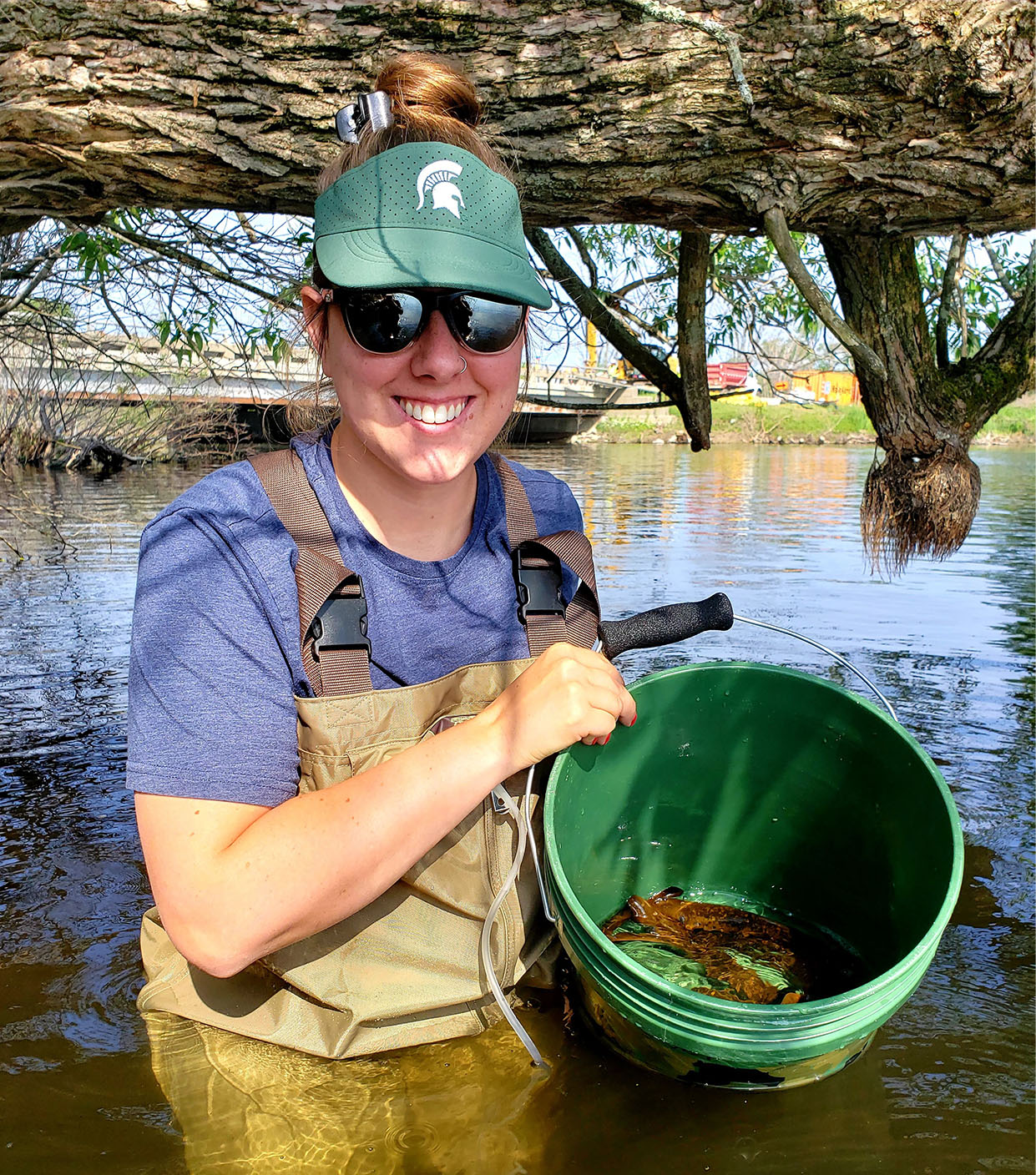
Kandace Griffin holding a bucket of sea lampreys

Each year the U.S. and Canadian governments mount joint operations to kill millions of invasive sea lampreys. I am among the very few trying to keep one alive. Well, 60 to be exact.

Before starting at MSU, I had never heard of a sea lamprey, but I quickly learned about their destructive history with the Great Lakes fishery, nearly wiping out the lake trout and whitefish populations in the Great Lakes.

Animal behavior and conservation have always been my passions. Coursework and internships provided theory and hands-on experience in animal behavior, but I had never worked in the aquatic world. I took a leap of faith because this position at MSU ticked many other boxes for me, but mostly I wanted to apply my knowledge and passions to the creation of novel solutions to ecological problems.

However, I never imagined I had to become a fish surgeon to fulfill this role. I had a lot to learn — from first holding a lamprey and not freaking out when they attach to me (they use their circular mouth like a suction cup to grab onto rocks in the river… or onto your arm) to finally completing surgery. The surgeries I perform are to implant a small acoustic transmitter inside the lamprey, which allows me to track their movement paths in three dimensions as they migrate upstream through the river. To reduce stress and the amount of time the animal is sedated, I have to intubate the fish with flowing water, make an incision about the width of your thumbnail, insert the tag and close the incision with two sutures in less than three minutes. Thankfully, no malpractice insurance is required!

I was so nervous on my first day of surgery. I had practiced on countless bananas (pro tip – bananas do not attack arms), but now it was showtime. This was going to be the most valuable fish I have ever held, not only because of the $550 transmitter I’d just implanted, but also because of the data I’d get for completing my degree and informing management. Every interaction with my fish must be as stress-free as possible from a quick and flawless surgery to careful release back into the river. After some mistakes and adjustments to the protocols and surgery setup, I became a more comfortable and efficient surgeon:  Incisions became smaller, sutures were quicker and smaller, and total surgery time went down. I had only 60 transmitters to implant. I needed every fish to survive and swim through the river just as every other lamprey that had not undergone surgery.

Understanding where the sea lamprey moves, and why, will allow us to create novel tools to control this invasive species. Currently, U.S. and Canadian managers rely on two main methods for controlling sea lamprey: 1) a targeted pesticide, or lampricide, which kills the larvae in streams; and 2) dams that prevent access to spawning ground. By knowing and manipulating sea lamprey movement, we could guide them into a trap, removing them before they make a bunch of baby lampreys.

Our lab is developing a device that can be installed in a fish ladder that would selectively block their passage through the fishway but allow native fish through. Having this tool would also allow for control efforts across more of the Great Lakes Basin where dams are failing or lampricide use is impractical or not valued. While sea lampreys are a pest in the Great Lakes, around the world other lamprey species need our help. Tools to guide lamprey movement could also be expanded to those situations, such as guiding Pacific lamprey around dams that block their migration. I am so excited that I have the opportunity to contribute to such a wide range of management and conservation concerns.


MEDIA CONTACTS

Beth Brauer
MSU ResearchMSU Leadership and ImpactBiodiversity and WildlifeClimate and EnvironmentBiodiversity and Wildlife

Collection

more content from this collection

Student Views

Latest News

MSUToday Weekly Update

The MSUToday Weekly Update email showcases how Spartans are making a difference through academic excellence, research impact and community outreach. Get inspired by these stories of innovation, collaboration and determination. Plus, enjoy photos and videos of campus and more MSU content to help keep you connected to the Spartan community.

Sign UpUpdate My Information

Connect With Us

Visit our Facebook pageVisit our page on XVisit our Instagram pageVisit our LinkedIn pageVisit our YouTube pageVisit our TikTok page

Health and Safety

  • MSU Police and Public Safety
  • Olin Health Center
  • Counseling & Psychiatric Services (CAPS)
  • University Health and Wellbeing
  • MSU Health Care
  • Civil Rights and Title IX
  • Our Commitment
  • Center for Survivors
  • Security & Fire Safety Report
  • University Policy on Relationship Violence and Sexual Misconduct
  • Notice of Non-Discrimination, Anti-Harassment and Non-Retaliation
  • Health Care Non-Discrimination Notice

Support Services

  • Disability Resources
  • Supportive Services
  • Learning Resources

Working at MSU

  • Human Resources
  • EBS Login
  • Job Postings
  • Employee Assistance Program

Reports

  • CARES Act Funding
  • Student Achievement and Outcomes

Contact us

517-355-1855

Address

Michigan State University 426 Auditorium Road East Lansing, MI 48824

Follow Us

  • Visit our Facebook page
  • Visit our page on X
  • Visit our Instagram page
  • Visit our TikTok page
  • Visit our LinkedIn page
  • Visit our YouTube page

If you're having accessibility issues, please let us know.

Know More: Campus Safety Information and ResourcesTransparency Reporting: Budget & Salary/Compensation
  • Contact Information|
  • Site Map|
  • Privacy Statement|
  • Site Accessibility|
  • Call MSU: (517) 355-1855|
  • Visit: msu.edu|
  • Notice of Nondiscrimination|

SPARTANS WILL|© Michigan State University|