Jump to HeaderJump to Main ContentJump to Footer
Michigan State University
  • Browse Stories By

    Topics

    Explore stories by subject area

    • Arts and Culture
    • Business and Economy
    • Climate and Environment
    • Education and Learning
    • Engineering, Science and Technology
    • Government and Society
    • Health and Medicine
    • Media and Communications
    • MSU Leadership and Impact
    • Sports and Recreation
    • Student and Campus Experience
    View All Stories

    Collections

    Curated story series

    • Turfgrass
    • Ask the Expert
    • Big Ideas
    • Climate solutions
    • Water at MSU
    • Mobility
    • Spartan Perspectives
    • Student views
    • Graduate voices
    • Faculty voices
    View All Collections

    Featured

    Editor's picks

    • The Spartans behind your favorite Michigan golf courses

      July 22, 2026

      The Spartans behind your favorite Michigan golf courses

    • MSU in the 1990s: 10 Spartan milestones

      July 14, 2026

      MSU in the 1990s: 10 Spartan milestones

MSUTODAY
  • Browse Stories By

< Browse Stories By

Topics

Explore stories by subject area

  • Arts and Culture
  • Business and Economy
  • Climate and Environment
  • Education and Learning
  • Engineering, Science and Technology
  • Government and Society
  • Health and Medicine
  • Media and Communications
  • MSU Leadership and Impact
  • Sports and Recreation
  • Student and Campus Experience
  • View All Stories

Collections

Curated story series

  • Turfgrass
  • Ask the Expert
  • Big Ideas
  • Climate solutions
  • Water at MSU
  • Mobility
  • Spartan Perspectives
  • Student views
  • Graduate voices
  • Faculty voices
  • View All Collections

Featured

Editor's picks

  • The Spartans behind your favorite Michigan golf courses

    July 22, 2026

    The Spartans behind your favorite Michigan golf courses

  • MSU in the 1990s: 10 Spartan milestones

    July 14, 2026

    MSU in the 1990s: 10 Spartan milestones

  • For Media
  • Experts
  • Releases and Statements
  • Sign Up
  • Update Information

Resources

  • A to Z Index
  • Find People
  • Maps
  • Email
  • Student Information System (SIS)
  • D2L
  • Libraries
  • Tech Support
  • MSU Misconduct Hotline
  • Social Media Directory
  • Events Calendar
  • For Media
Michigan State University
MSUToday
  • For Media
  • Experts
  • Releases and Statements
  • Sign Up
  • Update Information
MSUTODAY
MSU Research

Aug. 27, 2021

My Spartan Summer

By land, air and water, Michigan State researchers chronicle their summer research in the field.

By: Beth Brauer, Kelsie Lane

drawing of a microscopeWhile vacationing crowds head to Michigan’s beaches, lakes and cities, for many Spartan scientists, the summer months are ripe for research in the field.  As one of the nation’s top research universities, Michigan State University prepares students, faculty and staff to think critically and creatively to gather important data that will help shape future conservation methods and inform public health measures across the state.

These intrepid researchers can be found drilling into steel frames from 10 feet above, navigating municipal wastewater, tracking invasive species in kayaks and mapping coastal erosion along the Great Lakes.

The following photo galleries chronicle some of the important research projects Spartans took part in this summer.

Creating drought conditions

Drawing of clouds with raindrops falling

For more than 30 years, W.K. Kellogg Biological Station, located between Kalamazoo and Battle Creek, has been part of the national Long-Term Ecological Research network, where MSU researchers have studied the effects of land use intensity in agricultural landscapes on yield, soil health, food webs and more.

Led by MSU professor and principal investigator Nick Haddad, the MSU Kellogg Biological Research Station’s Long-Term Ecological Research team has discovered that no-till agriculture increases soil health and reduces greenhouse gas emissions, all while increasing agricultural yield. This summer, the team embarked upon a new experiment to find out how resilient different land uses are in response to growing-season drought.

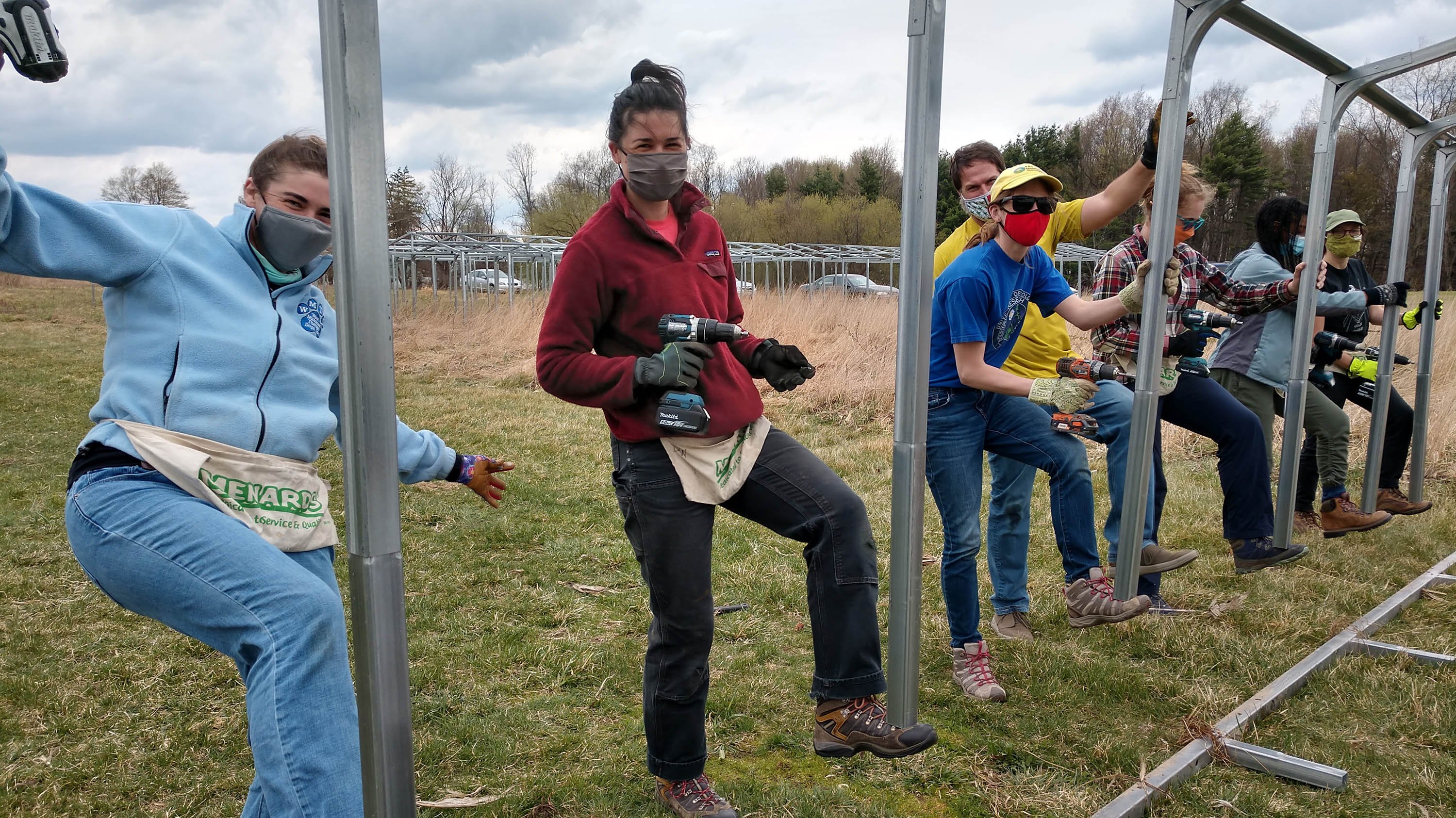
Since drought-like conditions do not happen on command, KBS faculty, staff and students rolled up their sleeves to construct rainout shelters, which are, as the name suggests, shelters that prevent rain from hitting the ground.

As Haddad put it, the experiment provides “one of the best snapshots in the 33-year experiment.”

Constructing rain shelters, as it turns out, is super labor-intensive. Nameer Baker, science coordinator, shares what the experience was like in his Faculty voice: Keeping the rain out.
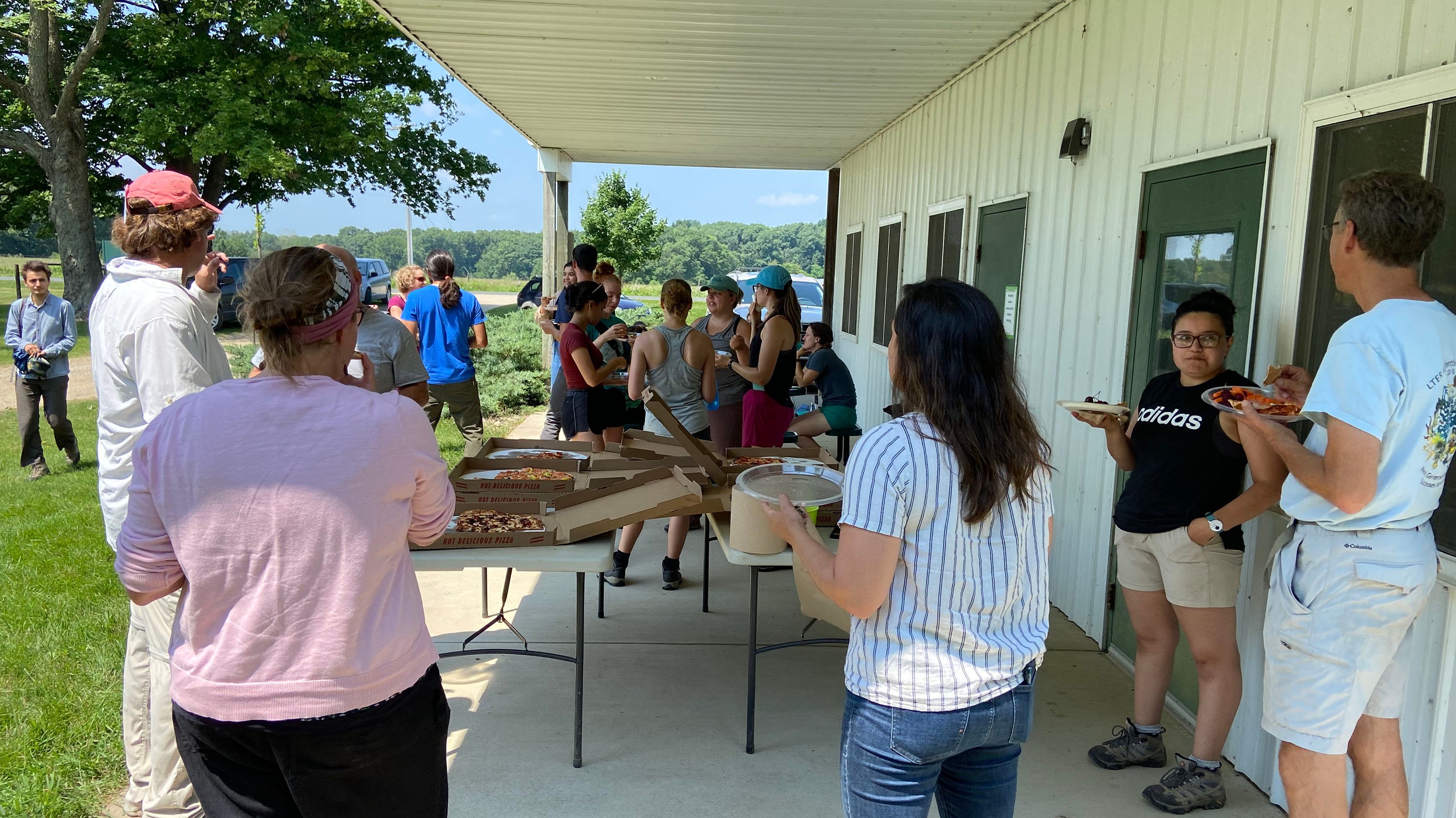
Members of the Haddad lab eating pizza at KBS
Members of the Haddad research lab installing one of the rain out shelters
Members of the Haddad lab installing the rain out shelters
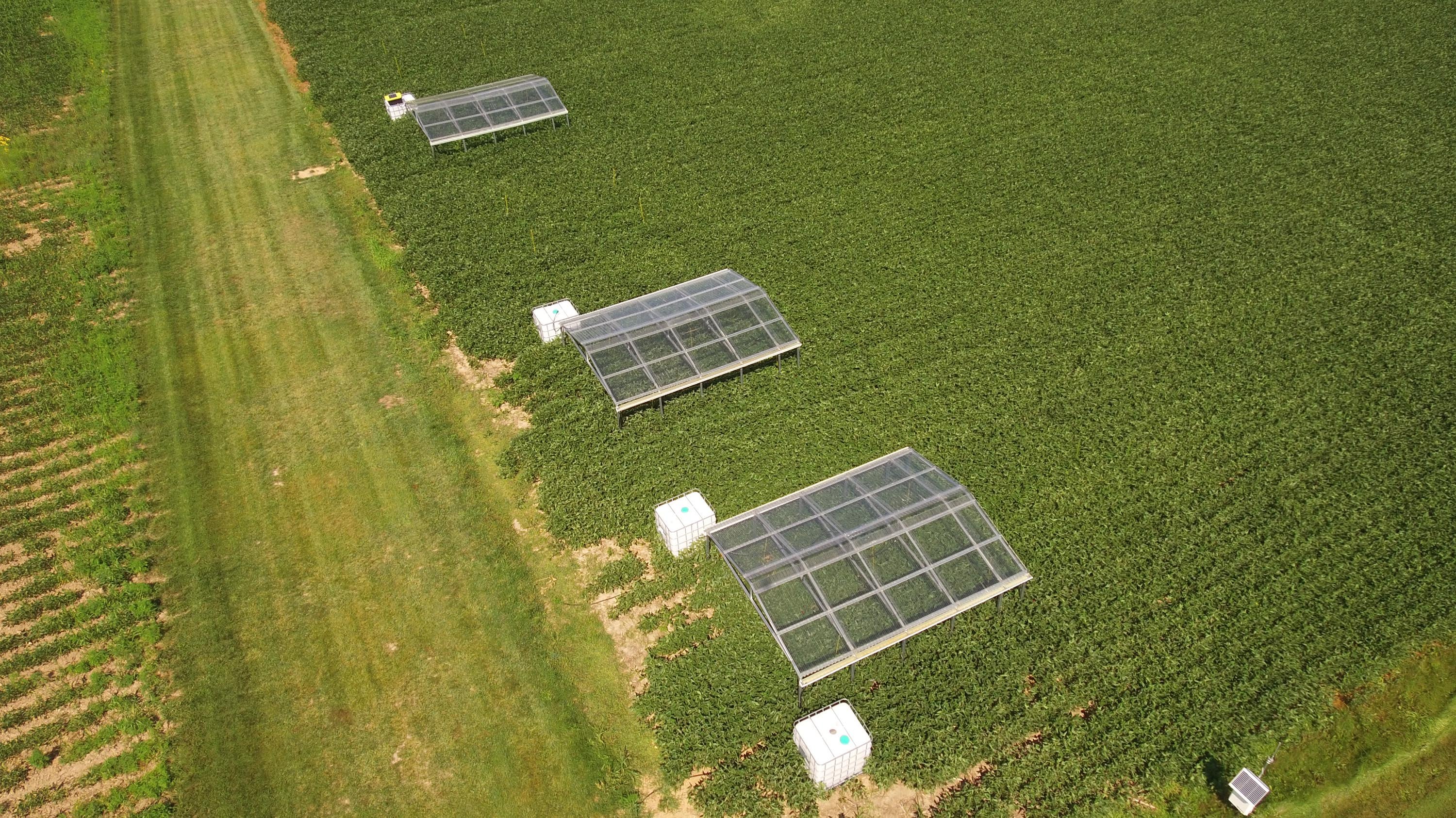
Aerial view of the completed rain-out shelters
A completed rain out shelter
Members of the Haddad lab eating pizza at KBS
Members of the Haddad research lab installing one of the rain out shelters
Once the rainout shelters were completely constructed and the experiment commenced, KBS LTER students, staff and faculty celebrated with a pizza party. Photo courtesy of KBS.
Students and staff construct rainout shelters at the Kellogg Biological Research Station during the spring. The rainout shelters are needed to conduct drought experiments that have been in progress all summer.

"At every stage, the construction took more time than we ever anticipated," said Nick Haddad, MSU professor and PI. Photos courtesy of Nick Haddad.
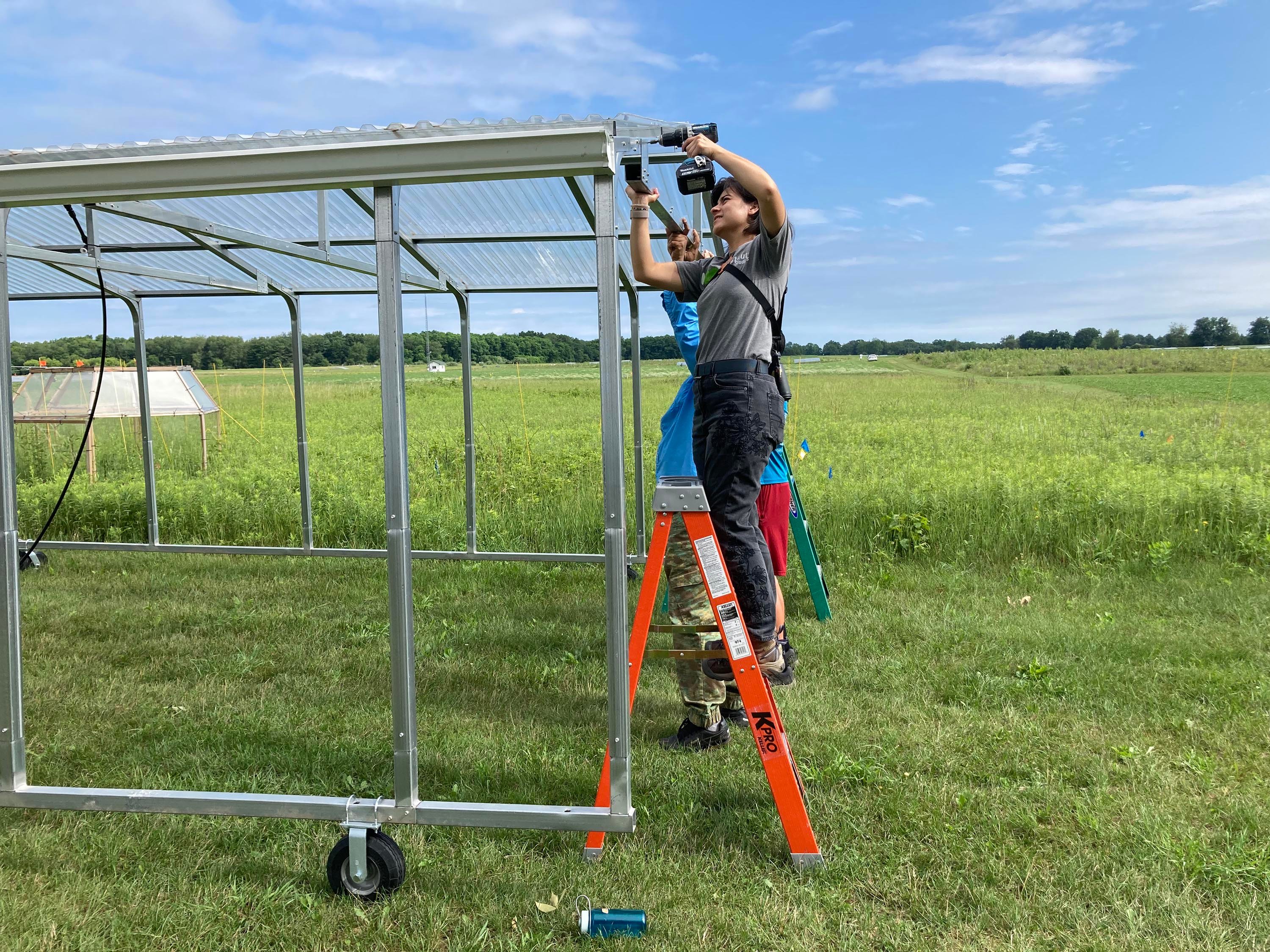
Annabelle McCarthy, a resident mentor and tech in the Haddad Lab, attaches the plexiglass roof to the steel frames of the rainout shelters. The rain-exclusion experiment is the biggest experiment since KBS Long-Term Ecological Research team's original experiment 33 years ago. Approximately eight different faculty labs participated with an average of five people per lab. Photo courtesy of KBS.
An aerial view of Kellogg Biological Research Station's LTER rainout shelters. Rain is excluded from areas of land for two-week intervals with two-week breaks in between for a total of six-weeks of rain exclusion. A second shelter received drought conditions for six continuous weeks, and the third shelter — the control — receives average rainfall ever week. The shelters will be removed this month. Photo courtesy of KBS.


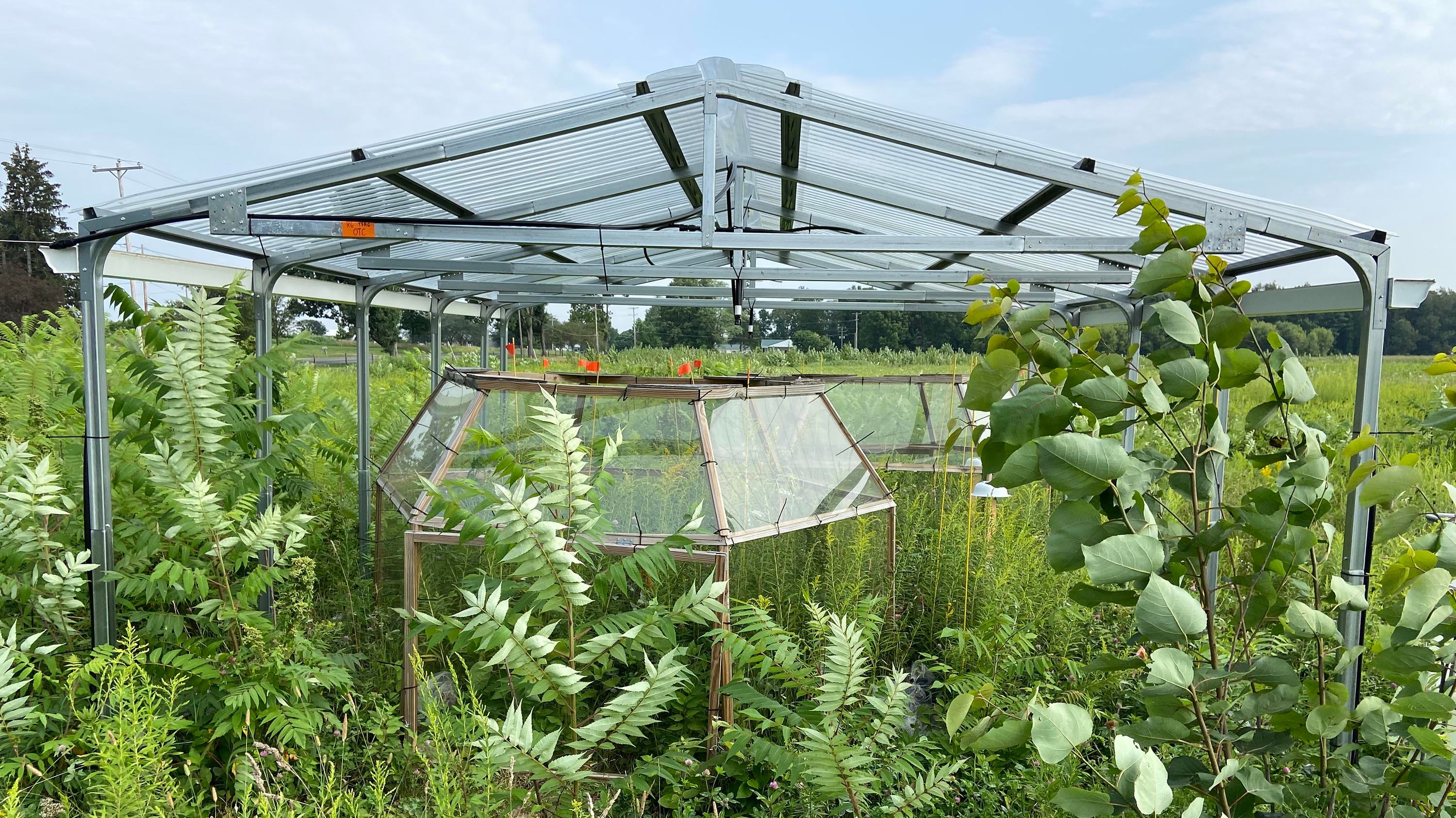
An experiment within an experiment. The LTER rainout exclusion shelter with another experiment, run by Phoebe Zarnetske, associate professor and plant biologist, and members of her lab, beneath it. The structures inside are called “open-top chambers,” and they are a way to passively warm the area to mimic warming from climate change. These are crossed with the rain exclusion experiment, so there are both warm + drought, drought alone, warm alone and control treatments. Photo courtesy of KBS.
Once the rainout shelters were completely constructed and the experiment commenced, KBS LTER students, staff and faculty celebrated with a pizza party. Photo courtesy of KBS.
Students and staff construct rainout shelters at the Kellogg Biological Research Station during the spring. The rainout shelters are needed to conduct drought experiments that have been in progress all summer.

"At every stage, the construction took more time than we ever anticipated," said Nick Haddad, MSU professor and PI. Photos courtesy of Nick Haddad.

01 / 05

Collecting virus clues in wastewater

Drawing of goggles

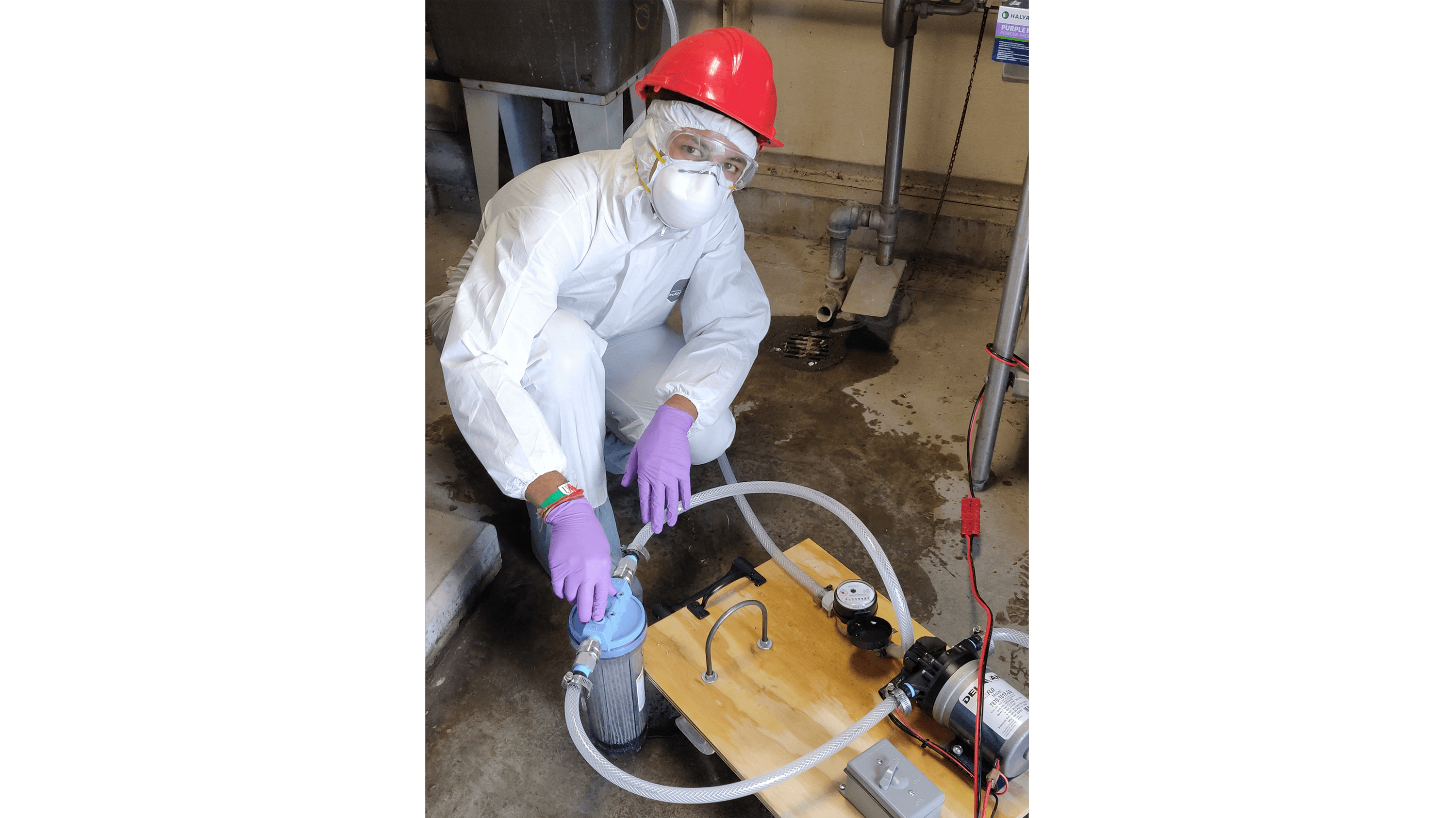
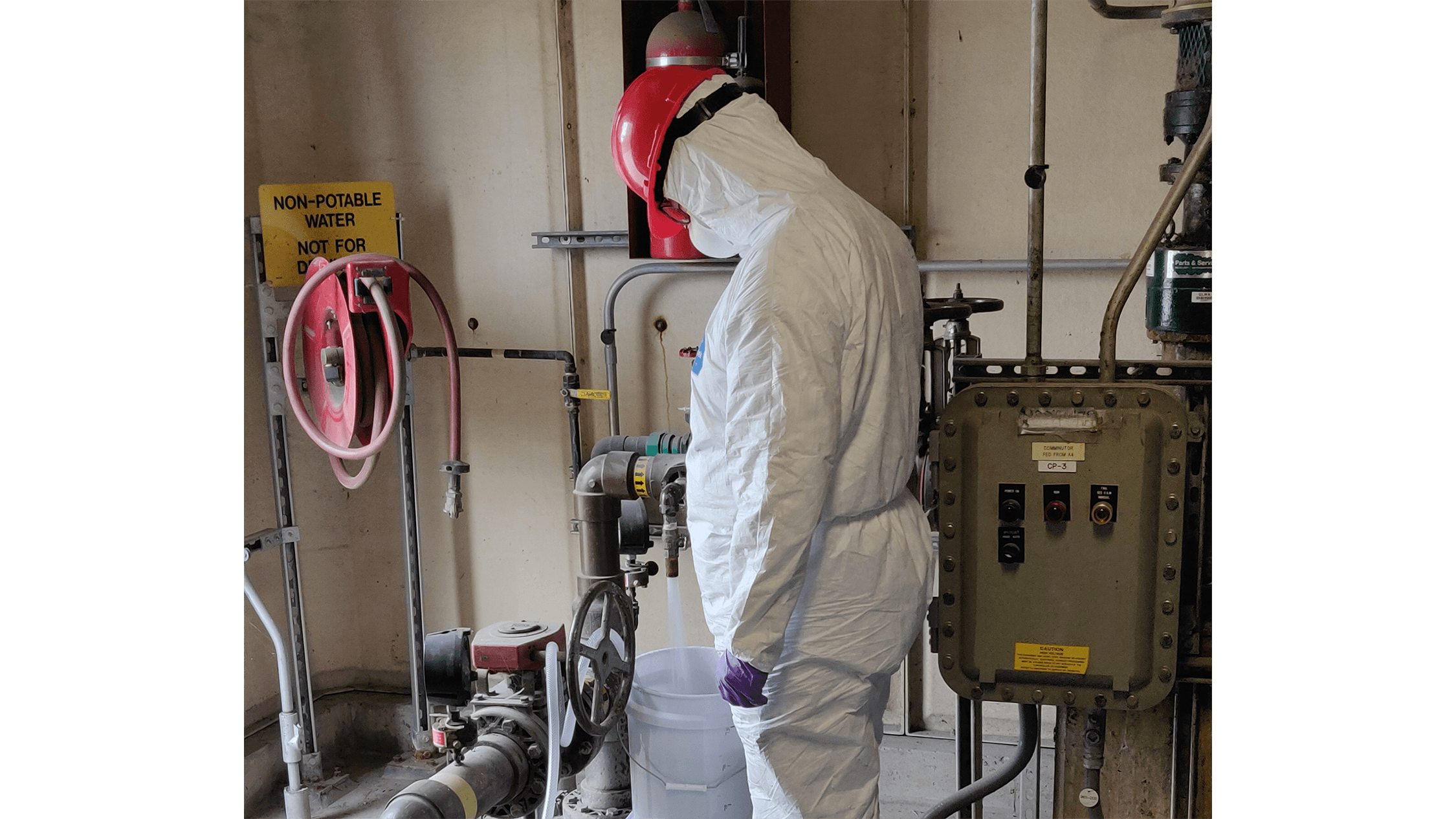
The members of the MSU Environmental Virology Lab in the College of Engineering, led by Professor of Environmental Engineering Irene Xagoraraki, may be seen in the Detroit metro area in head-to-toe personal protective equipment. Wearing lab coveralls, N95 masks, goggles, nitrile gloves, steel toe shoes and hard hats, student researchers have been collecting wastewater samples every Monday since January 2018 from three different interceptor facilities in Oakland, Macomb and Wayne counties.

Drawing of manhole in sidewalk

Collecting wastewater is not everyone’s cup of tea, but it is important work for so many reasons. For starters, wastewater contains viruses, which provide important clues that may inform public health protocols. Since the onset of the pandemic, the main virus extracted these days is COVID-19.

The objective is to quantify the amount of virus in a sample. This allows the lab to track and predict COVID-19 outbreaks and detect the presence of variants. Having this information available helps to warn public officials, who can then make informed decisions about pressing issues such as how to open the economy in safe ways and when to channel efforts toward vaccination drives.

While the work is far from glamorous, it is both exciting and gratifying. “Our research has real impact on people’s lives,” says Liang Zhao, a doctoral student in environmental engineering.

Environmental engineering graduate student Maddie Spooner; Zach Gentry, senior in the College of Engineering; and Brijen Miyani, doctoral student in environmental engineering, are all members of the lab and contributed to this story. To learn more about Miyani's experience, read his Student view: Preparing for a pandemic.


Wastewater sampling device
Brijen Miyani working with one of the sampling devices
Liang Zhao in the lab
Wastewater sampling device
Brijen Miyani working with one of the sampling devices
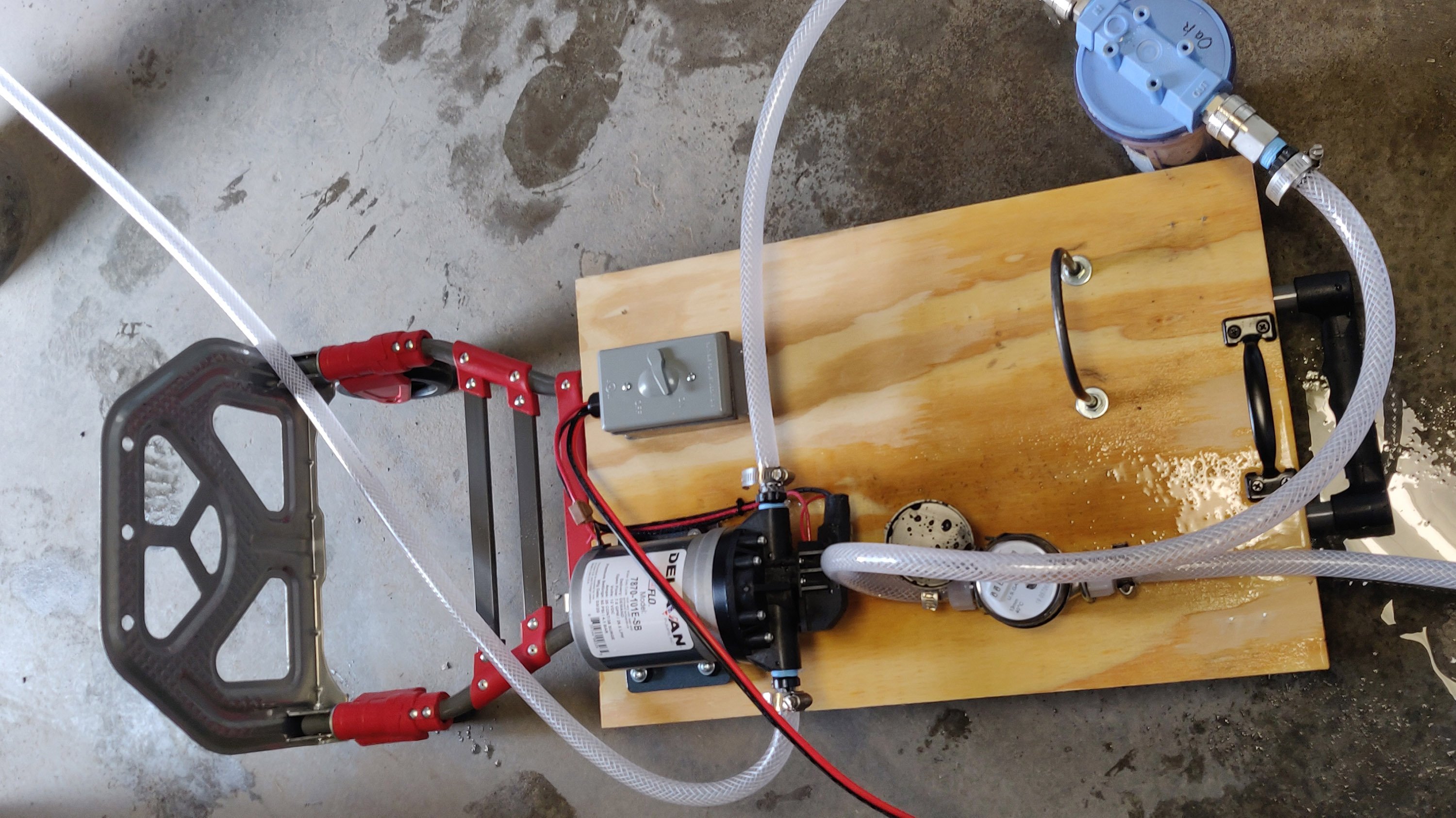
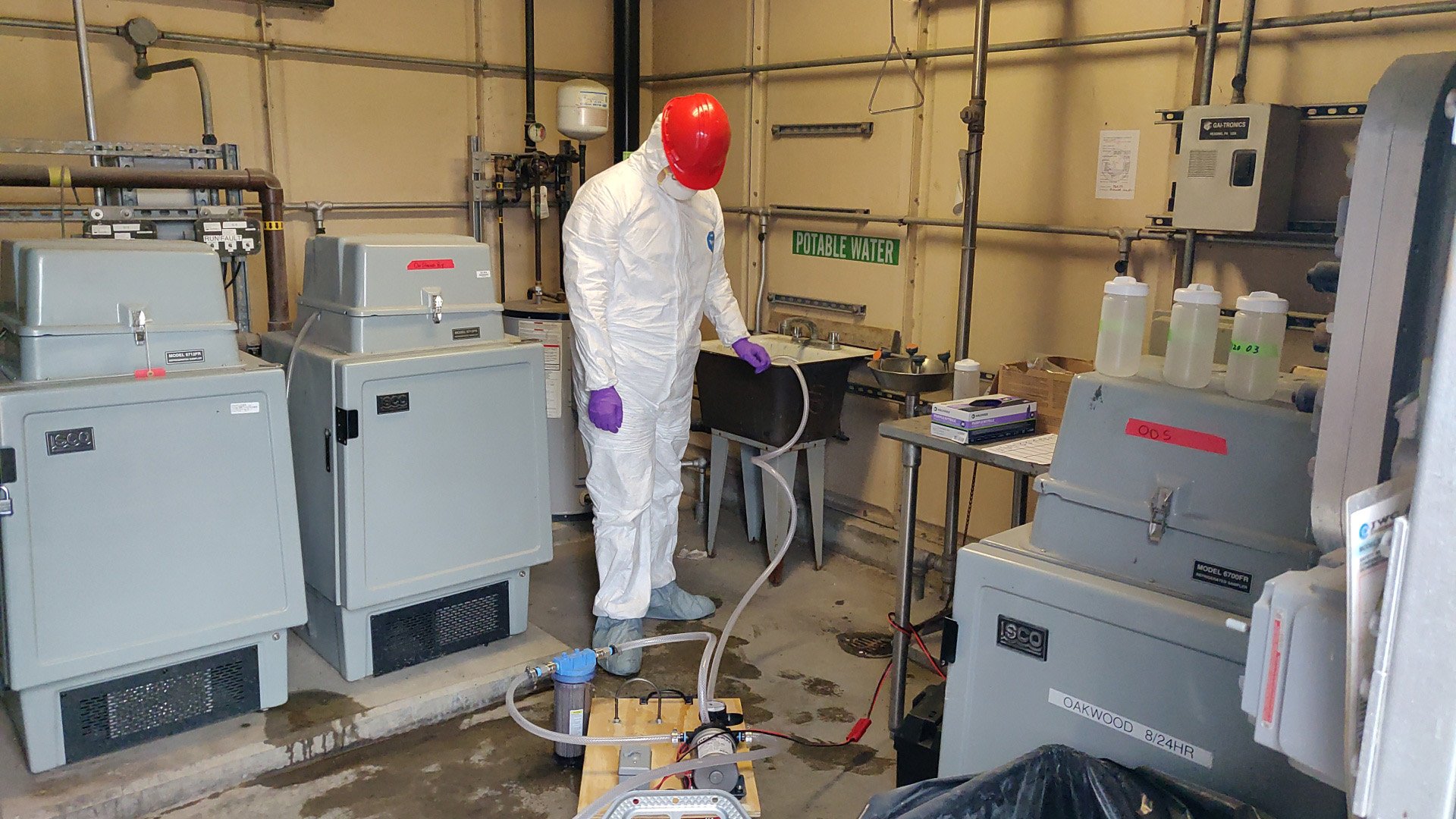
The sampling apparatus consists of influent and effluent hoses, a water pump, a filter hose, a water meter, a waterproof container (for battery storage), a car battery and waterproof switchboard.

Influent wastewater is collected in a sterile bucket. Then, an influent hose is put in the bucket. With the help of the pump, wastewater is forced through the filter hose (containing an electropositive filter). The viruses are adsorbed on the surface of filters. The water meter is used to calculate the volume of influent wastewater passed through the filters. This volume will be used to calculate SARS-CoV-2 RNA in wastewater. Once, the samples (filters) are shipped back to MSU, a high-affinity solution (like Beef extract) is passed through the filters in the reverse direction, so that viruses can detach into the solution.

Even without the threat of COVID-19, Maddie Spooner, master’s student in environmental engineering, says monitoring wastewater is critical because it serves as an accurate indicator of what the public is experiencing and how we can best prepare to mitigate the spread of illness and disease.

While the collection can be physically laborious, there’s an emotional burden the team bears as well. Senior Zach Gentry describes the frustration of having to see cases go back up after they had come down as a disappointment that never seems to end. Plus, because the collection, testing and reporting of this data has very serious and immediate implications, it can all weigh heavily. “The real data that goes to the state and the precautions that we have to take to protect ourselves — it’s a huge responsibility what we are reporting,” Gentry said.

Photo courtesy of MSU Environmental Virology Lab.

Doctoral student Brijen Miyani collects samples of wastewater at the Great Lakes Water Authority Water Resource Recovery Facility located in southeast Michigan. “A couple of days ahead of what everyone else knows about COVID, we are already three steps ahead," said Miyani. Photo courtesy of MSU Environmental Virology Lab.
Doctoral student Liang Zhao fills a sterile bucket with influent wastewater so that it can be passed through the sampling apparatus. Photo courtesy of MSU Environmental Virology Lab.
Zhao waits for influent wastewater to pass through the filter to concentrate viruses. After each collection, lab members dispose of all PPE equipment in biohazard waste bins, except for their goggles and helmet which are treated with Envirocide. Photo courtesy MSU Environmental Virology Lab.
The sampling apparatus consists of influent and effluent hoses, a water pump, a filter hose, a water meter, a waterproof container (for battery storage), a car battery and waterproof switchboard.

Influent wastewater is collected in a sterile bucket. Then, an influent hose is put in the bucket. With the help of the pump, wastewater is forced through the filter hose (containing an electropositive filter). The viruses are adsorbed on the surface of filters. The water meter is used to calculate the volume of influent wastewater passed through the filters. This volume will be used to calculate SARS-CoV-2 RNA in wastewater. Once, the samples (filters) are shipped back to MSU, a high-affinity solution (like Beef extract) is passed through the filters in the reverse direction, so that viruses can detach into the solution.

Even without the threat of COVID-19, Maddie Spooner, master’s student in environmental engineering, says monitoring wastewater is critical because it serves as an accurate indicator of what the public is experiencing and how we can best prepare to mitigate the spread of illness and disease.

While the collection can be physically laborious, there’s an emotional burden the team bears as well. Senior Zach Gentry describes the frustration of having to see cases go back up after they had come down as a disappointment that never seems to end. Plus, because the collection, testing and reporting of this data has very serious and immediate implications, it can all weigh heavily. “The real data that goes to the state and the precautions that we have to take to protect ourselves — it’s a huge responsibility what we are reporting,” Gentry said.

Photo courtesy of MSU Environmental Virology Lab.

Doctoral student Brijen Miyani collects samples of wastewater at the Great Lakes Water Authority Water Resource Recovery Facility located in southeast Michigan. “A couple of days ahead of what everyone else knows about COVID, we are already three steps ahead," said Miyani. Photo courtesy of MSU Environmental Virology Lab.

01 / 04

Diverting a Great Lakes threat

Drawing of sea lampreys swimming

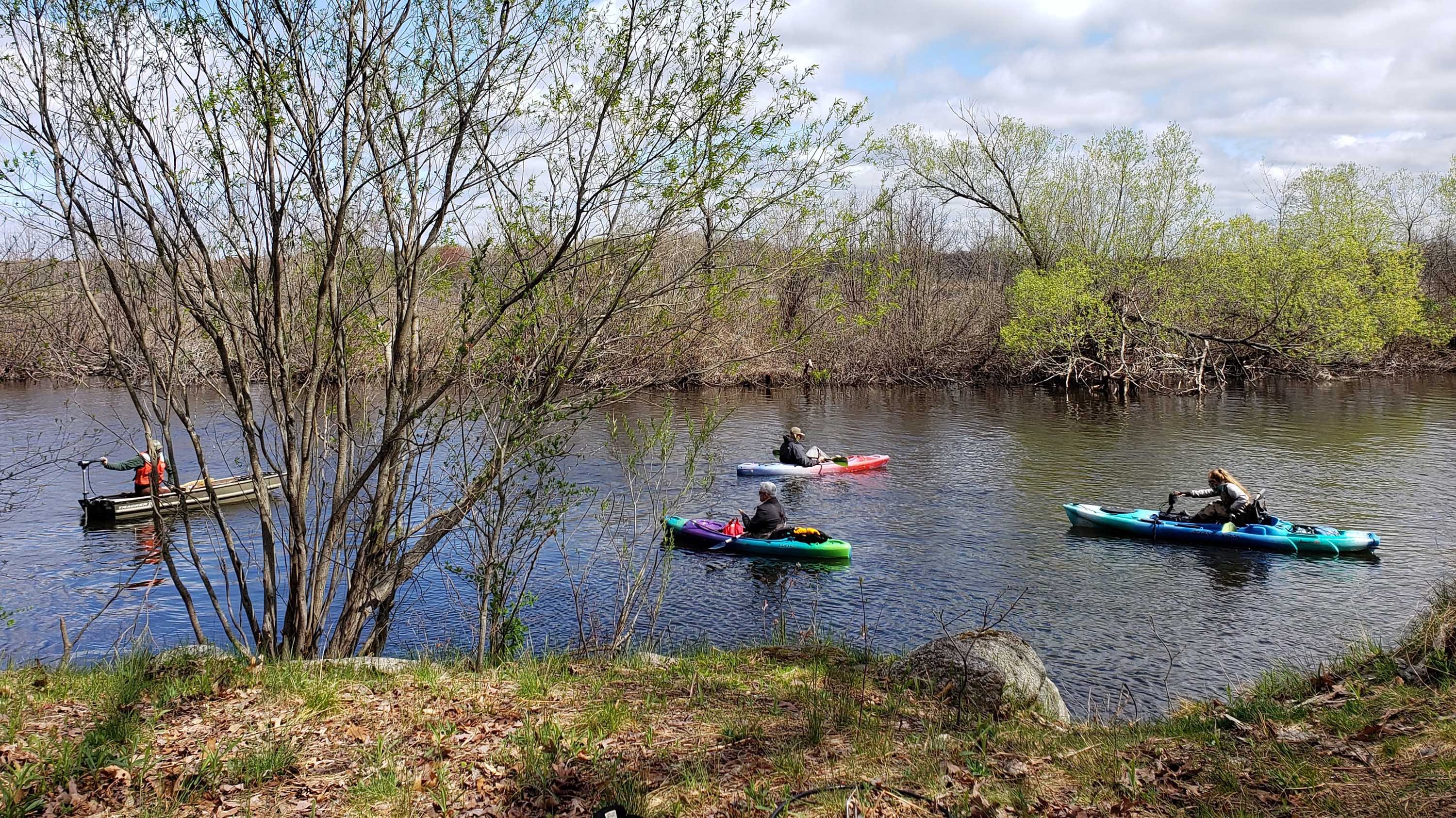
In an effort to protect the Great Lakes from invasive species and to develop more eco-friendly strategies to manage invasive species, members of the Applied Behavioral Ecology Lab, or ABEL, led by Michael Wagner, associate professor in the Department of Fisheries and Wildlife in the College of Agriculture and Natural Resources, track sea lampreys along the White River near Whitehall, Michigan.

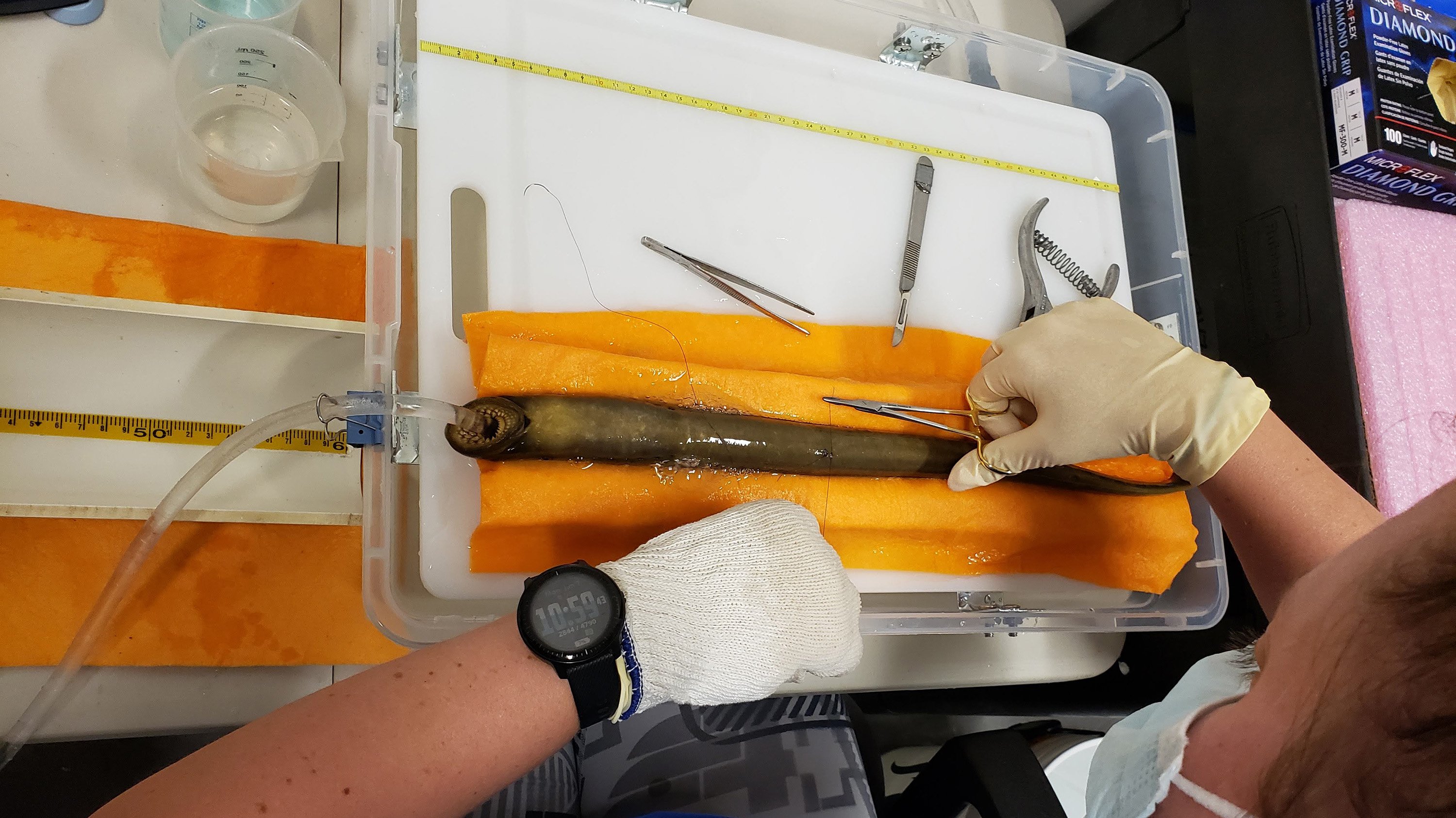
Doctoral student Kandace Griffin is focused on understanding lamprey behaviors to determine how to best guide them toward traps and other fishing devices. In between catch-and-release sessions, she implants 3D acoustic telemetry tracking devices to study sea lampreys’ behaviors. These devices monitor lamprey movement patterns and map their responses when exposed to a chemical lampreys release when attacked by predators.

Drawing of five test tubes in a stand

The chemical serves as an alarm cue to other lampreys. That's where master's student Emily Mensch comes in. She focuses on discovering the chemical makeup of the alarm cue. Once the composition of the chemical is known, the opportunity to manufacture it as a repellent to encourage certain migration patterns among lampreys, becomes a viable option in responding to invasive species.

By manipulating the information landscape the animal uses to decide where to go (and where not to), the ABEL lab hopes to lead lamprey into fewer rivers, creating the capacity for more targeted and efficient chemical treatments currently used to manage this devastating invader.

In her Student view: Performing surgery on sea lampreys, Griffin describes how ABEL’s efforts contribute to meaningful acts of conservation in the Great Lakes and beyond.


Emily Mensch holding up a sea lamprey
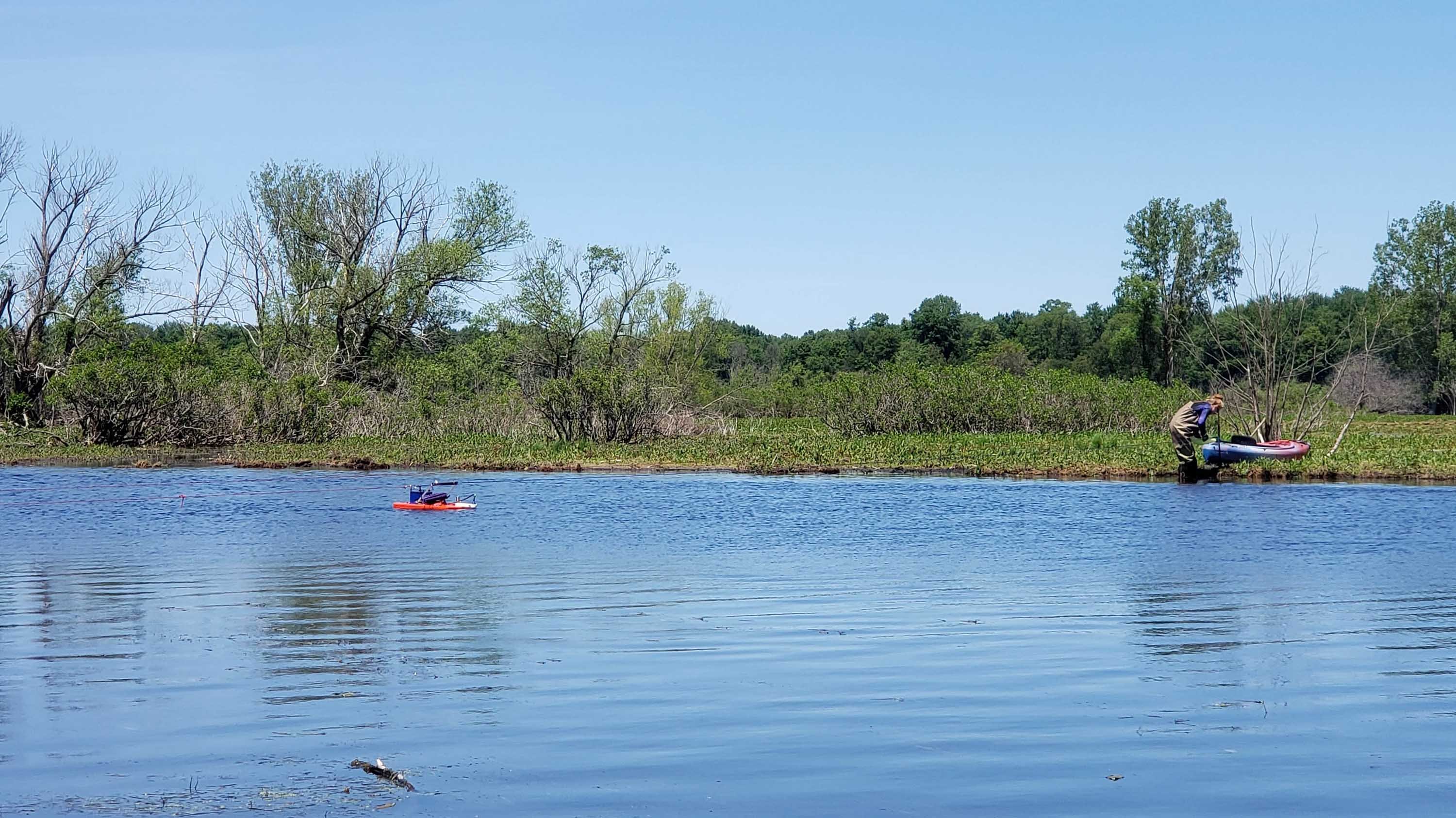
Members of the Wagner lab conducting research via kayak
Wagner lab researcher stopping along the shore conducting research
Performing surgery on a sea lamprey
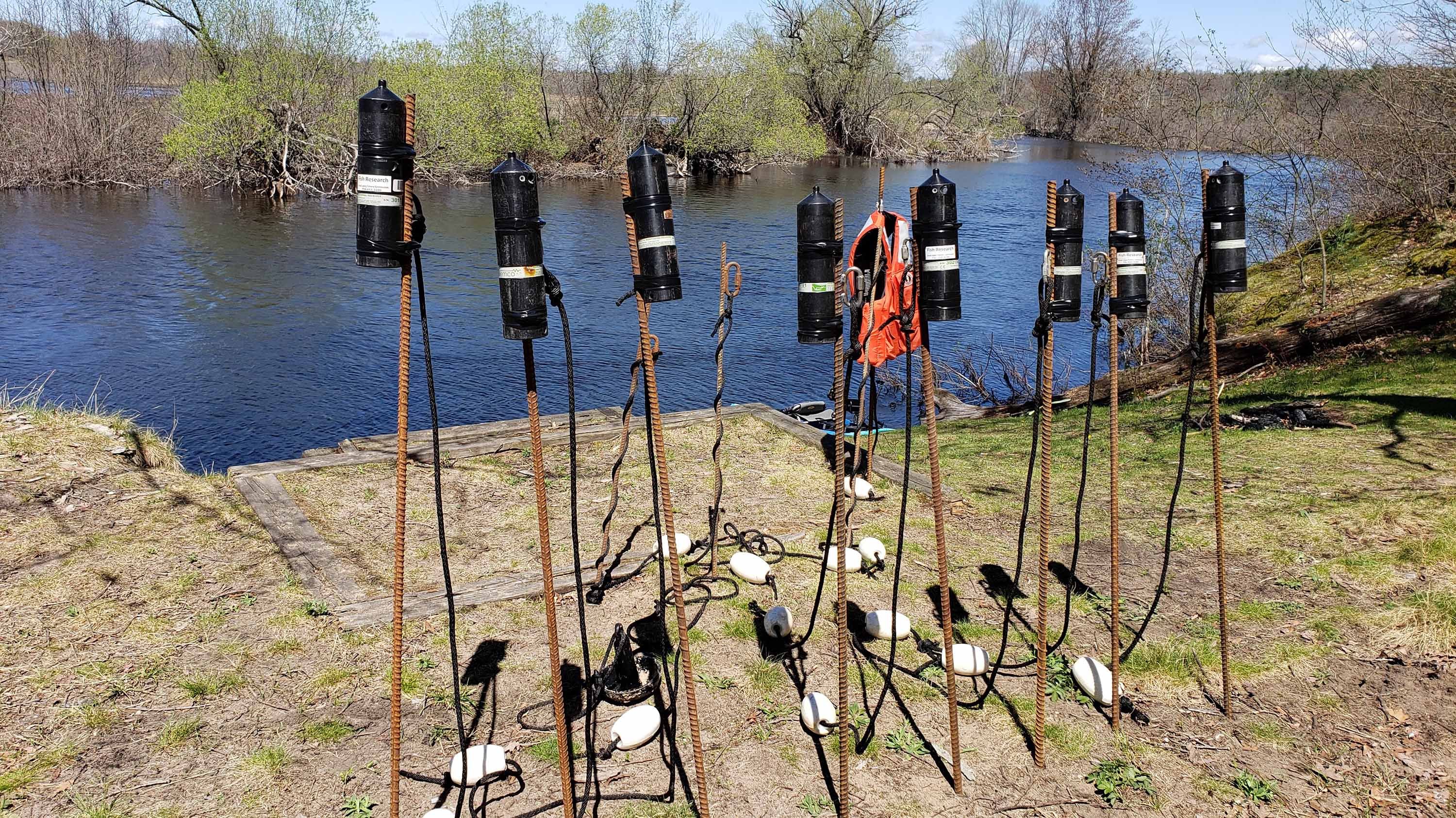
Receivers used as part of the lamprey research
Emily Mensch holding up a sea lamprey
Members of the Wagner lab conducting research via kayak
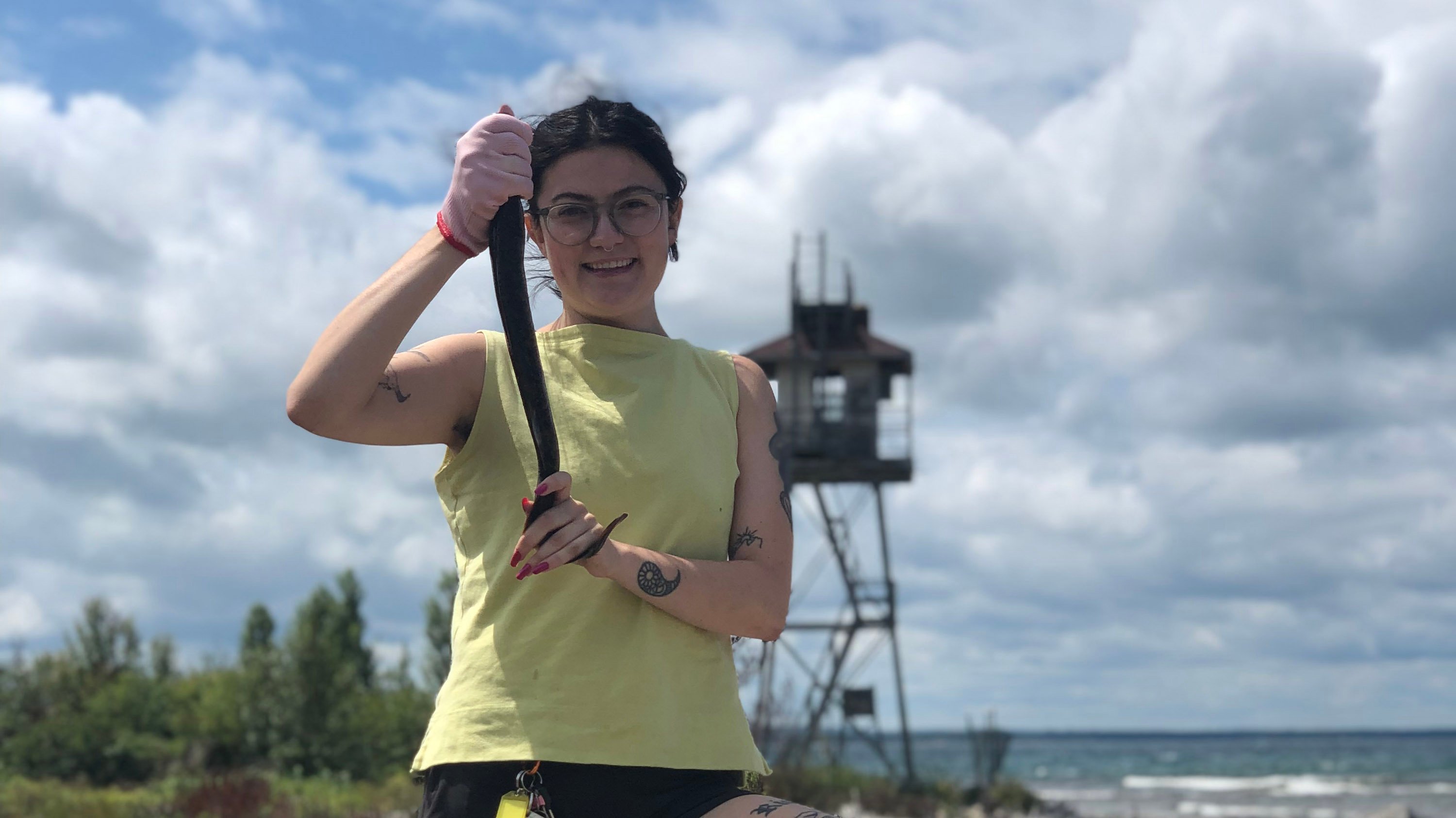
Master's student Emily Mensch holds a sea lamprey near the White River in Whitehall, Michigan. Photo courtesy of Michael Wagner.
Techs on the river. Researchers Michael Wagner, MSU; Ceridwyn Hunter, MSU; Christopher Holbrook, United States Geological Survey; and Nick Plants, United States Fish and Wildlife Service, prepare to deploy acoustic telemetry receivers on the White River to track sea lamprey movement on their spawning migration. Photo courtesy of Kandace Griffin.

Ceridwyn Hunter, MSU undergraduate research technician, ferries an Acoustic Doppler Current Profiler across the White River to measure water velocity across the river transect. Photo courtesy of Kandace Griffin.
Doctoral student Kandace Griffin with an anaesthetized sea lamprey on the surgical table, having an acoustic transmitter implanted into the body cavity. Photo courtesy of Michael Wagner.
Acoustic telemetry receivers are prepared for deployment into the White River. These receivers log detections from transmitters implanted into the fish to monitor movement. Photo courtesy of Kandace Griffin.
Master's student Emily Mensch holds a sea lamprey near the White River in Whitehall, Michigan. Photo courtesy of Michael Wagner.
Techs on the river. Researchers Michael Wagner, MSU; Ceridwyn Hunter, MSU; Christopher Holbrook, United States Geological Survey; and Nick Plants, United States Fish and Wildlife Service, prepare to deploy acoustic telemetry receivers on the White River to track sea lamprey movement on their spawning migration. Photo courtesy of Kandace Griffin.

01 / 05

Mapping Michigan’s coastal erosion

Drawing of cattails

Wetlands are an important barrier to Michigan’s coastline. If they are not protected, flooding and erosion  literally will wash away both plant and animal ecosystems, not to mention people’s livelihoods.

Led by Ethan Theuerkauf, assistant professor in the Department of Geography, Environment and Spatial Sciences in the College of Social Science, the MSU Coastal Processes and Geomorphology Lab studies the impacts of changing water levels and storm events on erosion and sediment transport in Great Lakes wetlands. According to Theuerkauf, “These geomorphic changes are understudied, yet they set the template for whether wetlands can survive changing water levels. ”Theuerkauf and two students in his lab — Megan Castro, graduate student in geography, environment and spatial sciences; and Ryan Poe, undergraduate student double majoring in civil and environmental engineering and geography, environment and spatial sciences — have spent much of the summer mapping lake beds along the coast of Saginaw Bay. What that looks like on any given day varies.

Drawing of a kayak and a paddleWhen they are not flying a drone, the team regularly tests their sea legs, using sonar technology aboard a boat and donning waders to get to those hard-to-reach spaces. Castro got creative by devising a way to collect data with GPS equipment strapped to the bottom of her kayak.

Many variables must align to conduct any of this research. Whether that’s having access to equipment (like a boat) or abandoning the day’s plan because a giant wall of fog moved in, both Castro and Theuerkauf agree coastal work forces them to be very adaptable. “Just when you feel like you’ve figured out the protocol, you learn weather conditions have changed and you develop a new method on the fly,” Theuerkauf says.

In her Student view: Almost perfect, Castro describes those moments when adaptability is key. She says, “Prepare for everything, but know you still might not be prepared.”


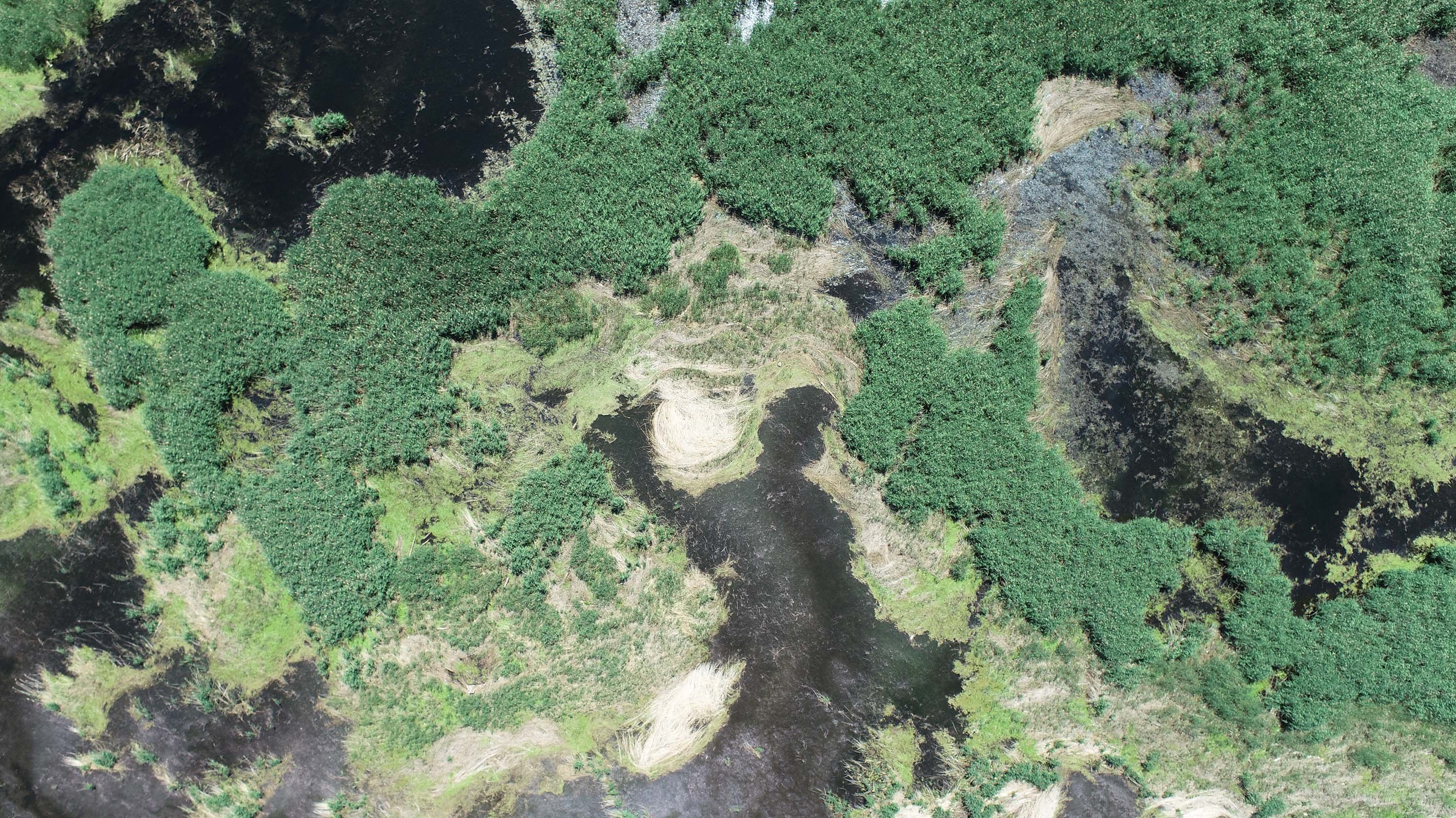
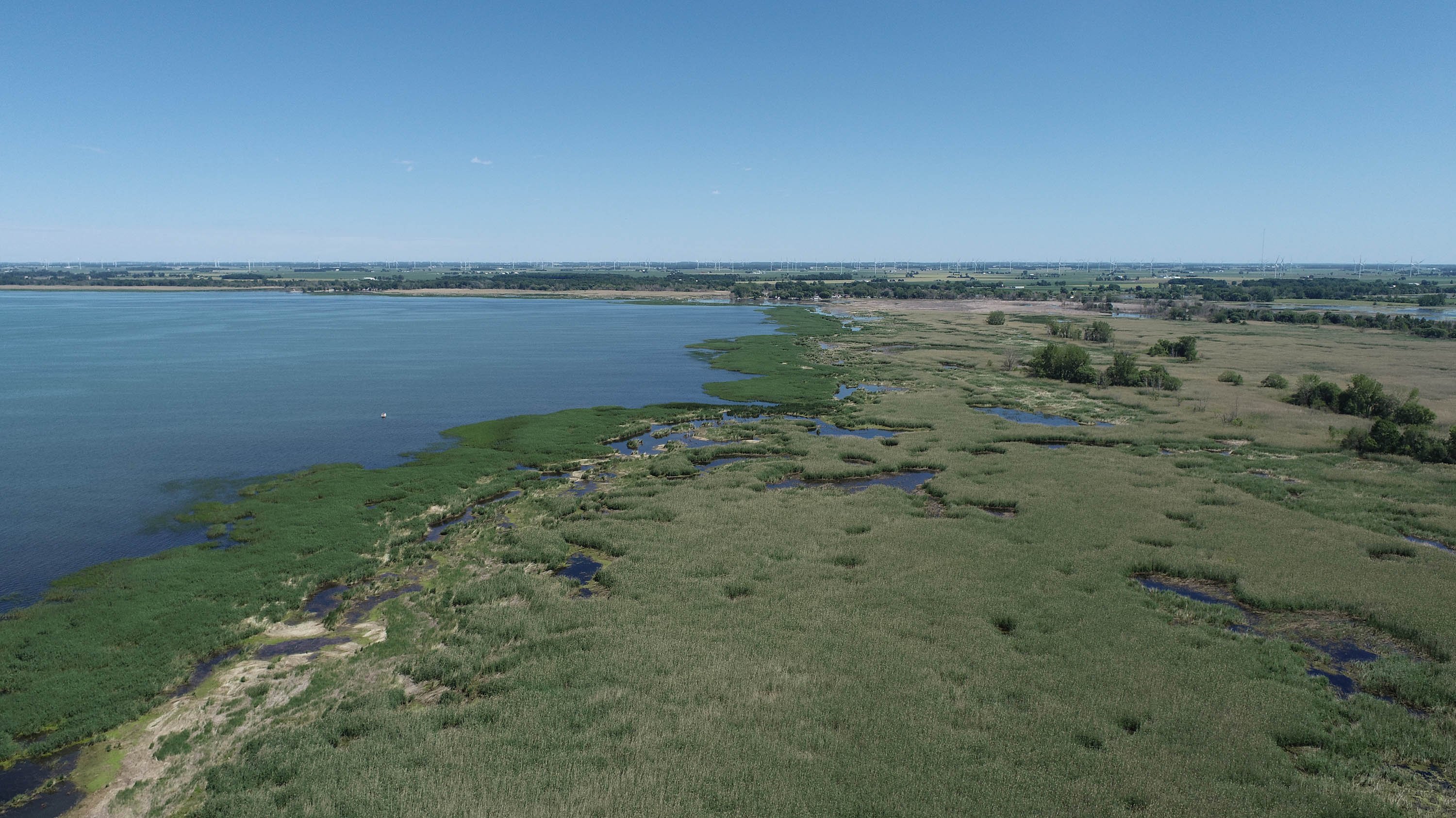
Drone image of the wetland at Quanicasse
The wetland at Quanicassee
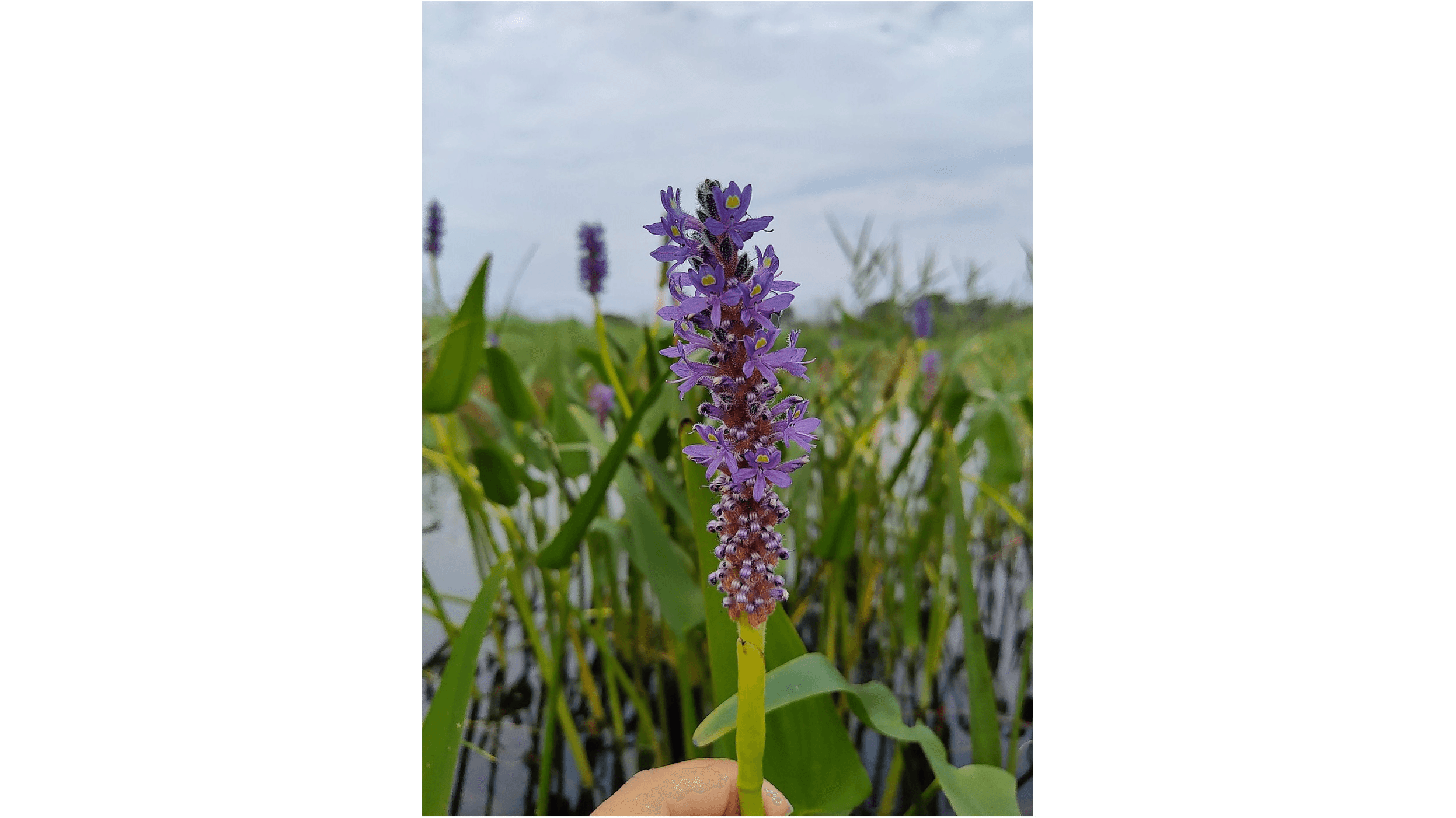
Pontederia cordata
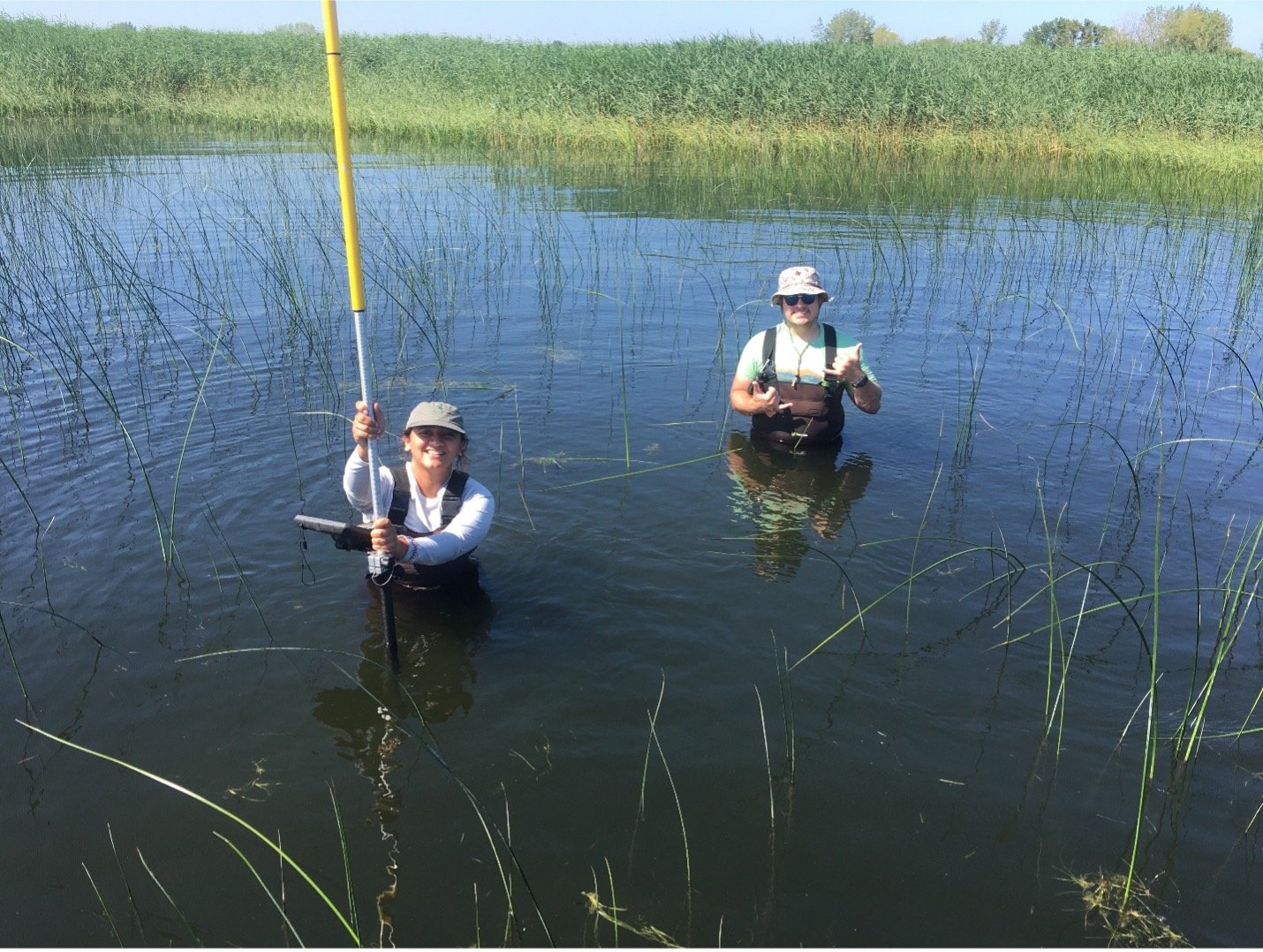
Meg Castro and Ryan Poe in the wetlands
Drone image of the wetland at Quanicasse
The wetland at Quanicassee
Drone image of the wetland at Quanicassee State Wildlife Area, highlighting the diversity of plant types in Great Lakes wetlands. The dark green plants are an invasive reed grass known as phragmites. The wispy light brown material is dead plant material that has been washed up against the marsh during a flood event. Photo courtesy of Ethan Theuerkauf.
Oblique image of the wetland at Quanicassee State Wildlife Area collected from a drone. Here, phragmites fringe the marsh shoreline. Wetlands are essential for protecting mainland areas from flooding during storms and high lake levels. Photo courtesy of Ethan Theuerkauf.
Pontederia cordata (Pickerelweed), native to the area and found in clusters throughout the research site in Wigwam Bay State Wildlife Area. Photo courtesy of Meg Castro.
Graduate student Meg Castro conducts elevation survey, while undergraduate student Ryan Poe assists in vegetation observations in Quanicassee State Wildlife Area.
Drone image of the wetland at Quanicassee State Wildlife Area, highlighting the diversity of plant types in Great Lakes wetlands. The dark green plants are an invasive reed grass known as phragmites. The wispy light brown material is dead plant material that has been washed up against the marsh during a flood event. Photo courtesy of Ethan Theuerkauf.
Oblique image of the wetland at Quanicassee State Wildlife Area collected from a drone. Here, phragmites fringe the marsh shoreline. Wetlands are essential for protecting mainland areas from flooding during storms and high lake levels. Photo courtesy of Ethan Theuerkauf.

01 / 04

MEDIA CONTACTS

Beth Brauer
MSU ResearchMSU Leadership and ImpactStudent and Campus ExperienceEngineering, Science and Technology

Latest News

MSUToday Weekly Update

The MSUToday Weekly Update email showcases how Spartans are making a difference through academic excellence, research impact and community outreach. Get inspired by these stories of innovation, collaboration and determination. Plus, enjoy photos and videos of campus and more MSU content to help keep you connected to the Spartan community.

Sign UpUpdate My Information

Connect With Us

Visit our Facebook pageVisit our page on XVisit our Instagram pageVisit our LinkedIn pageVisit our YouTube pageVisit our TikTok page

Health and Safety

  • MSU Police and Public Safety
  • Olin Health Center
  • Counseling & Psychiatric Services (CAPS)
  • University Health and Wellbeing
  • MSU Health Care
  • Civil Rights and Title IX
  • Our Commitment
  • Center for Survivors
  • Security & Fire Safety Report
  • University Policy on Relationship Violence and Sexual Misconduct
  • Notice of Non-Discrimination, Anti-Harassment and Non-Retaliation
  • Health Care Non-Discrimination Notice

Support Services

  • Disability Resources
  • Supportive Services
  • Learning Resources

Working at MSU

  • Human Resources
  • EBS Login
  • Job Postings
  • Employee Assistance Program

Reports

  • CARES Act Funding
  • Student Achievement and Outcomes

Contact us

517-355-1855

Address

Michigan State University 426 Auditorium Road East Lansing, MI 48824

Follow Us

  • Visit our Facebook page
  • Visit our page on X
  • Visit our Instagram page
  • Visit our TikTok page
  • Visit our LinkedIn page
  • Visit our YouTube page

If you're having accessibility issues, please let us know.

Know More: Campus Safety Information and ResourcesTransparency Reporting: Budget & Salary/Compensation
  • Contact Information|
  • Site Map|
  • Privacy Statement|
  • Site Accessibility|
  • Call MSU: (517) 355-1855|
  • Visit: msu.edu|
  • Notice of Nondiscrimination|

SPARTANS WILL|© Michigan State University|