Jump to HeaderJump to Main ContentJump to Footer
Michigan State University
  • Browse Stories By

    Topics

    Explore stories by subject area

    • Arts and Culture
    • Business and Economy
    • Climate and Environment
    • Education and Learning
    • Engineering, Science and Technology
    • Government and Society
    • Health and Medicine
    • Media and Communications
    • MSU Leadership and Impact
    • Sports and Recreation
    • Student and Campus Experience
    View All Stories

    Collections

    Curated story series

    • Turfgrass
    • Ask the Expert
    • Big Ideas
    • Climate solutions
    • Water at MSU
    • Mobility
    • Spartan Perspectives
    • Student views
    • Graduate voices
    • Faculty voices
    View All Collections

    Featured

    Editor's picks

    • The Spartans behind your favorite Michigan golf courses

      July 22, 2026

      The Spartans behind your favorite Michigan golf courses

    • MSU in the 1990s: 10 Spartan milestones

      July 14, 2026

      MSU in the 1990s: 10 Spartan milestones

MSUTODAY
  • Browse Stories By

< Browse Stories By

Topics

Explore stories by subject area

  • Arts and Culture
  • Business and Economy
  • Climate and Environment
  • Education and Learning
  • Engineering, Science and Technology
  • Government and Society
  • Health and Medicine
  • Media and Communications
  • MSU Leadership and Impact
  • Sports and Recreation
  • Student and Campus Experience
  • View All Stories

Collections

Curated story series

  • Turfgrass
  • Ask the Expert
  • Big Ideas
  • Climate solutions
  • Water at MSU
  • Mobility
  • Spartan Perspectives
  • Student views
  • Graduate voices
  • Faculty voices
  • View All Collections

Featured

Editor's picks

  • The Spartans behind your favorite Michigan golf courses

    July 22, 2026

    The Spartans behind your favorite Michigan golf courses

  • MSU in the 1990s: 10 Spartan milestones

    July 14, 2026

    MSU in the 1990s: 10 Spartan milestones

  • For Media
  • Experts
  • Releases and Statements
  • Sign Up
  • Update Information

Resources

  • A to Z Index
  • Find People
  • Maps
  • Email
  • Student Information System (SIS)
  • D2L
  • Libraries
  • Tech Support
  • MSU Misconduct Hotline
  • Social Media Directory
  • Events Calendar
  • For Media
Michigan State University
MSUToday
  • For Media
  • Experts
  • Releases and Statements
  • Sign Up
  • Update Information
MSUTODAY
MSU Faculty and Staff

Aug. 12, 2021

Faculty voice: Getting answers about the bees

Meghan Milbrath is an assistant professor in the Department of Entomology and is the coordinator of the Michigan Pollinator Initiative, a program started at MSU to address concerns related to pollinators and pollination, and to work on understanding the threats and solutions for bees in Michigan.

For me, the problems affecting our pollinators are personal. As a kid in Northern Wisconsin, I would help my dad in the bee yard, peering over his shoulder as he worked in the hive, bottling honey or taking off on my bike to follow a swarm. When I left to pursue studies in environmental health sciences I kept beehives as a hobby, an escape from the stress of my doctoral research modeling the risks of diseases and chemicals on human health. My beekeeping hobby, however, was not always a relaxing escape.   

Beekeeping had changed considerably since I was a kid. I had learned to keep bees the same way that my dad had learned when he was young — you put the hives out and the bees fend for themselves and make lots of honey that we get to take in the fall. It was very little work and the bees lived from year to year. Now, the bees were making less honey, it was a lot more work and my colonies kept dying.   

I joined many local beekeeping clubs to compare notes with other beekeepers, read all the trade journals and followed the online forums, trying to understand what had changed and what it meant. I worked with beekeepers whose families had kept bees for generations and talked to beekeepers who had been honing their craft for decades. I kept hearing the same thing: Beekeeping just isn’t the same. Suddenly, it is much worse.  
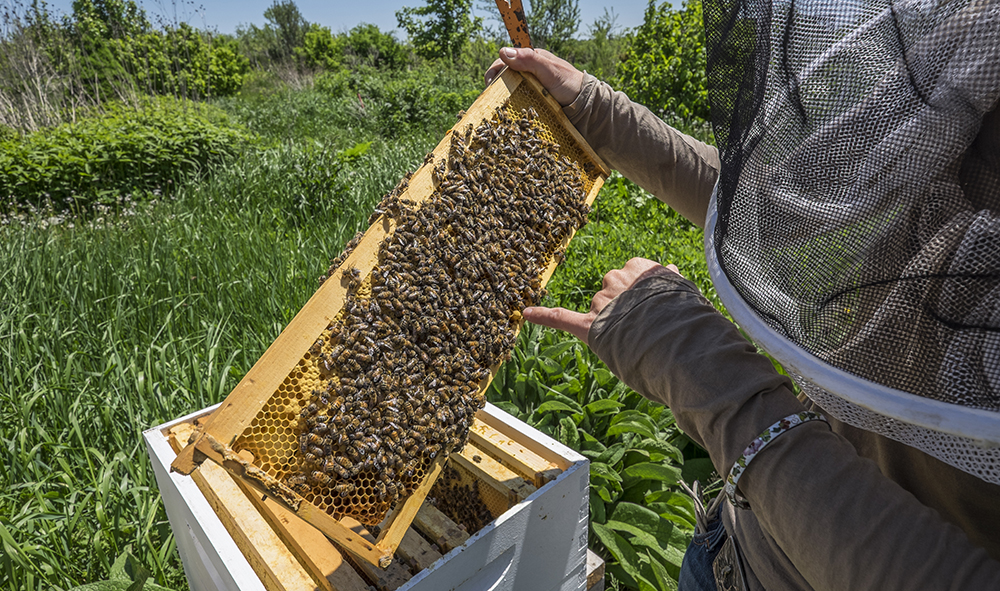

The parallels between what was happening to bees and some of the things affecting humans were obvious. As I studied emerging diseases in humans for my dissertation, I read about the new pests and pathogens affecting honeybees. I modeled the effect of environmental exposure to persistent pollutants on humans and learned about the complex mixtures of pesticides and other chemicals that bees are exposed to in the nectar and pollen of the plants that make up their food. I included sensitive populations in my models to account for the effects of poor diets and learned about the dramatic loss of the forage plants that feed our bees, which reduces their access to food.   

By the time I defended my dissertation I was running a small beekeeping business selling honeybee queens and was fully immersed in the issues facing today’s beekeepers. I decided to apply my skills in risk assessment and disease transmission to honeybees and began work as a postdoctoral research associate in Zachary Huang’s honeybee lab at MSU. There, I studied one of the main emerging diseases affecting honeybees, called nosema ceranae.  

I was thrilled to become an academic specialist and work as the coordinator of a new project at MSU: The Michigan Pollinator Initiative, funded by MSU Extension and MSU AgBioResearch. I coordinate and participate in research that can help understand what is happening with pollinators. I work with extension educators and specialists to provide the latest information to beekeepers on how they can better care for their animals and provide information to growers on how they can minimize the risk of their practices for pollinators. I work with other agencies and groups around the state, linking our work at MSU to larger programs, and ensuring that our work is coordinated and efficient.  

In 2020 I became an assistant professor in the Department of Entomology, as MSU expanded the pollinator research and extension program. My current work focuses on a variety of risks associated with the health of pollinators, including pesticides, nutrition and diseases. 

As the country becomes more focused and interested in the problems facing honeybees and other pollinators, there are a lot of opportunities for MSU to lead the way.

Photos by Kurt Stepnitz.

MEDIA CONTACTS

Beth Brauer
MSU Faculty and StaffMSU Leadership and ImpactBiodiversity and WildlifeClimate and EnvironmentClimate and Environment

Collection

more content from this collection

Faculty Voices

Latest News

MSUToday Weekly Update

The MSUToday Weekly Update email showcases how Spartans are making a difference through academic excellence, research impact and community outreach. Get inspired by these stories of innovation, collaboration and determination. Plus, enjoy photos and videos of campus and more MSU content to help keep you connected to the Spartan community.

Sign UpUpdate My Information

Connect With Us

Visit our Facebook pageVisit our page on XVisit our Instagram pageVisit our LinkedIn pageVisit our YouTube pageVisit our TikTok page

Health and Safety

  • MSU Police and Public Safety
  • Olin Health Center
  • Counseling & Psychiatric Services (CAPS)
  • University Health and Wellbeing
  • MSU Health Care
  • Civil Rights and Title IX
  • Our Commitment
  • Center for Survivors
  • Security & Fire Safety Report
  • University Policy on Relationship Violence and Sexual Misconduct
  • Notice of Non-Discrimination, Anti-Harassment and Non-Retaliation
  • Health Care Non-Discrimination Notice

Support Services

  • Disability Resources
  • Supportive Services
  • Learning Resources

Working at MSU

  • Human Resources
  • EBS Login
  • Job Postings
  • Employee Assistance Program

Reports

  • CARES Act Funding
  • Student Achievement and Outcomes

Contact us

517-355-1855

Address

Michigan State University 426 Auditorium Road East Lansing, MI 48824

Follow Us

  • Visit our Facebook page
  • Visit our page on X
  • Visit our Instagram page
  • Visit our TikTok page
  • Visit our LinkedIn page
  • Visit our YouTube page

If you're having accessibility issues, please let us know.

Know More: Campus Safety Information and ResourcesTransparency Reporting: Budget & Salary/Compensation
  • Contact Information|
  • Site Map|
  • Privacy Statement|
  • Site Accessibility|
  • Call MSU: (517) 355-1855|
  • Visit: msu.edu|
  • Notice of Nondiscrimination|

SPARTANS WILL|© Michigan State University|
