Researchers led by Michigan State University’s Johannes Pollanen have developed a new device to help future quantum bits, or qubits (pronounced “Q bits”), take flight.
Using liquid helium and readily available modern telecommunications technology —based on so-called “surface acoustic wave” devices — the Spartan team has created a new way to precisely manipulate electrons. With this capability, scientists can envision building what are known as trapped-electron quantum computers powered by processors whose quantum bits are free to move — or fly — around.
The team showcased its new tech on July 6 in the journal Nature Communications.
“We’re developing tools to grab single quantum particles and control them. It’s very exciting work,” said Pollanen, a Jerry Cowen Endowed Chair of Experimental Physics in the College of Natural Science. “This work really opens up new possibilities for moving these electron qubits around, and there are lots of fun experiments one can imagine now that we demonstrated these proof-of-concept devices.”
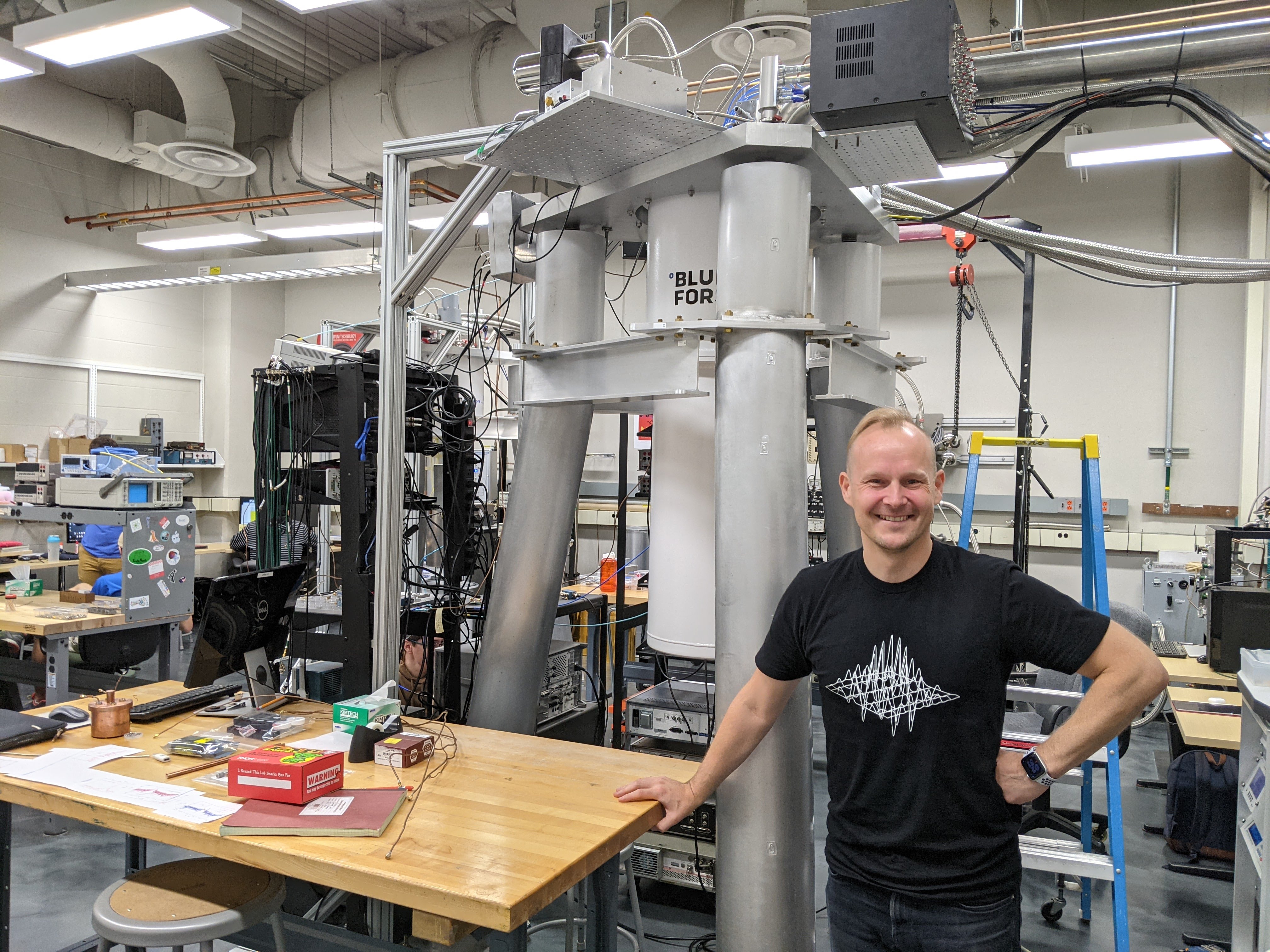
Pollanen is also an assistant professor in the Department of Physics and Astronomy and the associate director for MSU-Q, the Center for Quantum Computing Science and Engineering.
Thanks to the arcane workings of quantum mechanics, quantum computing stands poised to solve problems that are very messy or impossible to solve with conventional computers. Because of that, there’s no shortage on interest in quantum computing technologies from the areas of science, finance, cybersecurity and others.
Still, quantum computing faces major hurdles before it can make meaningful contributions to these applications. One of these hurdles is that current quantum computing technologies are noisier or more error-prone than their classical counterparts.
Classical or conventional computers, like your smart phone or laptop, have a staggering number of bits at their disposal to store and process information. In the binary language of bits, this information is represented as 1s and 0s and any given bit can be only a 1 or a 0, not both.
Still, errors happen. Sometimes bits get flipped: what should be a 1 is instead a 0, or vice versa. Because a bit can be only one or the other, though, it’s relatively easy to correct this error in conventional computers, Pollanen said.
Quantum bits aren’t so straightforward. A qubit isn’t either/or, but rather some combination of a 0 and a 1. The states that are mutually exclusive in classical computing can coexist in a qubit.
This is one reason why quantum computers can handle much more complex information than conventional computers using far fewer bits. With a fairly modest number of qubits, quantum computers would be able to do things that classical computers simply can’t.
“One of the things I love about quantum computers is that, if we could build a 100-qubit machine, we couldn’t directly verify what it does with a classical computer,” Pollanen said. “There’s just no way.”
On the other hand, moving from the clarity of a 0-or-1 system to the murkiness of quantum introduces far more complexity when it comes to noise, random changes or fluctuations in the system that can lead to errors. Flying qubits might offer a way to simplify that.
“If you can move the qubits around, you can essentially cancel out some of the errors,” Pollanen said.
His team has now introduced a device that could one day help build flying qubits. The Spartans start with what’s known as a piezoelectric crystal. This may sound exotic, but these materials are widely used in today’s telecom devices.
Coating the piezoelectric is a thin layer of liquid helium, a very cold liquid that is just a little warmer than absolute zero. The researchers can then float electrons — particles that naturally store quantum information — above that pool.
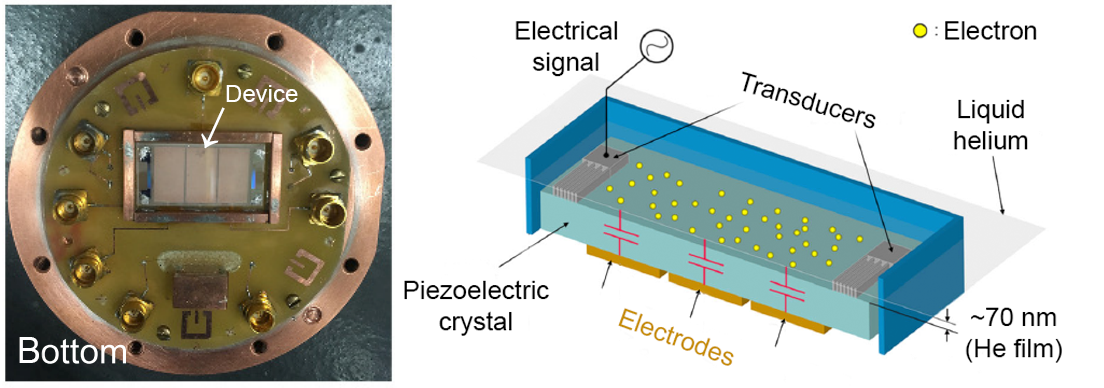
A photograph on the left shows the new quantum device (a light copper-colored rectangle in the center of a metal holder). On the right, an illustration shows a close-up of the device. Electrodes underneath the device help researchers trap electrons, which float above a thin layer of liquid helium. Transducers on top of the device create waves or vibrations that let researchers precisely manipulate electrons. Credit: Nature Communications/Laboratory for Hybrid Quantum Systems
“We drop the electrons in and they get stuck there, literally floating like 10 nanometers above the surface,” Pollanen said. “And this liquid helium surface is pristine. You don’t have to worry about defects like you would with semiconductors used in some quantum computing devices.”
By sending an electrical signal to the piezoelectric, the researchers set it vibrating in a very precise way, creating finely tuned waves to control the hovering electron.
“With this work, we showed that we can grab ahold and manipulate these quantum particles with modern telecom devices,” Pollanen said. “The next question is: Can we create flying qubits with this type of device? I think the answer is ultimately yes but there’s lots of cool experiments to do to get there.”
For years, experts at MSU and elsewhere have hypothesized that approaches like this would work for building floating qubits. Now, with increasingly refined and accessible technologies, scientists are starting to put these approaches into action.
Because of this increased accessibility, more scientists from more backgrounds can contribute to quantum computing research, a fact on display at MSU-Q. The center boasts nearly 30 faculty from a breadth of disciplines — physics, chemistry, computer science and more — working to bring the promise of quantum computing to the real world.
“A big part of that is limiting error rates and noise. We have experimentalists and theorists working to attack that problem,” Pollanen said. “Flying qubits are one way that we can do that.”

