Jump to HeaderJump to Main ContentJump to Footer
Michigan State University
MSUToday
  • For Media
  • Experts
  • Releases and Statements
  • Sign Up
  • Update Information
MSUTODAY
  • Browse Stories By

    Topics

    Explore stories by subject area

    • Arts and Culture
    • Business and Economy
    • Climate and Environment
    • Education and Learning
    • Engineering, Science and Technology
    • Government and Society
    • Health and Medicine
    • Media and Communications
    • MSU Leadership and Impact
    • Sports and Recreation
    • Student and Campus Experience
    View All Stories

    Collections

    Curated story series

    • Alumni stories
    • Turfgrass
    • Ask the Expert
    • Big Ideas
    • Climate solutions
    • Water at MSU
    • Mobility
    • Spartan Perspectives
    • Student views
    • Graduate voices
    • Faculty voices
    View All Collections

    Featured

    Editor's picks

    • 9 reasons to love being a Spartan

      Aug. 28, 2026

      9 reasons to love being a Spartan

    • NIH awards multi-university team over $4M to improve women’s health

      Sept. 15, 2026

      NIH awards multi-university team over $4M to improve women’s health

MSUTODAY
  • Browse Stories By

< Browse Stories By

Topics

Explore stories by subject area

  • Arts and Culture
  • Business and Economy
  • Climate and Environment
  • Education and Learning
  • Engineering, Science and Technology
  • Government and Society
  • Health and Medicine
  • Media and Communications
  • MSU Leadership and Impact
  • Sports and Recreation
  • Student and Campus Experience
  • View All Stories

Collections

Curated story series

  • Alumni stories
  • Turfgrass
  • Ask the Expert
  • Big Ideas
  • Climate solutions
  • Water at MSU
  • Mobility
  • Spartan Perspectives
  • Student views
  • Graduate voices
  • Faculty voices
  • View All Collections

Featured

Editor's picks

  • 9 reasons to love being a Spartan

    Aug. 28, 2026

    9 reasons to love being a Spartan

  • NIH awards multi-university team over $4M to improve women’s health

    Sept. 15, 2026

    NIH awards multi-university team over $4M to improve women’s health

  • For Media
  • Experts
  • Releases and Statements
  • Sign Up
  • Update Information

Resources

  • A to Z Index
  • Find People
  • Maps
  • Email
  • Student Information System (SIS)
  • D2L
  • Libraries
  • Tech Support
  • MSU Misconduct Hotline
  • Social Media Directory
  • Events Calendar
  • For Media
Climate and Environment

July 29, 2021

SHARE

Identifying mothers at risk of preterm births

By: Emilie Lorditch

One in ten babies is born prematurely in the United States, but a blood test during a routine prenatal visit could reveal if a woman is at risk of a preterm delivery, according to a Michigan State University researcher.

“Preterm births are common,” said Hanne Hoffmann, an assistant professor in the Department of Animal Science within the College of Agriculture and Natural Resources and a Global Impact Initiative researcher. “If we know the mother is at risk for a preterm birth, her doctor can monitor her more closely.”

Hoffmann’s research was published online June 18 in the Journal Biology of Reproduction. 

 
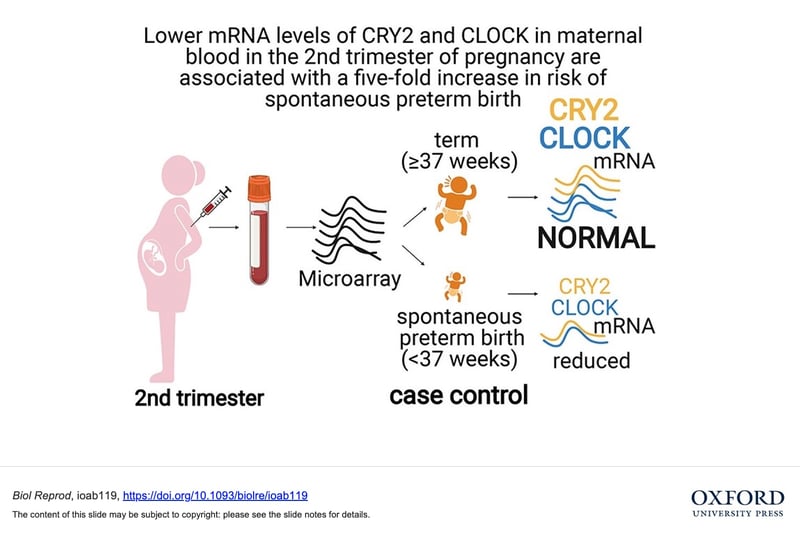
Hoffmann and her colleagues studied 157 healthy mothers with no history of preterm births, among them 51 who subsequently gave birth preterm. Researchers looked at second trimester data for evidence of biomarkers that could signal preterm delivery.

“How often do you find the needle in the haystack?” Hoffmann said. “We were excited to discover lower mRNA levels in the CRY2 and CLOCK genes.”

The CRY2 and CLOCK genes belong to a family of genes responsible for cell circadian rhythms. Hoffmann said that each human cell has its own 24-hour clock that keeps track of time inside the cell. Low levels of mRNA, or messenger DNA, in those two genes is associated with a higher risk of preterm birth, suggesting these genes provide information as to when labor should start.


Decreased levels of mRNA in the mother's blood become present during the second trimester of pregnancy when most women have an important 20-week prenatal appointment to screen for Down syndrome. This presents the ideal time to also test for the risk of preterm delivery.

The next step is to determine if the CRY2 and CLOCK genes are coming from the mother, placenta or fetus. The researchers also want to see how the mRNA levels in healthy women compare with levels in women with underlying conditions or a history of preterm births to determine if this blood test could be helpful for these at-risk mothers, too.


“If we could measure women’s mRNA levels and tell them for their second or third pregnancies, that they aren’t at risk for a preterm birth because their levels are higher (in a normal/healthy range), that would be such a comfort to the mothers who previously had a preterm birth,” Hoffmann said.

The researchers are also interested in looking at other genes such as another circadian clock gene, called PER3, that in combination with CRY2 and CLOCK levels could indicate other pregnancy complications such a preeclampsia and gestational diabetes. 


“If I can help one baby make it to full term who wasn’t supposed to, that would make my day,” said Hoffmann.

Preterm birth graphic


Climate and EnvironmentHealth ProfessionsHealth and Medicine

Latest News

MSUToday Weekly Update

The MSUToday Weekly Update email showcases how Spartans are making a difference through academic excellence, research impact and community outreach. Get inspired by these stories of innovation, collaboration and determination. Plus, enjoy photos and videos of campus and more MSU content to help keep you connected to the Spartan community.

Sign UpUpdate My Information

Connect With Us

Visit our Facebook pageVisit our page on XVisit our Instagram pageVisit our LinkedIn pageVisit our YouTube pageVisit our TikTok page

Health and Safety

  • MSU Police and Public Safety
  • Olin Health Center
  • Counseling & Psychiatric Services (CAPS)
  • University Health and Wellbeing
  • MSU Health Care
  • Civil Rights and Title IX
  • Our Commitment
  • Center for Survivors
  • Security & Fire Safety Report
  • University Policy on Relationship Violence and Sexual Misconduct
  • Notice of Non-Discrimination, Anti-Harassment and Non-Retaliation
  • Health Care Non-Discrimination Notice

Support Services

  • Disability Resources
  • Supportive Services
  • Learning Resources

Working at MSU

  • Human Resources
  • EBS Login
  • Job Postings
  • Employee Assistance Program

Reports

  • CARES Act Funding
  • Student Achievement and Outcomes

Contact us

517-355-1855

Address

Michigan State University 426 Auditorium Road East Lansing, MI 48824

Follow Us

  • Visit our Facebook page
  • Visit our page on X
  • Visit our Instagram page
  • Visit our TikTok page
  • Visit our LinkedIn page
  • Visit our YouTube page

If you're having accessibility issues, please let us know.

Know More: Campus Safety Information and ResourcesTransparency Reporting: Budget & Salary/Compensation
  • Contact Information|
  • Site Map|
  • Privacy Statement|
  • Site Accessibility|
  • Call MSU: (517) 355-1855|
  • Visit: msu.edu|
  • Notice of Nondiscrimination|

SPARTANS WILL|© Michigan State University|
