Jump to HeaderJump to Main ContentJump to Footer
Michigan State University
MSUTODAY
  • Browse Stories By

    Topics

    Explore stories by subject area

    • Arts and Culture
    • Business and Economy
    • Climate and Environment
    • Education and Learning
    • Engineering, Science and Technology
    • Government and Society
    • Health and Medicine
    • Media and Communications
    • MSU Leadership and Impact
    • Sports and Recreation
    • Student and Campus Experience
    View All Stories

    Collections

    Curated story series

    • Turfgrass
    • Ask the Expert
    • Big Ideas
    • Climate solutions
    • Water at MSU
    • Mobility
    • Spartan Perspectives
    • Student views
    • Graduate voices
    • Faculty voices
    View All Collections

    Featured

    Editor's picks

    • 9 reasons to love being a Spartan

      Aug. 28, 2026

      9 reasons to love being a Spartan

    • NIH awards multi-university team over $4M to improve women’s health

      Sept. 15, 2026

      NIH awards multi-university team over $4M to improve women’s health

MSUTODAY
  • Browse Stories By

< Browse Stories By

Topics

Explore stories by subject area

  • Arts and Culture
  • Business and Economy
  • Climate and Environment
  • Education and Learning
  • Engineering, Science and Technology
  • Government and Society
  • Health and Medicine
  • Media and Communications
  • MSU Leadership and Impact
  • Sports and Recreation
  • Student and Campus Experience
  • View All Stories

Collections

Curated story series

  • Turfgrass
  • Ask the Expert
  • Big Ideas
  • Climate solutions
  • Water at MSU
  • Mobility
  • Spartan Perspectives
  • Student views
  • Graduate voices
  • Faculty voices
  • View All Collections

Featured

Editor's picks

  • 9 reasons to love being a Spartan

    Aug. 28, 2026

    9 reasons to love being a Spartan

  • NIH awards multi-university team over $4M to improve women’s health

    Sept. 15, 2026

    NIH awards multi-university team over $4M to improve women’s health

  • For Media
  • Experts
  • Releases and Statements
  • Sign Up
  • Update Information

Resources

  • A to Z Index
  • Find People
  • Maps
  • Email
  • Student Information System (SIS)
  • D2L
  • Libraries
  • Tech Support
  • MSU Misconduct Hotline
  • Social Media Directory
  • Events Calendar
  • For Media
Michigan State University
MSUToday
  • For Media
  • Experts
  • Releases and Statements
  • Sign Up
  • Update Information
Media and Communications

June 15, 2021

Putting speech development on wheels

Researchers and technical experts from Michigan State University collaborate to bring speech development research and assistance to children in local communities

By: Ann Kammerer

Bridget Walsh, an assistant professor of communicative sciences and disorders in the MSU College of Communication Arts and Sciences, has a new mission: put a speech development lab on wheels to reach children and families away from her brick-and-mortar lab on the East Lansing campus. Walsh received a $3.1 million grant from the National Institutes of Health to study the risk factors in children that lead to chronic stuttering in adulthood. 

Taking her expertise from lab to local communities required Walsh to step outside of her academic department to collaborate with MSU’s Transportation Services, housed within Infrastructure Planning and Facilities.

Walsh’s goal is to reach young children when they first show signs of stuttering.
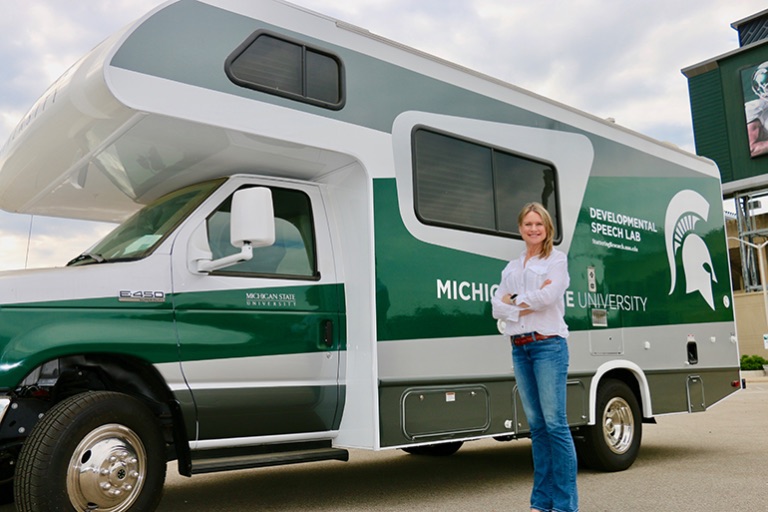
Bridget Walsh, assistant professor of Communicative Sciences and Disorders in the MSU College of Communication Arts and Sciences, in front of the Mobile Developmental Speech Lab.
Bridget Walsh, assistant professor of communicative sciences and disorders in the MSU College of Communication Arts and Sciences, and the Mobile Developmental Speech Lab. Photo courtesy of the College of Communication Arts and Sciences.

“To better understand the genesis of stuttering, we focus on the time when it emerges — in the preschool years — most often between ages 2 to 5 years,” said Walsh. “Typically, kids begin to stutter around age 3, a time when they start putting multiple words together to make longer utterances. That’s when parents start to notice that their child may be stuttering.”

Stuttering is fairly common in young children: Approximately 5% to 8% of preschoolers go through a period of stuttering. The good news is that most, nearly 80%, of these children will recover from stuttering. On the other hand, children who continue are at risk for developing chronic stuttering that may lead to the development of adverse impact.

“These individuals often go to great lengths to avoid moments of stuttering and conceal their disfluencies, sometimes at the expense of saying precisely what they mean or asking for exactly what they want,” said Walsh.

Walsh referred to the example of President Joe Biden, who sometimes changes direction when he gives a public speech. “It’s incredibly inspiring that we have a president who is a person who stutters,” she said. “I wish, though, that he would be a bit more open about his stuttering.”

In March 2020, soon after the pandemic hit the U.S., Walsh realized the public health concerns and limitations of face-to-face research. That realization caused her to reflect even more on something she had long recognized: the barriers children from diverse populations face when seeking treatment.

Traditionally, Walsh’s research relied on the ability of families with young children to come to MSU multiple times for research studies taking place in the Developmental Speech Lab. For many participants, that simply wasn’t possible because of distance, time commitments, work and financial issues, or reliable transportation.

“By taking the burden off families and bringing the research to them, we can cast a wider net and include participants in our research who reflect the population at large,” Walsh said. “Our goals are to better understand the neurological basis of stuttering, to assess risk factors for persistence and to address the adverse impact on children when stuttering persists.” 

Once the mobile lab was approved, the search for the perfect used RV began, as well as her collaboration with MSU’s Transportation Services.

Brian Watts, assistant director of Transportation Services, agreed that the “out-of-the-box” project showcased the talents, creativity and immense collective knowledge of IPF personnel. From engineering to design, the team customized the vehicle to exact specifications, constructing an ideal interior to house sensitive diagnostic equipment, support a consistent power supply and provide a welcoming atmosphere for children and families. The team also was called to help with branding the exterior and to create an inviting, recognizable presence for the vehicle’s future on the road.

Walsh plans to drive the mobile lab to communities within a two-hour radius of campus, or even further, once health concerns related to face-to-face meetings diminish. To date, she’s reached out to more than 1,200 health, speech and language professionals to recruit children who stutter.

The purchase and conversion of the RV was supported by the MSU Office of Research and Innovation, the College of Communication Arts and Sciences, the Department of Communicative Sciences and Disorders and start-up funds provided by Walsh.

Families interested in participating in Walsh’s research can email her at dsl@msu.edu or complete a questionnaire.

MEDIA CONTACTS

Zach Richardson
Media and CommunicationsMedia and CommunicationsMedia and Communications

Latest News

MSUToday Weekly Update

The MSUToday Weekly Update email showcases how Spartans are making a difference through academic excellence, research impact and community outreach. Get inspired by these stories of innovation, collaboration and determination. Plus, enjoy photos and videos of campus and more MSU content to help keep you connected to the Spartan community.

Sign UpUpdate My Information

Connect With Us

Visit our Facebook pageVisit our page on XVisit our Instagram pageVisit our LinkedIn pageVisit our YouTube pageVisit our TikTok page

Health and Safety

  • MSU Police and Public Safety
  • Olin Health Center
  • Counseling & Psychiatric Services (CAPS)
  • University Health and Wellbeing
  • MSU Health Care
  • Civil Rights and Title IX
  • Our Commitment
  • Center for Survivors
  • Security & Fire Safety Report
  • University Policy on Relationship Violence and Sexual Misconduct
  • Notice of Non-Discrimination, Anti-Harassment and Non-Retaliation
  • Health Care Non-Discrimination Notice

Support Services

  • Disability Resources
  • Supportive Services
  • Learning Resources

Working at MSU

  • Human Resources
  • EBS Login
  • Job Postings
  • Employee Assistance Program

Reports

  • CARES Act Funding
  • Student Achievement and Outcomes

Contact us

517-355-1855

Address

Michigan State University 426 Auditorium Road East Lansing, MI 48824

Follow Us

  • Visit our Facebook page
  • Visit our page on X
  • Visit our Instagram page
  • Visit our TikTok page
  • Visit our LinkedIn page
  • Visit our YouTube page

If you're having accessibility issues, please let us know.

Know More: Campus Safety Information and ResourcesTransparency Reporting: Budget & Salary/Compensation
  • Contact Information|
  • Site Map|
  • Privacy Statement|
  • Site Accessibility|
  • Call MSU: (517) 355-1855|
  • Visit: msu.edu|
  • Notice of Nondiscrimination|

SPARTANS WILL|© Michigan State University|
