Jump to HeaderJump to Main ContentJump to Footer
Michigan State University
  • Browse Stories By

    Topics

    Explore stories by subject area

    • Arts and Culture
    • Business and Economy
    • Climate and Environment
    • Education and Learning
    • Engineering, Science and Technology
    • Government and Society
    • Health and Medicine
    • Media and Communications
    • MSU Leadership and Impact
    • Sports and Recreation
    • Student and Campus Experience
    View All Stories

    Collections

    Curated story series

    • Turfgrass
    • Ask the Expert
    • Big Ideas
    • Climate solutions
    • Water at MSU
    • Mobility
    • Spartan Perspectives
    • Student views
    • Graduate voices
    • Faculty voices
    View All Collections

    Featured

    Editor's picks

    • The Spartans behind your favorite Michigan golf courses

      July 22, 2026

      The Spartans behind your favorite Michigan golf courses

    • MSU in the 1990s: 10 Spartan milestones

      July 14, 2026

      MSU in the 1990s: 10 Spartan milestones

MSUTODAY
  • Browse Stories By

< Browse Stories By

Topics

Explore stories by subject area

  • Arts and Culture
  • Business and Economy
  • Climate and Environment
  • Education and Learning
  • Engineering, Science and Technology
  • Government and Society
  • Health and Medicine
  • Media and Communications
  • MSU Leadership and Impact
  • Sports and Recreation
  • Student and Campus Experience
  • View All Stories

Collections

Curated story series

  • Turfgrass
  • Ask the Expert
  • Big Ideas
  • Climate solutions
  • Water at MSU
  • Mobility
  • Spartan Perspectives
  • Student views
  • Graduate voices
  • Faculty voices
  • View All Collections

Featured

Editor's picks

  • The Spartans behind your favorite Michigan golf courses

    July 22, 2026

    The Spartans behind your favorite Michigan golf courses

  • MSU in the 1990s: 10 Spartan milestones

    July 14, 2026

    MSU in the 1990s: 10 Spartan milestones

  • For Media
  • Experts
  • Releases and Statements
  • Sign Up
  • Update Information

Resources

  • A to Z Index
  • Find People
  • Maps
  • Email
  • Student Information System (SIS)
  • D2L
  • Libraries
  • Tech Support
  • MSU Misconduct Hotline
  • Social Media Directory
  • Events Calendar
  • For Media
Michigan State University
MSUToday
  • For Media
  • Experts
  • Releases and Statements
  • Sign Up
  • Update Information
MSUTODAY
Natural Sciences

March 17, 2021

MSU scientists one million ‘hops’ closer to ending a disease endemic in cattle

By: Sarah Zwickle

Many people have never heard of Brucellosis, but farmers and ranchers in the United States forced to cull animals that test positive for the disease and people infected by the animal-transmitted Brucella abortus (B. abortus) pathogen that suffer chronic, Malaria-type symptoms, certainly have.

Brucellosis is an agricultural and human health concern on a global scale. It was introduced over 100 years ago to Bison and elk in Yellowstone National Park by cattle and has been circulating among the wild herds ever since, leading to periodic outbreaks and reinfection. There is no vaccine for humans, and experimental studies of B. abortus in its natural animal hosts are technically difficult, extremely expensive and only a few facilities are capable of conducting these studies.
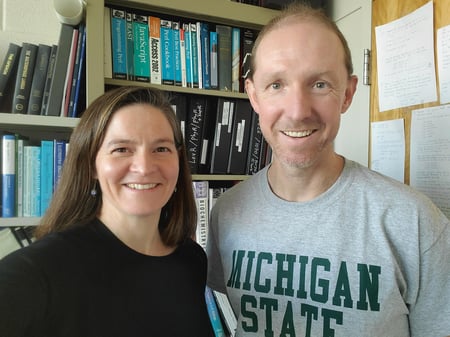
Aretha Fiebig and Sean Crosson
MSU’s Aretha Fiebig, associate professor, and Sean Crosson, professor, used barcoded bacteria to study the pathogenesis of Brucella abortus in the field. Credit: Sean Crosson and Aretha Fiebig

That did not stop Sean Crosson, MSU Rudolph Hugh Endowed Professor, and colleague Aretha Fiebig, research associate professor in Michigan State University’s Department of Microbiology and Molecular Genetics, from bringing sophisticated genomics tools from the lab to the field to gain new insight into how B. abortus infects cattle and help stop the spread of this deadly disease.

The results of their study were published in the Proceedings of the National Academy of Sciences.

“B. abortus primarily infects cattle, causing pregnant cows to abort the fetus, but the infection is typically studied in mouse models, which are not the true host of the bacterium,” explained Crosson, who has been studying the bacteria for more than 14 years. “If you want to understand the infection biology underlying bovine disease, then it’s helpful to study things in the natural host in a field context.”

In the microbiological equivalent to tagging cattle, Crosson and Fiebig harnessed the hopping ability of specialized DNA called transposons to tag individual strains of B. abortus with unique barcodes. This gave them the ability to count how many B. abortus bacteria made it from the cow’s eye, a common point of infection in the field, to the lymph nodes.

“As molecular biologists, we can harness hopping DNA by separating away the enzyme that allows it to continue moving,” said Fiebig, who specializes in bacterial regulatory mechanisms. “We temporarily gave DNA the ability to hop into the B. abortus genome, but it didn’t hop out again.”
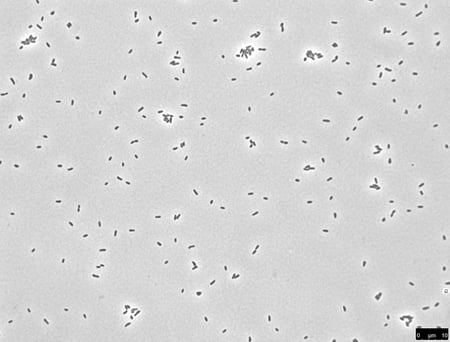
Image of Brucella abortus cells captured by light microscopy
Image of Brucella abortus cells captured by light microscopy (magnified 630x). Each of these cells contain a short, unique DNA sequence, or “barcode”, that enables the identification of individual strains in a mixed population. Credit: Sean Crosson and Aretha Fiebig

The scientists mixed millions of E. coli bacteria carrying transposons with millions of B. abortus in a broth containing amino acids and sugars, initiating mass tagging through a process called bacterial conjugation where transposons hop into and unite with the B. abortus genome. When the remaining E. coli cells were washed away, they were left with a vat of individually barcoded B. abortus strains.

“We were able to make a rich pool of about a million different barcoded strains,” Fiebig said. “When we infected the cattle, we could track almost every single strain and ask, ‘how many strains got lost, what strains had an advantage and was that advantage for a genetic reason or just chance?’”
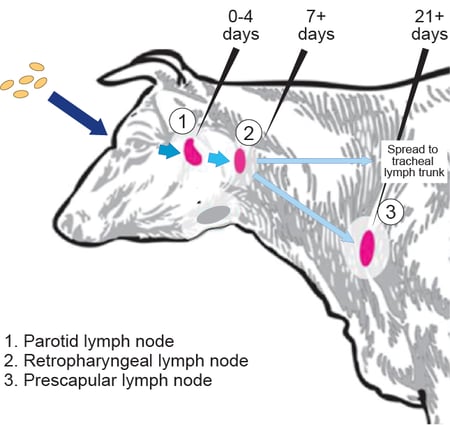
Diagram of how a disease infects cows through their eyes. Text reads:
Brucella (yellow ovals) can infect a cow through the cow’s eye and travel from there to the lymph nodes, where they replicate. Credit: Aretha Fiebig

Millions of bacteria went in, but surprisingly few came out.  And while the genetic identity of strains that made it through was random, the number of strains that managed to infect individual lymph nodes was remarkably similar.

“We knew there was some restriction, or infection bottleneck, but we didn’t understand the magnitude until this study,” said Fiebig.

The unexpected results required nontraditional computational analysis, so Marianne Huebner, director of MSU’s Center for Statistical Training and Consulting, provided expert guidance on the use of mathematical models to assess the population structures of the bacteria that survived the bottleneck.

Infecting a large animal host with a federally regulated pathogen also presented significant methodological challenges. The researchers relied on the highly skilled veterinarians and high-tech facilities at the United States Department of Agriculture-Agricultural Research Service's (USDA-ARS) National Animal Disease Center in Ames, Iowa where the cows in the study were housed and treated.

The challenging field study paid off, providing critical insight into just how good the cow’s mucosal barrier is at restricting B. abortus during infection.

“In the end, we gained a quantitative understanding of an infection bottleneck via a common route of bovine infection in the field,” Crosson said. “This information is useful for scientists studying the epidemiology of Brucellosis in livestock and wildlife and can help us build better transmission models as we work to stop the spread of this disease.”

The proof of principle paper also opened new doors to discovering specific B. abortus genes involved in the devastating disease.

“Going forward, we better understand how to use our library of barcoded mutants over longer timepoints in a pregnant host to find B. abortus genes that influence the most severe outcomes in cattle, including abortion,” Crosson said. “This is a goal of the USDA-ARS as well, to know what genes in B. abortus are critical to infection in the bovine host.”

The researchers emphasized that MSU’s College of Veterinary Medicine, the College of Natural Science and AgBioResearch in the College of Agriculture and Natural Resources were instrumental in supporting the study.

Banner image: A 2-year-old beef cow attends to her newborn calf. Brucellosis, which primarily infects cattle, is a global agricultural and human health concern of endemic proportions. Credit: USDA National Animal Disease Center


MEDIA CONTACTS

Caroline Brooks
Natural SciencesEngineering, Science and TechnologyAgricultural Sciences and FarmingClimate and EnvironmentDiseases, Conditions and TreatmentsHealth and Medicine

Latest News

MSUToday Weekly Update

The MSUToday Weekly Update email showcases how Spartans are making a difference through academic excellence, research impact and community outreach. Get inspired by these stories of innovation, collaboration and determination. Plus, enjoy photos and videos of campus and more MSU content to help keep you connected to the Spartan community.

Sign UpUpdate My Information

Connect With Us

Visit our Facebook pageVisit our page on XVisit our Instagram pageVisit our LinkedIn pageVisit our YouTube pageVisit our TikTok page

Health and Safety

  • MSU Police and Public Safety
  • Olin Health Center
  • Counseling & Psychiatric Services (CAPS)
  • University Health and Wellbeing
  • MSU Health Care
  • Civil Rights and Title IX
  • Our Commitment
  • Center for Survivors
  • Security & Fire Safety Report
  • University Policy on Relationship Violence and Sexual Misconduct
  • Notice of Non-Discrimination, Anti-Harassment and Non-Retaliation
  • Health Care Non-Discrimination Notice

Support Services

  • Disability Resources
  • Supportive Services
  • Learning Resources

Working at MSU

  • Human Resources
  • EBS Login
  • Job Postings
  • Employee Assistance Program

Reports

  • CARES Act Funding
  • Student Achievement and Outcomes

Contact us

517-355-1855

Address

Michigan State University 426 Auditorium Road East Lansing, MI 48824

Follow Us

  • Visit our Facebook page
  • Visit our page on X
  • Visit our Instagram page
  • Visit our TikTok page
  • Visit our LinkedIn page
  • Visit our YouTube page

If you're having accessibility issues, please let us know.

Know More: Campus Safety Information and ResourcesTransparency Reporting: Budget & Salary/Compensation
  • Contact Information|
  • Site Map|
  • Privacy Statement|
  • Site Accessibility|
  • Call MSU: (517) 355-1855|
  • Visit: msu.edu|
  • Notice of Nondiscrimination|

SPARTANS WILL|© Michigan State University|