Third grade literacy has improved in Michigan according to a new report on Michigan’s Read by Grade 3 law from Michigan State University’s Education Policy Innovation Collaborative, the strategic research partner of the Michigan Department of Education.
But progress is threatened because of insufficient targeted funding and concerns that students have fallen behind during the COVID-19 pandemic.
This new report reviewed mostly pre-pandemic data beginning Sept. 2019 through May 2020. Overall, 45% of Michigan’s third graders rated proficient or above on Michigan’s standardized English language assessment, or M-STEP ELA, a slight improvement over 2017’s 44% proficiency rate, which was the first year of test results after the implementation of the law.
The most current data from 2019 for low-income students shows a rate of 31%, an improvement over 2017’s 29% rate. And the proficiency rate for Hispanic students rose to 34% in 2019 from 32% in 2017. However, the proportion of Black third graders who scored proficient or above remained unchanged at 20%.
“The good news is that Michigan improved its early literacy achievement over a few years pre-pandemic,” said Michigan Department of Education State Superintendent Dr. Michael Rice. “The state’s literacy essentials, teacher and administrator professional development, literacy coaches, the expansion of pre-school, and individualized reading plans, among other factors, contributed to this improvement.”
Although proficiency gains appear small, they do not tell the full story, said Katharine Strunk, director of the Education Policy Innovation Collaborative, or EPIC, and the Clifford Erickson Distinguished Professor of Education Policy at MSU’s College of Education. The report shows that third grade M-STEP ELA scores have improved each year after the law’s passage, relative to the prior trends in scores from earlier years. These gains have increased in size each year.

“Third grade literacy has improved in Michigan, in particular for traditionally underserved students,” Strunk said. “This is a very good sign that many of the specific literacy supports and interventions in place in Michigan are working. While our study shows promising gains for some third graders, the COVID-19 pandemic has undoubtably set back educators’ efforts to implement evidence-based strategies to help early learners continue to build their literacy knowledge.”
The study also found that educators already believed that interventions required by the Read by Grade 3 law are under-resourced, with a clear shortage of high-quality literacy coaches and educators, and disparities in the availability of effective literacy resources.
“Overall, teachers and administrators in Michigan believe that literacy coaches are effective in helping teachers to improve their literacy instruction,” said Tanya Wright, co-author of the report and associate professor of language and literacy in the Department of Teacher Education at MSU’s College of Education. “However, because of limited funding for coaches, many schools and teachers do not have access to literacy coaches, and this limited access seems to be even more of a challenge in traditionally underserved schools and districts.”
Educators are also worried that students have fallen behind in literacy during the pandemic and that barriers have prevented them from accessing materials for literacy learning.
“It has always been important to provide districts and schools with sufficient funding to help young learners with fundamental literacy skills,” Strunk said. “Now, in the wake of the COVID-19 pandemic, it will be more important than ever for Michigan to provide the necessary resources to help schools continue to make gains in early literacy and to make up for the inevitable challenges that have arisen as a result of the pandemic.”
Notably, these improvements have been occurring in absence of the retention component of the law, which has not yet gone into effect as a result of the pandemic, Strunk said.
“As we move forward, it will be important to continue to focus on evidence-based literacy interventions,” she said. “Given the controversy over retention that existed before the pandemic and has only increased since March of 2020, policymakers may want to reevaluate whether now is the time to implement third grade retention.”
Estimates based off the most recent M-STEP ELA from 2019 show that if Michigan superintendents retained all students who failed to meet the required retention cut-point, between 2% and 5%, 2,000-5,000 students, would be retained in third grade. Between 7% and 11% of Black third graders and between 12% and 20% of students in Partnership Schools, the lowest-performing schools in Michigan, would have to repeat third grade reading.
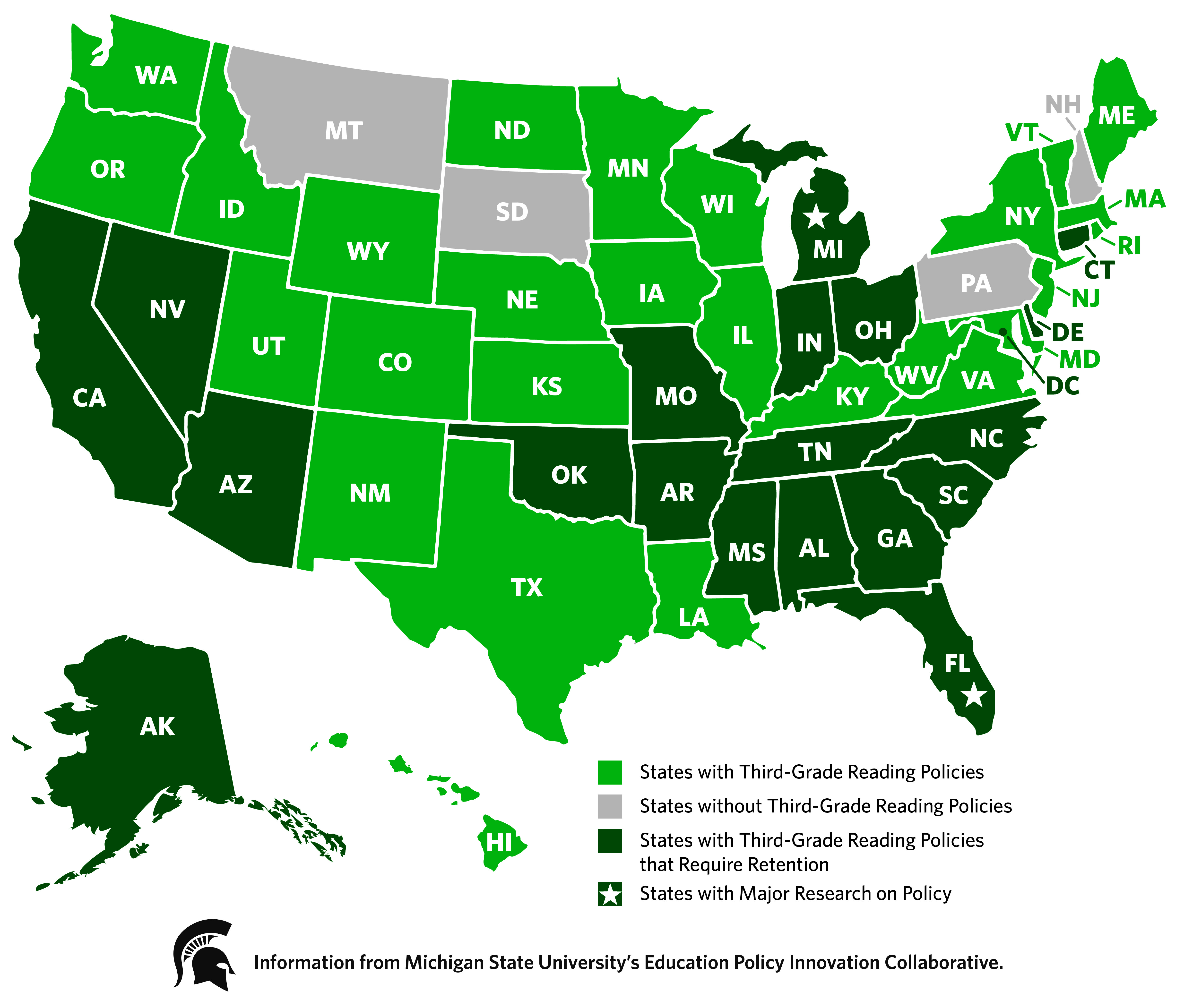
The nation can benefit from EPIC’s Michigan report since 46 states and Washington D.C. have laws related to third-grade literacy, and 19 other states have a required third-grade retention component like in Michigan. But, in addition to Michigan, Florida is the only other state researching the effectiveness and student outcomes of these policies and laws.
The report also finds that literacy interventions were not widely addressed in states’ COVID-19 guidance. Only five states included information about the continued provision of literacy interventions in their guidance, with two, Michigan and Ohio, issuing guidance stating that student reading improvement plans must continue to be provided. South Carolina issued guidance stating that districts must continue to provide summer reading camps to third graders, while Mississippi indicated that literacy coaches should continue to provide support to teachers virtually. Iowa stated that schools and districts were not required to continue providing literacy interventions.
“We found little is being done nationally to address specifically how these laws and policies will be affected by the pandemic for the 2020-2021 school year,” Strunk said. “Most states are just generally talking about assessments. Guidance for these literacy policies was slim for the spring 2020 semester with only nine states issuing any guidance in the spring, and for the most part it wasn’t updated for this new school year.”
EPIC used multiple methods of data and analysis, including interviews of state-level stakeholders; surveys of teachers, principals, district superintendents and early literacy coaches; and longitudinal administrative records to develop this report.
“The pandemic has adversely affected our progress and that of many other states,” Rice said. “With additional expansion of pre-school to include the approximately 27,000 students each year eligible for but not receiving state pre-school programming; a more substantial return of students to in-person instruction next fall; additional professional development on the technical aspects of literacy and on literacy engagement, including diversity in literature; additional family and community engagement around literacy; and diverse classroom libraries, Michigan can and will re-begin its upward trajectory in literacy.”
Additional co-authors are EPIC-affiliated researchers Tara Kilbride, Qiong Zhu, Amy Cummings, Joanne West, Meg Turner, and Craig DeVoto.
Note to media: Note to media: Please link to the full report: https://epicedpolicy.org/rbg3-year-one-report
###

