Jump to HeaderJump to Main ContentJump to Footer
Michigan State University
MSUTODAY
  • Browse Stories By

    Topics

    Explore stories by subject area

    • Arts and Culture
    • Business and Economy
    • Climate and Environment
    • Education and Learning
    • Engineering, Science and Technology
    • Government and Society
    • Health and Medicine
    • Media and Communications
    • MSU Leadership and Impact
    • Sports and Recreation
    • Student and Campus Experience
    View All Stories

    Collections

    Curated story series

    • Turfgrass
    • Ask the Expert
    • Big Ideas
    • Climate solutions
    • Water at MSU
    • Mobility
    • Spartan Perspectives
    • Student views
    • Graduate voices
    • Faculty voices
    View All Collections

    Featured

    Editor's picks

    • The Spartans behind your favorite Michigan golf courses

      July 22, 2026

      The Spartans behind your favorite Michigan golf courses

    • MSU in the 1990s: 10 Spartan milestones

      July 14, 2026

      MSU in the 1990s: 10 Spartan milestones

MSUTODAY
  • Browse Stories By

< Browse Stories By

Topics

Explore stories by subject area

  • Arts and Culture
  • Business and Economy
  • Climate and Environment
  • Education and Learning
  • Engineering, Science and Technology
  • Government and Society
  • Health and Medicine
  • Media and Communications
  • MSU Leadership and Impact
  • Sports and Recreation
  • Student and Campus Experience
  • View All Stories

Collections

Curated story series

  • Turfgrass
  • Ask the Expert
  • Big Ideas
  • Climate solutions
  • Water at MSU
  • Mobility
  • Spartan Perspectives
  • Student views
  • Graduate voices
  • Faculty voices
  • View All Collections

Featured

Editor's picks

  • The Spartans behind your favorite Michigan golf courses

    July 22, 2026

    The Spartans behind your favorite Michigan golf courses

  • MSU in the 1990s: 10 Spartan milestones

    July 14, 2026

    MSU in the 1990s: 10 Spartan milestones

  • For Media
  • Experts
  • Releases and Statements
  • Sign Up
  • Update Information
Michigan State University

Resources

  • A to Z Index
  • Find People
  • Maps
  • Email
  • Student Information System (SIS)
  • D2L
  • Libraries
  • Tech Support
  • MSU Misconduct Hotline
  • Social Media Directory
  • Events Calendar
  • For Media
Michigan State University
MSUToday
  • For Media
  • Experts
  • Releases and Statements
  • Sign Up
  • Update Information
Business and Economy

Feb. 25, 2021

Paper without the microplastics

New MSU packaging technology protects paper products used in food service from oil and water without adding harmful pollutants to the environment

By: Matt Davenport

Michigan State University’s Muhammad Rabnawaz has created a new coating for paper packaging that’s both economical and ecofriendly.

 

MSU Assistant Professor Muhammad Rabnawaz

The coating, developed by Rabnawaz’s Sustainable Materials Group, protects paper packaging from oil and water — making it useful for things like paper plates and juice boxes — using environmentally friendly ingredients.


“If it enters the water, if it enters the ocean, it will decompose,” said Rabnawaz, an assistant professor in the School of Packaging, who shared the coating’s latest formulation online on Jan. 18 in the Journal of Applied Polymer Science.


This is an upgrade over many existing paper products that rely on resilient polymers called thermoplastics to keep the underlying paper dry and sturdy when holding food or beverages.


“Uncoated paper will leak,” Rabnawaz said, which is a shortcoming that has likely crossed the mind of anyone who has trusted a paper cup to hold their hot tea or coffee. “So the solution has been to laminate it with plastic.”
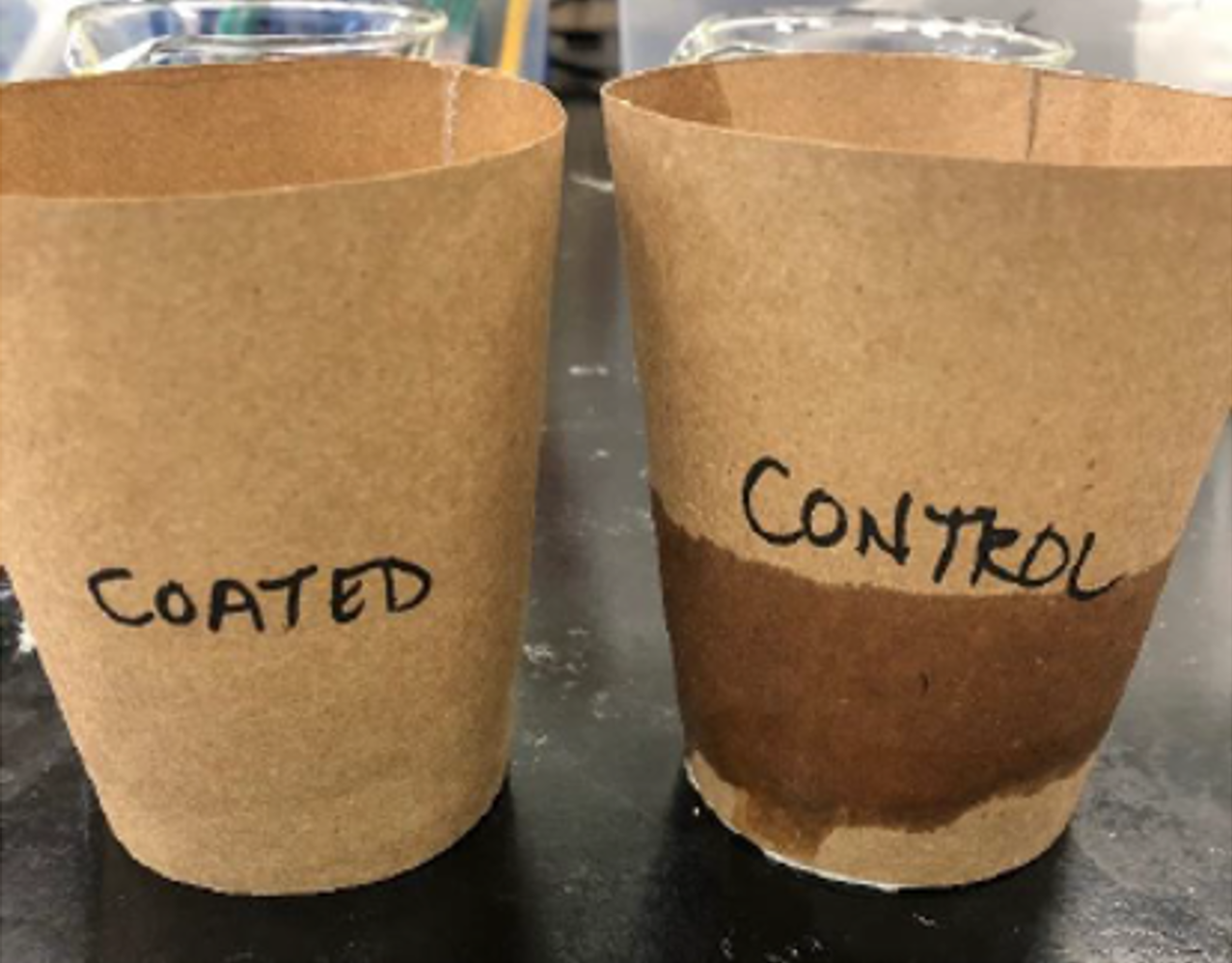
 

Two light brown paper cups are photographed side by side. The one on the left is labeled with the word
A paper cup coated with the new MSU material on the left holds liquid without leaking, unlike its uncoated counterpart on the right. Credit: Muhammad Rabnawaz/Sustainable Materials Group

The plastic, however, is too good at its job. It keeps protecting the paper, even after it’s thrown out. This has two major drawbacks.


For one, the paper can’t be recycled with the plastic clinging to it. Secondly, these paper packaging products can easily end up in bodies of water, adding litter to lakes, oceans and streams.


“There’s waves. There’s tides. There’s UV light from the sun,” said Rabnawaz. “It’s the perfect recipe to turn the material from the paper into microplastics.”


Microplastics are tiny plastic fragments that pollute aquatic ecosystems and make their way into the water and seafood that people consume, carrying unknown health consequences.


Manufacturers have explored alternatives to plastic coatings, but they usually come with other problems. One of the more popular options involves coatings that belong to the PFAS family of “forever chemicals.”  PFAS is the abbreviation for perfluoroalkyl and polyfluoroalkyl substances, which pose their own health concerns.
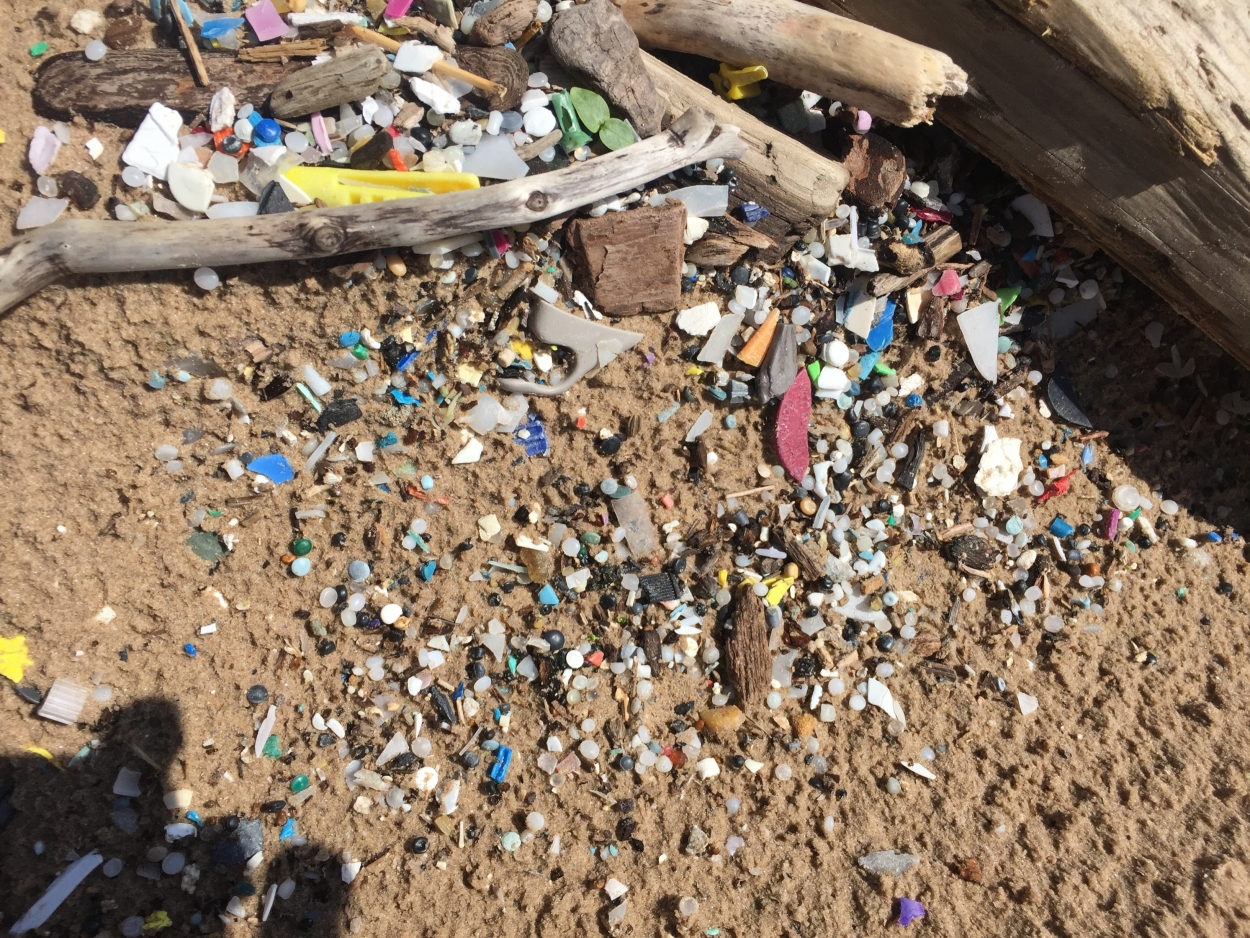
 

Small, colorful plastic particle pollute the brown sand of Lake Ontario's shore.
Microplastics and other plastic fragments are seen in this photo taken on the shores of Lake Ontario. Credit: Eileen Stegemann/NOAA Marine Debris Program

“The question we asked was can we get rid of the plastics that become microplastics without using PFAS,” Rabnawaz said.


To answer this, he enlisted the help of his Spartan team: graduate students Aditya Nair and Dhwani Kansal; research assistant Ruoqi Ping; and recent Ph.D. recipient Li Zhao.


The group formulated a coating based on biocompatible and biodegradable components. The coating contains an oil used in contact lenses, a water-soluble polymer called polyvinyl alcohol and a natural starch-like polymer derived from shellfish (which is different from the shellfish proteins that trigger allergic reactions).


Although this composition uses polymers, none are resilient as the thermoplastics currently used in paper products, Rabnawaz said.


“All plastics are polymers, but not all polymers are plastic,” he said. The new coating breaks down into water, carbon dioxide and other inert molecules instead of lingering in the environment as microplastics.


“Another good thing is, once the paper is repulped, you can remove the coating,” he added, which means that the paper can be recycled. “The paper becomes just like pristine paper and you can use it over and over again.”


Although the coating was motivated by environmental and public health concerns, Rabnawaz’s team also developed it with an eye toward economics.


For example, chitosan is naturally abundant, but the United States doesn’t prepare a lot of it for manufacturing. So the Spartans figured out how to incorporate polyvinyl alcohol, which is more readily available and less expensive. It’s what laundry pods use to encapsulate their detergent. This addition reduces the amount of chitosan required to make the coating, resulting in a more commercially viable product.


The team’s approach explains the diversity of funding supporting the work, which comes from the U.S. Environmental Protection Agency, an MSU ADVANCE Grant and the Michigan Economic Development Corporation’s Michigan Translational Research and Commercialization, or MTRAC, program.


Rabnawaz has already filed two patents related to the coating — adding to his multiple filings since joining MSU in 2016 — and started sharing samples with interested companies.


“We are definitely working on commercialization,” Rabnawaz said.


(Note for media: Please include a link to the original paper in online coverage: https://doi.org/10.1002/app.50494)


MEDIA CONTACTS

Caroline Brooks, Muhammad Rabnawaz
Business and EconomyPollutionClimate and EnvironmentPollution

Latest News

MSUToday Weekly Update

The MSUToday Weekly Update email showcases how Spartans are making a difference through academic excellence, research impact and community outreach. Get inspired by these stories of innovation, collaboration and determination. Plus, enjoy photos and videos of campus and more MSU content to help keep you connected to the Spartan community.

Sign UpUpdate My Information

Connect With Us

Visit our Facebook pageVisit our page on XVisit our Instagram pageVisit our LinkedIn pageVisit our YouTube pageVisit our TikTok page

Health and Safety

  • MSU Police and Public Safety
  • Olin Health Center
  • Counseling & Psychiatric Services (CAPS)
  • University Health and Wellbeing
  • MSU Health Care
  • Civil Rights and Title IX
  • Our Commitment
  • Center for Survivors
  • Security & Fire Safety Report
  • University Policy on Relationship Violence and Sexual Misconduct
  • Notice of Non-Discrimination, Anti-Harassment and Non-Retaliation
  • Health Care Non-Discrimination Notice

Support Services

  • Disability Resources
  • Supportive Services
  • Learning Resources

Working at MSU

  • Human Resources
  • EBS Login
  • Job Postings
  • Employee Assistance Program

Reports

  • CARES Act Funding
  • Student Achievement and Outcomes

Contact us

517-355-1855

Address

Michigan State University 426 Auditorium Road East Lansing, MI 48824

Follow Us

  • Visit our Facebook page
  • Visit our page on X
  • Visit our Instagram page
  • Visit our TikTok page
  • Visit our LinkedIn page
  • Visit our YouTube page

If you're having accessibility issues, please let us know.

Know More: Campus Safety Information and ResourcesTransparency Reporting: Budget & Salary/Compensation
Michigan State University
  • Contact Information|
  • Site Map|
  • Privacy Statement|
  • Site Accessibility|
  • Call MSU: (517) 355-1855|
  • Visit: msu.edu|
  • Notice of Nondiscrimination|

SPARTANS WILL|© Michigan State University|