
Jump to HeaderJump to Main ContentJump to Footer
Michigan State University
  • Browse Stories By

    Topics

    Explore stories by subject area

    • Arts and Culture
    • Business and Economy
    • Climate and Environment
    • Education and Learning
    • Engineering, Science and Technology
    • Government and Society
    • Health and Medicine
    • Media and Communications
    • MSU Leadership and Impact
    • Sports and Recreation
    • Student and Campus Experience
    View All Stories

    Collections

    Curated story series

    • Turfgrass
    • Ask the Expert
    • Big Ideas
    • Climate solutions
    • Water at MSU
    • Mobility
    • Spartan Perspectives
    • Student views
    • Graduate voices
    • Faculty voices
    View All Collections

    Featured

    Editor's picks

    • The Spartans behind your favorite Michigan golf courses

      July 22, 2026

      The Spartans behind your favorite Michigan golf courses

    • MSU in the 1990s: 10 Spartan milestones

      July 14, 2026

      MSU in the 1990s: 10 Spartan milestones

MSUTODAY
  • Browse Stories By

< Browse Stories By

Topics

Explore stories by subject area

  • Arts and Culture
  • Business and Economy
  • Climate and Environment
  • Education and Learning
  • Engineering, Science and Technology
  • Government and Society
  • Health and Medicine
  • Media and Communications
  • MSU Leadership and Impact
  • Sports and Recreation
  • Student and Campus Experience
  • View All Stories

Collections

Curated story series

  • Turfgrass
  • Ask the Expert
  • Big Ideas
  • Climate solutions
  • Water at MSU
  • Mobility
  • Spartan Perspectives
  • Student views
  • Graduate voices
  • Faculty voices
  • View All Collections

Featured

Editor's picks

  • The Spartans behind your favorite Michigan golf courses

    July 22, 2026

    The Spartans behind your favorite Michigan golf courses

  • MSU in the 1990s: 10 Spartan milestones

    July 14, 2026

    MSU in the 1990s: 10 Spartan milestones

  • For Media
  • Experts
  • Releases and Statements
  • Sign Up
  • Update Information

Resources

  • A to Z Index
  • Find People
  • Maps
  • Email
  • Student Information System (SIS)
  • D2L
  • Libraries
  • Tech Support
  • MSU Misconduct Hotline
  • Social Media Directory
  • Events Calendar
  • For Media
Michigan State University
MSUToday
  • For Media
  • Experts
  • Releases and Statements
  • Sign Up
  • Update Information
MSUTODAY
Literature

Feb. 8, 2021

Faculty voice: Comics and the Black experience

By: Julian Chambliss
Julian Chambliss

Julian Chambliss is a professor in the Department of English, core faculty for the Consortium for Critical Diversity in Digital Age Research and Val Berryman Curator of History for the MSU Museum.

What can comics tell us about the Black experience? As a scholar of comics and Afrofuturism, my teaching in the Department of English and my curatorial work are linked to the Black imagination. I see an opportunity to use comics to explore the intersection between speculation and liberation at the heart of Afrofuturism. On the surface, this may seem odd. The popular imagination about comics in the United States has long been defined by the assumption that comics are escapist fantasy geared toward a mostly white male audience. The reason for this is historically grounded, but this assumption ignores Black comic creators.  

“Beyond the Black Panther: Visions of Afrofuturism in American Comics,” the virtual exhibit I have curated at the MSU Museum, offers a view on Afrofuturism in American comics. The choice to pursue comics to better understand Afrofuturism grows from the origins of the contemporary movement. In his definition of Afrofuturism, cultural critic Mark Dery called our attention to the fact “African-American voices have other stories to tell about culture, technology and things to come.” For us to truly understand Afrofuturism, he stressed we must seek it in “unlikely places” and “constellated from far-flung points.” Ironically, Dery’s reading of Afrofuturism relied heavily on comic books. Indeed, he says Afrofuturism “percolates” through “Black-written, Black drawn comics” produced by Milestone Media. The bold visual style and the complex world offered by Milestone was not an outlier. Instead, careful consideration of the comics produced by African American people highlights an engagement with speculation and liberation throughout the twentieth century. 

“Beyond the Black Panther” offers the viewer a chance to engage with Afrofuturism's transformative message through the pages of comic books. The themes in the show — aesthetics, metaphysics, gender, science and community — are explored through a variety of comics created between 1940 and today.

For example, Lion Man, a character first published in “All Negro Comics” #1 in 1947, is presented alongside several re-imagined versions created by John Jennings, artist and professor from the University of California, Riverside. Published in the pages of the first comic book written, drawn and published by African Americans, Lion Man serves as a protector of uranium deposit in Africa. Appointed by the United Nations, the character carries many of the tropes we attached to Black Panther today. Yet, taken in historical context, Lion Man also highlights an internationalism and fascination with innovation central to the African American vision of freedom in the 1940s. 
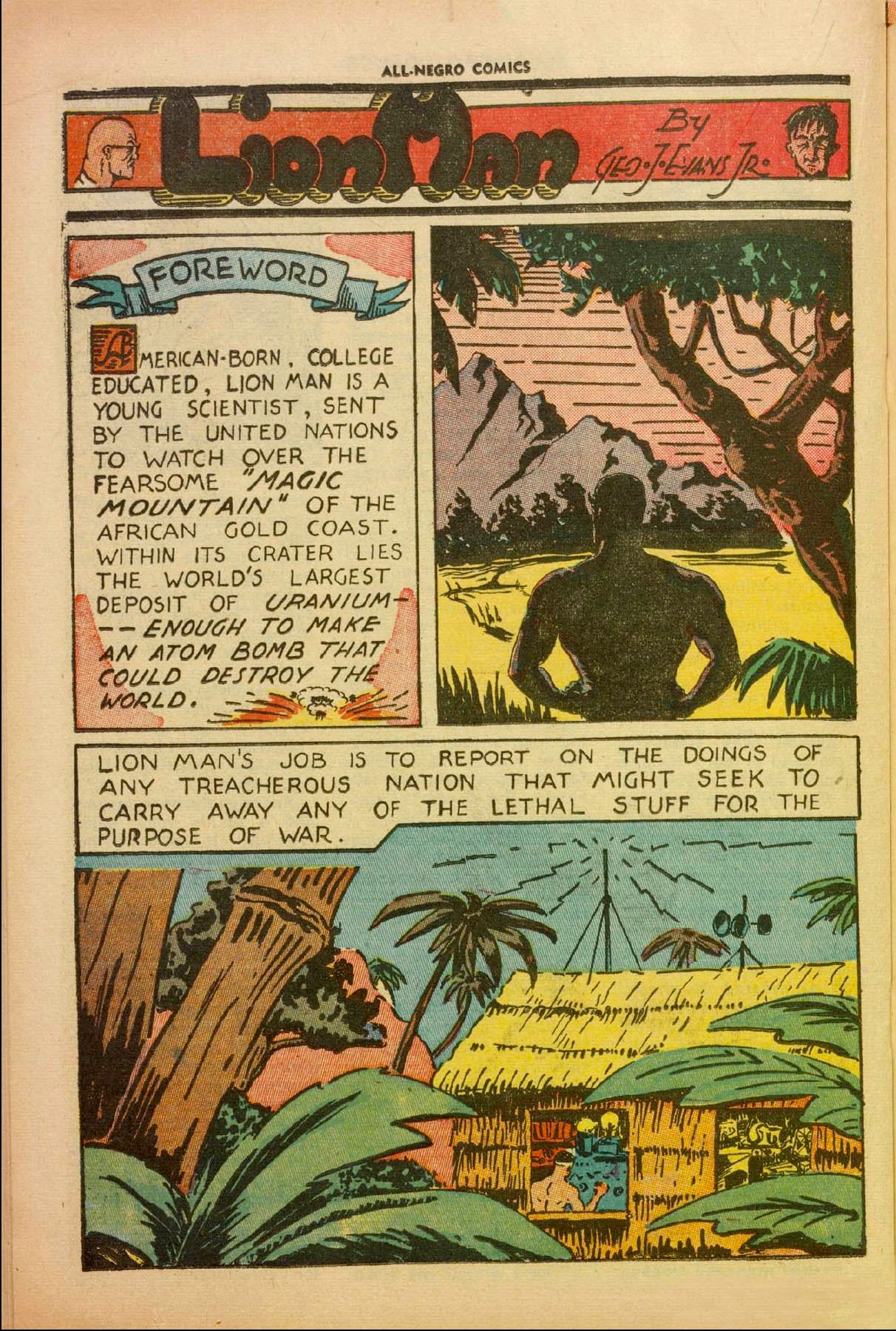
Lion Man Comics page. Text reads: 'Foreword: American Born, college educated, Lion Man is a young scientist sent by the United Nations to watch over the fearsome 'Magic Mountain' of the African Gold Coast. Within its crate lies the world's largest deposit of uranium ? enough to make an atom bomb that could destroy the world. Lion Man's job is to report the doings of any treacherous nation that might seek to carry away any of the lethal stuff for the purpose of war.'
All-Negro comics cover
Lion Man #50 comic cover
Lion Man Comics page. Text reads: 'Foreword: American Born, college educated, Lion Man is a young scientist sent by the United Nations to watch over the fearsome 'Magic Mountain' of the African Gold Coast. Within its crate lies the world's largest deposit of uranium ? enough to make an atom bomb that could destroy the world. Lion Man's job is to report the doings of any treacherous nation that might seek to carry away any of the lethal stuff for the purpose of war.'
All-Negro comics cover

01 / 03

In bringing together the comics in the exhibition, I hope to spark a broader understanding of the transformative legacy and contemporary inventiveness in Black comics. The creators in the exhibition draw inspiration from the full complexity of Black diaspora to create the stories they tell. In doing so, they entertain us and open the door to new ideas and pathways for us to explore. In this way, they are a powerful reminder that our popular culture plays a vital role in societal change.

Referenced work: Mark Dery, ed., “Black to the Future: Interviews with Samuel R. Delany, Greg Tate, and Tricia Rose,” in Flame Wars: The Discourse of Cyberculture (Durham, NC: Duke University Press Books, 1994), 182.

MEDIA CONTACTS

Caroline Brooks, Kimberly Popiolek
LiteratureArts and CultureLiteratureArts and Culture

Collection

more content from this collection

Faculty Voices

Latest News

MSUToday Weekly Update

The MSUToday Weekly Update email showcases how Spartans are making a difference through academic excellence, research impact and community outreach. Get inspired by these stories of innovation, collaboration and determination. Plus, enjoy photos and videos of campus and more MSU content to help keep you connected to the Spartan community.

Sign UpUpdate My Information

Connect With Us

Visit our Facebook pageVisit our page on XVisit our Instagram pageVisit our LinkedIn pageVisit our YouTube pageVisit our TikTok page

Health and Safety

  • MSU Police and Public Safety
  • Olin Health Center
  • Counseling & Psychiatric Services (CAPS)
  • University Health and Wellbeing
  • MSU Health Care
  • Civil Rights and Title IX
  • Our Commitment
  • Center for Survivors
  • Security & Fire Safety Report
  • University Policy on Relationship Violence and Sexual Misconduct
  • Notice of Non-Discrimination, Anti-Harassment and Non-Retaliation
  • Health Care Non-Discrimination Notice

Support Services

  • Disability Resources
  • Supportive Services
  • Learning Resources

Working at MSU

  • Human Resources
  • EBS Login
  • Job Postings
  • Employee Assistance Program

Reports

  • CARES Act Funding
  • Student Achievement and Outcomes

Contact us

517-355-1855

Address

Michigan State University 426 Auditorium Road East Lansing, MI 48824

Follow Us

  • Visit our Facebook page
  • Visit our page on X
  • Visit our Instagram page
  • Visit our TikTok page
  • Visit our LinkedIn page
  • Visit our YouTube page

If you're having accessibility issues, please let us know.

Know More: Campus Safety Information and ResourcesTransparency Reporting: Budget & Salary/Compensation
  • Contact Information|
  • Site Map|
  • Privacy Statement|
  • Site Accessibility|
  • Call MSU: (517) 355-1855|
  • Visit: msu.edu|
  • Notice of Nondiscrimination|

SPARTANS WILL|© Michigan State University|