Jump to HeaderJump to Main ContentJump to Footer
Michigan State University
MSUTODAY
  • Browse Stories By

    Topics

    Explore stories by subject area

    • Arts and Culture
    • Business and Economy
    • Climate and Environment
    • Education and Learning
    • Engineering, Science and Technology
    • Government and Society
    • Health and Medicine
    • Media and Communications
    • MSU Leadership and Impact
    • Sports and Recreation
    • Student and Campus Experience
    View All Stories

    Collections

    Curated story series

    • Alumni stories
    • Turfgrass
    • Ask the Expert
    • Big Ideas
    • Climate solutions
    • Water at MSU
    • Mobility
    • Spartan Perspectives
    • Student views
    • Graduate voices
    • Faculty voices
    View All Collections

    Featured

    Editor's picks

    • 9 reasons to love being a Spartan

      Aug. 28, 2026

      9 reasons to love being a Spartan

    • NIH awards multi-university team over $4M to improve women’s health

      Sept. 15, 2026

      NIH awards multi-university team over $4M to improve women’s health

MSUTODAY
  • Browse Stories By

< Browse Stories By

Topics

Explore stories by subject area

  • Arts and Culture
  • Business and Economy
  • Climate and Environment
  • Education and Learning
  • Engineering, Science and Technology
  • Government and Society
  • Health and Medicine
  • Media and Communications
  • MSU Leadership and Impact
  • Sports and Recreation
  • Student and Campus Experience
  • View All Stories

Collections

Curated story series

  • Alumni stories
  • Turfgrass
  • Ask the Expert
  • Big Ideas
  • Climate solutions
  • Water at MSU
  • Mobility
  • Spartan Perspectives
  • Student views
  • Graduate voices
  • Faculty voices
  • View All Collections

Featured

Editor's picks

  • 9 reasons to love being a Spartan

    Aug. 28, 2026

    9 reasons to love being a Spartan

  • NIH awards multi-university team over $4M to improve women’s health

    Sept. 15, 2026

    NIH awards multi-university team over $4M to improve women’s health

  • For Media
  • Experts
  • Releases and Statements
  • Sign Up
  • Update Information

Resources

  • A to Z Index
  • Find People
  • Maps
  • Email
  • Student Information System (SIS)
  • D2L
  • Libraries
  • Tech Support
  • MSU Misconduct Hotline
  • Social Media Directory
  • Events Calendar
  • For Media
Michigan State University
MSUToday
  • For Media
  • Experts
  • Releases and Statements
  • Sign Up
  • Update Information
Agricultural Sciences and Farming

Nov. 25, 2020

The science of the season

Roasted chestnuts, fragrant firs: MSU scientists improve the seasonal favorites

By: Emilie Lorditch

Michigan State University researchers are helping keep the holiday season green and fragrant by dedicating their expertise year-round to Michigan’s flourishing Christmas tree and chestnut industries.
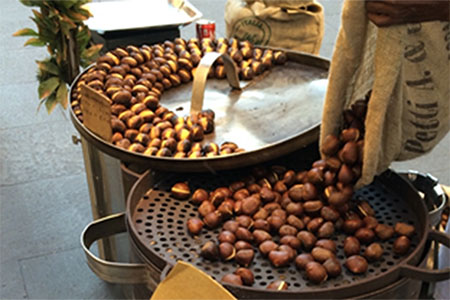
Chestnut display - Image  courtesy of Mario Mandujano

Chestnuts roasting on an open fire

MSU’s chestnut research program, launched in the early 1990s, includes a multidisciplinary team of faculty, including Daniel Guyer, a professor of biosystems and agricultural engineering in the College of Engineering and the College of Agriculture and Natural Resources, and Mario Mandujano, a research associate in CANR’s Department of Plant, Soil and Microbial Sciences, who are developing new ways to keep chestnuts growing and flourishing in Michigan.

Chestnut micropropagation - Image courtesy of Mario MandujanoChestnut plants from tissue cultures. Courtesy of Mario Mandujano
Instead of growing chestnut trees from seed, one programming effort uses plant tissue cultures to grow multiple clonal chestnut plants from a single parent plant selected for their desirable genetic traits, giving researchers control and consistency over the genetic variables of the plant.
Chestnut start - Image courtesy of Mario MandujanoA chestnut plant start. Courtesy of Mario Mandujano</span>
Chestnuts - Credit: Emilie LorditchChestnuts. Courtesy of Emilie Lorditch
While researchers and growers desire certain characteristics, consumers also want specific qualities from their chestnuts. Some prefer smaller chestnuts that are about an inch or less in size,  while others want the large Colossal chestnuts that can grow as large as 2 inches in diameter. Consumers and restaurants want chestnuts that are easy to peel and taste sweet. “Some people think the smaller chestnuts are sweeter,” he said. “But we think the chestnuts, after curing in cold storage, eventually have similar taste and sugar content."
Bowls of Colossal and small chestnuts - Credit: Emilie LorditchBowls of chestnuts. Courtesy of Emilie Lorditch

Another issue with chestnuts is storing them. They should be treated more like produce than like traditional nuts, such as dry as they are a living respiring commodity. They should be stored between 28 and 30 degrees Fahrenheit, Mandujano said. If you keep chestnuts cold and in an air-tight container to minimize moisture loss, it is possible they can last three to four months.

That means you can enjoy fresh chestnuts well past the holiday season. 

chestnut bucket - Image courtesy of Mario MandujanoChestnut picking. Courtesy of Mario Mandujano

Oh, Christmas tree

Like chestnuts, Christmas trees also have a long history as a research subject at MSU. Bert Cregg, a professor of horticulture and forestry in CANR, has been conducting Christmas tree research for the past 21 years. Cregg specializes in tree physiology, nutrition and coning. Unlike crops planted and harvested in the same year, Christmas trees are a waiting game that take up to a decade from seed to cutting.


“We help farmers manage their crops, and they can maximize their efficiency by not putting out fertilizer they don’t need,” Cregg said. “Farmers are good stewards and try to be as sustainable and environmentally friendly as possible.”

Coning, or the excess production of cones, on Frasier fir trees is another issue Cregg is working on. “Frasier firs produce a lot of cones at an early age and the growers have to pick them off by hand,” he said. “A 9-foot tree could have up to a thousand cones.” 

Cone picking - Image courtesy of Bert CreggHand picking cones off of Frasier fir trees. Courtesy of Bert Cregg
Interfering with the tree’s hormone cycle can reduce tree coning by half, Cregg said. Also, applying organic herbicides that break down the cone’s waxy cuticles cause them to dry and fall off.

Cregg also is looking at other tree species from around the world to find trees with desirable traits such as vivid green color, smell and needle retention.“We are looking at the Turkish and Trojan fir from northern Turkey,” he said. “I’m not sure it is going to be a winner in Michigan because one problem we are already seeing is late frost damage.”
closeup of Fraser fir tree branchesFrasier fir tree. Courtesy of Emilie Lorditch
Robert Goodwin, a senior geospatial analyst with Remote Sensing and Geographic Information Systems at MSU, and colleagues Nicholas Weil and Joseph Welsh, are measuring the health and height of Christmas trees using drones programmed to fly more than 150 feet above the ground.
Drone demo Christmas Trees - Image courtesy fo Bert CreggDrone test for Christmas trees in Bert Cregg's research plot. Courtesy of Bert Cregg
Back at the office, special software stitches these images together to form both a surface model and mosaic of the tree farm that looks like a high-resolution satellite picture. A custom processing model is then used to generate a point representing the highest peak on each tree.
Drone Christmas tree map -Image courtesy of Robert GoodwinChristmas tree heights map. Courtesy of Robert Goodwin
“Using statistical GIS (Geographic Information Systems), we can filter out non-trees and then subtract the ground measurement from the highest point of each tree to obtain the height,” Goodwin said. “We can inventory trees with 95% to 97% accuracy and extract measurements accurate to within 4 to 6 inches.”

To image the health of the trees, Goodwin and his team use a special camera on the drone that measures how much light the trees reflect in different wavelengths from infrared to blue light.
NDVI Christmas Trees - Image Courtesy of Robert GoodwinNDVI image of tree health. Courtesy of Robert Goodwin

Applying vegetative indices to these images, such as NDVI (Normalized Difference Vegetation Index) and others, tree health can be displayed according to an easily interpretable color ramp,” he said. “Typically, dark green represents healthy trees and orange or red represents trees that are less healthy.”

From Christmas trees that are the perfect shade and height to chestnuts that produce the sweetest treat after roasting on the open fire, MSU research means that even during a unique year like this one, there are still some holiday traditions that will remain.

Chestnut display - Image  courtesy of Mario MandujanoRoasted chestnuts Image courtesy of Mario Mandujano
Drone scan grid Image courtesy of Robert Goodwin
Frasier fir - Credit Emilie LorditchFrasier fir tree Image courtesy of Emilie Lorditch

MEDIA CONTACTS

Caroline Brooks
Agricultural Sciences and FarmingClimate and EnvironmentNatural Resources and ConservationAgricultural Sciences and Farming

Collection

more content from this collection

Michigan Food Agriculture

Latest News

MSUToday Weekly Update

The MSUToday Weekly Update email showcases how Spartans are making a difference through academic excellence, research impact and community outreach. Get inspired by these stories of innovation, collaboration and determination. Plus, enjoy photos and videos of campus and more MSU content to help keep you connected to the Spartan community.

Sign UpUpdate My Information

Connect With Us

Visit our Facebook pageVisit our page on XVisit our Instagram pageVisit our LinkedIn pageVisit our YouTube pageVisit our TikTok page

Health and Safety

  • MSU Police and Public Safety
  • Olin Health Center
  • Counseling & Psychiatric Services (CAPS)
  • University Health and Wellbeing
  • MSU Health Care
  • Civil Rights and Title IX
  • Our Commitment
  • Center for Survivors
  • Security & Fire Safety Report
  • University Policy on Relationship Violence and Sexual Misconduct
  • Notice of Non-Discrimination, Anti-Harassment and Non-Retaliation
  • Health Care Non-Discrimination Notice

Support Services

  • Disability Resources
  • Supportive Services
  • Learning Resources

Working at MSU

  • Human Resources
  • EBS Login
  • Job Postings
  • Employee Assistance Program

Reports

  • CARES Act Funding
  • Student Achievement and Outcomes

Contact us

517-355-1855

Address

Michigan State University 426 Auditorium Road East Lansing, MI 48824

Follow Us

  • Visit our Facebook page
  • Visit our page on X
  • Visit our Instagram page
  • Visit our TikTok page
  • Visit our LinkedIn page
  • Visit our YouTube page

If you're having accessibility issues, please let us know.

Know More: Campus Safety Information and ResourcesTransparency Reporting: Budget & Salary/Compensation
  • Contact Information|
  • Site Map|
  • Privacy Statement|
  • Site Accessibility|
  • Call MSU: (517) 355-1855|
  • Visit: msu.edu|
  • Notice of Nondiscrimination|

SPARTANS WILL|© Michigan State University|
