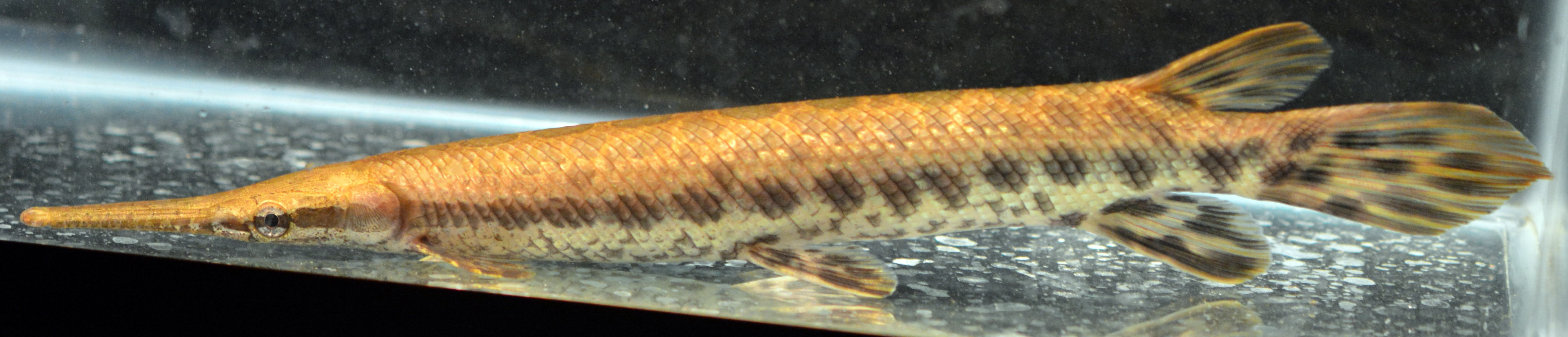
Evolutionarily speaking, the spotted gar is a bit of an old soul.
That’s why Ingo Braasch, a Michigan State University assistant professor in the Department of Integrative Biology, is so interested in helping other scientists study the fish. It’s also why the National Science Foundation is investing over $1.6 million to help.
With this new NSF EDGE grant, which stands for Enabling Discovery through Genomics, Braasch and his team are working to establish the spotted gar fish as a model organism to spur research in evolution, development and human biology. The goal is to make genetic studies in these fields more accessible to investigators with an assist from a slender, spotted fish with a unique history in Michigan.
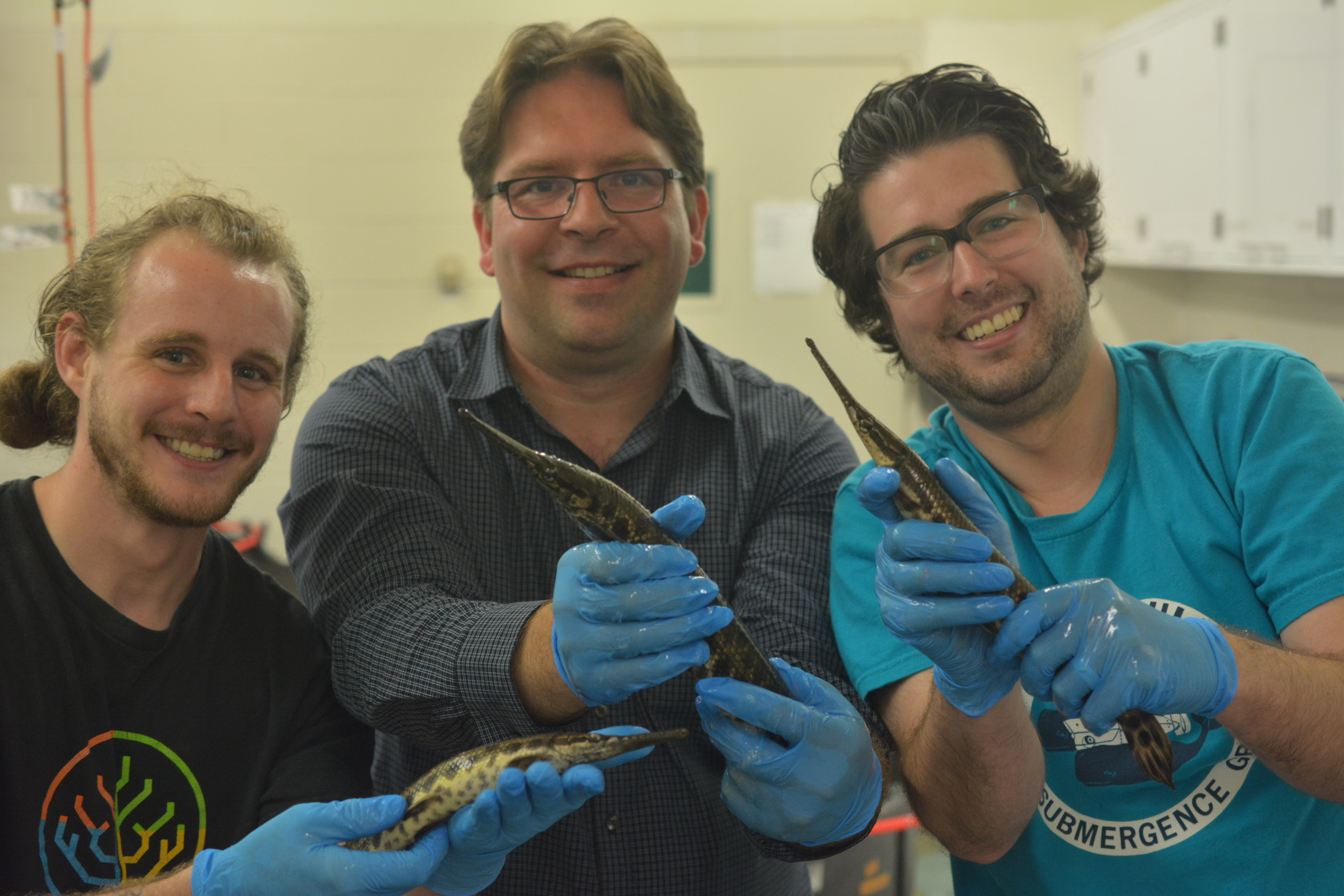
Scientists routinely rely on animals as model organisms to suss out what specific sets of genetic instructions, or genes, do. Humans share many genes with many different creatures and it is much easier — and much more ethical — to study what those genes do in animal model systems, Braasch said. Still, validating animals as research organisms and then deciphering what they can teach us about human biology is no small feat.
“When it comes to understanding vertebrate animals, including humans, so far there are still really relatively few models that we use,” Braasch said. Such models include mice, chicken, frogs and zebrafish. “If you want to use zebrafish to understand human biology, you can do that, but there are a lot of challenges in interpreting the data.”
So what does spotted gar bring to the table that zebrafish don’t? It turns out gar, like humans, took a more relaxed approach to evolution.
Some 450 million years ago, fish and mammals shared a common ancestor. In the time since, species have diverged onto different evolutionary paths, evolving with different evolutionary clocks. Most model organisms have changed more in less time, Braasch said.
“At the genetic level, for zebrafish, that clock ticks fast,” Braasch said. “For gar and humans, changes have been comparatively slow.”
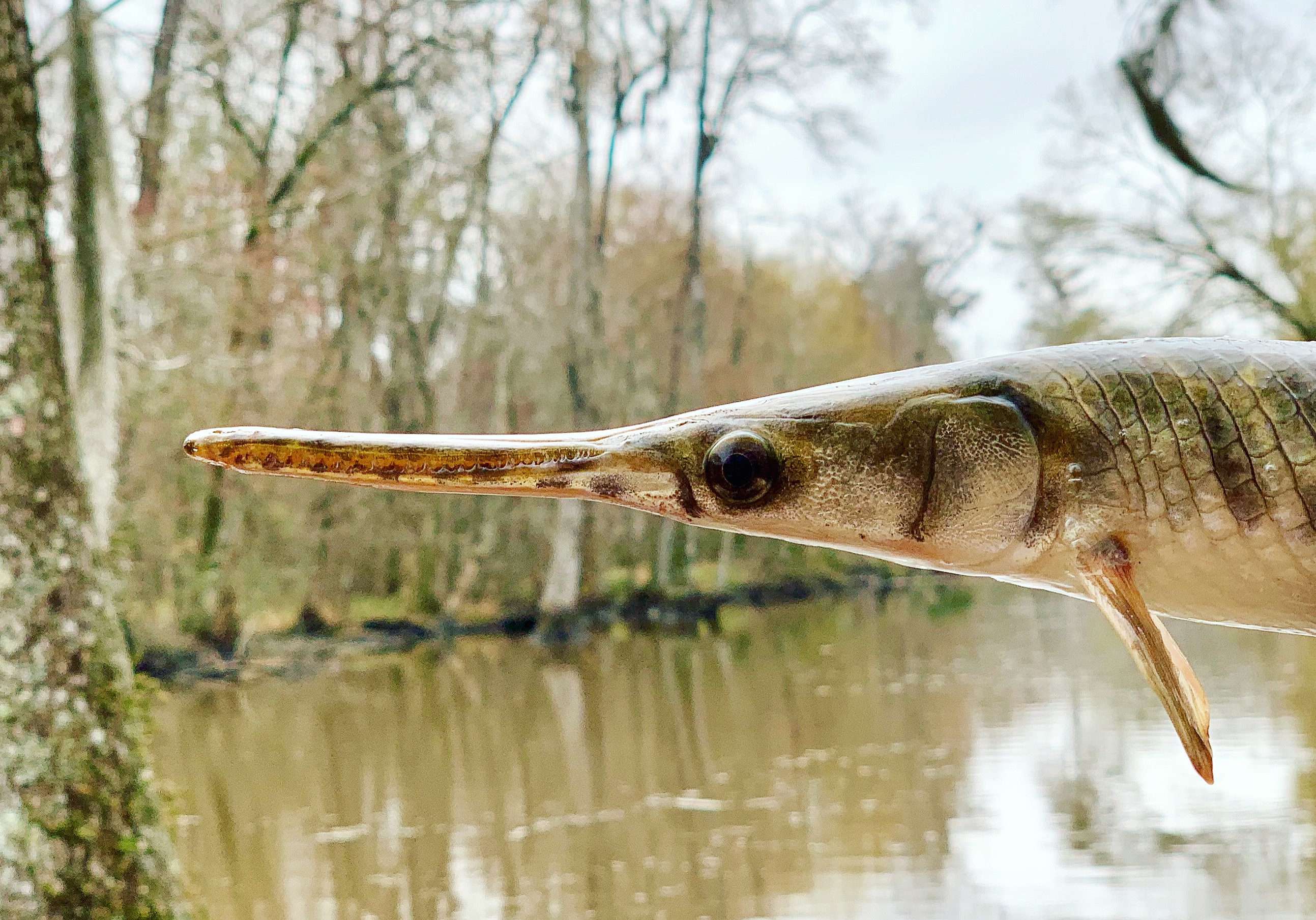
What this means is the comparison between the gar and human genomes is a little bit more straightforward than with, say, zebrafish genomes. The comparison is even more straightforward between gar and that 450-million-year-old common ancestor, which has led some people to use the controversial phrase “living fossil” when talking about the fish. The problem with the terminology is that it implies these animals haven’t changed in millions of years, Braasch said.
“Of course gars have changed. But they haven’t changed as much as other fish.”
So Braasch thinks of the gar more of as a Rosetta Stone to help translate humanity’s genetic history and, in so doing, understand where certain genes came from and what they do.
For example, gars are covered in tough scales that derive their strength, in part, from a ceramic-like coating.
“It’s actually very similar to the enamel coating on our teeth,” Braasch said. And the similarities don’t end on the surface.
The gar genes that carry instructions to make the scale coating are basically what humans use for making enamel. “So it looks like the coating on our teeth originally evolved in fish ancestors to coat their scales,” Braasch said.
To bolster that case with direct experimental evidence, researchers could run an experiment to silence or knock out these genes in gar and then check whether the fish scales lose their coating.
But doing a single experiment is not the goal of the Spartans’ grant. Rather, the goal is to develop technologies to give the research community the power to do that experiment and others like it. Braasch and his team are going to show how to edit and probe a gar’s genes to better understand biology.
One such technique will be the gene-editing tool known as CRISPR, which earned this year’s Nobel Prize in Chemistry (the prize was shared by Jennifer Doudna of University of California, Berkeley, and Emmanuelle Charpentier of Max Planck Unit for the Science of Pathogens).
“This grant will bring revolutions in gene-editing using CRISPR technology and in genome sequencing together with advances in husbandry to make gar an accessible model organism for directly testing questions about genes and phenotypes,” Braasch said.
On the husbandry side, Braasch’s group is teaming up with Assistant Professor Solomon David and Distinguished Service Professor Allyse Ferrara of Nicholls State University to develop new techniques for year-round spawning and husbandry of gar. Although David and Ferrara are based in Louisiana, their techniques will fuel a Spartan homecoming of sorts in Michigan.
In the 1980s, embryological work done at MSU’s Kellogg Biological Station started highlighting the gar’s potential as a model organism, Braasch said. Over the next four years, his team will be working with KBS to adopt this new project’s spawning techniques to help further study the fish.
This grant also continues a more recent trend of MSU advancing science’s understanding of biology, genetics and evolution with a variety of aquatic model organisms, including an earlier Spartan NSF EDGE grant to study electric fish.
“We’ve got quite a cluster of cool fish and other aquatic models,” Braasch said. “We’re studying functional aquatic genomics in a way that the community can be proud of.”
Perhaps it would be fair to say, then, that when it comes to genetics, Michigan State is making a splash.

