Jump to HeaderJump to Main ContentJump to Footer
Michigan State University
  • Browse Stories By

    Topics

    Explore stories by subject area

    • Arts and Culture
    • Business and Economy
    • Climate and Environment
    • Education and Learning
    • Engineering, Science and Technology
    • Government and Society
    • Health and Medicine
    • Media and Communications
    • MSU Leadership and Impact
    • Sports and Recreation
    • Student and Campus Experience
    View All Stories

    Collections

    Curated story series

    • Turfgrass
    • Ask the Expert
    • Big Ideas
    • Climate solutions
    • Water at MSU
    • Mobility
    • Spartan Perspectives
    • Student views
    • Graduate voices
    • Faculty voices
    View All Collections

    Featured

    Editor's picks

    • The Spartans behind your favorite Michigan golf courses

      July 22, 2026

      The Spartans behind your favorite Michigan golf courses

    • MSU in the 1990s: 10 Spartan milestones

      July 14, 2026

      MSU in the 1990s: 10 Spartan milestones

MSUTODAY
  • Browse Stories By

< Browse Stories By

Topics

Explore stories by subject area

  • Arts and Culture
  • Business and Economy
  • Climate and Environment
  • Education and Learning
  • Engineering, Science and Technology
  • Government and Society
  • Health and Medicine
  • Media and Communications
  • MSU Leadership and Impact
  • Sports and Recreation
  • Student and Campus Experience
  • View All Stories

Collections

Curated story series

  • Turfgrass
  • Ask the Expert
  • Big Ideas
  • Climate solutions
  • Water at MSU
  • Mobility
  • Spartan Perspectives
  • Student views
  • Graduate voices
  • Faculty voices
  • View All Collections

Featured

Editor's picks

  • The Spartans behind your favorite Michigan golf courses

    July 22, 2026

    The Spartans behind your favorite Michigan golf courses

  • MSU in the 1990s: 10 Spartan milestones

    July 14, 2026

    MSU in the 1990s: 10 Spartan milestones

  • For Media
  • Experts
  • Releases and Statements
  • Sign Up
  • Update Information

Resources

  • A to Z Index
  • Find People
  • Maps
  • Email
  • Student Information System (SIS)
  • D2L
  • Libraries
  • Tech Support
  • MSU Misconduct Hotline
  • Social Media Directory
  • Events Calendar
  • For Media
Michigan State University
MSUToday
  • For Media
  • Experts
  • Releases and Statements
  • Sign Up
  • Update Information
MSUTODAY
Biodiversity and Wildlife

Oct. 19, 2020

Discovering beetles abroad to protect trees at home

By: Matt Davenport

Not every child gets a bark beetle named after them. Then again, not every kid has Michigan State University entomologists Sarah Smith and Anthony Cognato as parents.


The duo discovered two new beetle species in Southeast Asia, which they named and announced in the September issue of The Coleopterists Bulletin. (A coleopterist is someone who studies beetles). The diminutive beetle species — they’re roughly as long as a nickel is thick — are both reddish brown and dotted with little spines.


“That’s why we named one after our son, Lorenzo,” Smith said.


“He can be a little prickly,” Cognato explained.
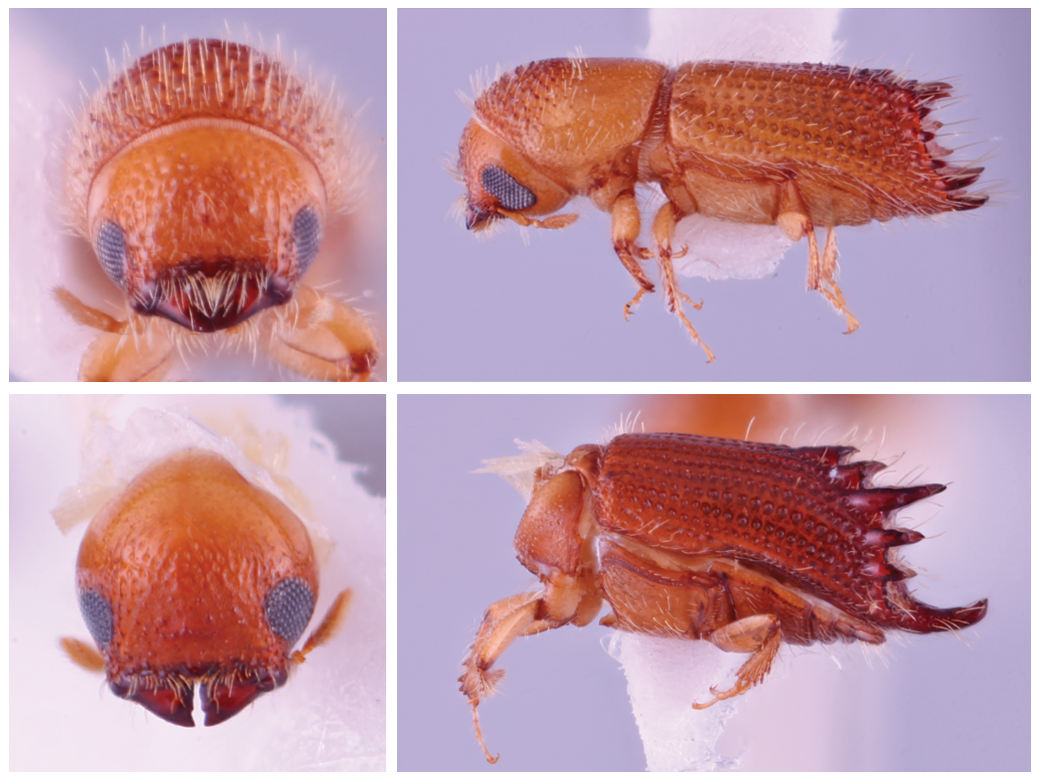
 

A set of four photos shows A. diaboliculus and A. enzoi specimens
Two views of Acanthotomicus diaboliculus (top row) and A. enzoi (bottom row) that were discovered by MSU researchers Sarah Smith and Anthony Cognato. The head of the A. enzoi sample in the lower right was removed for DNA analysis. Credit: The Coleopterists Bulletin

The beetles both belong to the Acanthotomicus genus, with Lorenzo being the namesake for the newly christened Acanthotomicus enzoi. The researchers named the other new species A. diaboliculus, derived from the Latin for “little devil,” just in time for Halloween.


Behind these playful names, however, is a serious motivation for Smith, who is a curator in the Albert J. Cook Arthropod Research Collection and for Cognato, who is the director of the collection. Cognato is also a professor in the Department of Entomology and leads the Holistic Insect Systematics Laboratory.  By identifying and studying different beetle species around the globe, in their native habitats, researchers are working to better protect the United States from species that could cause problems here.


Bark beetles bore into trees for food and shelter, Smith said. In fact, to discover bark beetles during trips to China or Thailand, for example, the team looks for the telltale sign of sawdust on fallen trees. The researchers then chip away at a tree to see what’s inside.  


“Splitting wood is like opening a Christmas present,” Smith said.


After collecting beetles in the field, the researchers meticulously characterize their haul, documenting details about the insects’ appearance and genes. The team then compares its samples with all potential matches, which are scattered in collections around the globe. This step can take some time.


“For these, it took about 15 years to know that they were new,” Cognato said, referring to the two new species. “We had to rule out 96 other species.”


Another important facet of this work is understanding the behavior and habits of the new species. Many bark beetles are innocuous, setting up shop in dead, dying or injured trees, but that’s not always the case.


When beetles attack healthy trees, “that can have catastrophic implications for ecosystems,” Smith said. This can be especially true when these beetles find their way to new habitats that haven’t evolved defenses to keep the pests in check.


Although neither one of the newly discovered beetle species appears to pose such a threat to the U.S., nonnative bark beetles and related ambrosia beetles have caused problems on American soil before.


For example, the redbay ambrosia beetle found its way from Asia to the state of Georgia in the early 2000s, likely stowed away in wooden packaging materials. Now, the beetle has made its home in nine states, bringing with it a fungus that has all but destroyed coastal redbay laurels and has started attacking other trees, too.


“It’s decimated avocado trees in the Southeast,” Cognato said. There are looming concerns the beetle will spread to larger avocado operations in California, Mexico and South America.


This may remind Michiganders of the nonnative emerald ash borer, or EAB, whose beetle babies have killed tens of millions of ash trees in Michigan since 2002. The EAB belongs to a different family of beetle than what Smith and Cognato have discovered, but it underscores the importance of this type of work. By discovering and documenting beetles in their native habitats, researchers in the U.S. can better prepare for and possibly predict the next invasive species.
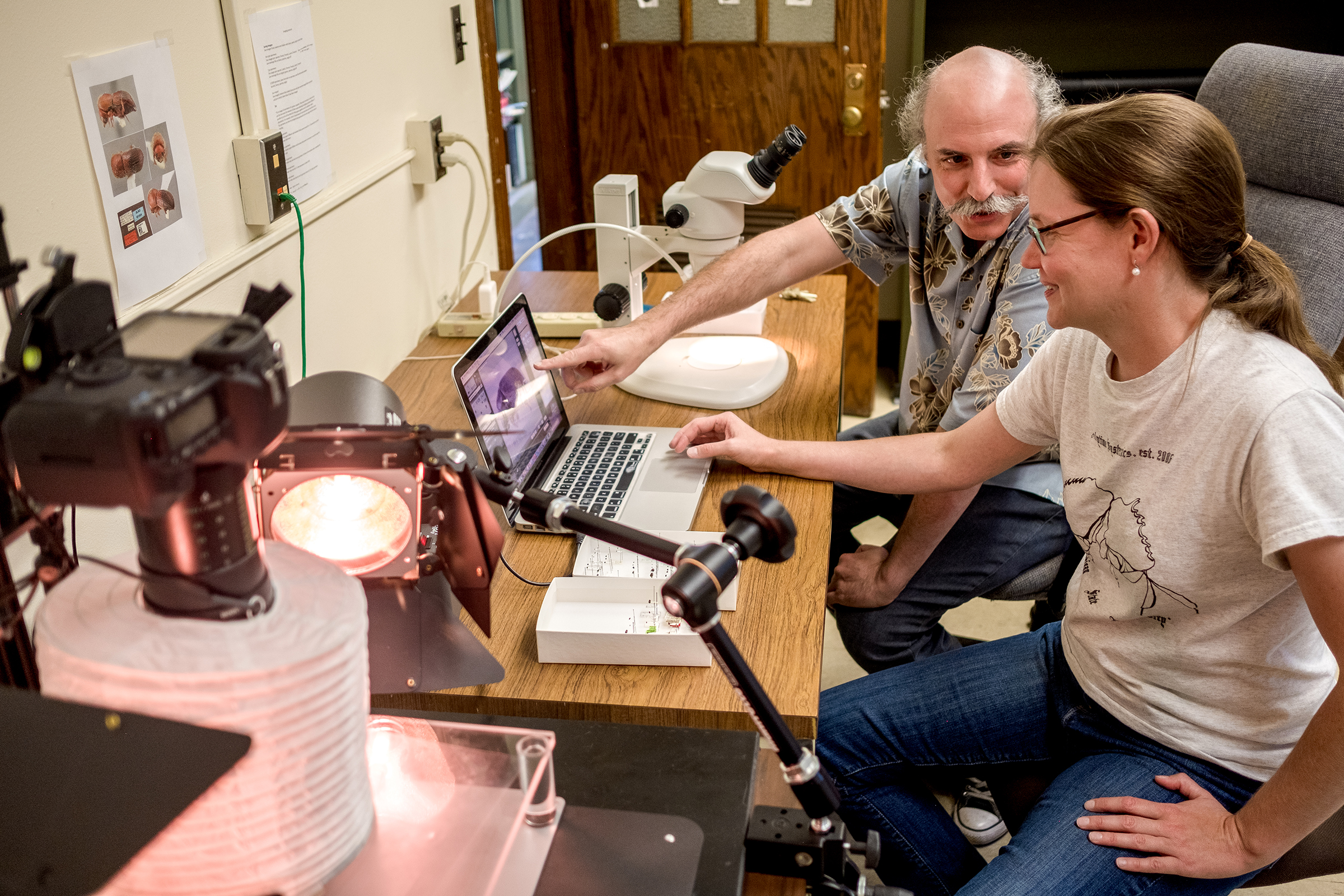
 

A photo of MSU entomologists Anthony Cognato and Sarah Smith.
MSU entomologists Anthony Cognato (left) and Sarah Smith (right). Credit: Be Noble Photography

To that end, Smith and Cognato are preparing to publish a book detailing 315 ambrosia beetle species found in Southeast Asia, 63 of which are new to science. They’ve also created an online database to help others rapidly ID these beetles.


Beyond the protective aspects of this work, beetle biodiversity remains a huge mystery, Smith and Cognato added. Scientists have discovered just a fraction of beetle species worldwide and within this small piece, researchers have revealed myriad appearances and behaviors.


“Biodiversity in general is amazing and relatively unknown,” Cognato said. “It’s worth the time and effort to try and discover new species.”


Acanthotomicus enzoi and A. diaboliculus are the latest additions to the list of discoveries made by Smith and Cognato, which contains well over 100 species and counting.


That said, the two new species do present one element of completion. Now all three children in Smith and Cognato’s household have beetles named after them.


MEDIA CONTACTS

Anthony Cognato, Caroline Brooks
Biodiversity and WildlifeClimate and EnvironmentMSU International ImpactMSU Leadership and ImpactEngineering, Science and Technology

Latest News

MSUToday Weekly Update

The MSUToday Weekly Update email showcases how Spartans are making a difference through academic excellence, research impact and community outreach. Get inspired by these stories of innovation, collaboration and determination. Plus, enjoy photos and videos of campus and more MSU content to help keep you connected to the Spartan community.

Sign UpUpdate My Information

Connect With Us

Visit our Facebook pageVisit our page on XVisit our Instagram pageVisit our LinkedIn pageVisit our YouTube pageVisit our TikTok page

Health and Safety

  • MSU Police and Public Safety
  • Olin Health Center
  • Counseling & Psychiatric Services (CAPS)
  • University Health and Wellbeing
  • MSU Health Care
  • Civil Rights and Title IX
  • Our Commitment
  • Center for Survivors
  • Security & Fire Safety Report
  • University Policy on Relationship Violence and Sexual Misconduct
  • Notice of Non-Discrimination, Anti-Harassment and Non-Retaliation
  • Health Care Non-Discrimination Notice

Support Services

  • Disability Resources
  • Supportive Services
  • Learning Resources

Working at MSU

  • Human Resources
  • EBS Login
  • Job Postings
  • Employee Assistance Program

Reports

  • CARES Act Funding
  • Student Achievement and Outcomes

Contact us

517-355-1855

Address

Michigan State University 426 Auditorium Road East Lansing, MI 48824

Follow Us

  • Visit our Facebook page
  • Visit our page on X
  • Visit our Instagram page
  • Visit our TikTok page
  • Visit our LinkedIn page
  • Visit our YouTube page

If you're having accessibility issues, please let us know.

Know More: Campus Safety Information and ResourcesTransparency Reporting: Budget & Salary/Compensation
  • Contact Information|
  • Site Map|
  • Privacy Statement|
  • Site Accessibility|
  • Call MSU: (517) 355-1855|
  • Visit: msu.edu|
  • Notice of Nondiscrimination|

SPARTANS WILL|© Michigan State University|