The fight against COVID-19 and the race to learn more about it are front and center on the global stage. Educators, scientists and clinicians at the MSU College of Veterinary Medicine are hard at work protecting animal and human health in four key areas: public health, education, research and pet health care.
Public health
Near or far, champions of veterinary or human health, Spartans and medical professionals have come together throughout the COVID-19 pandemic. Whether it be in terms of developing best practices to protect MSU health care workers or sharing personal protective equipment with Lansing hospitals, members of the Spartan medical community have been united.
The MSU Veterinary Medical Center donated both of their ventilators and their continual renal replacement therapy machine to Lansing’s Sparrow Hospital. Though this meant they could no longer use those machines on their animal patients, veterinary staff knew they could play a part in preserving human life.
The college’s commitment to animal, human and public health isn’t only seen in the treatment room, but in MSU’s laboratories. University Veterinarian and Director of Campus Animal Resources Claire Hankenson championed a personal protective equipment decontamination process via vaporized hydrogen peroxide that allows Spartans to repurpose nearly 15,000 essential materials each day. Thanks to Hankenson, MSU is the first public institution in the state to employ the vaporized hydrogen peroxide decontamination process at this scale.
To provide further support to human and animal health agencies in Michigan, the MSU Veterinary Diagnostic Laboratorybecame a SARS-CoV-2 (the virus that causes COVID-19) certified testing site for animals.*
Education
Hands-on, in-person instruction and clinical experience is critical for future veterinarians. Veterinary schools across the country have launched virtual labs as a substitute for these experiences while also balancing the roles veterinary students play in teaching hospitals.
After recently launching a new curriculum, MSU’s CVM is maximizing digital spaces by leveraging the technological expertise of faculty and staff, as well as peers, in the higher education and veterinary medical arenas. By the close of the spring 2020 semester, CVM successfully transitioned classes online and supplemented educational opportunities for students through free courses offered by the University of Illinois, the Veterinary Dental Company, the American Animal Hospital Association and the American Veterinary Medical Association.
To prepare for MSU’s fall semester, CVM will keep instruction virtual where possible and ensure necessary laboratory and clinical experiences are safe through personal protective equipment, social distancing and other practices. Continuing education opportunities remain available for practicing veterinarians, such as the Department of Large Animal Clinical Sciences’ summer webinar series.
Research
The MSU Veterinary Medical Center has continued to see patients during the pandemic, which offered the opportunity for researchers at the college to learn more about COVID-19’s prevalence in companion animals and other pet- and owner-related factors that might be associated with infection. Daniel Langlois, associate professor in the Department of Small Animal Clinical Sciences, is working with Steve Bolin, professor in the Department of Pathobiology and Diagnostic Investigation, and other college faculty to fill in these gaps through a combination of polymerase chain reaction and antibody testing as well as pet owner surveys.
“We really do not know what impact COVID-19 has had on the pet population in our area,” Langlois said. “We hope to identify which pets, if any, actually warrant testing. At the same time, our results should better inform safety protocols and use of personal protective equipment in veterinary hospitals.”
Researchers at the college also wondered how the pandemic could impact the human-animal bond between pets and their owners. Kirk Munoz, assistant professor in the Department of Small Animal Clinical Sciences, is working with Jane Manfredi, assistant professor in the Department of Pathobiology and Diagnostic Investigation, to survey pet owners and use that data to assess the impact that COVID-19 has had on the way people interact with their pets.
“We know the human-animal bond offers many benefits to people, such as improved mental health,” Munoz said. “Gathering this information from pet owners and noting whether they are medically trained or not could provide us with important insights into how COVID-19 is affecting our relationship with our most beloved animals.”
Pet health care
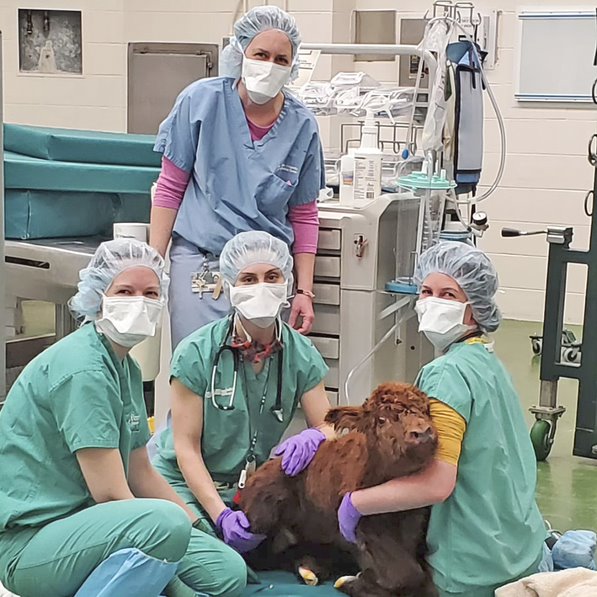
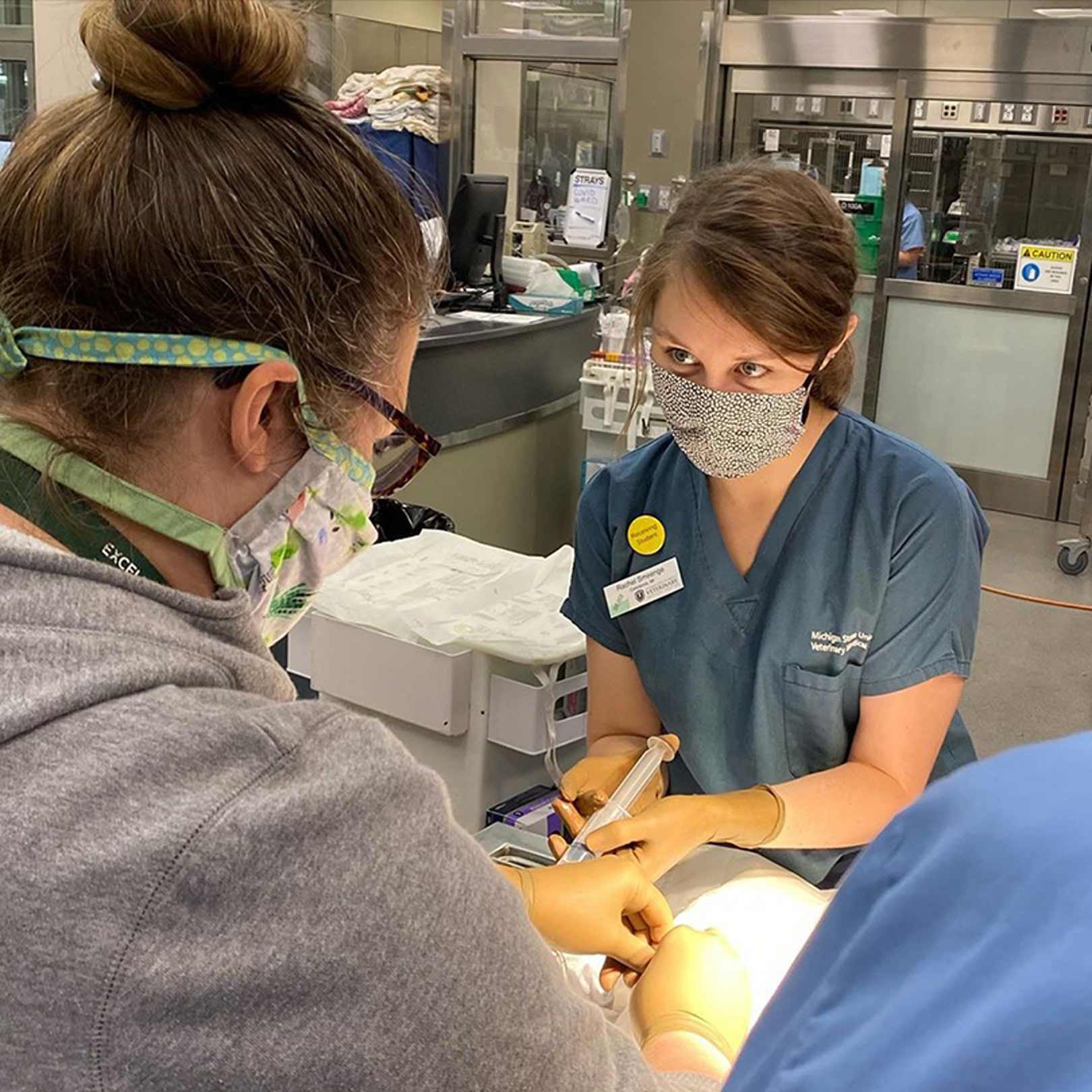
Throughout the COVID-19 pandemic, the hospital’s clinical team members have saved the lives of their patients as they protected themselves and their clients. Though the hospital closed to all non-emergent patients on March 16, the doors never closed. This hasn’t come without a price; at the end of June, they had to make difficult operational changes in an effort to limit their busyness and protect the mental and physical health of their team. But despite the long, busy hours, the fatigue, the worry, and the emotional toll, our Spartan veterinary team never stopped working.
A parking lot triage system, full personal protective equipment coverage, and as much physical distancing as possible has allowed the hospital team to stay healthy and treat 13,910 patients in just three months. Through their unwavering commitment to animal health, the MSU Veterinary Medical Center has brought special meaning to the phrase “not all heroes wear capes.”
All the hard work has paid off. The college community hasn’t reported a single positive COVID-19 case, per the hospital’s mandatory text messaging screening system.
“The VMC’s show of teamwork is exactly what being a Spartan is all about — the hard work, sacrifice, and expertise we provide for our patients and their owners, no matter the circumstances. And we’re very lucky,” said Birgit Puschner, dean of the college.
The hospital also has been able to provide financial support to clients through the college’s Lucky Fund and its Retired Police and Arson Dog Fund. Thanks to the College’s House System (all veterinary medical and nursing students are sorted into one of four houses, as are faculty and staff. Just like Hogwarts, the houses provide a “home” for members of our community), $1,000 was allocated to clients in both the Large and Small Animal Clinics who received emergency care. The total allocation was $26,000; $12,402 of those funds have been used to date.
*This test is not currently available to veterinarians or the general public for routine testing.
For guidance on when testing is appropriate, see Evaluation for SARS-CoV-2 Testing in Animals from the Centers for Disease Control and Prevention, the American Veterinary Medical Association guidance on testing animals for SARS-CoV-2 and the FAQ on Animal Coronavirus Testing from the United States Department of Agriculture (USDA).
Contact your state veterinarian to obtain approval and for required information for testing. For Michigan animals, please call the Michigan Department of Agriculture and Rural Development at 800-292-3939. Positive test results will be reported after confirmation by the USDA’s National Veterinary Services Laboratory. Any detection of SARS-CoV-2 in an animal must be reported to the World Organization for Animal Health.