Mark Wilson and Eva Kassens-Noor from Michigan State University's Urban and Regional Planning department, wrote this piece for The Conversation, an independent collaboration between editors and academics that provides informed news analysis and commentary to the general public. See the entire list of articles written by MSU faculty for The Conversation.Michigan State University
Italy will host the 2026 Winter Games, the International Olympic Committee announced on June 24. The IOC, which organizes the Winter and Summer Games, chose a bid from Milan and the Alpine ski resort of Cortina d’Ampezzo over a single rival bid from the Swedish capital of Stockholm and the village of Åre. The field had narrowed to two contenders after four others had dropped out due to public pressure.
We are urban planners who lead a Michigan State University research group about big events that transform cities like the Olympics and natural disasters.
In our view, the limited competition among potential host cities for the 2026 Winter Games was only natural given the soaring costs to put on these events and the erosion of public support among leery taxpayers.
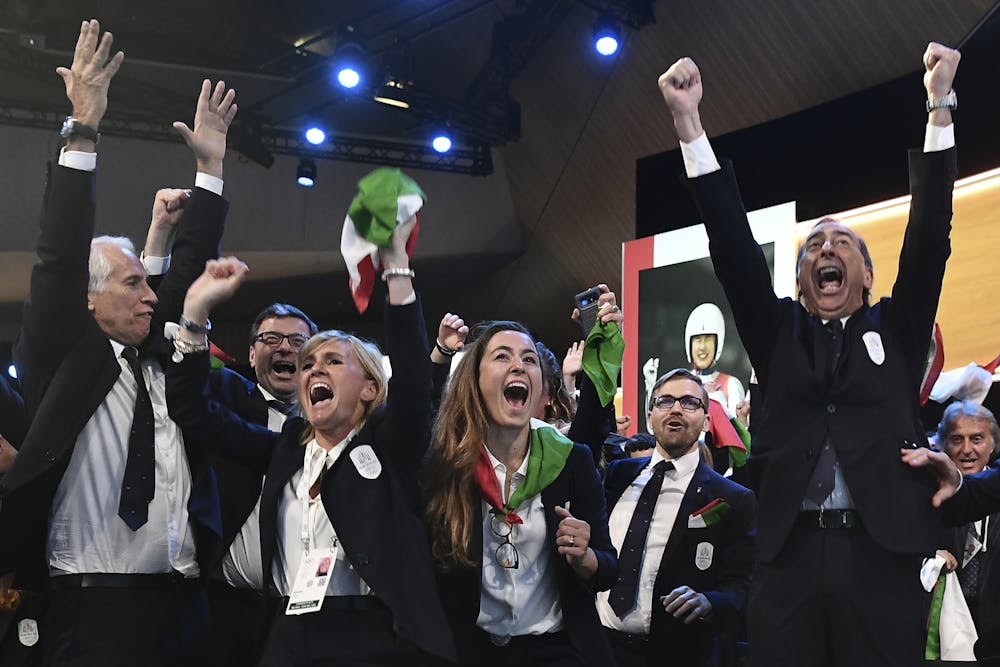 Team Italy. Philippe Lopez/Pool via AP
Rising costs
Advocates for hosting the Olympics say the events draw such big investments in facilities and infrastructure and boost current and future tourism income enough to be worth it. But most experts agree that these claims don’t hold up because the costs are too high.
Cities generally lose money when they serve as hosts, even though calculating the exact tab in terms of the money spent on infrastructure, transportation, sanitation, security and more is next to impossible.
What is clear is that hosting the Winter Games is getting more and more costly for local and national governments that shoulder most of the expense and no one denies that the events almost always exceed their budgets.
For example, local authorities, the state of Utah, the federal government, corporate sponsors and the IOC spent an estimated US$2.5 billion when Salt Lake City hosted the 2002 Winter Games. The 2006 Games in Turin, Italy cost $4.4 billion, and the 2010 games in Vancouver cost $7.6 billion.
The 2014 Winter Games in the Russian resort town of Sochi cost the host country and region more than $50 billion according to many estimates. This record tab subsequently catalyzed opposition around the globe in communities where city officials submit their own bids to host the event. The 2018 Games that took place in the South Korean city of Pyeongchang cost much less at $13 billion.
Waning interest
As the expenses rise, the number of cities vying to host the Winter Games is dwindling.
After four of the original six candidates for the 2022 Winter Games bowed out, the IOC chose Beijing – where it almost never snows. All the skiing events will take place 120 miles away in the city of Zhangjiakou when that event gets underway on Feb. 4, 2022.
Aside from the Swedish and Italian contenders for the 2026 Winter Games, the six cities that met IOC standards included Calgary, Canada; Graz, Austria; Sapporo, Japan; and Sion, Switzerland. The IOC eliminated a fifth, Erzurum, Turkey, which it said wasn’t eligible.
More than half of the public in Calgary and Sion opposed hosting the Winter Games in those places. Graz withdrew based on expectations that local residents would object and a realization that the provincial government opposed the bid. Sapporo withdrew after a major earthquake shook Japan.
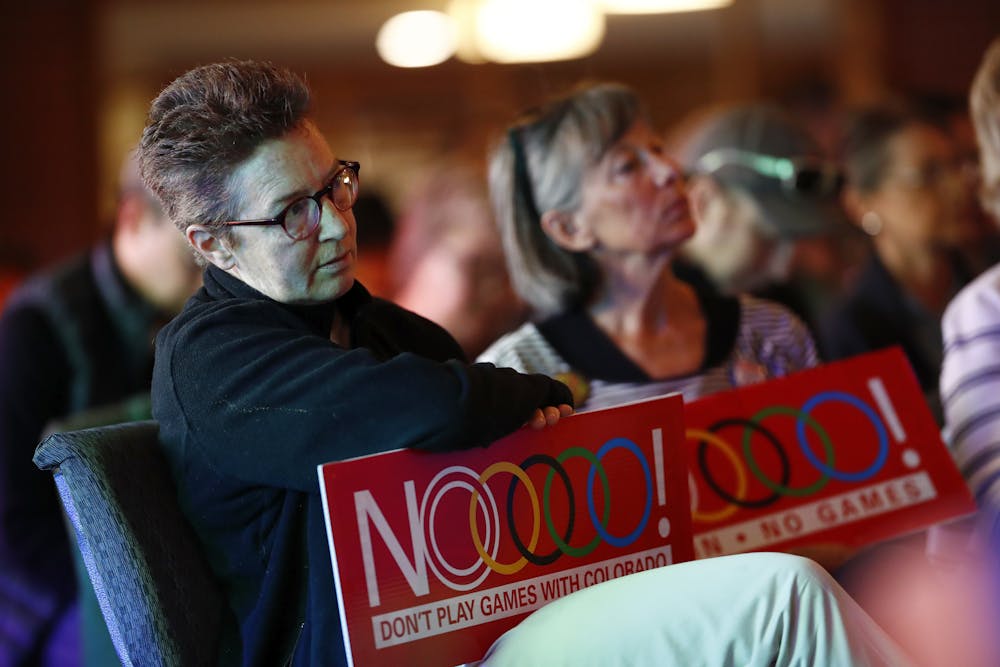 Opponents of hosting the Winter Games in Denver objected to the concept at a town hall in 2018. AP Photo/David Zalubowski
Climate change
The IOC’s own polling found that a much bigger share of the Italian public favored hosting the Winter Games in 2026 than was the case in Sweden. But hosting in Stockholm and the village of Åre would have been more practical for a simple reason: It’s colder there and the Swedish region gets far more natural snow than Milan and Cortina d’Ampezzo.
Looking ahead, we believe that climate change will make it even harder to find willing host cities that are snowy enough to hold this event. A multinational team of researchers led by the University of Waterloo in Canada has predicted that by the 2080s as few as four places that have hosted the Games in the past or will soon do so may have climates that are reliably cold enough to do so again: Calgary, Salt Lake City, Albertville, France and Beijing – which gets very little precipitation in the wintertime.
Already, the Winter Games are harder on the environment than other big events. That’s because they require the construction of venues and other infrastructure, which is often located in protected areas – potentially harming endangered plants and animals.
Due to the risks tied to running out of snow, hosts stockpile natural snow or divert and use a lot of water to make mountains of artificial snow that’s expensive and harder on the environment.
The future
What might help contain costs, alleviating the public’s qualms?
The simplest way to reduce expenditures would be for cities to use existing infrastructure instead of building anew. Hosting the Winter Games and the Summer Games in the same places, as is happening for the first time with Beijing, might for this reason appear to be practical. But it might not be, due to the lack of natural snow in the Chinese capital.
Building Olympic venues at permanent sites in a more appropriate climate than Sochi, Pyeongchang or Beijing would surely cost less over time. But historically the IOC has opposed that solution out of concern that if the Olympics stops rotating between different countries it will no longer be a truly global event or able to operate independently.
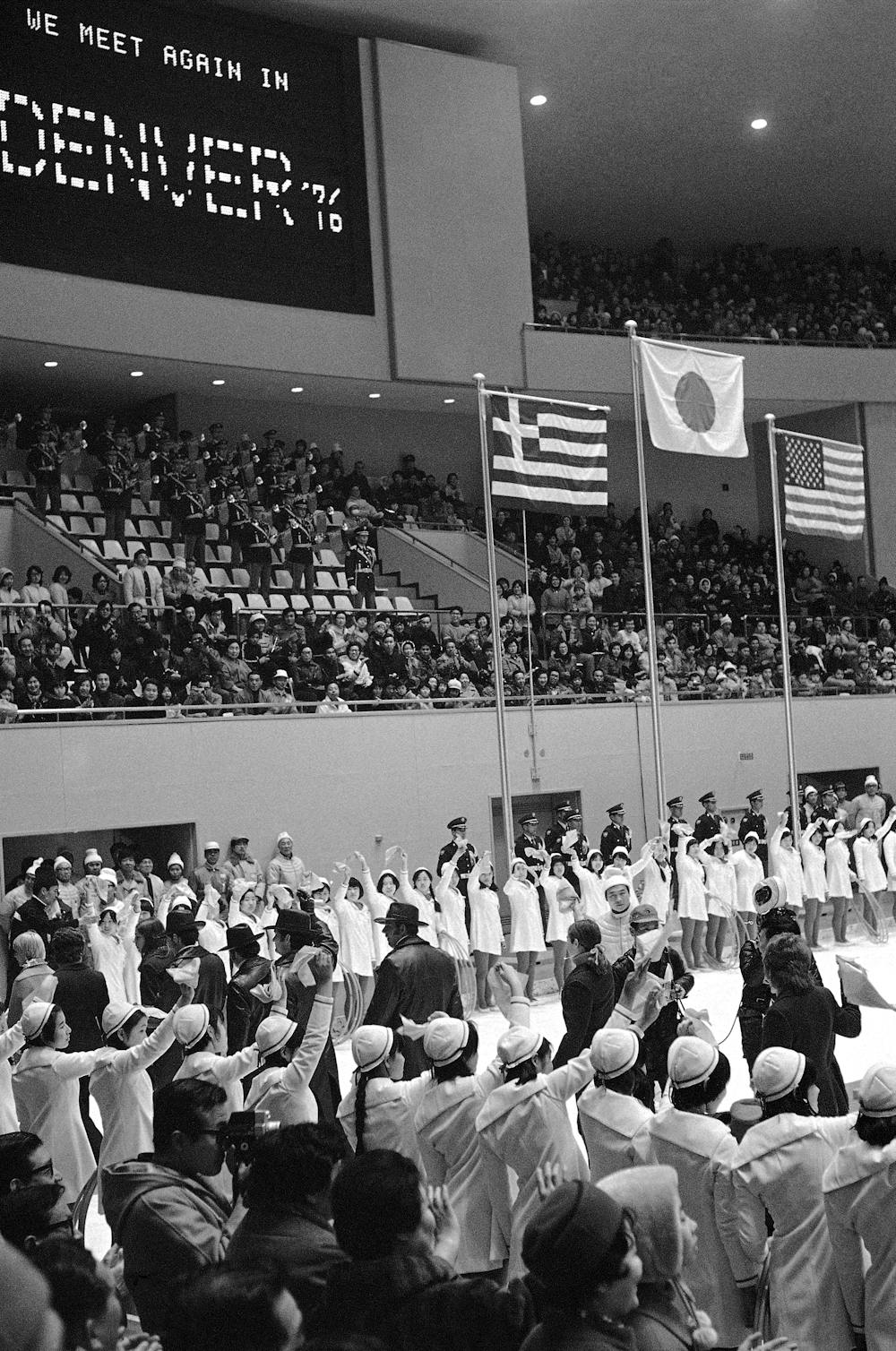
Denver was supposed to host the Winter Games in 1976, before the city backed out of that plan. AP Photo
For decades after Chamonix, France hosted the Winter Sports Week in 1924 that served as a template for the Winter Games, many cities eagerly sought a chance to host their own.
Until now, only one city has ever rejected the opportunity. After having won the bid to host the 1976 Winter Olympics, Denver held a referendum over whether to borrow $5 billion to cover the costs and its voters rejected that plan.
To be sure, the Winter Games is bound to find willing hosts even if there’s no city on earth where the locals want to do the honors – as long as there are authoritarian governments. We have observed that regimes where freedom of speech and electoral power are limited at best have grown more likely to proceed with bids because the public opposition in those countries is inherently quieter and weaker.
[ Like what you’ve read? Want more? Sign up for The Conversation’s daily newsletter. ]
Mark Wilson, Professor, Urban & Regional Planning, School of Planning, Design and Construction, Michigan State University and Eva Kassens-Noor, Associate Professor, Urban & Regional Planning Program and Global Urban Studies Program, Michigan State University
This article is republished from The Conversation under a Creative Commons license. Read the original article.

