What is Novichok? A neurotoxicologist explains
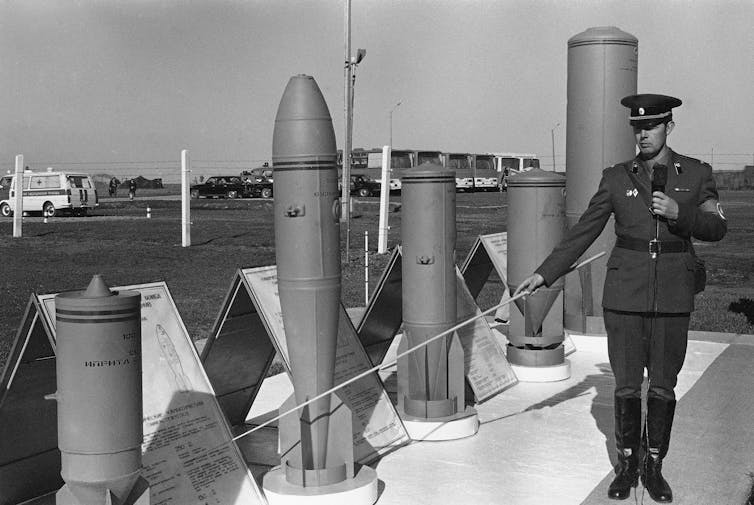 In this file photo taken on on Oct. 4, 1987, a Soviet army officer presents ammunition rigged with chemical agents during a visit by Western diplomats and journalists to a chemical weapons research facility in Shikhany, Saratov region, Russia. The facility in Shikhany led the efforts to develop Soviet chemical weapons, including Novichok-class nerve agents. John Thor Dahlburg/ AP Photo William Atchison, Michigan State University
MSU's William Atchison, professor of pharmacology and toxicology, wrote this piece for The Conversation, an independent collaboration between editors and academics that provides informed news analysis and commentary to the general public. See the entire list of articles written by MSU faculty for The Conversation.
Novichok, or “newcomer” in Russian, refers not to a single chemical but rather a group of related molecules designed for only one purpose: to kill.
Soviet Scientists applied that nickname to extremely toxic “nerve poisons” developed between the 1970s and 1990s.
I am a neurotoxicologist. Since 1980 I have studied how environmental chemicals and toxins can disrupt or block chemical signaling in the nervous system, leading to temporary and sometimes permanent health problems. Our work has explored the role of environmental chemicals in diseases such as ALS and the autoimmune disease Lambert-Eaton Syndrome. I and my team have also focused on neuromuscular signaling, which is a target of Novichok.
Novichok kills by disrupting communication between nerves and muscles or nerves in the brain. They work within minutes by paralyzing the muscles responsible for breathing, and stopping the heart. Seizures also occur. However, in some cases, if the dose is insufficient, death may be delayed or prevented but the victim continues to suffer from seizures, neuromuscular weakness, liver failure, and other damage.
To be clear, much of what is known about Novichok is conjecture. It is based on the limited information provided by two Russian chemists, one a defector, and the other who accidentally poisoned himself with a Novichok compound and died, though not immediately. It is his delayed clinical symptoms which have been the basis for understanding about what can happen when death isn’t immediate.
Novichok has been implicated in the poisoning of two couples in Great Britain, causing the death of one woman. The chemical structures of Novichok agents are not known for sure, but they bind more tightly and rapidly to their enzyme target, called acetylcholinesterase, found in nerves and muscle cells than other nerve poisons such as sarin or tabun. This causes death within minutes by making normal nerve-muscle, nerve-gland, and nerve-heart function impossible.
The deaths have been attributed to Russia, either the country’s intelligence service or a rogue who obtained them illegally. Russia vehemently denies either involvement in the poisonings or development of the Novichok chemicals.
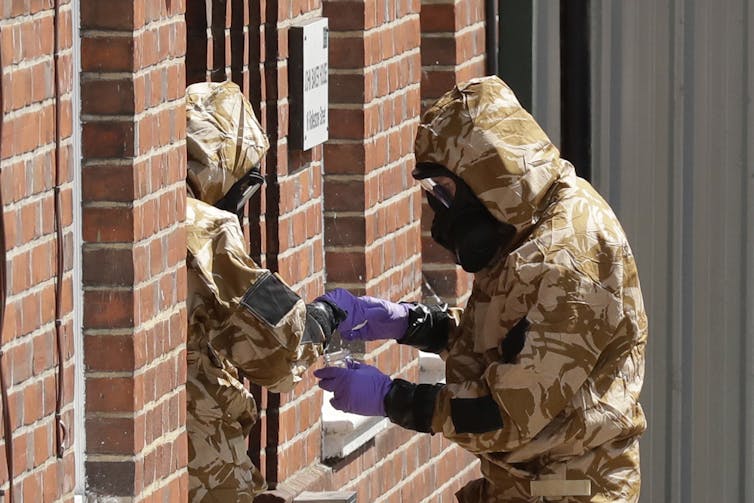 Emergency workers in military protective suits search the fenced-off John Baker House for homeless people on Rollestone Street in Salisbury, England, Friday, July 6, 2018. British police are scouring sections of Salisbury and Amesbury in southwest England, searching for a container feared to be contaminated with Novichok. Matt Dunham/AP Photo
How long these chemical stay active is unknown, largely because they were developed illegally and in secret by Soviet and later Russian chemists as part of a program entitled “Foliant” designed to skirt the guidelines of the Chemical Weapons Convention signed with the United States, and to elude detection by weapons inspectors, according to a classified Pentagon report originally made public by The Washington Times. An article from the BBC speculates that the agent used in the Wiltshire poisonings in Britain could remain active for as long as 50 years.
Several factors make Novichok especially sinister.
First, the chemicals are reported by Soviet chemists to be the most potent agents ever made, with potency between 6-10 times higher than VX, the chemical used to kill the half brother of Kim Jong-Un, or sarin, the prototypical poisonous nerve gas the Iraqi government allegedly used in 1989, and which was used Syria last April. Thus extremely low doses, powder or liquid, the exact concentration of which remains unknown, are lethal.
More disturbing, especially for those living near the poisonings in Britain, is that the Novichok agents were designed to be undetectable by NATO chemical warfare detection methods, and to circumvent any NATO protective gear. This would allow them to be used with impunity by the Soviet Union (or Russia), against NATO troops. Professor Gary Stephens, quoted in the BBC News, concurred that the Novichok agents would be extremely difficult to detect. It would be equally difficult to clean up, because exactly which of the Novichok chemicals was used cannot be definitively determined.
Though Novichok agents have never yet been used on a battlefield, their sole purpose is for chemical warfare. Their mission: kill rapidly, silently and undetectably. Apparently, as seen in Britain, these chemists succeeded in their mission.