As published in Chicago Tribune and News & Observer. MSU's Jonathan Spiegler, political science doctoral student co- wrote this piece for The Conversation, an independent collaboration between editors and academics that provides informed news analysis and commentary to the general public. See the entire list of articles written by MSU faculty for The Conversation.
Gun violence remains a highly controversial issue in the wake of school shootings in Parkland, Florida, and other communities. At such times, politicians seem compelled to offer the public solutions.
The two most prominent solutions put forth are stricter gun control laws and addressing mental illness.
The frequency with which these two solutions are proposed might suggest that they are equally important. Yet, there is little research that directly tests the relative effectiveness of stricter gun control versus a mental illness solution.
We are political scientists who have studied this issue. In a forthcoming paper from Policy Studies Journal, we report on our study of stricter gun control laws versus greater access to mental health services. We examined the relative effectiveness of each policy approach on the number of gun-related deaths for each state during the years 2012 and 2013.
What we find casts serious doubt on the ability of mental health care alone to reduce the rate of gun violence.
Testing each approach
Gun control refers to a wide variety of laws designed to reduce gun violence. These measures include restrictions on the types of guns that can be manufactured and sold, the size of ammunition magazines, where one can carry a firearm, and who can carry one.
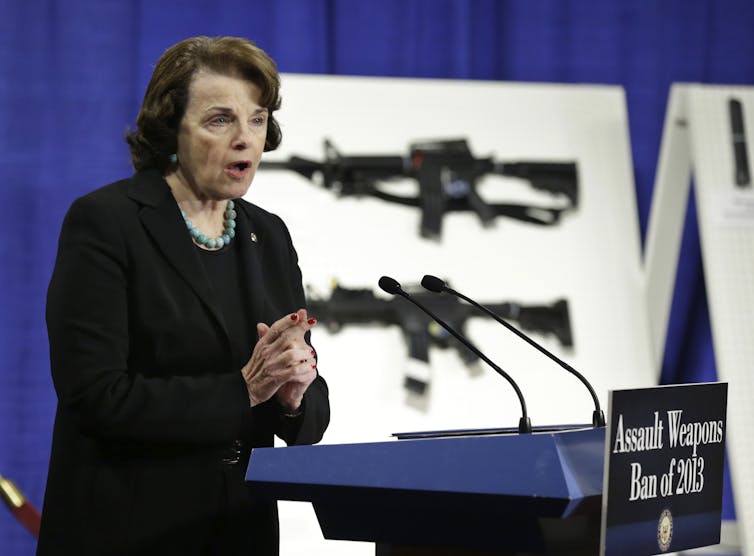
There are two main rationales behind these types of restrictions. One, they make it less likely that someone intent on violence will be able to get a gun. And two, by making the weapon less deadly, gun control laws reduce the danger that the victim of a gun attack will die.
The other approach to reducing gun violence advocated by many politicians is the mental health approach. They argue that there is a link between mental illness and violence and say that addressing that link would reduce gun violence. Since mental illness can often be managed by treatments including psychotherapy and/or drug therapy, proponents say that providing mental health services will make it less likely that those with a mental illness will become violent.
We wanted to test whether these ideas were true. So we looked at both the strictness of gun control laws and access to mental health care for those who need it at the state level. We wanted to determine the relative effects of these two approaches on the number of gun-related deaths in each state.
To do that, we used data on gun control from the Brady Campaign to Prevent Gun Violence, and data on mental health from the federal government.
What we found was surprising.
Policy choices are real
While strict gun control laws alone were strongly correlated with fewer gun deaths (as expected), greater access to mental health services alone appeared to have no significant effect on the number of gun fatalities.
We also found evidence that a combination of both approaches was effective at reducing the rate of gun deaths. States that had both strict gun control laws and a high percentage of residents with access to mental health care experienced fewer gun deaths than the mental health care solution alone.
The results of our study can be further broken down into two categories: suicides, which represent the majority of gun deaths, and non-suicides, which include mostly homicides and a few accidental shootings.
The results for non-suicides are the same as the overall results. Both strict gun control and the combination of gun control and mental health care were effective at preventing non-suicides.
However, for just suicides, the combination approach was ineffective.
The reason for this difference may result from the way that gun laws target those with mental illness. To legally take away someone’s guns due to mental illness, he or she must first be declared mentally incompetent by a court, or committed to a mental institution.

In practice, those with a mental illness that makes them more likely to be homicidal than suicidal – such as schizophrenia – are more likely to be committed or declared mentally incompetent. And greater access to mental health care likely leads to greater rates of commitment due to mental illness.
So gun control laws related to mental health – such as those that allow law enforcement to take guns away from a person likely to harm others – are more likely to target those with a mental illness that makes one homicidal rather than suicidal. As a result, these laws reduce homicides committed by those with a mental illness, but are ineffective at reducing suicides.
 The implication of this for policymakers interested in reducing gun violence is that providing more mental health care alone is unlikely to significantly reduce gun deaths in the United States. Instead, any policy to reduce gun violence should include stricter gun control laws.
Jonathan Spiegler, PhD Student in Political Science, Michigan State University and Jacob Smith, Ph.D. Candidate in Political Science, University of North Carolina at Chapel Hill
This article was originally published on The Conversation. Read the original article.

