Shannon Schmoll, director of Abrams Planetarium at Michigan State University, wrote this piece for The Conversation, an independent collaboration between editors and academics that provides informed news analysis and commentary to the general public. See the entire list of articles written by MSU faculty for The Conversation.
As comets blaze across the night sky, they can bring wonder and excitement to those watching from Earth – or even a sense of impending doom. In the past, people debated what comets even are – an atmospheric phenomenon, a fire in the sky, a star with a broom-like tail?
You’ll get a chance to see which visual description you think fits best this month: Comet 46P/Wirtanen is expected to make an appearance in mid-December that may well be visible even to the naked eye.

Anatomy of a comet
Through Edmond Halley’s study in the 17th century of what became known as Halley’s comet, astronomers realized comets are within our solar system. They have highly elliptical or elongated orbits around the sun. Some have orbits that extend well beyond Pluto while some stay relatively close.

When comets are farther out in the solar system, they’re not much to look at. They’re often compared to dirty snowballs. But unlike a rocky asteroid, a comet also has volatile frozen gases such as methane, carbon monoxide, carbon dioxide and ammonia along with their nucleus of rock, ice and dust.
As a comet gets closer to the sun, heat causes the comet’s volatile elements to turn from solid into gas in a process called sublimation. As water, methane, carbon dioxide, and ammonia are released, it creates the tail comets are known for, as well as a bright cloud called a coma around its nucleus.
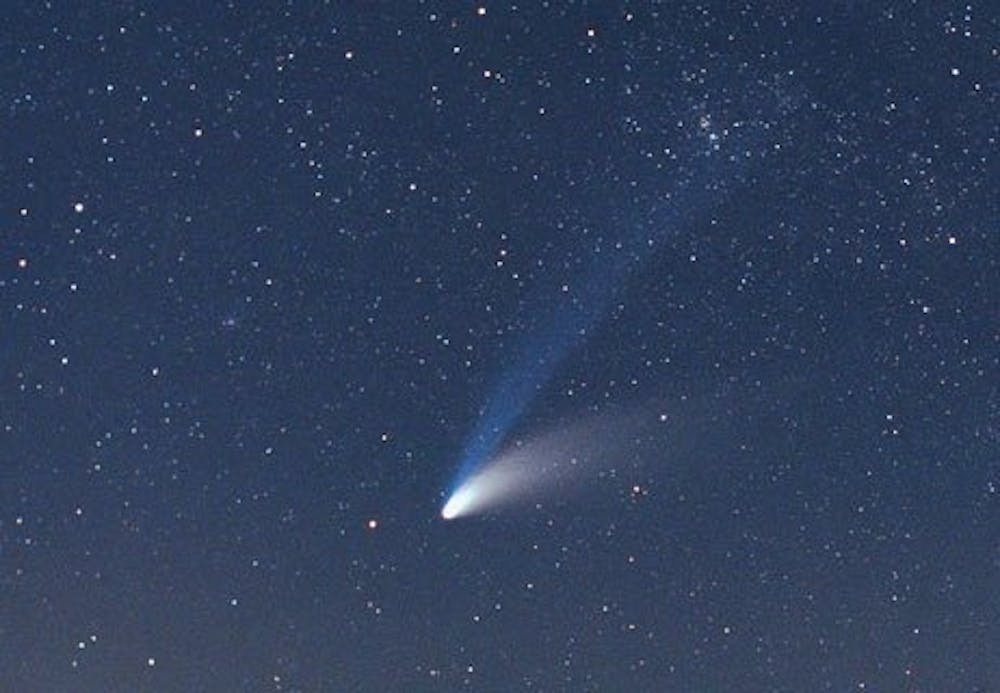
Comets actually have two distinct tails: one a dust tail, the other an ion or gas tail. Solar wind and radiation pressure push the tails away from the sun. Ultraviolet light ionizes some of the tail material, creating a charged gas that interacts with the charged solar wind and ends up pointing directly away from the sun. The noncharged dust tail still follows the comet’s orbit, resulting in a more curved tail.
As a comet goes through this process, it will brighten, making for a great show for stargazers – or rather, cometgazers. Predicting how bright a comet will be is notoriously difficult though, since it’s never clear exactly how the gases will behave. Even measuring the brightness is tricky. Unlike the way a star’s brightness is concentrated into a single point from our perspective on Earth, a comet’s brightness is diffused over a larger area.
A visit from 46P/Wirtanen
Astronomer Carl Wirtanen discovered his namesake comet in 1948. He was a skilled object hunter and used photos of the night sky to spot the quickly moving object, at least astronomically speaking.
Comet 46P/Wirtanen’s orbit keeps it pretty near to the sun. Its aphelion, or farthest point from the sun, is about 5.1 astronomical units (AU), which is just a tad bigger than Jupiter’s orbit. Its perihelion, or closest approach to the sun, is about 1 AU, just about the Earth’s distance from the sun. This path takes about 5.4 years to complete, meaning it comes back into view quite frequently compared to other famous comets.
Right now, it is approaching its perihelion. Its closest point to the sun will fall on Dec. 16 – which is why it will be brightest on this day.
Comet 46P/Wirtanen is a particularly active comet – called a hyperactive comet – and tends to be brighter than other comets of a similar size. This makes it a good candidate for viewing. Predictions suggest it will be as bright as a magnitude 3, which is a little brighter than the dimmest star in the Big Dipper, Megrez. However, there are some predictions that keep it beyond naked eye visibility at a brightest magnitude of only 7.6. The dimmest object visible with the naked human eye is magnitude 6, under perfect observing conditions.
If those magnitudes seem a little off, it’s because astronomers use a backwards system. The smaller the number, the brighter the object.
To try to see this comet, get to as dark a sky as you can on Dec. 16, when it will be at its brightest. It will be between the constellation Taurus and the Pleiades star cluster.
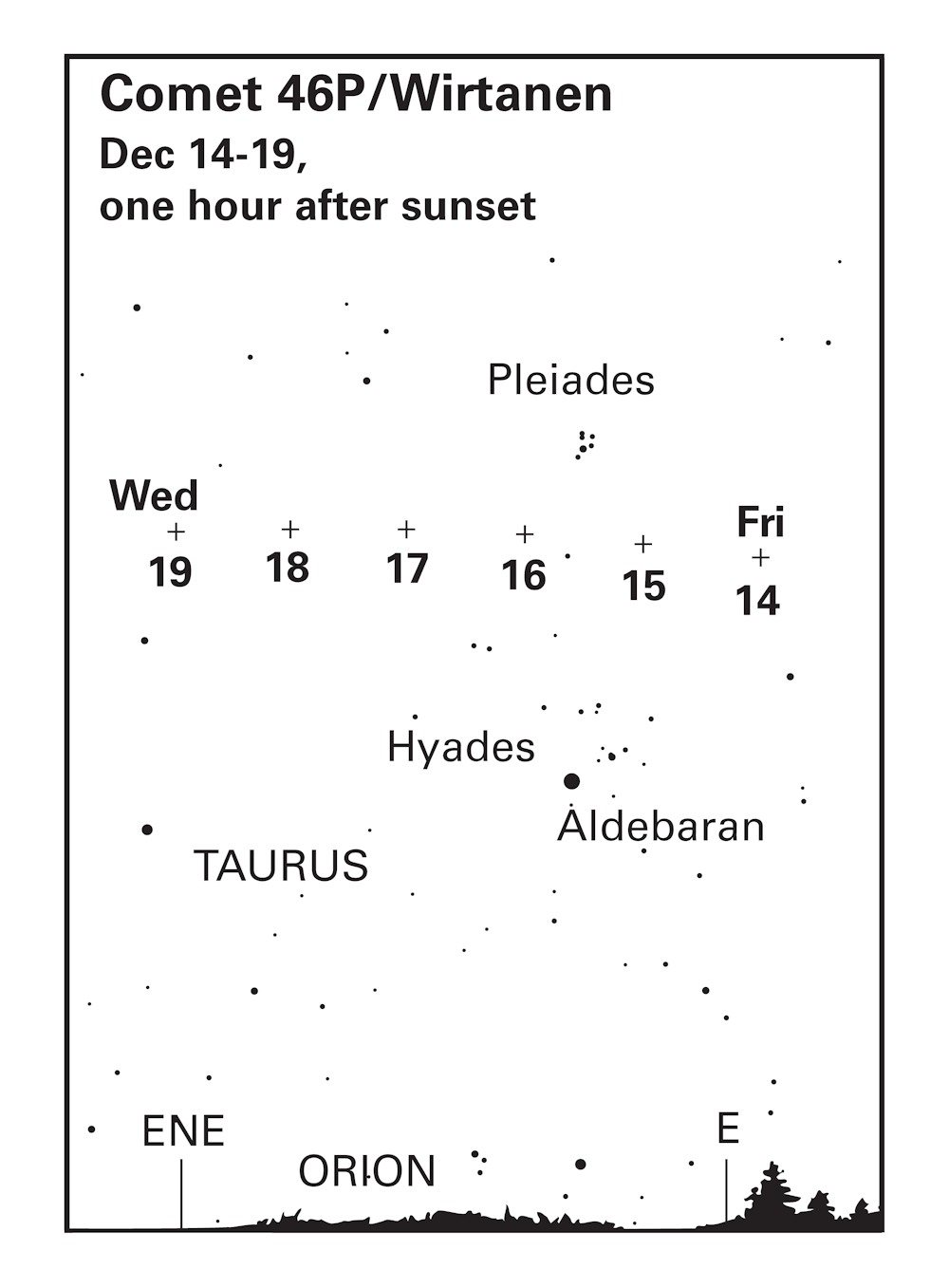
The plus sign indicates where you can spot Comet 46P/Wirtanen the evenings of Dec. 14 through 19. The plot is set for one hour after sunset for a latitude between 40-90 degrees. John French, CC BY-ND
If you cannot see Comet 46P/Wirtanen with your naked eye, use binoculars or a small telescope to catch a glimpse. The comet is already in the sky, but requires a telescope. You can start following now using maps showing its position night by night. Its location in the sky also means it is visible for all but Earth’s extreme southernmost latitudes.
The comet’s position near Taurus makes it ideal for spotting all night long. Taurus is just in the east after the sunset and moves toward the west throughout the night.
May you have clear skies for observing. You can decide for yourself whether this comet will be an omen of good or bad luck for 2019.
This article is republished from The Conversation under a Creative Commons license. Read the original article.

