Robert Montgomery, assistant professor in Michigan State University's Department of Fisheries and Wildlife, and Arthur Muneza, doctoral candidate at MSU, wrote this piece for The Conversation, an independent collaboration between editors and academics that provides informed news analysis and commentary to the general public. See the entire list of articles written by MSU faculty for The Conversation.
Two years ago, the conservation status of giraffes was downgraded from “least concern” to “vulnerable” after it was discovered that the species had declined by 40 percent over the past 30 years.
Giraffe populations are largely threatened by human activities. These include habitat loss and fragmentation, civil unrest, illegal hunting, poaching and climate change.
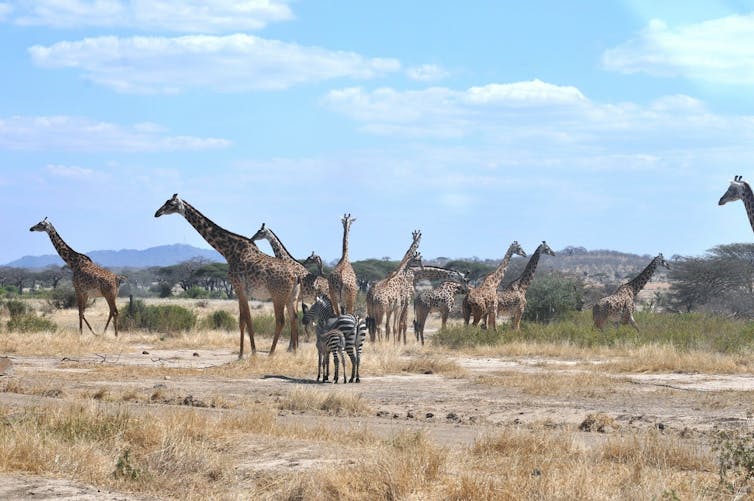
Protecting them has become a priority. This is particularly true in East Africa which is home to an estimated 55.2 percent of the remaining 100,000 giraffes living in the wild in Africa. They are mostly concentrated in Kenya, Tanzania, and Uganda.
Our research identified another threat, a disease generically referred to as Giraffe Skin Disease. The disease is characterised by large greyish-brown lesions that form on various parts of a giraffe’s body. We conducted our research in 2014 and by 2015 Giraffe Skin Disease was recorded in seven African countries – Kenya, Uganda, Tanzania, Namibia, Botswana, Zimbabwe and South Africa. The disease is most prevalent in East Africa, where it affects 86 percent of the giraffes in Ruaha National Park, Tanzania.
The disease can break out in different parts of a giraffe’s body depending where they’re located. For example, in Tanzania giraffes’ legs are affected while in Uganda it tends to be the neck and shoulders.
We were unable to establish whether the disease was fatal. But we concluded that it’s possible giraffes are made more vulnerable to predators if they have lesions that make fleeing a predator difficult.
Our research revealed that skin disease is more widespread than initially thought and more conservation research is required. The disease was first described in Uganda in 1994 and in Tanzania in 2000. Yet it’s only recently that researchers have started to study it in detail.
Threats
Giraffes face unprecedented risks as the region experiences some of the fastest human population growth rates in the world. One of consequences is likely to be subsistence hunting. According to conservation organisations in southern Kenya, if a poacher manages to sell meat as well as parts from a single giraffe, the return can fetch a minimum of $1,000. This is enough to purchase a motorbike.
In northern Tanzania, giraffe parts are used in traditional medicine. And giraffe bone marrow and brains are incorrectly believed to cure AIDS.
Poison arrows, spears, and rifles are used to kill giraffes. However, the most common tools used are wire snares attached to trees. These typically capture giraffes around their necks or legs. In areas such as Murchison Falls National Park, Uganda, giraffes aren’t necessarily the intended target when caught in snares. The traps are set to capture smaller antelope for food but can trap giraffes. The injuries they sustain can be fatal.
Giraffe skin disease is reportedly caused by a parasitic worm – the specific species of the worm has not been identified. The severity of the lesions is further complicated by secondary fungal infections. While the severe form of the disease restricts the movement of giraffes, very few studies have examined the exact cause of the disease and its physiological effects. In addition, it is still unclear whether the disease leads to mortality.
As humans and wildlife become more interactive with increasing encroachment of wildlife habitats, there should be a bigger focus on wildlife diseases. Understanding the effects of these skin disease lesions will undoubtedly help advance giraffe conservation as the role of diseases in the decline of giraffe populations across Africa is still unclear.
Next steps
For a long time, conservation issues have been addressed from an ecological perspective, not taking into account the human dimensions of conservation. To this end, the socio-economic and cultural importance of giraffes remains poorly understood and documented.
One of our projects, the Snares to Wares Initiative, seeks to address this. The initiative reuses the raw wire from snares set in Murchison Falls National Park to create wire art, which is sold around the world. This addresses a conservation and human livelihood issue by providing benefits and an alternative source of income to young locals. The initiative also trains students through the Research on the Ecology of Carnivores and their Prey Laboratory.
Knowledge gaps and lack of incentives for wildlife conservation deter local communities from contributing towards preservation of wildlife and wild spaces. The lab’s approach is to recruit students from different backgrounds working collaboratively to address conservation issues. The students gain skills in socio-economics and wildlife ecology and drive conservation efforts from the East African region and beyond.
Arthur Muneza, PhD candidate, Michigan State University, Michigan State University and Robert Montgomery, Assistant Professor, Department of Fisheries and Wildlife, Michigan State University
This article is republished from The Conversation under a Creative Commons license. Read the original article.

