Jump to HeaderJump to Main ContentJump to Footer
Michigan State University
  • Browse Stories By

    Topics

    Explore stories by subject area

    • Arts and Culture
    • Business and Economy
    • Climate and Environment
    • Education and Learning
    • Engineering, Science and Technology
    • Government and Society
    • Health and Medicine
    • Media and Communications
    • MSU Leadership and Impact
    • Sports and Recreation
    • Student and Campus Experience
    View All Stories

    Collections

    Curated story series

    • Turfgrass
    • Ask the Expert
    • Big Ideas
    • Climate solutions
    • Water at MSU
    • Mobility
    • Spartan Perspectives
    • Student views
    • Graduate voices
    • Faculty voices
    View All Collections

    Featured

    Editor's picks

    • The Spartans behind your favorite Michigan golf courses

      July 22, 2026

      The Spartans behind your favorite Michigan golf courses

    • MSU in the 1990s: 10 Spartan milestones

      July 14, 2026

      MSU in the 1990s: 10 Spartan milestones

MSUTODAY
  • Browse Stories By

< Browse Stories By

Topics

Explore stories by subject area

  • Arts and Culture
  • Business and Economy
  • Climate and Environment
  • Education and Learning
  • Engineering, Science and Technology
  • Government and Society
  • Health and Medicine
  • Media and Communications
  • MSU Leadership and Impact
  • Sports and Recreation
  • Student and Campus Experience
  • View All Stories

Collections

Curated story series

  • Turfgrass
  • Ask the Expert
  • Big Ideas
  • Climate solutions
  • Water at MSU
  • Mobility
  • Spartan Perspectives
  • Student views
  • Graduate voices
  • Faculty voices
  • View All Collections

Featured

Editor's picks

  • The Spartans behind your favorite Michigan golf courses

    July 22, 2026

    The Spartans behind your favorite Michigan golf courses

  • MSU in the 1990s: 10 Spartan milestones

    July 14, 2026

    MSU in the 1990s: 10 Spartan milestones

  • For Media
  • Experts
  • Releases and Statements
  • Sign Up
  • Update Information

Resources

  • A to Z Index
  • Find People
  • Maps
  • Email
  • Student Information System (SIS)
  • D2L
  • Libraries
  • Tech Support
  • MSU Misconduct Hotline
  • Social Media Directory
  • Events Calendar
  • For Media
Michigan State University
MSUToday
  • For Media
  • Experts
  • Releases and Statements
  • Sign Up
  • Update Information
MSUTODAY
Natural Sciences

Oct. 16, 2018

Evolution is at work in computers as well as life sciences

By: Arend Hintze

Arend Hintze, MSU assistant professor of integrative biology and computer science and engineering, wrote this piece for The Conversation, an independent collaboration between editors and academics that provides informed news analysis and commentary to the general public. See the entire list of articles written by MSU faculty for The Conversation.
File 20181011 154555 l3rbo1.jpg?ixlib=rb 1.1

Artificial intelligence research has a lot to learn from nature. My work links biology with computation every day, but recently the rest of the world was reminded of the connection: The 2018 Nobel Prize in Chemistry went to Frances Arnold together with George Smith and Gregory Winter for developing major breakthroughs that are collectively called “directed evolution.” One of its uses is to improve protein functions, making them better catalysts in biofuel production. Another use is entirely outside chemistry – outside even the traditional life sciences.

That might sound surprising, but many research findings have very broad implications. It’s part of why just about every scientist wonders and hopes not only that maybe they would be selected for a Nobel Prize, but, far more likely, that the winner might be someone they know or have worked with. In the collaborative academic world, this isn’t terribly uncommon: In 2002, I was studying under a scholar who had studied under one of the three co-winners of that year’s Nobel Prize in Physiology or Medicine. This year, it happened again – one of the winners has written a couple of papers with a scholar I have collaborated with.

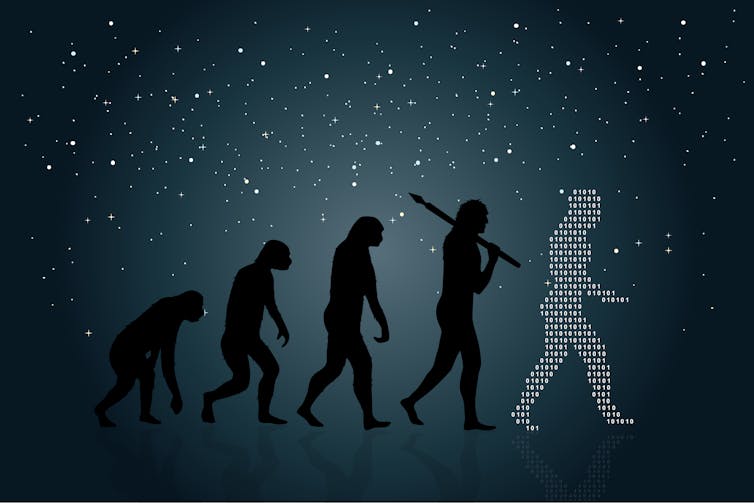
Beyond satisfying my own vanity, the award reminds me how useful biological concepts are for engineering problems. The best-known example is probably the invention of Velcro hook-and-loop fasteners, inspired by burrs that stuck to a man’s pants while he was walking outdoors. In the Nobel laureates’ work, the natural principle at work is evolution – which is also the approach I use to develop artificial intelligence. My research is based on the idea that evolution led to general intelligence in biological life forms, so that same process could also be used to develop computerized intelligent systems.

When designing AI systems that control virtual cars, for example, you might want safer cars that know how to avoid a wide range of obstacles – other cars, trees, cyclists and guardrails. My approach would be to evaluate the safety performance of several AI systems. The ones that drive most safely are allowed to reproduce – by being copied into a new generation.

Yet just as nature does not make identical copies of parents, genetic algorithms in computational evolution let mutations and recombinations create variations in the offspring. Selecting and reproducing the safest drivers in each new generation finds and propagates mutations that improve performance. Over many generations, AI systems get better through the same method nature improves upon itself – and the same way the Nobel laureates made better proteins.

In the effort to understand human intelligence, many researchers are working to reverse-engineer the brain, figuring out how it works at all levels. Complex gene networks control the neurons that form the layers of the neocortex that are sitting on top of a highway of connections. These interconnections support communications between the different cortical regions that make up most of our cognitive functions. All of this is integrated into the phenomenon of consciousness.
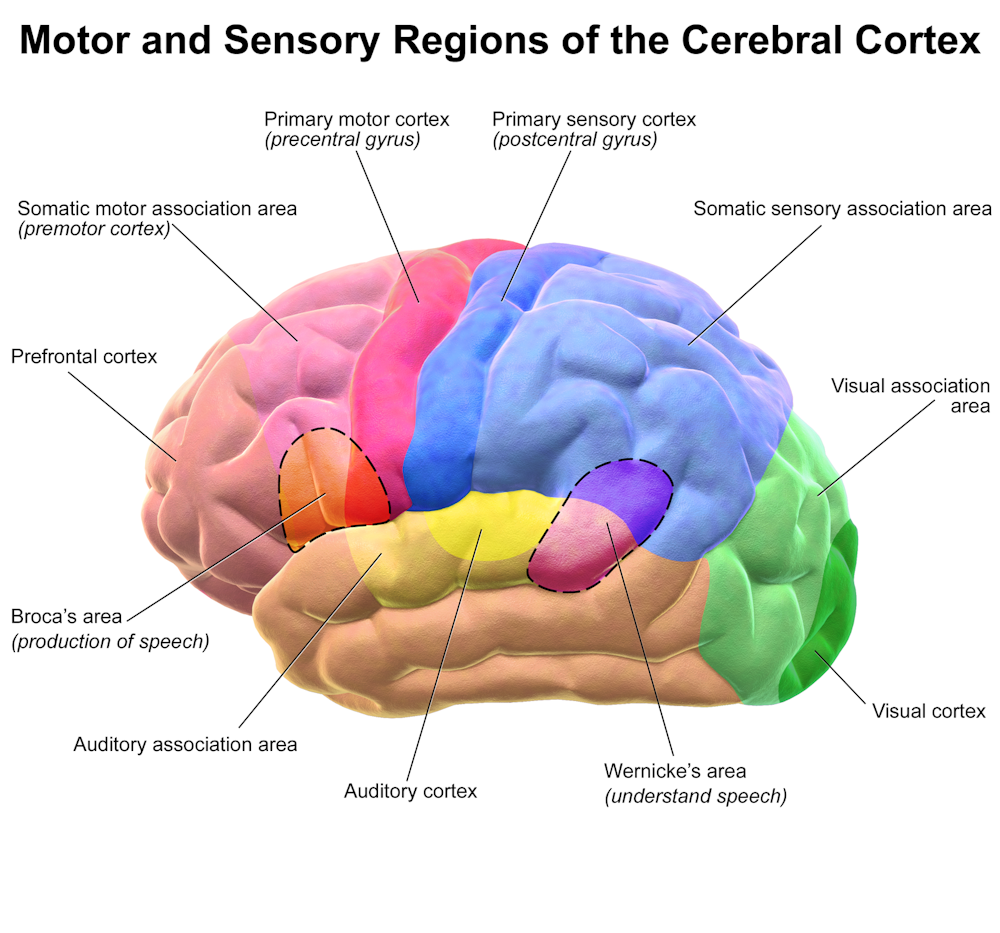

Deep learning and neural networks are computer-based approaches that attempt to recreate how the brain works – but even they can only achieve the equivalent activity of a clump of brain cells smaller than a sugar cube. There remains an enormous amount to learn about the brain – and that’s before trying to write the intensely complicated software that can emulate all those biological interactions.

Capitalizing on evolution can make systems that seem lifelike and are inherently as open-ended and innovative as natural evolution is. It is also the key methodology used in genetic algorithms and genetic programming. The Nobel Prize committee’s recognition highlights a technology that has evolution at its core. That indirectly justifies my own research approach and the idea that evolution in action is a critical research topic with vast potential.The Conversation

This article is republished from The Conversation under a Creative Commons license. Read the original article.


MEDIA CONTACTS

Layne Cameron
Natural SciencesEngineering, Science and Technology

Latest News

MSUToday Weekly Update

The MSUToday Weekly Update email showcases how Spartans are making a difference through academic excellence, research impact and community outreach. Get inspired by these stories of innovation, collaboration and determination. Plus, enjoy photos and videos of campus and more MSU content to help keep you connected to the Spartan community.

Sign UpUpdate My Information

Connect With Us

Visit our Facebook pageVisit our page on XVisit our Instagram pageVisit our LinkedIn pageVisit our YouTube pageVisit our TikTok page

Health and Safety

  • MSU Police and Public Safety
  • Olin Health Center
  • Counseling & Psychiatric Services (CAPS)
  • University Health and Wellbeing
  • MSU Health Care
  • Civil Rights and Title IX
  • Our Commitment
  • Center for Survivors
  • Security & Fire Safety Report
  • University Policy on Relationship Violence and Sexual Misconduct
  • Notice of Non-Discrimination, Anti-Harassment and Non-Retaliation
  • Health Care Non-Discrimination Notice

Support Services

  • Disability Resources
  • Supportive Services
  • Learning Resources

Working at MSU

  • Human Resources
  • EBS Login
  • Job Postings
  • Employee Assistance Program

Reports

  • CARES Act Funding
  • Student Achievement and Outcomes

Contact us

517-355-1855

Address

Michigan State University 426 Auditorium Road East Lansing, MI 48824

Follow Us

  • Visit our Facebook page
  • Visit our page on X
  • Visit our Instagram page
  • Visit our TikTok page
  • Visit our LinkedIn page
  • Visit our YouTube page

If you're having accessibility issues, please let us know.

Know More: Campus Safety Information and ResourcesTransparency Reporting: Budget & Salary/Compensation
  • Contact Information|
  • Site Map|
  • Privacy Statement|
  • Site Accessibility|
  • Call MSU: (517) 355-1855|
  • Visit: msu.edu|
  • Notice of Nondiscrimination|

SPARTANS WILL|© Michigan State University|