Jump to HeaderJump to Main ContentJump to Footer
Michigan State University
MSUTODAY
  • Browse Stories By

    Topics

    Explore stories by subject area

    • Arts and Culture
    • Business and Economy
    • Climate and Environment
    • Education and Learning
    • Engineering, Science and Technology
    • Government and Society
    • Health and Medicine
    • Media and Communications
    • MSU Leadership and Impact
    • Sports and Recreation
    • Student and Campus Experience
    View All Stories

    Collections

    Curated story series

    • Turfgrass
    • Ask the Expert
    • Big Ideas
    • Climate solutions
    • Water at MSU
    • Mobility
    • Spartan Perspectives
    • Student views
    • Graduate voices
    • Faculty voices
    View All Collections

    Featured

    Editor's picks

    • 9 reasons to love being a Spartan

      Aug. 28, 2026

      9 reasons to love being a Spartan

    • NIH awards multi-university team over $4M to improve women’s health

      Sept. 15, 2026

      NIH awards multi-university team over $4M to improve women’s health

MSUTODAY
  • Browse Stories By

< Browse Stories By

Topics

Explore stories by subject area

  • Arts and Culture
  • Business and Economy
  • Climate and Environment
  • Education and Learning
  • Engineering, Science and Technology
  • Government and Society
  • Health and Medicine
  • Media and Communications
  • MSU Leadership and Impact
  • Sports and Recreation
  • Student and Campus Experience
  • View All Stories

Collections

Curated story series

  • Turfgrass
  • Ask the Expert
  • Big Ideas
  • Climate solutions
  • Water at MSU
  • Mobility
  • Spartan Perspectives
  • Student views
  • Graduate voices
  • Faculty voices
  • View All Collections

Featured

Editor's picks

  • 9 reasons to love being a Spartan

    Aug. 28, 2026

    9 reasons to love being a Spartan

  • NIH awards multi-university team over $4M to improve women’s health

    Sept. 15, 2026

    NIH awards multi-university team over $4M to improve women’s health

  • For Media
  • Experts
  • Releases and Statements
  • Sign Up
  • Update Information

Resources

  • A to Z Index
  • Find People
  • Maps
  • Email
  • Student Information System (SIS)
  • D2L
  • Libraries
  • Tech Support
  • MSU Misconduct Hotline
  • Social Media Directory
  • Events Calendar
  • For Media
Michigan State University
MSUToday
  • For Media
  • Experts
  • Releases and Statements
  • Sign Up
  • Update Information
Politics

Sept. 7, 2018

What the 25th Amendment says about presidents who are 'unable' to serve

By: Brian Kalt

File 20180906 190653 qk9lkc.jpg?ixlib=rb 1.1

As published in UPI and Philly Voice, MSU Law's Brian Kalt, professor of law and the Harrold Norris Faculty Scholar, wrote this piece for The Conversation, an independent collaboration between editors and academics that provides informed news analysis and commentary to the general public. See the entire list of articles written by MSU faculty for The Conversation.

A stunning, unsigned op-ed in The New York Times reported on Sept. 5 that members of President Donald Trump’s Cabinet discussed removing him from power by using the 25th Amendment, but decided against it to avoid causing a “constitutional crisis.”

As a law professor who studies the presidency, I have written extensively on the 25th Amendment.

Interest in this form of presidential removal may be high, but evidence suggests it could not be used successfully against Trump at this point.

What is the 25th Amendment?

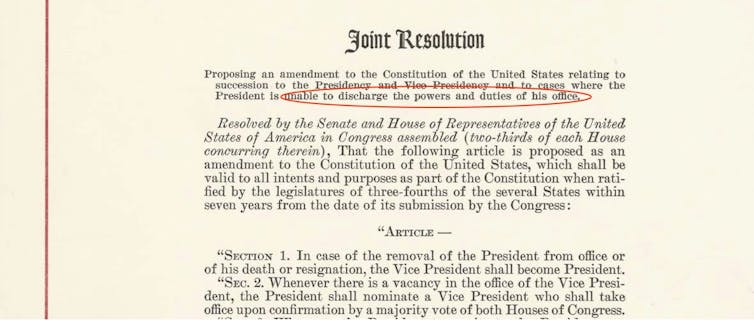
The U.S. Constitution has always specified that if the president suffers an “inability to discharge” his powers, the vice president takes over. But it supplied no details on how, exactly, this might be done.

The 25th Amendment, added in 1967, defines what happens if a president becomes “unable to discharge the powers and duties of his office.”

The president may declare himself unable to do his job and empower the vice president temporarily. Both Ronald Reagan and George W. Bush used this process before being sedated for surgery.

Alternatively, the vice president and a majority of the Cabinet may deem the president “unable to discharge the powers and duties of his office” and transfer power to the vice president. The president may later declare himself able and try to retake power.

But if the vice president and Cabinet object within four days, and are backed by two-thirds majorities in both the House and Senate, the vice president stays in power.

Impeachment and the 25th Amendment

The latter provision, which constitutes Section 4 of the 25th Amendment, is the “complex process for removing the president” referred to by the anonymous New York Times op-ed writer.

Section 4 has never been used. But it was seriously considered once.

In 1987, during a changeover in staff, President Reagan’s incoming team was advised to think about using Section 4. Mired in scandal, recovering from surgery and discouraged by Republicans’ disastrous results in the 1986 congressional elections, Reagan had become so disengaged that staffers reportedly signed his name to documents he’d never even read.

Reagan soon bounced back, showing himself quite capable of discharging his powers and duties. His new staff dropped any consideration of Section 4.

My understanding is that “unable” means being incapable of wielding power – not using it destructively. When a president misuses his powers, impeachment is the Constitution’s designated remedy.

By design, successfully using Section 4 requires much more support than impeachment, which needs just majority support in the House and two-thirds in the Senate. Displacing the president using the 25th Amendment, on the other hand, requires the additional support of the vice president, the Cabinet, and more of the House.

Because President Trump currently has enough support to avoid serious impeachment efforts, Section 4 seems wholly unfeasible.The Conversation


MEDIA CONTACTS

Kristen Parker
PoliticsGovernment and SocietyLaw and JusticeLaw and Justice

Latest News

MSUToday Weekly Update

The MSUToday Weekly Update email showcases how Spartans are making a difference through academic excellence, research impact and community outreach. Get inspired by these stories of innovation, collaboration and determination. Plus, enjoy photos and videos of campus and more MSU content to help keep you connected to the Spartan community.

Sign UpUpdate My Information

Connect With Us

Visit our Facebook pageVisit our page on XVisit our Instagram pageVisit our LinkedIn pageVisit our YouTube pageVisit our TikTok page

Health and Safety

  • MSU Police and Public Safety
  • Olin Health Center
  • Counseling & Psychiatric Services (CAPS)
  • University Health and Wellbeing
  • MSU Health Care
  • Civil Rights and Title IX
  • Our Commitment
  • Center for Survivors
  • Security & Fire Safety Report
  • University Policy on Relationship Violence and Sexual Misconduct
  • Notice of Non-Discrimination, Anti-Harassment and Non-Retaliation
  • Health Care Non-Discrimination Notice

Support Services

  • Disability Resources
  • Supportive Services
  • Learning Resources

Working at MSU

  • Human Resources
  • EBS Login
  • Job Postings
  • Employee Assistance Program

Reports

  • CARES Act Funding
  • Student Achievement and Outcomes

Contact us

517-355-1855

Address

Michigan State University 426 Auditorium Road East Lansing, MI 48824

Follow Us

  • Visit our Facebook page
  • Visit our page on X
  • Visit our Instagram page
  • Visit our TikTok page
  • Visit our LinkedIn page
  • Visit our YouTube page

If you're having accessibility issues, please let us know.

Know More: Campus Safety Information and ResourcesTransparency Reporting: Budget & Salary/Compensation
  • Contact Information|
  • Site Map|
  • Privacy Statement|
  • Site Accessibility|
  • Call MSU: (517) 355-1855|
  • Visit: msu.edu|
  • Notice of Nondiscrimination|

SPARTANS WILL|© Michigan State University|

