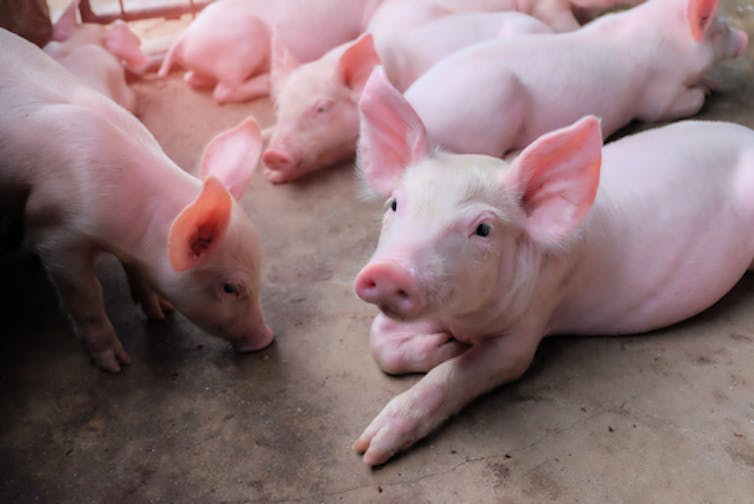
 Pigs and humans have a lot in common, particularly their digestive tracts. Krumanop/Shutterstock.com Adam Moeser, Michigan State University
MSU's Adam Moeser, Matilda R. Wilson Endowed Chair, associate professor of Large Animal Clinical Sciences, wrote this piece for The Conversation, an independent collaboration between editors and academics that provides informed news analysis and commentary to the general public. See the entire list of articles written by MSU faculty for The Conversation.
Stress affects most of us to one degree or another, and that even includes animals. My lab studies early-life stress in pigs and how it impacts their health later in life, specifically in the gastrointestinal (GI) tract. Pigs, whose GI tracts are extremely similar to those of humans, may be one of the clearest windows we have into researching stress, disease, and new therapies and preventatives – both in livestock and people.
In my study of how stress makes humans and pigs vulnerable to disease, I have seen the profound impact that stress-related chemical substances, such as hormones and peptides, can have on a body’s tissues. I’m hopeful that our research in piglets could eventually lead to treatments for both people and animals designed to mitigate the adverse effects of stress on the GI health.
How stress can save your life
Not all stress is bad. When we perceive a threat, our hypothalamus – one of our most basic parts of the brain – kicks in to protect us by triggering what many recognize as the “fight or flight” response. It is a primal evolutionary response programmed in our brains to help us first survive and then restore us to a normal set point, or what feels like stability.
 The stress response is essential to helping escape a dangerous situation, such as an attacking dog. Dmitri Ma/Shutterstock.com
What actually is happening has to do with something called the hypothalamic-pituitary-adrenal (HPA) axis, which is at the core of the stress response. During stress, the hypothalamus, a region in the brain, makes and sends out a chemical called corticotrophin-releasing factor, which signals for the pituitary gland to release another chemical, adrenocorticotrophic hormone.
This stimulates the adrenal gland to release adrenalin and cortisol. Adrenalin and cortisol, two of the most well-known stress hormones, power our bodies to react during the fight or flight response. They can heighten our response time in a fight. They can pump blood to our extremities when we flee. They can boost our immune system to protect against pathogens. That stress response gives us what we need to resolve the situation.
How stress can harm your life
Fortunately for many of us, we don’t have to deal with life-threatening situations on a regular basis. However, we still experience stress. This stress can be chronic, due to a specific situation or overall lifestyle.
But, our stress response is meant for short-term resolvable conflict. So, in a way, the stress response is misplaced in today’s world of enduring stressors. Danger comes when we experience repeated elevations of these stress hormones, or when we are exposed to too much of these stress hormones at a young age. Instead of physical threats, many of us experience psychosocial stress, which triggers a similar stress response but is often not resolvable.
For example, stress in the workplace, such as feeling overworked or undervalued, could be perceived as a threat and in turn activate the stress response. However, in these situations, the survival aspects of the stress response, such as increased heart rate and immune activation, is not effective in resolving this threat.
This results in continued production and higher levels of these stress chemicals in the body. They bind to target receptors in many organs, which can have profound effects on physiology and function.
 Stress is particularly damaging to the developing brain. Mcimage/Shutterstock.com
High levels of stress are also especially harmful when they occur at a young age, when many of the body’s important stress regulatory systems – for example, the brain and nervous systems – are still developing. Exposure to stress in early life can alter the normal development and physiology of many organ systems, resulting in increased sensitivity to stress and lifelong health risks in offspring.
Also, a mother’s stress during pregnancy can be “transmitted” to the fetus, resulting in permanent changes to the stress response system and health in offspring.
This early-life stress can fuel a constant stress response inside the body. This can include inflammation, or increased activity of the immune system, or immune suppression as its new “normal.”
Inflammation and immune suppression are unpredictable and can manifest in many parts of our body, with different consequences. For example, stress and inflammation near blood vessels can cause blood vessels to constrict. This causes elevated blood pressure, which can lead to a slew of other conditions like coronary artery disease and heart attack.
Immune suppression can reduce the body’s ability to heal wounds and make it more susceptible to other pathogens. Inflammation and immune suppression can affect anything, including our mental health. Chronic stress can traffic immune cells into the brain, where they can cause neuroinflammation, which can affect our mood and fuel diseases like depression and anxiety.
Your GI tract and you
The GI tract is our largest interface with the outside world. If you think about it, your GI system is “outside” your body; it experiences many of the pathogens and other foreign entities with which we come into contact. If you unfolded your entire GI system, it would cover a tennis court. The GI system also contains just as many neurons as your spinal cord and houses the largest collection of immune cells in the body. A system of that size is as powerful as it is susceptible.
Chronic stress that affects your GI tract can manifest as abdominal pain, diarrhea or constipation and can lead to common diseases such as irritable bowel syndrome or inflammatory bowel disease.
Early-life stress is especially concerning; scientists only now are beginning to understand the long-term consequences. My research demonstrates the impacts of early-life stress on animal health and productivity, as well as human health. In pigs, this stress can result from early weaning and other management practices. In humans, it could be from physical or emotional trauma like abuse or neglect.
What we can learn from piglets
Pigs and humans have similar digestive tracts, making pigs an excellent model for human GI disease. My research team has demonstrated early stress in piglets results in GI symptoms (e.g. diarrhea, GI infections) that are remarkably similar to stress-related GI disorders in people: Irritable bowel syndrome, inflammatory bowel disease and food allergies are examples.
Through my lab’s research of piglets and early-life stress, we have been able to significantly lower the stress and GI disease that they experience through their life by eliminating individual early-life stressors.
Much of their stress is caused through early weaning, social change due to maternal separation and mixing with unfamiliar pigs. These pigs then experience a higher rate of gastrointestinal and respiratory diseases, as well as reduced growth performance and feed efficiency into adulthood.
We also learned that a particular type of immune cell, called the mast cell, becomes highly activated during stress, which in turn causes much of the stress-associated GI disease. By focusing on animal welfare and implementing new management practices to eliminate individual stressors or intervene therapeutically with mast cell blockers, we can lower the overall threshold of stress that the piglets experience.
This basic research could result in future breakthroughs regarding how we combat stress in humans. Maybe with more fundamental research in animal models, we can develop a therapy to help lessen the impact of bad stress on our bodies.
 In the meantime, those of us experiencing stress can take action. If you experience a lot of stress on a daily basis, focus on what you can and cannot control, and then apply your energy to the things within your control while taking care of your body by eating properly, getting enough sleep, and maintaining some level of physical activity. Then, learn to cope with the things you cannot control through therapy, meditation and other stress management practices.

