 Trolls spread Russian disinformation campaigns across Europe and the U.S. Shutterstock Thomas Holt, Michigan State University
The U.S. has been rocked over the last two years by claims that the Russian government directly attempted to meddle in the 2016 presidential election.
Social media companies initially claimed such efforts must have been limited in scope. But this notion was refuted by the recent indictment of 13 Russian nationals for their actions during the election.
The indictment, brought by special counsel Robert Mueller, revealed a highly organized and sophisticated effort to drive a wedge between Americans through social media.
The recent revelations about Cambridge Analytica’s potentially illegal harvest of Facebook user information raise further questions about how much American citizens have been manipulated via social media.
Such efforts may be relatively new in the U.S. But they are part of a much larger global push by the Kremlin to affect politics across the European Union and exploit citizens through the internet.
I study computer hacking, malware and the role of the internet in fraud and deception by various actors. And I believe that the Europeans have something to teach the United States about how to protect citizens subject to Russian internet propaganda.
Russia’s mastery of disinformation
The Russians have keenly recognized that they could subvert the modern dependence on social media as a seemingly trustworthy platform for news and information. They have used Facebook, Twitter, Tumblr, Instagram and websites as tools to launch overt and covert information warfare campaigns against various nations.
The internet is a critical tool for spreading false information – or disinformation in the parlance of information warfare – to either manipulate or demoralize a nation and its people. Since most people now find news stories online, whether through traditional news media or on social media, governments can engage in campaigns of disinformation on the internet.
The Internet Research Agency is one of the primary arms of the Russian government’s propaganda efforts. It operates a “troll factory” out of St. Petersburg where individuals create and spread false information. The false information is spread through social media posts, comments in news stories and videos posted on traditional journalistic outlets. It’s also spread via websites the trolls create.
The Internet Research Agency also operates covertly through false online profiles. In some cases, they create entirely false profiles. In others, they have stolen identities in an attempt to seem like a citizen of a specific place and a true believer in a specific ideology.
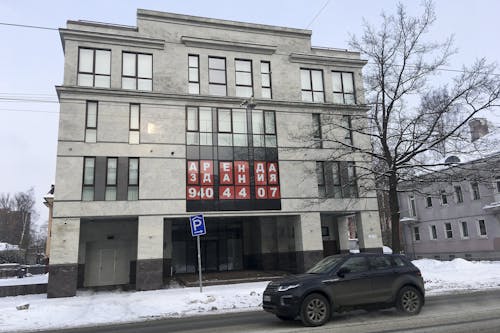 The four-story building known as the ‘troll factory’ in St. Petersburg, Russia. AP Photo/Naira Davlashyan
These efforts seek to turn average people against their governments or against their fellow citizens and sow mistrust and discontent.
The European Union has been targeted with propaganda efforts by the Internet Research Agency for the last decade, as part of a campaign to destabilize European politics and increase Russian power within the region.
There have been repeated attempts to influence the views of Finnish and German voters. The Internet Research Agency has also attempted to whitewash and legitimize the Russian invasion of the Ukraine.
Europe fights back
The current campaign being waged against the U.S. is serious. I believe it merits a response from a trusted source.
Though there are fact-checking websites in the U.S. like Snopes, a threat of this magnitude requires more than just citizen-run or private organization-operated programs.
A government effort to combat fake news would provide citizens with information about the scope of information warfare. It would also create a clearinghouse about fake news that can inform not only the public, but also government agencies and policy-makers. There is no current effort of this sort in the United States.
The EU created a specialized task force in March 2015 to identify the Russian campaign’s strategies and expose them to the public. The East StratCom Task Force was formed by the European Council to provide information to the European Union and its member states on the extent of Russian disinformation campaigns.
The task force publishes two weekly newsletters. The Disinformation Review is published every Tuesday to show the latest examples and trends in Russian trolling. There’s also a Disinformation Review Facebook page and Twitter account that has 35,000 followers.
The Disinformation Digest is released every Friday. It features what the pro-government media outlets in Russia are saying and compares that to independent media voices. It also presents trends in Russian social media feeds.
In addition, the task force publishes analyses and reports about specific stories that have begun to trend on social media. Those reports appear as close as possible to the time the stories appear. They help illustrate how hashtagging and trending stories may be falsified and why they can both directly and indirectly benefit the Kremlin.
For instance, they have published analyses of the manipulation of trending stories on the Salisbury poisoning. That’s the incident in which a former Russian spy who was living in England, Sergei Skripal, and his daughter, Yulia, were poisoned by a nerve agent. British Prime Minister Theresa May has accused the Russians of the attack. The task force highlighted Russian disinformation about the incident, including stories that claimed that the “West (was) using it to destroy Russia’s reputation as a peacemaker.”
Lastly, they provide briefings to law enforcement agencies across the EU, as well as lawmakers and the general public. This helps to make the role of Russian propaganda a real, tangible problem that can be understood by anyone.
In fact, the U.S. government is already taking steps abroad to combat Russian messaging via a new service operating via Polygraph.info.
The site acts as a counterpart to the European task force, though it is not currently directed to U.S. audiences. Instead it operates via the Voice of America and Radio Free Europe, which serves international audiences. It seems plausible that the U.S. government could adapt this tool to directly service U.S. citizens, which could be a tremendous step forward to counter Russian messaging.
The suggestion that the U.S. engage in efforts to formally counter disinformation campaigns from Russia and elsewhere was recently made in a report by Brookings Institution scholar Alina Polyakova and former State Department official Daniel Fried.
It may seem odd to propose that the government run its own campaign to clarify what is real and fake online. But I believe it is necessary in an era where individuals may not be able to fully separate fact from fiction, and legitimate news sources from the disreputable. An effort like this is not government censorship of the news – or even of fake news. It is government fighting false information by providing context, analysis and facts.
These EU newsletters provide a way to fact-check stories initially released by social media accounts with no apparent journalistic credentials. Further, their reporting communicates practical insights as to how propaganda campaign messaging fits into broader stories being pushed by the Kremlin that in some way benefit Russia.
 Creating similar resources within a government organization like the Department of Homeland Security could go a long way to helping the general public separate truth from reality and become more informed of the real threat America faces from the insidious and manipulative practices of information warfare.
Thomas Holt, Associate Professor of Criminal Justice, Michigan State University
This article was originally published on The Conversation. Read the original article.

