As published in Salon and the Chicago Tribune. MSU's Sheril Kirshenbaum, host of Food@MSU, wrote this piece for The Conversation, an independent collaboration between editors and academics that provides informed news analysis and commentary to the general public. See the entire list of articles written by MSU faculty here.
 Refugee women from Darfur, Sudan return to their camp in eastern Chad with wood for their households in 2011. European Commission DG ECHO, CC BY-SA
On Nov. 2, U.S. Secretary of Energy Rick Perry clumsily stated that fossil fuels could help prevent sexual assaults on vulnerable women in Africa. “When the lights are on, when you have light, it shines the righteousness, if you will, on [sexual assault],” Perry asserted. “So from the standpoint of how you really affect people’s lives, fossil fuels is [sic] going to play a role in that.”
This wasn’t the first time that Perry’s views have raised eyebrows and garnered snickers. But on this issue, he was partly right. Access to energy can promote women’s rights and improve their lives.
However, fossil fuels do not offer any special benefit for women in the developing world, and they pose some very real threats. From our perspective as energy researchers, the Trump administration can do much more to help women in low-income countries by promoting clean-burning fuels, efficient technologies and electricity from renewable sources.
Dirty cookstoves kill millions
In the United States, where energy access is universal, Perry’s claim that fossil fuels directly improve women’s quality of life falls flat. Here their cumulative impacts on our environment and health can actually make things worse for everyone. But much of the developing world lacks access to modern forms of energy, and this situation puts women at risk in many ways.
Today over 1 billion people live without electricity, safe drinking water or proper sanitation. These conditions burden women far more than men. Women and girls in developing nations typically manage households, which can require them to walk for 1.4 hours daily to collect primitive solid fuels like wood, straw and cow dung for heating and cooking. This puts them at risk of sexual violence while they are out in remote areas.
Air pollution from indoor cooking with primitive fuels kills millions of people yearly.
Burning primitive fuels in inefficient cookstoves generates smoke, ash, soot and particulate matter, producing dangerous indoor air pollution. According to the World Health Organization, 4.3 million people die every year from pneumonia, stroke, heart disease and other illnesses associated with exposure to inefficient stoves burning fuels like wood, dung, crop waste – and, notably, coal. Women and young children, who spend the most time near home hearths, suffer the highest exposures. The International Energy Agency estimates that providing universal access to clean cooking systems would avert 1.8 million premature deaths annually by 2030.
Giving households in low-income regions like sub-Saharan Africa and Southeast Asia access to modern forms of energy, such as propane, piped natural gas and electricity, would also free up women and girls to go to school or earn extra household income. Educated girls have more choices, frequently marry later and opt to have fewer children, which helps to alleviate the cycle of extreme poverty.
Deterring crime, or sometimes attracting it
Perry was correct in linking light with reduced risk of sexual assault and other crimes. Cities in the developed world have installed lighting systems (often powered by fossil fuels) for nearly 200 years to promote public safety. Familiar examples include London’s gas lamps; so-called “moontowers” in Austin, Texas; and the high-efficiency LED systems that illuminate many major U.S. cities today.
However, Perry’s attempt to identify these benefits exclusively with fossil fuels is absurd. True, electrification at home has made Americans safer by enabling ubiquitous public lighting, alarm systems and, now, mobile phones. But it makes no difference whether that electricity is made from fossil fuels, nuclear energy or renewables. What people really want aren’t raw forms of energy like lumps of coal or a tank of gas. Instead, they want energy services like heat, motion and illumination. Providing those services in a cleaner, more sustainable way benefits everyone.
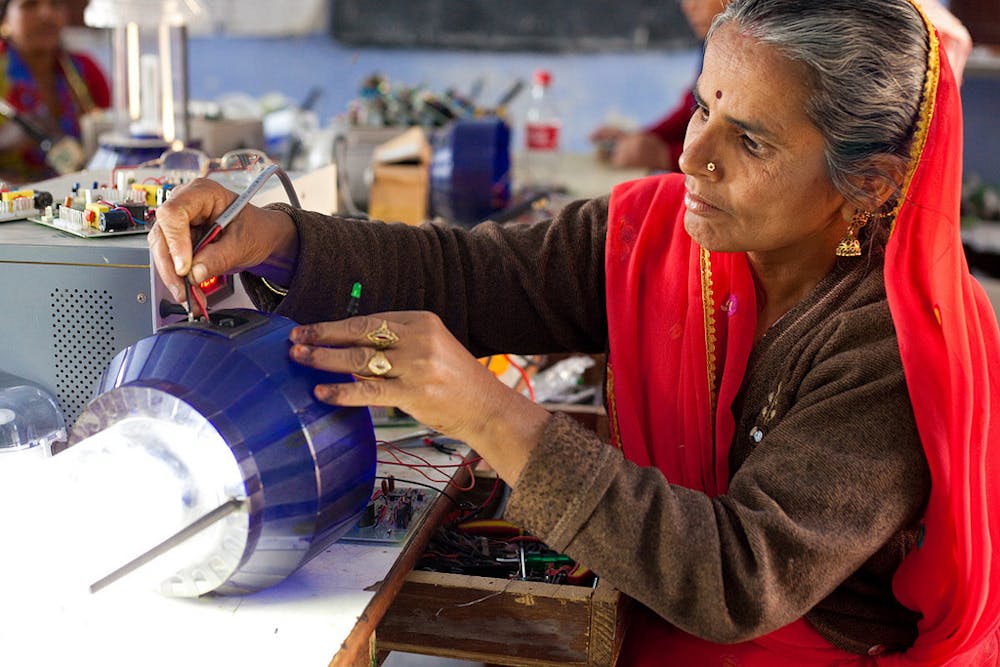 Women train to become solar engineers, Barefoot College, India, 2012. UN Women, CC BY-NC-ND
With international attention focused on mitigating the impacts of climate change, many developed and developing countries are boosting investments in renewables and other low-carbon sources of energy. India is making aggressive plans for solar and wind, while China has prioritized research and development to become a dominant producer of solar panels and wind turbines. By promoting outdated energy sources like coal, the United States is ceding leadership on clean energy while downplaying energy systems that better enable women’s rights.
And sometimes fossil fuel production can actually foster crime. For more than a century, energy “boom towns” have been associated with prostitution and human trafficking, fueled by large populations of men with money and nothing to do after work. The pattern can be seen today in Australian coal towns, North Dakota’s Bakken oil and gas zone and Niger Delta oil communities. Disturbing reports have linked fossil fuel “man camps” in the United States with increases in domestic violence and sexual assault.
Empowering women
The #MeToo campaign has brought the pervasiveness of sexual assault and harassment to light. Americans must address this ubiquitous problem head-on. It is also important to expand access to energy globally. Women will benefit from advances on both of these issues. But when Secretary Perry doubled down on protecting old, inefficient and dirty forms of energy like coal, he set back progress instead of pointing the way forward.
 In our view, the most effective way in which U.S. energy policy can help women around the world is by promoting American-made natural gas, propane and renewable electricity worldwide. If Perry also wants to help women here in the United States, he can work to bring more women into visible positions of influence at energy companies and government agencies, where the glass ceiling is still strong. By doing so, he could help develop a more thoughtful culture about how energy decisions affect women.
Michael E. Webber, Professor of Mechanical Engineering and Deputy Director of the Energy Institute, University of Texas at Austin and Sheril Kirshenbaum, Food@MSU, Michigan State University
This article was originally published on The Conversation. Read the original article.

