Apple tree blossoms are very sensitive to cold temperatures. Every year, apple crops in the western part of Michigan’s lower peninsula suffer frost damage, but in some years, the results are catastrophic, with nearly entire apple crops being wiped out. Additionally, climate change continues to cause warmer springs, which means apple trees begin blooming sooner — increasing their risk of frost damage.
This is why Steve van Nocker, a plant geneticist and professor in the Michigan State University College of Agriculture and Natural Resources, has been on a quest the last few years to find an apple species that’s more tolerant to spring frosts.
Luckily, he and doctoral student Kaz Christian found one — the native Michigan apple tree, Malus coronaria. Van Nocker said his team is the first to scientifically document the late-blooming trait of this frost-tolerant tree.
“We found that the native apple tree is incredibly tolerant to spring frost simply because it blooms several weeks later than commercial apple trees,” van Nocker said. “This tree is naturally adapted to our region — in terms of resistance to extremes of weather, climate, and microbial and insect pests. It also has really good postharvest resilience. The fruit also doesn’t decay very quickly. In fact, I had one in my office for a year, and it never went bad.”
At one time, the species was common in the state. In fact, Malus coronaria was designated as Michigan’s state flower in 1897. However, van Nocker said the tree is now hard to find, which suggests that the species is in decline.
“Most of the sites where it’s been recorded in the past are now shopping malls and housing developments,” van Nocker said. “I think it’s not listed as threatened or endangered because most people misidentify it because there are so many feral apples assumed to be Malus coronaria.
“We need to find more evidence to prove if it is in decline or not. This is really important and valuable because if we lose this tree, we also lose all of the genetic potential it offers.”
.
Finding and conserving the wild apple tree
.
Van Nocker will use a grant from the U.S. Department of Agriculture’s Agricultural Research Service to help find the elusive tree in Michigan. He has additional funding from the Michigan Apple Committee and from the MSU Project GREEEN program.
The USDA funds exploration trips to all over the world for scientists to collect wild plant varieties to add to the USDA germplasm collection. These plants could have unique traits that could be introduced into crop plants to improve efficiency of production.
“Grants are typically for exploration of exotic places,” van Nocker said. “They were surprised that we were interested in exploring Michigan since it’s not very exotic, but they understood our rationale and desire to preserve this tree and its traits.
“This project, to identify and conserve the last remaining wild apples in Michigan, it’s part of our state’s history,” van Nocker said. “There is real concern that due to climate change there may come a time where we can’t grow apples here, which would be devasting to Michigan since we are the second largest producer of apples in the nation. Growers are really concerned about climate change, and that’s why this research has such potential because it could lead to frost-resistant apple crops in the nation.”
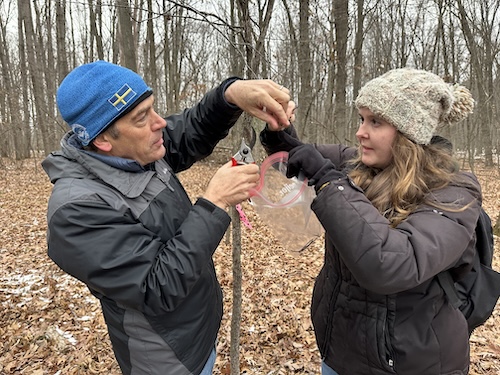
Van Nocker and his team recently went north in search of Malus coronaria. They found the elusive tree in the Manistee National Forest area and a few in the Huron National Forest near the Au Sable River.
He said this quest provided further evidence that the native apple tree is indeed in decline because all the specimens found were obviously unhealthy, with a lot of dead wood, little or no new growth, and an undiagnosed leaf-spot disorder. Additionally, there were no or very few seedlings or young plants nearby.
The team collected fruit and cuttings. The seeds from the fruit will be added to the collection at USDA in upstate New York, ensuring the genetic stock will not be lost.
Van Nocker also will grow seedlings from seeds and plant them around campus with the help of the MSU Herbarium, the 27th largest in the U.S. with a worldwide collection of all groups of plants and fungi. Additionally, the cuttings they brought back from the national forests will be grafted onto rootstocks for a permanent live collection of the species at the Clarksville Research Center.
“Seeds are an excellent potential way to preserve genetics, as they last many years in the cooler,” van Nocker said. “However, seeds aren’t a sure thing, since there could have been cross-pollination from a feral or commercial apple plants, in which case the seed is a hybrid and the original genetics are lost.
“For this reason, we preserve the original plant by taking a cutting — a piece of stem — and grafting it onto an apple rootstock, which is the underground portion of a plant that provides the base and root system for a new plant. Most commercial apples are propagated in this way. So, the plant that grows from the graft is identical to the original individual.”
.
Creating a frost-resistant apple crop for the future
.
Van Nocker will first test the cuttings to ensure they aren’t hybrids. After that, his hope is to identify the actual genes that cause the late blooming.
Ultimately, he is trying to create a genetic stock that plant breeders can use to develop commercial apples that flower a little bit later and are insensitive to frost.
“My goal is to identify the genes and create the genetic stock apple breeders can use,” van Nocker said. “If I can cross Malus coronaria into a common Honeycrisp or Gala or Fuji to create a late-blooming apple that’s frost-proof and has a long shelf life, that would be huge for the industry and for consumers.”

