Aquatic plants are a vital component of freshwater environments, providing habitat for fish and delivering a plethora of ecosystem services.
These plants — known as macrophytes to distinguish them from microscopic plants — live in or near water and can be partially or fully submerged, while growing from the soil or floating.
The distribution and abundance of macrophytes, both native and invasive, is not well-known in Michigan’s inland lakes, which leaves scientists and management professionals seeking to protect these ecosystems at a significant disadvantage.
With funding from the Michigan Department of Natural Resources (MDNR), researchers from Michigan State University surveyed 78 lakes in northern Michigan to gain a better understanding of the vegetation within.
The project set the stage for an ongoing follow-up effort funded by the Michigan Department of Environment, Great Lakes and Energy to explore early detection of invasive macrophytes.

Daniel Hayes, an MSU AgBioResearch scientist and professor in the MSU Department of Fisheries and Wildlife, led the MDNR project, while Jo Latimore, an aquatic ecologist and outreach specialist in FW, heads up the EGLE work. Although they each led one of the projects, Hayes and Latimore have actively participated in both efforts.
The research group also includes Erick Elgin, a water resources educator with MSU Extension, and Jeremy Hartsock, a wetland ecologist and outreach educator in FW and the Institute of Water Research.
Which plants are present?
In 2020, the team received the MDNR grant and began its quest to assemble a broad set of quantitative macrophyte data for inland lakes across two of the eight MDNR Fisheries Division Management Units: Northern Lake Huron and Lake Superior.
The Northern Lake Huron unit encompasses counties in the northeastern Lower Peninsula and eastern Upper Peninsula, while the Lake Superior unit includes the northern counties throughout the Upper Peninsula.
“Discussions with biologists in these districts highlighted the lack of knowledge on the occurrence of individual macrophyte species,” Hayes said. “Macrophytes are a critical component of lake ecosystems and fish habitat. They are frequent targets of lake management activities, so the lack of quantitative macrophyte data is a management impediment.
“There are many reasons for this, including cost, staff time and the expertise required for vegetation assessment. There has also been a partitioning of interest and responsibility in aquatic vegetation surveys between the MDNR and EGLE, which has led to this being an underserved area of research. There was a great opportunity for us to work with both agencies while bringing MSU expertise to the table.”
One of the major macrophyte management challenges for MDNR Fisheries Division staff is reviewing annual permit applications to EGLE for control of nuisance aquatic vegetation.
Latimore said empirical data on which to base application approval is limited. A primary objective of the project was aimed at demonstrating how a larger dataset informs application approval and thus macrophyte management, with the hope that the model can be used across the state in the future.

“There are several factors to consider with aquatic vegetation removal,” Latimore said. “While macrophytes are a critical part of fish habitat, overly dense or invasive plant populations can impede human uses of water resources. It’s a balance we have to strike, but we can only do that if we have a good understanding of the macrophytes in these lakes.”
The team consulted with biologists in the management units to identify high-priority lakes, as well as ones that would allow for sufficient data collection in the project timeframe.
A point-intercept survey design was implemented for each of the 78 lakes, a method used to account for variation across a given space. Roughly 100 individual sites in each lake were sampled. Two rake throws were used at each site, in which a small rake-like tool is attached to a rope, thrown into the lake and retrieved to provide a snapshot of the macrophytes in that spot.
Researchers found that one rake throw underestimates the prevalence of macrophyte species. While two rake throws means fewer individual sites can be sampled in a given timeframe, it paints a clearer picture.
The results were evaluated using occupancy analyses, which are frequently used in fisheries and wildlife studies but not in macrophyte surveys. Among all the models reviewed, no single method worked best across all lakes, pointing to the need to have a variety of usable techniques.
“Different models may be more appropriate under different circumstances,” Hayes said. “The point-intercept survey, for example, can be achieved in a relatively short time and with minimal equipment. We chose 100 sites per lake based on our resources, but we know a greater number of locations for sampling provides more precise information on the macrophytes present.”
Early detection of invasive plants
Using the surveys explored in the MDNR project, the team received funding from EGLE in 2023 to focus on efficient and cost-effective ways of finding invasive macrophytes before they pose serious problems.
Billy Keiper, an aquatic biologist in EGLE’s Water Resources Division, leads the agency’s portion of the project.
“Invasive species can lead to ecological and economic challenges because they’re aggressive and reproduce quickly,” he said. “Eurasian milfoil is a great example of this. It costs about $25 million per year in Michigan to deal with this problem, and the overwhelming majority of that burden falls on private landowners who are paying companies to use herbicide treatments. Our goal is to find the next high-threat aquatic invasive plant before it becomes established.”
The research builds on more than a decade of working to prevent the establishment of aquatic invasive plants through the state’s Aquatic Plant Early Detection and Response Initiative, which brings together MSU, EGLE, MDNR and the Michigan Natural Features Inventory.
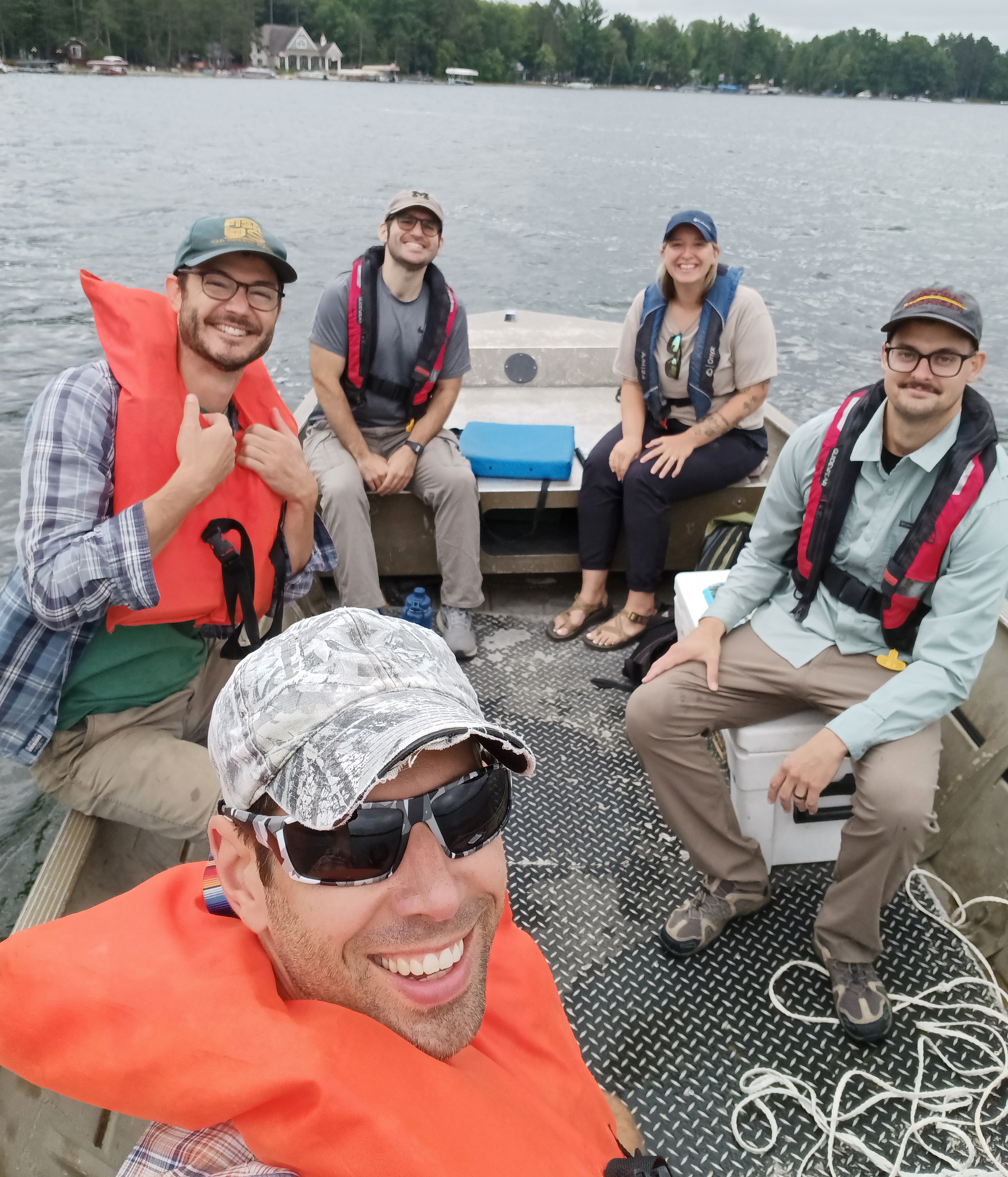
The creation of the EDRI led to the formation of a team with complementary expertise that set out to address invasive macrophytes on Michigan’s Watch List. These 10 species were identified because they pose an immediate threat to the economy, environment or human health.
Keiper said of the 10 species, seven have been previously detected in Michigan. To date, seven Watch List populations have been eradicated, and several more are nearing eradication — three years without regrowth.
“Although Michigan was new to invasive macrophyte research when the EDRI was first formed, the initiative has developed into a highly successful example of interagency cooperation,” Latimore said. “We’re well-positioned to address these issues moving forward because of our united focus on protecting aquatic ecosystems and the recreational use of them.”
For this project, MSU researchers are evaluating multiple sampling strategies, while EGLE biologists will work on widespread implementation of the recommended methods. The group is also investigating the effects invasive macrophytes have on native species, responding to new reports of watch list species, and improving preparedness to respond to detection of Hydrilla, a notably problematic invasive macrophyte.
Thus far in 2024, scientists have used point-intercept surveys on eight inland lakes in the Lower Peninsula, and invasive macrophytes were found in all. Three more lakes will be assessed with the point-intercept survey this year.
MSU researchers will also examine six of the 11 lakes with an aquatic vegetation survey, which includes rake throws and visual observations depending on water clarity. EGLE will conduct aquatic vegetation surveys on the remaining lakes, in addition to snorkel surveys in all 11, in which trained staff visually identify plants by getting in the water.
“There are benefits and drawbacks to each type of survey, but it’s crucial that we identify strategies that are economical and replicable across the state,” Keiper said. “That may require multiple options depending on the waterbody or type of plant we’re targeting, so we need more data on a variety of methods."
“We’re extremely fortunate to partner with MSU on this project. Along with MDNR and EGLE, they have the expertise and passion to work toward sustainable solutions that benefit our state for years to come.”
This story originally appeared on the AgBioResearch website.

