Jump to HeaderJump to Main ContentJump to Footer
Michigan State University
  • Browse Stories By

    Topics

    Explore stories by subject area

    • Arts and Culture
    • Business and Economy
    • Climate and Environment
    • Education and Learning
    • Engineering, Science and Technology
    • Government and Society
    • Health and Medicine
    • Media and Communications
    • MSU Leadership and Impact
    • Sports and Recreation
    • Student and Campus Experience
    View All Stories

    Collections

    Curated story series

    • Turfgrass
    • Ask the Expert
    • Big Ideas
    • Climate solutions
    • Water at MSU
    • Mobility
    • Spartan Perspectives
    • Student views
    • Graduate voices
    • Faculty voices
    View All Collections

    Featured

    Editor's picks

    • The Spartans behind your favorite Michigan golf courses

      July 22, 2026

      The Spartans behind your favorite Michigan golf courses

    • MSU in the 1990s: 10 Spartan milestones

      July 14, 2026

      MSU in the 1990s: 10 Spartan milestones

MSUTODAY
  • Browse Stories By

< Browse Stories By

Topics

Explore stories by subject area

  • Arts and Culture
  • Business and Economy
  • Climate and Environment
  • Education and Learning
  • Engineering, Science and Technology
  • Government and Society
  • Health and Medicine
  • Media and Communications
  • MSU Leadership and Impact
  • Sports and Recreation
  • Student and Campus Experience
  • View All Stories

Collections

Curated story series

  • Turfgrass
  • Ask the Expert
  • Big Ideas
  • Climate solutions
  • Water at MSU
  • Mobility
  • Spartan Perspectives
  • Student views
  • Graduate voices
  • Faculty voices
  • View All Collections

Featured

Editor's picks

  • The Spartans behind your favorite Michigan golf courses

    July 22, 2026

    The Spartans behind your favorite Michigan golf courses

  • MSU in the 1990s: 10 Spartan milestones

    July 14, 2026

    MSU in the 1990s: 10 Spartan milestones

  • For Media
  • Experts
  • Releases and Statements
  • Sign Up
  • Update Information

Resources

  • A to Z Index
  • Find People
  • Maps
  • Email
  • Student Information System (SIS)
  • D2L
  • Libraries
  • Tech Support
  • MSU Misconduct Hotline
  • Social Media Directory
  • Events Calendar
  • For Media
Michigan State University
MSUToday
  • For Media
  • Experts
  • Releases and Statements
  • Sign Up
  • Update Information
MSUTODAY
Diseases, Conditions and Treatments

July 26, 2024

MSU researchers use VR to understand stuttering in children


Researchers in Michigan State University’s Developmental Speech Lab have codeveloped virtual reality, or VR, simulations to understand how stuttering develops in young children with the goal of improving diagnostic and treatment approaches for children who stutter. 
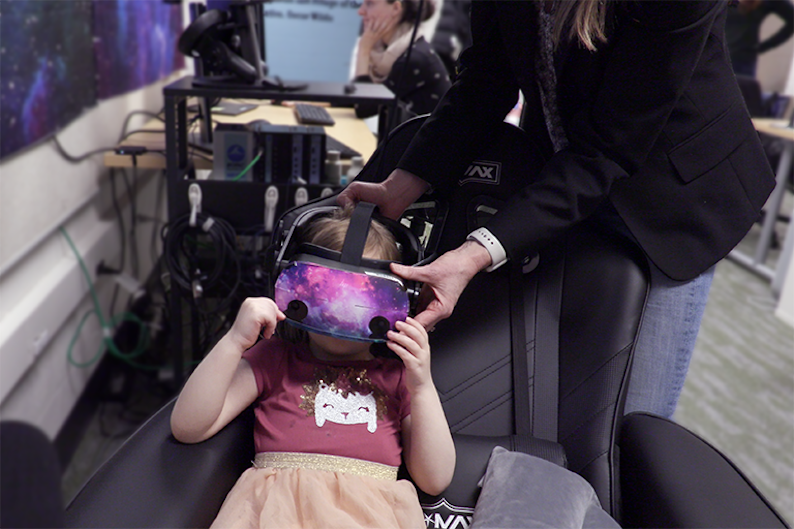
An adult helps a child put on a virtual reality headset.
Researchers at Michigan State University are using virtual reality simulations to understand how stuttering develops in young children.

This pediatric lab is directed by Bridget Walsh, a certified speech-language pathologist, Brandt-Endowed Associate Professor, and the director of undergraduate studies for MSU’s Department of Communicative Sciences and Disorders.

Supported by a grant from the National Institutes of Health, Walsh and her team want to learn why stuttering persists for some children while others outgrow the condition as well as what other factors might be contributing to speech fluency.

Portrait of Bridget Walsh
Bridget Walsh is a certified speech-language pathologist, Brandt-Endowed Associate Professor, and Director of Undergraduate Studies in the Department of Communicative Sciences and Disorders at Michigan State University.

“People who stutter anecdotally report that speaking in certain communication situations causes them to stutter more or less,” Walsh said. “Variability is one of the hallmark features of stuttering, and it’s also a significant challenge for people. But it’s difficult to replicate real-world communication situations in a lab setting that would allow us to research stuttering variability.”

Walsh and her team collaborated with Gareth Walkom, founder of withVR — a software that provides customizable virtual reality speaking situations to support speech therapists and researchers — to develop two VR speaking situations: a “higher-load” condition in which children participate in a virtual classroom circle and a “lower-load” conversation with a virtual pet. Walkom, who stutters himself, has received support from major backers such as Google and the United Kingdom’s National Health Service for his software that is used in clinical and research settings.

To do this, they’ve designed a unique VR experiment to simulate real-life scenarios.
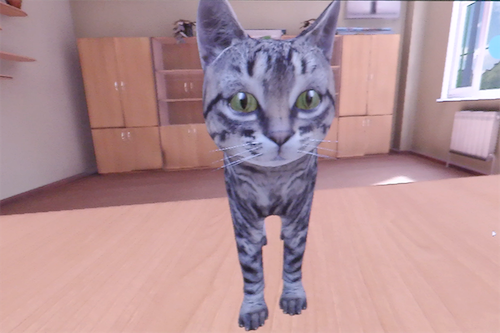
 A cat in a room as part of a virtual reality simulation.
One of the speaking scenarios in the simulation Walsh and her colleagues use in their research is talking with a pet.

“Gareth developed these scenarios specifically for us,” Walsh said. “Originally, the withVR tool came packaged with a coffee shop scene for adults. And we thought, ‘That’s great. But we’re working with four- and five-year-olds.’ We provided input for how children would behave and what they would say in the virtual classroom scenario.”

The VR environments offer a realistic context, addressing the challenge of laboratory results often failing to capture real-life speech dynamics. Early sessions that include control participants — children who do not stutter — recently started using the VR scenarios, ushering in fresh excitement for the project that has been two years in the making.

“We are very excited about the potential of VR,” said Walsh.

The lab is designed with a welcoming spaceship theme to ensure children feel at ease, encouraging their return for follow-up studies. These longitudinal studies are vital for tracking the development of stuttering over time.
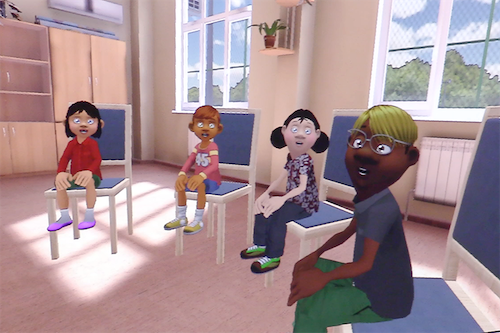
A virtual reality simulation of children sitting in chairs in a circle formation in a classroom.
Another one of the speaking scenarios in the simulation Walsh and her colleagues use in their research is a virtual classroom circle.

As the study advances, the team hopes VR technology will illuminate the intricacies of stuttering variability and lead to more effective therapies — ultimately improving the lives of those who stutter.

“This research has promising clinical implications for helping those who stutter practice speaking in realistic, controlled environments,” Walsh said.

The MSU Development Speech Lab welcomes families interested in participating in its study to fill out this survey the lab is specifically seeking families with children ages 3-6 who stutter or children ages 4-6 who exhibit typical speech and language.


MEDIA CONTACTS

Alex Tekip, Jessica Mussell
Diseases, Conditions and TreatmentsHealth and MedicineEngineeringEngineering, Science and TechnologyMSU ResearchMSU Leadership and Impact

Collection

more content from this collection

Keeping Families Healthy

Latest News

MSUToday Weekly Update

The MSUToday Weekly Update email showcases how Spartans are making a difference through academic excellence, research impact and community outreach. Get inspired by these stories of innovation, collaboration and determination. Plus, enjoy photos and videos of campus and more MSU content to help keep you connected to the Spartan community.

Sign UpUpdate My Information

Connect With Us

Visit our Facebook pageVisit our page on XVisit our Instagram pageVisit our LinkedIn pageVisit our YouTube pageVisit our TikTok page

Health and Safety

  • MSU Police and Public Safety
  • Olin Health Center
  • Counseling & Psychiatric Services (CAPS)
  • University Health and Wellbeing
  • MSU Health Care
  • Civil Rights and Title IX
  • Our Commitment
  • Center for Survivors
  • Security & Fire Safety Report
  • University Policy on Relationship Violence and Sexual Misconduct
  • Notice of Non-Discrimination, Anti-Harassment and Non-Retaliation
  • Health Care Non-Discrimination Notice

Support Services

  • Disability Resources
  • Supportive Services
  • Learning Resources

Working at MSU

  • Human Resources
  • EBS Login
  • Job Postings
  • Employee Assistance Program

Reports

  • CARES Act Funding
  • Student Achievement and Outcomes

Contact us

517-355-1855

Address

Michigan State University 426 Auditorium Road East Lansing, MI 48824

Follow Us

  • Visit our Facebook page
  • Visit our page on X
  • Visit our Instagram page
  • Visit our TikTok page
  • Visit our LinkedIn page
  • Visit our YouTube page

If you're having accessibility issues, please let us know.

Know More: Campus Safety Information and ResourcesTransparency Reporting: Budget & Salary/Compensation
  • Contact Information|
  • Site Map|
  • Privacy Statement|
  • Site Accessibility|
  • Call MSU: (517) 355-1855|
  • Visit: msu.edu|
  • Notice of Nondiscrimination|

SPARTANS WILL|© Michigan State University|