Jump to HeaderJump to Main ContentJump to Footer
Michigan State University
MSUTODAY
  • Browse Stories By

    Topics

    Explore stories by subject area

    • Arts and Culture
    • Business and Economy
    • Climate and Environment
    • Education and Learning
    • Engineering, Science and Technology
    • Government and Society
    • Health and Medicine
    • Media and Communications
    • MSU Leadership and Impact
    • Sports and Recreation
    • Student and Campus Experience
    View All Stories

    Collections

    Curated story series

    • Turfgrass
    • Ask the Expert
    • Big Ideas
    • Climate solutions
    • Water at MSU
    • Mobility
    • Spartan Perspectives
    • Student views
    • Graduate voices
    • Faculty voices
    View All Collections

    Featured

    Editor's picks

    • 9 reasons to love being a Spartan

      Aug. 28, 2026

      9 reasons to love being a Spartan

    • NIH awards multi-university team over $4M to improve women’s health

      Sept. 15, 2026

      NIH awards multi-university team over $4M to improve women’s health

MSUTODAY
  • Browse Stories By

< Browse Stories By

Topics

Explore stories by subject area

  • Arts and Culture
  • Business and Economy
  • Climate and Environment
  • Education and Learning
  • Engineering, Science and Technology
  • Government and Society
  • Health and Medicine
  • Media and Communications
  • MSU Leadership and Impact
  • Sports and Recreation
  • Student and Campus Experience
  • View All Stories

Collections

Curated story series

  • Turfgrass
  • Ask the Expert
  • Big Ideas
  • Climate solutions
  • Water at MSU
  • Mobility
  • Spartan Perspectives
  • Student views
  • Graduate voices
  • Faculty voices
  • View All Collections

Featured

Editor's picks

  • 9 reasons to love being a Spartan

    Aug. 28, 2026

    9 reasons to love being a Spartan

  • NIH awards multi-university team over $4M to improve women’s health

    Sept. 15, 2026

    NIH awards multi-university team over $4M to improve women’s health

  • For Media
  • Experts
  • Releases and Statements
  • Sign Up
  • Update Information

Resources

  • A to Z Index
  • Find People
  • Maps
  • Email
  • Student Information System (SIS)
  • D2L
  • Libraries
  • Tech Support
  • MSU Misconduct Hotline
  • Social Media Directory
  • Events Calendar
  • For Media
Michigan State University
MSUToday
  • For Media
  • Experts
  • Releases and Statements
  • Sign Up
  • Update Information
Natural Sciences

April 10, 2024

From negative results to new discoveries

By: Kara Headley

Photosynthesis is a complex process, involving many pathways and puzzle pieces working together to keep the organism alive.

In a recent study in Plant Physiology, Michigan State University researchers revealed a misconception that had been growing in plant science about one of the fundamental puzzle pieces of photosynthesis. In correcting the record, researchers can now think about using this knowledge to improve plant function and grow more efficient crops.

“Sometimes you just have to understand how the world works,” said Ron Cook, the first author of this study and a postdoctoral researcher in the MSU-Department of Energy Plant Research Laboratory, or PRL.

“It’s basic research,” said Cook, who works in the lab of Christoph Benning. “Once you understand how things work, then you could start thinking about how to change things and make them better.”

‘Nonviable’ proven viable
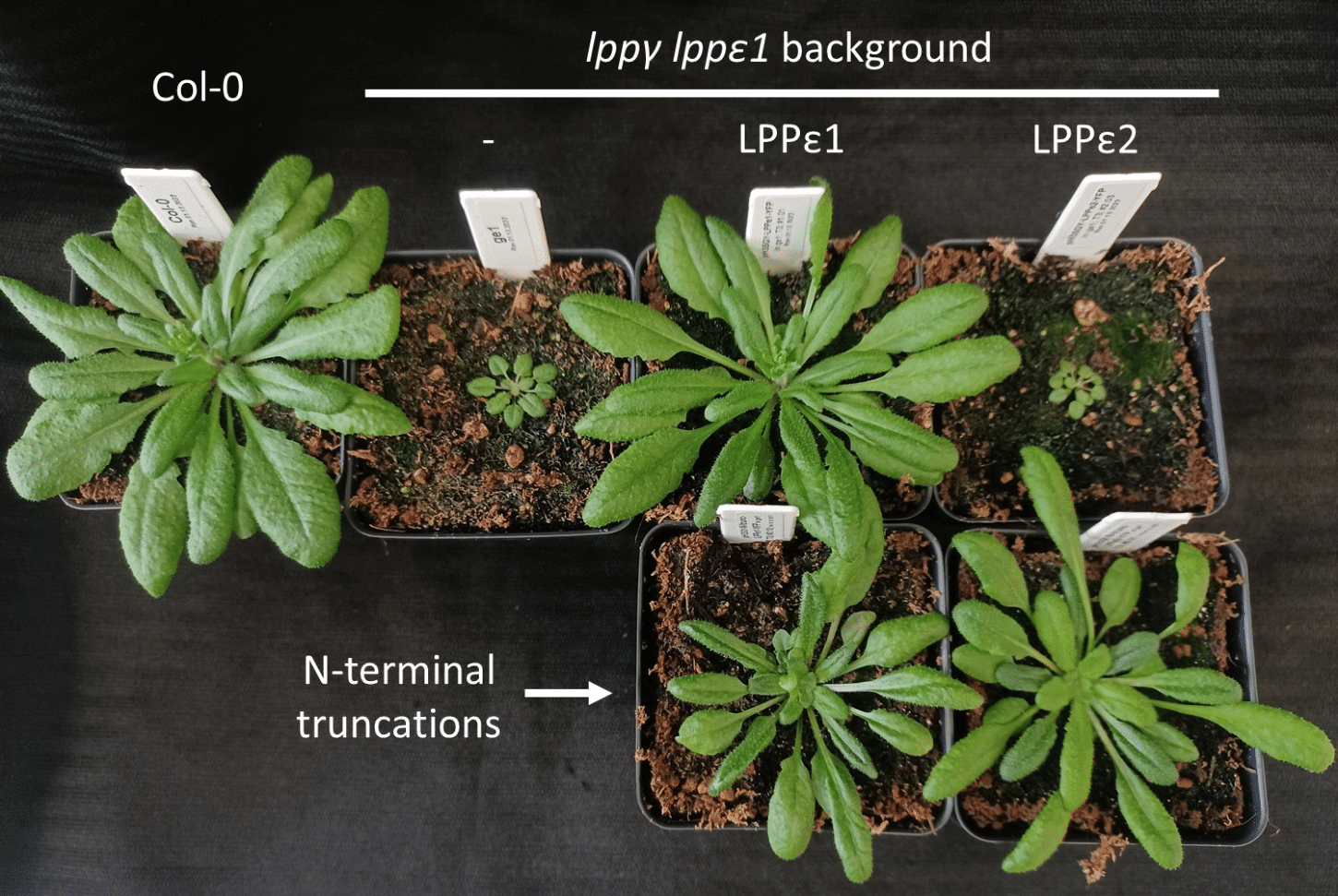
A control Arabidoposis (Col-0), as compared to mutations.

The paper focused on enzymes that help build the photosynthetic chloroplast membranes in plant cells.

One of those enzymes is known as LPPγ, or lipid phosphate phosphatase gamma.

LPPγ was previously thought to be essential to the growth of the plant. That is, any mutants lacking this enzyme would not grow. Yet, the Benning lab found they were able to grow these mutants without any problems.

“The paper essentially builds on a negative result correcting a previous misconception in the literature and points to a new direction to address an important biological question about chloroplast biochemistry,” said Benning, principal investigator of the study and director of the PRL.

Working with the surprisingly viable mutants led the investigators to look closer at two of LPPγ’s enzyme “cousins,” LPPε1 and LPPε2.

The role in the cell membrane

Photosynthesis happens in the chloroplast of plant cells, specifically in their photosynthetic membranes.

These differ from other membranes in biology. Most membranes have phospholipids. Plants’ photosynthetic membranes have sugar lipids instead. Researchers suspect plants made the switch because it decreases their dependence on phosphate nutrients in the soil.

And it is literally a switch: The membrane building blocks, or lipids, start out with phosphates. Plants use one enzyme to remove the phosphate and another enzyme to replace it with a sugar.

“It’s known which enzyme attaches that sugar after the phosphate has been removed, but less is known about which enzymes are responsible for removing the phosphate,” Cook said.

To see which enzymes play a part in this process, known as dephosphorylation, the researchers generated mutants of the plant Arabidopsis, a model organism used in research. Each of these mutant plants was missing two to three of the LPPγ, LPPε1 and LPPε2 enzymes thought to take part in this process.
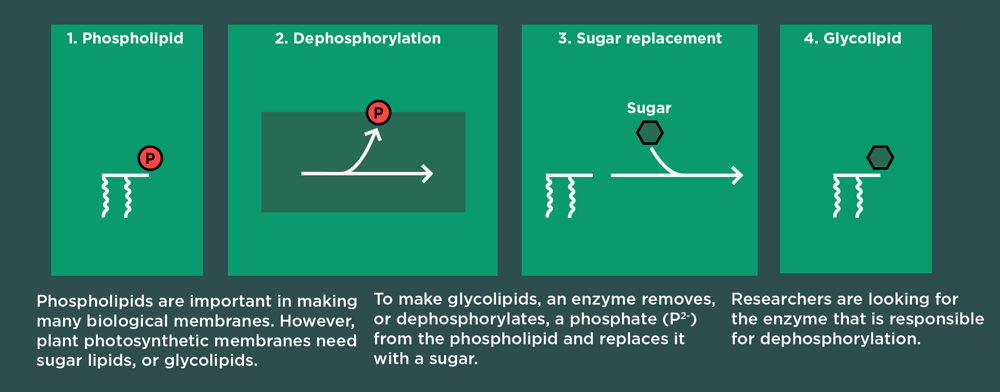
Dephosphorylation is the process in which a phosphate is removed from a phospholipid. The researchers are looking for the enzyme that makes this process possible.

Dephosphorylation can occur either within the chloroplast or outside of it, in what’s known as the endoplasmic reticulum, or ER. One of the mutants in the project struggled to convert those lipids made in the ER, Cook said.

With their experiments, the researchers determined that two of the enzymes, LPPγ and LPPε1, were partially responsible for dephosphorylation of ER-derived phospholipids.

“Two of these affect the import of lipids into the chloroplast and their combined function is essential for normal growth of the plant,” Benning said. “The function of the third homolog remains less certain.”

Looking for this unknown function is among the next steps for the researchers, continuing to unravel the mysteries of photosynthesis.

This story originally appeared on the College of Natural Science website. 

The research in this story is supported by the Office of Basic Energy Sciences of the United States Department of Energy (grant DE-FG02-91ER20021), Michigan State University AgBioResearch, and Michigan State University through a Training Program in Plant Biotechnology for Health and Sustainability funded by the National Institute of Health.


Natural SciencesEngineering, Science and TechnologyMSU ResearchMSU Leadership and ImpactNatural Sciences

Latest News

MSUToday Weekly Update

The MSUToday Weekly Update email showcases how Spartans are making a difference through academic excellence, research impact and community outreach. Get inspired by these stories of innovation, collaboration and determination. Plus, enjoy photos and videos of campus and more MSU content to help keep you connected to the Spartan community.

Sign UpUpdate My Information

Connect With Us

Visit our Facebook pageVisit our page on XVisit our Instagram pageVisit our LinkedIn pageVisit our YouTube pageVisit our TikTok page

Health and Safety

  • MSU Police and Public Safety
  • Olin Health Center
  • Counseling & Psychiatric Services (CAPS)
  • University Health and Wellbeing
  • MSU Health Care
  • Civil Rights and Title IX
  • Our Commitment
  • Center for Survivors
  • Security & Fire Safety Report
  • University Policy on Relationship Violence and Sexual Misconduct
  • Notice of Non-Discrimination, Anti-Harassment and Non-Retaliation
  • Health Care Non-Discrimination Notice

Support Services

  • Disability Resources
  • Supportive Services
  • Learning Resources

Working at MSU

  • Human Resources
  • EBS Login
  • Job Postings
  • Employee Assistance Program

Reports

  • CARES Act Funding
  • Student Achievement and Outcomes

Contact us

517-355-1855

Address

Michigan State University 426 Auditorium Road East Lansing, MI 48824

Follow Us

  • Visit our Facebook page
  • Visit our page on X
  • Visit our Instagram page
  • Visit our TikTok page
  • Visit our LinkedIn page
  • Visit our YouTube page

If you're having accessibility issues, please let us know.

Know More: Campus Safety Information and ResourcesTransparency Reporting: Budget & Salary/Compensation
  • Contact Information|
  • Site Map|
  • Privacy Statement|
  • Site Accessibility|
  • Call MSU: (517) 355-1855|
  • Visit: msu.edu|
  • Notice of Nondiscrimination|

SPARTANS WILL|© Michigan State University|