This personal account talks about the Feb. 13 violence the Michigan State University community experienced and other forms of trauma. It may be disturbing and upsetting for some people to read. If you are grieving or in distress, there are different ways to seek support, including talking with friends, family, and colleagues. MSU’s Office for Resource and Support Coordination offers many different resources and can also be reached at orsc@msu.edu. There are also services available through MSU’s Counseling and Psychiatric Services, United Resiliency, Keeping Michigan Healthy and the National Disaster Distress Helpline.
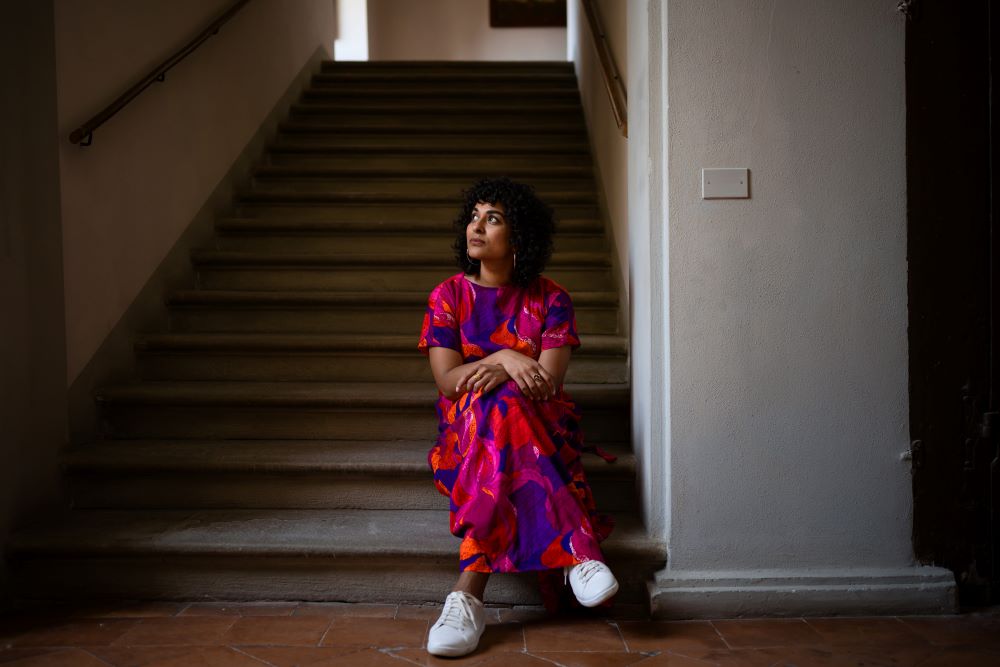
Divya Victor is an associate professor in the Department of English at Michigan State University where she teaches courses on the history and practice of contemporary poetry and creative nonfiction. As a writer, scholar, editor and poet, Victor’s work has been published, read and performed in places including The New York Times Magazine, The Atlantic, Poetry Magazine, Poetry Unbound through the On Being Project and the Museum of Modern Art.
Victor’s most recent book of poetry, CURB, won the 2022 PEN America Open Book Award and the 2022 Kingsley Tufts Poetry Award, and explores South Asian resilience, what it means to be an immigrant and the roles of individual and collective grief.
As a scholar, Victor looks at representations of trauma, both systemic and interpersonal, through innovative and experimental forms of writing and poetry, though more recently she’s turned to the political aspects of pleasure. Here Victor talks about the ways writing and art can help us tell our stories and connect us with others.
Language is my medium. I often don't know what I’m thinking, feeling, or sensing until I have put it down into words. One’s experience isn't as vivid to oneself until one has been given an audience. Writing lets you create an audience for yourself. It invites you to be your first listener.
Poetry opens us to different perspectives, new ways of seeing the world, new ways of inhabiting our own culture and questioning the assumptions that undergird our lives. We’re reading differently now. We’re reading faster and we’re reading overwhelmingly to sort through information that helps us survive. But, with poetry, we’re not reading for survival necessarily and we’re not reading only to glean information. We’re reading for deeper understanding, deeper self-awareness. We’re reading to feel more connected to lives that are otherwise not palpable to us.
We often read to understand strangers, and that’s what I’ve sought to do in my writing and work. Poetry can help us reconnect to others so that we develop new kithships across identities, geographic and cultural boundaries. There are infinite trajectories that connect us to someone else, and it’s poetry's work to single out one thread and strengthen that connection. To make it strong through sound and semantic resonance.
I often summarize my career as one of being a grief worker. I’ve been studying genocide and interpersonal trauma since I was 24 years old. About a year ago, when I turned 40, I had to evaluate the cost of being a grief worker. There’s a great personal cost to paying attention to trauma in scholarship and in art.
I decided to pause the grief work and become a pleasure worker instead to address the importance of joy, erotic frisson, pleasure and sensuality in architecture, visual art, and American literature. My hope is to pluralize narratives of immigrant lives and amplify our attention to the very peculiar and particular differences between linguistic communities, between various points of origin, and how we arrive in a culture in relation to the United States.
I’ve been at MSU for six years. My husband Josh Lam — who is also my colleague in the Department of English — and I moved here with my daughter when she was 8 weeks old and now, she is 6 and in first grade. It wasn't until March 2023 that I really felt that this was my home. And it was very much because I felt a new deepened responsibility towards my students after the violence and loss we experienced on Feb. 13.
I felt a deepened sense of personal responsibility for my students and their well-being. Creative writing professors take a trauma-informed approach to their classrooms. We’re always in conversation about pedagogical approaches that consider the personal circumstances, cultures, and languages of our students. But, the events of Feb. 13 placed us in an emergent situation where the call for care was urgent, even more personal, even more collective. Our creative writing students rose to this emergency just as my colleagues did. We were able to take up this interpersonal responsibility, which asked us to go beyond a professional one.
I also felt a deepened need to teach students about how art helps us organize the intensity and chaos of grief and helps narrate its arc as it transforms us. We were in our Advanced Poetry class on Feb. 13, just hours before the shooting. We had just finished talking about what it means to represent a crisis in a discussion about Joan Didion and Adrienne Rich. Hours later, it was no longer abstract to my students. We were bonded through the mutual witnessing of our fear and our grief and our sense of deepened responsibility.
Systemic failures around gun control and institutional misrecognition of student needs can alienate our students. These factors drain them of their sense of purpose, compromise their optimism, and exacerbate a sense of insecurity. This affects the soul of the work they are taking up for their generation.
It is part of my professional role to help people tell these soul stories, and when they are drained, the words don't come, their vision remains blurry. Without institutional and social support, their own stories may sometimes seem not worth telling, and I'm concerned about that.
My work as a director of the Creative Writing program is to facilitate more platforms for students to recognize their worth, and the importance of their own political and social concerns. Our work as writers and teachers of writing is to help people see that their stories matter a great deal in fact.
We could be doing more to help our students feel that their everyday labor and experience matters a great deal. We could make it simpler and easier to access platforms for students to express themselves creatively and artistically on campus. Expressing themselves is one of the foundational ways in which they know they exist. They should be allowed to dream openly, loudly, publicly. It matters for civil society. Democracy was built by loud dreamers.
Can we allow students to perform on the green spaces, paint murals on the walls, set up public arts projects? Can we have spaces where open mics can be easily organized and for students to gather to hear the voices of their peers? Do we have structures in place that help students, staff and faculty freely express themselves without being expected to maintain the institutional “brand” or taking on a role of unofficial ambassadors? The stories of their lives matter on their own terms.
We should invest in performance spaces and studios where writers can write and perform, where musicians can belt out anthems for their generation, where artists can compose and collaborate across disciplinary silos and the secrecy of studios.
I want to see us developing an institutional culture that serves students even when they are emerging, when they are figuring themselves out. We should celebrate them even when they aren’t bringing in big awards or grants. We should begin supporting our students early when they need paintbrushes, mics, platforms, canvases or comfortable chairs. The CREATE! Micro-Grants initiative through the College of Arts and Letters is one example of how we are moving in this direction. Let us keep this up!
Fundamentally, I think art lets us listen to ourselves as if we were others, as if we were a worthy audience of our own thinking and our own feeling. Our work is to persuade our students of the same, and to be their listeners until they learn to listen to their own voices.

