A new study led by Michigan State University researcher Peter Williams sheds light on the profound influence of deep geographic isolation on the evolution of mammals. Published in Nature Communications on March 28, the research reveals how long-lasting separation between continents has shaped distinct mammal communities around the globe.
“Today’s ecology was not inevitable. If there were different isolating factors long ago, we might have vastly different ecosystems today,” said Peter Williams, the lead author of the study. Williams is a research associate in the Integrative Biology department and a postdoctoral researcher in MSU’s Ecology, Evolution and Behavior program, or EEB.

While environmental factors like climate and vegetation are well-known drivers of biodiversity, the new study highlights the crucial role that isolation played for mammals.
“Think tree-dwelling mammals,” Williams said. “Despite similar climates, you’ll find koalas in Australia and squirrels in Spain.”
What you won’t find, however, are koalas native to Spain or squirrels native to Australia.
“That distinction stems from deep-seated geographic isolation and diverging evolutionary paths long ago,” Williams said.
With this new perspective, the findings of this research don’t just satisfy curiosity about that natural world. The report holds significant implications for conservation efforts and modern ecological issues.
“By understanding how historical isolation has shaped biodiversity, we can gain valuable insights into the delicate balance of ecosystems and develop strategies for protecting biodiversity in regions with unique evolutionary histories,” Williams said.

“In ecology, even hyperlocal problems need to incorporate regional, continental or even global processes — weather patterns, ocean currents or, in this case, deep-seated geographic barriers,” said Elise Zipkin, co-author of the study and associate professor of integrative biology. She’s also the leader of the Zipkin Quantitative Ecology Lab and director of EEB. “They all impact today’s natural world.”
Deep isolation shapes mammal evolution
Supported by the National Science Foundation, the study uses a novel approach to analyze biogeographic isolation, incorporating a continuous measure called “phylobetadiversity,” which quantifies shared evolutionary history, Williams said.
For instance, phylobetadiversity would be low when comparing Michigan with somewhere in Europe that’s also home to deer, rabbits, squirrels and the like, he said.
“Even if they aren't the same species, there is a lot of shared evolutionary history at the community level,” Williams said.
Michigan and Australia would be at the opposite end of the phylobetadiversity spectrum.
“Australia has mostly marsupials, while in Michigan we don't have any marsupials except the opossum,” he continued. “There is very little shared evolutionary history at the community level.”
Using phylobetadiversity paints a nuanced picture of how connected different regions have been historically.
“Isolated regions like Australia and Madagascar harbor mammal assemblages that are much less diverse than expected based on environment alone and those mammals possess unique combinations of functional traits, reflecting the distinct evolutionary paths they’ve taken,” Williams said. “It’s a fascinating idea that the biodiversity patterns we see in today’s world were not inevitable.”
Also contributing to the study was Jedediah Brodie, the John Craighead Endowed Chair of Conservation in the Division of Biological Sciences at the University of Montana.
The key factor in biodivergence for isolated mammals seems to be the duration of isolation.
Regions like Australia, isolated for 30-35 million years, have had ample time for unique mammal lineages to evolve. In contrast, continents like North and South America, which were once separated but reconnected during the Great American Biotic Interchange 2.7 million years ago, show more convergence in their mammal communities, with similar climates selecting for similar functional traits.
Though the evolution of mammals was heavily impacted by the isolation of land masses, the study shows birds reacted quite differently.
Birds, with their greater ability to fly across vast distances, can more easily overcome geographic barriers. This constant movement and mixing of bird populations across continents has led to a homogenization of bird communities globally, with environmental factors playing a stronger role in shaping their diversity.
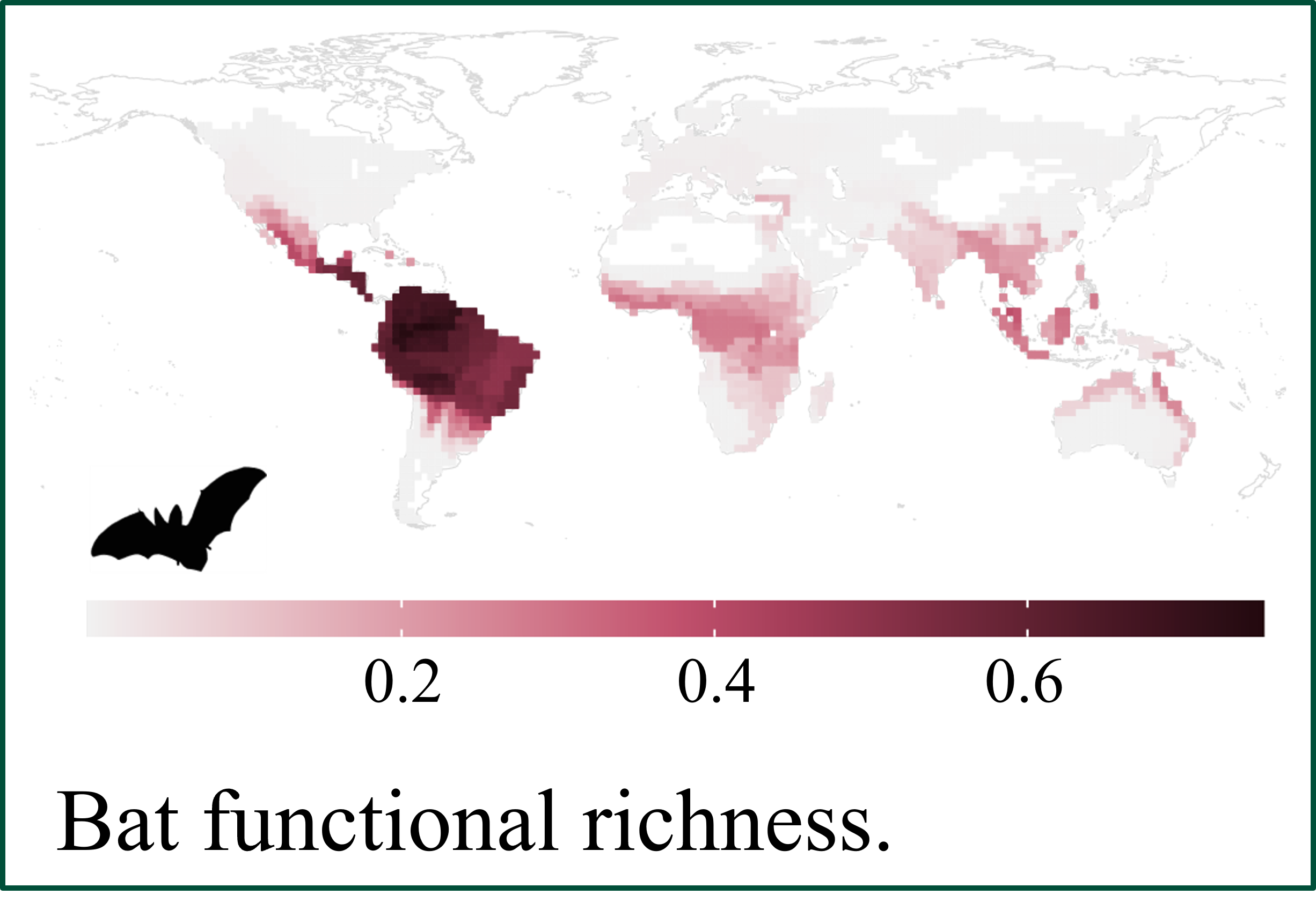
Interestingly, bats told a completely different story. As the only flying mammal group, bats in the Western Hemisphere, such as vampire bats and fish-eating bats, exhibit a much higher degree of functional diversity compared with their counterparts in the Eastern Hemisphere. This, the researchers suggest, is likely a consequence of their independent evolutionary trajectories shaped by the long-standing separation of landforms in the different regions.
Unlike other mammals, most bats didn’t have the cold tolerance to traverse the Beringia land bridge that, long ago, connected Alaska and Siberia, leading to their continued isolation and modern divergent species across hemispheres.
The team at the Zipkin lab aims to continue this line of research, conducting additional studies to look further into mammalian histories and how biogeographic divides have shaped the biota on our planet.
“This is just the beginning of our journey toward a deeper understanding of the world around us,” Zipkin said.
This story can also be found on the College of Natural Science website.

