A new study from Michigan State University warns that gains made to address broadband and internet connectivity in Michigan rural communities are beginning to fade.

According to MSU research, one in three, or 32.5%, of rural students still lack adequate, fast broadband home internet, despite progress achieved during the COVID-19 pandemic. Students who have no access, those who can only go online using a smartphone, and those with slower home internet struggle to complete homework and stay connected. They are also more likely to experience deficits in academic performance and well-being.
Approximately 18% of Michigan residents live in rural communities, compared with 14% of the total U.S. population, according to the U.S. Department of Agriculture.
“There are early indications that rural communities are at risk of losing the gains in internet connectivity rapidly achieved over the COVID-19 pandemic. There is a needed shift, from a single-minded focus on filling the gaps in the infrastructure for home internet access to also ensuring that households are able to maintain access over time,” said Keith Hampton, director of research at the MSU Quello Center, which focuses on the social and economic implications of communication, media and information technologies of the digital age, as well as the policy and management issues raised by these developments.
Hampton conducted the study with Quello Center Director Johannes Bauer and Gabriel Hales, a doctoral student in MSU’s Department of Media and Information. Hampton, Bauer and Hales worked with 13 local school districts in Michigan’s St. Clair County Regional Educational Service Agency and the Eastern Upper Peninsula Intermediate School District to administer a survey to nearly 3,000 students in grades 8-11. The team collected data in spring 2019, prior to the COVID-19 pandemic, and surveyed the same schools in 2022, near the end of the pandemic.
Wi-Fi hotspots
The study found that the number of students who currently have home internet access is lower than it was at the height of the pandemic. In the 2020-21 school year, 95.6% of students reported that they had internet access at home, compared to 93.2% of students in 2022.
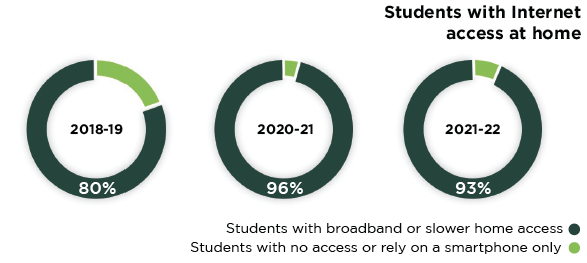
"During the COVID-19 pandemic, improvements in rates of student home internet access were driven largely by the efforts of school districts. With the need to pivot to learning online, schools provided students without home internet access with Wi-Fi hotspots,” Bauer said.
“Organizations were able to mobilize resources to provide students with increased internet access via federal and state pandemic relief funding, temporary relaxation of federal regulations and equipment donations.”
This had a lasting effect: Nearly 44% of the students who initially received a hotspot subsequently replaced the hotspot with another source of home internet access. Of those students who lost home internet access in 2022, 12% were students who previously had a school-provided hotspot, but most lost access either because their household could no longer afford internet, or their parents or guardians lost access for another reason.
“The problems associated with technology maintenance will increasingly represent the largest source of student disconnection. Parents or guardians may be unable to pay for access consistently, computing devices break and become dated and, some students — especially those who may live with parents/guardians in multiple households — can experience access insecurities,” Hampton said. “Schools often lack resources and systems to identify students who have such access insecurity and are unable to intervene in a short period of time to provide a student with one of a declining number of school-provided hotspots.”
Devices
The other component of online learning is the physical device. Access to a computer at home greatly impacts the ability of students to complete homework and develop digital skills outside of school. During the pandemic, school districts received funding and support to distribute laptops and Chromebooks to their students. In the 2020-21 school year, 55.7% of all students received a laptop/Chromebook from their school; by the 2021-22 school year, when most schools were back to primarily in-person instruction, this number declined to 40.3% of students.

Despite this, access to either a laptop or desktop at home continued to increase among rural students. In 2019, 75.6% of rural students had access to either a laptop/Chromebook or a desktop computer. In the 2020-21 school year, this increased to 89.1% of students and then reached 91.2% at the end of the 2021-22 school year.
“An effective approach to embracing online learning requires sustained and concerted efforts to close the remaining gaps in connectivity and access to appropriate devices,” Bauer said.
“While there are measures in place to reduce broadband access and affordability gaps, infrastructure investment is time-consuming and slow. There will be a transition period during which rural, low-income and other underserved populations will continue to experience gaps in network access. Because of this, temporary measures are needed to close the gaps.”
Digital skills and education
Compared to a student who rarely learned from home, a student who often attended school at home during the pandemic scored, on average, 9.1% higher in digital skills. This difference is roughly equivalent to the difference in digital skills found between students in ninth versus 11th grade.
“Online learning during the pandemic was considered by many to be a backup, second-best alternative to in-class learning. Our research suggests that integrating online learning into traditional modes of instruction can be a critical way to increase digital skills,” Bauer said.
Despite a declining interest in higher education and STEM careers, a student who has even modestly more digital skills than average is 36% more likely to complete a university degree. In addition, students who spent more time learning online from home during the pandemic were 37% more likely to be interested in STEM. A student who had even modestly more digital skills on average was 38% more likely to be interested in a STEM career.
“Given the growth of jobs in STEM fields, the higher income associated with STEM careers and the potential benefit of the STEM-related industry for the economic development in rural areas, fostering interest in STEM is key,” Hales said.
Broadband access also impacts students’ grades. Compared with a student who has no internet access, a student with broadband access has, on average, a 0.6 higher GPA overall on a 4.0 scale. For many students, this could be the difference between a B- and B+ grade.
Well-being
At the height of the COVID-19 pandemic, during the 2020-21 school year, 58.6% students at least occasionally felt isolated from their peers. For all but one-quarter of students (26%), those feelings had subsided by the end of the 2021-22 school year. Feelings of isolation remain most pronounced among girls and those who live in the most rural of areas. Feelings of social isolation are 66.5% higher among girls, and those living in the most rural areas are 45% more likely to feel isolated from their friends than those in even small urban areas.

“We found that students who had spent more time learning from home during the pandemic were no more likely to express continued feelings of loneliness and social isolation,” Hales said.
By the end of the 2021-22 school year, levels of adolescent self-esteem were nearly identical to pre-pandemic levels of self-esteem as measured in 2019.
“At the end of the 2021-22 school year there were no lingering, substantive differences in self-esteem between students who spent more or less time learning from home over the COVID-19 pandemic,” Hampton said.
The study also indicated that, on average, adolescents are spending more time in person with friends (14 minutes more) and less time with family (38 minutes less) than they did in 2019, prior to the COVID-19 pandemic. Young people who have more digital skills and those who spend more time on social media continue to spend more time with friends after the pandemic, which was the case for this group prior to the pandemic.
“Young people may be combatting feelings of isolation that were experienced during the COVID-19 pandemic by now spending additional time with friends,” Hampton said.
You can read more about this study on the Quello Center website.

