Jump to HeaderJump to Main ContentJump to Footer
Michigan State University
  • Browse Stories By

    Topics

    Explore stories by subject area

    • Arts and Culture
    • Business and Economy
    • Climate and Environment
    • Education and Learning
    • Engineering, Science and Technology
    • Government and Society
    • Health and Medicine
    • Media and Communications
    • MSU Leadership and Impact
    • Sports and Recreation
    • Student and Campus Experience
    View All Stories

    Collections

    Curated story series

    • Turfgrass
    • Ask the Expert
    • Big Ideas
    • Climate solutions
    • Water at MSU
    • Mobility
    • Spartan Perspectives
    • Student views
    • Graduate voices
    • Faculty voices
    View All Collections

    Featured

    Editor's picks

    • The Spartans behind your favorite Michigan golf courses

      July 22, 2026

      The Spartans behind your favorite Michigan golf courses

    • MSU in the 1990s: 10 Spartan milestones

      July 14, 2026

      MSU in the 1990s: 10 Spartan milestones

MSUTODAY
  • Browse Stories By

< Browse Stories By

Topics

Explore stories by subject area

  • Arts and Culture
  • Business and Economy
  • Climate and Environment
  • Education and Learning
  • Engineering, Science and Technology
  • Government and Society
  • Health and Medicine
  • Media and Communications
  • MSU Leadership and Impact
  • Sports and Recreation
  • Student and Campus Experience
  • View All Stories

Collections

Curated story series

  • Turfgrass
  • Ask the Expert
  • Big Ideas
  • Climate solutions
  • Water at MSU
  • Mobility
  • Spartan Perspectives
  • Student views
  • Graduate voices
  • Faculty voices
  • View All Collections

Featured

Editor's picks

  • The Spartans behind your favorite Michigan golf courses

    July 22, 2026

    The Spartans behind your favorite Michigan golf courses

  • MSU in the 1990s: 10 Spartan milestones

    July 14, 2026

    MSU in the 1990s: 10 Spartan milestones

  • For Media
  • Experts
  • Releases and Statements
  • Sign Up
  • Update Information

Resources

  • A to Z Index
  • Find People
  • Maps
  • Email
  • Student Information System (SIS)
  • D2L
  • Libraries
  • Tech Support
  • MSU Misconduct Hotline
  • Social Media Directory
  • Events Calendar
  • For Media
Michigan State University
MSUToday
  • For Media
  • Experts
  • Releases and Statements
  • Sign Up
  • Update Information
MSUTODAY
MSU Research

Jan. 17, 2023

Data-driven bird conservation project takes wing

MSU, Audubon receive $1.3M from NSF to support bird conservation in North America using data to create more robust population forecasts in the face of climate and land-use change

By: Matt Davenport

Michigan State University and the National Audubon Society are teaming up to help protect declining bird populations across North America.


With $1.3 million from a collaborative National Science Foundation grant, the team will develop statistical models fueled by four massive data sets to evaluate how climate change and land use are affecting hundreds of bird species.

 

MSU Associate Professor Elise Zipkin

Using this understanding, the team will develop forecasts about future responses of bird populations, enabling conservationists and wildlife managers to pinpoint where individual species may be most at risk and identify opportunities to protect these charismatic creatures and all that they do for us.


“People love birds and love looking at birds, but they do so much more that we don’t think about or appreciate as much,” said Elise Zipkin, an associate professor in the Department of Integrative Biology and MSU’s lead investigator on the NSF project. “Birds provide a ton of ecosystem services that are worth billions of dollars, including nutrient cycling, pest control, seed dispersal and pollination.”


Joining Zipkin’s Quantitative Ecology Lab is the Geospatial Laboratory at MSU, led by Andrew Finley, a professor in the Department of Forestry and the Department of Geography, Environment and Spatial Sciences.


Together with MSU postdoctoral researcher Jeff Doser, who will lead model development, the researchers have a breadth of expertise in aggregating large amounts of biodiversity data from disparate sources.


Working with Audubon, the MSU researchers have a partner that’s a leader in putting scientific approaches to work in bird conservation.


“Broadly speaking, our results will help with conservation planning for avian species and communities,” said Zipkin, who is also the director of the Ecology, Evolution and Behavior program, or EEB, at MSU. “Our models will reveal which areas are likely to be bad for birds in the future and which areas are likely to be climate refugia. We can use that information to make decisions about where to target conservation efforts so that they are most effective.”

 

Sarah Saunders, Michigan State University adjunct scholar and senior manager of quantitative science at the National Audubon Society

Researchers estimate that, in terms of overall population size, North America has lost more than 3 billion birds over the last 50 years. The trends continue to be concerning today, largely due to a warming planet and humans developing land in ways that damage natural ecosystems.


Researchers have been working to understand how different bird communities in different locations are responding to climate change and land-use changes. Historically, though, those two factors often have been studied separately, said Sarah Saunders, Audubon’s lead investigator on the project.


“Independently, there were people asking, ‘What is climate change doing to birds?’ or ‘What is land use doing?’ Now those questions are coming together,” said Saunders, who is a senior manager of quantitative science with Audubon and an adjunct scholar with MSU.


“We’ll be looking at data from the last 20 years and trying to predict what will be happening by midcentury and end–of century,” Saunders said. “We expect these predictions will be a lot more robust than what’s currently available because we’ll be integrating all of the best available data from across the continental U.S.”

A photograph taken through green leaves and thin, grayish-brown branches shows a red-breasted American robin perched in a tree. A robin perched in a tree in Michigan State University’s Radiology Healing Gardens. Credit: Derrick L. Turner

Putting data to work


To deliver those robust forecasts, the team will combine information from four giant databases that document bird abundance and diversity at different locations at different times.


Three of those data sources are maintained by government agencies, including NSF’s National Ecological Observatory Network, the National Park Service Inventory and Monitoring Program and the North American Breeding Bird Survey, which is a partnership between the U.S. Geological Survey and the Canadian Wildlife Service.


The fourth data set is provided by eBird, a collaborative online database managed by the Cornell Lab of Ornithology that enables anyone to submit bird sightings.


These diverse data sets, combined with the team’s modeling work, will enable the researchers to provide a comprehensive picture of the impacts of climate change and land use over the past several decades. They’ll also be able to share that picture on a large scale and with a high enough resolution to zoom into smaller areas.


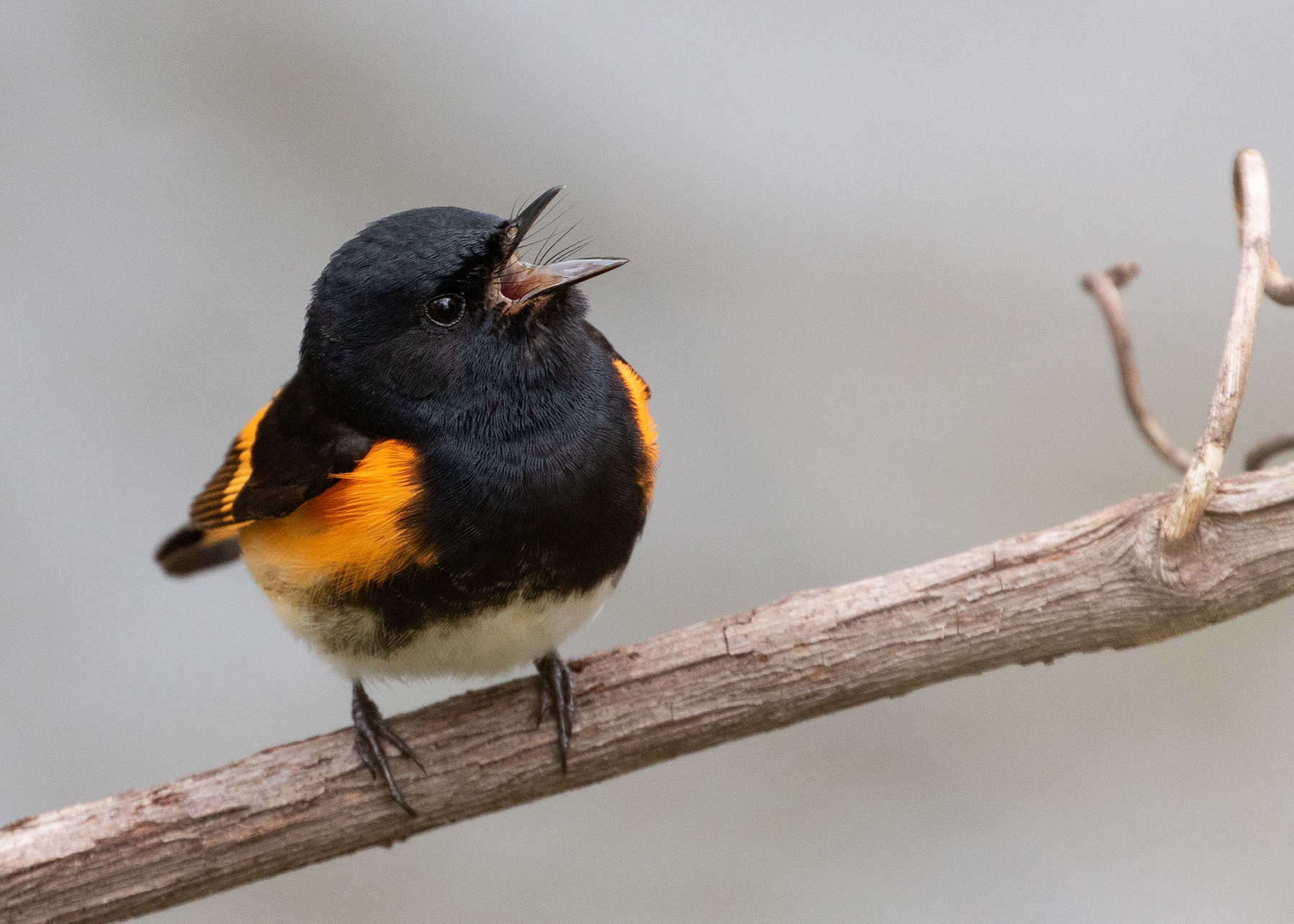
An adult male American redstart with black, white and bright orange feathers calling from a branch.
Michigan State University and the National Audubon Society are collaborating to project future impacts to hundreds of bird species, including the American redstart. Credit: Denise Dupras

“Our forecasts will be really useful for people working to manage species locally and across the U.S.,” Saunders said.


“By integrating all that data together we’ll have a much better idea of what’s going on with birds in the past and going into the future,” Zipkin said.


The team’s models and forecasts will bring a new level of understanding to the unique challenges faced by birds that migrate and cover large ranges, the researchers said.


Take the American redstart as an example, a warbler that spends the warmer months nesting in the eastern U.S. and Canada. In the winter, however, this species heads south to the Caribbean and as far as Central and South America.


The impacts of climate change and how people use land are not uniform throughout the entire range of a particular species. Researchers need to consider what’s happening at various locations throughout that range to forecast what the future looks like for American redstarts and other migratory species.


“We need to think about how variables are affecting species in different places over a large scale,” Zipkin said. “The effects may not be the same everywhere.”


Another distinctive feature of the grant is its collaborative nature, pairing a major research university with a nonprofit organization focused on conservation. That was a major selling point because of the group’s potential to bridge the gap between knowledge and implementation, Saunders said.


“I think this is a perfect project for developing action-oriented science,” Saunders said. “I’m really excited to be collaborating with MSU.”

MEDIA CONTACTS

Elise Zipkin, Kaylie Crowe
MSU ResearchMSU Leadership and ImpactBiodiversity and WildlifeClimate and EnvironmentClimate and Climate Solutions

Collection

more content from this collection

Climate Solutions

Latest News

MSUToday Weekly Update

The MSUToday Weekly Update email showcases how Spartans are making a difference through academic excellence, research impact and community outreach. Get inspired by these stories of innovation, collaboration and determination. Plus, enjoy photos and videos of campus and more MSU content to help keep you connected to the Spartan community.

Sign UpUpdate My Information

Connect With Us

Visit our Facebook pageVisit our page on XVisit our Instagram pageVisit our LinkedIn pageVisit our YouTube pageVisit our TikTok page

Health and Safety

  • MSU Police and Public Safety
  • Olin Health Center
  • Counseling & Psychiatric Services (CAPS)
  • University Health and Wellbeing
  • MSU Health Care
  • Civil Rights and Title IX
  • Our Commitment
  • Center for Survivors
  • Security & Fire Safety Report
  • University Policy on Relationship Violence and Sexual Misconduct
  • Notice of Non-Discrimination, Anti-Harassment and Non-Retaliation
  • Health Care Non-Discrimination Notice

Support Services

  • Disability Resources
  • Supportive Services
  • Learning Resources

Working at MSU

  • Human Resources
  • EBS Login
  • Job Postings
  • Employee Assistance Program

Reports

  • CARES Act Funding
  • Student Achievement and Outcomes

Contact us

517-355-1855

Address

Michigan State University 426 Auditorium Road East Lansing, MI 48824

Follow Us

  • Visit our Facebook page
  • Visit our page on X
  • Visit our Instagram page
  • Visit our TikTok page
  • Visit our LinkedIn page
  • Visit our YouTube page

If you're having accessibility issues, please let us know.

Know More: Campus Safety Information and ResourcesTransparency Reporting: Budget & Salary/Compensation
  • Contact Information|
  • Site Map|
  • Privacy Statement|
  • Site Accessibility|
  • Call MSU: (517) 355-1855|
  • Visit: msu.edu|
  • Notice of Nondiscrimination|

SPARTANS WILL|© Michigan State University|

