Jump to HeaderJump to Main ContentJump to Footer
Michigan State University
  • Browse Stories By

    Topics

    Explore stories by subject area

    • Arts and Culture
    • Business and Economy
    • Climate and Environment
    • Education and Learning
    • Engineering, Science and Technology
    • Government and Society
    • Health and Medicine
    • Media and Communications
    • MSU Leadership and Impact
    • Sports and Recreation
    • Student and Campus Experience
    View All Stories

    Collections

    Curated story series

    • Turfgrass
    • Ask the Expert
    • Big Ideas
    • Climate solutions
    • Water at MSU
    • Mobility
    • Spartan Perspectives
    • Student views
    • Graduate voices
    • Faculty voices
    View All Collections

    Featured

    Editor's picks

    • The Spartans behind your favorite Michigan golf courses

      July 22, 2026

      The Spartans behind your favorite Michigan golf courses

    • MSU in the 1990s: 10 Spartan milestones

      July 14, 2026

      MSU in the 1990s: 10 Spartan milestones

MSUTODAY
  • Browse Stories By

< Browse Stories By

Topics

Explore stories by subject area

  • Arts and Culture
  • Business and Economy
  • Climate and Environment
  • Education and Learning
  • Engineering, Science and Technology
  • Government and Society
  • Health and Medicine
  • Media and Communications
  • MSU Leadership and Impact
  • Sports and Recreation
  • Student and Campus Experience
  • View All Stories

Collections

Curated story series

  • Turfgrass
  • Ask the Expert
  • Big Ideas
  • Climate solutions
  • Water at MSU
  • Mobility
  • Spartan Perspectives
  • Student views
  • Graduate voices
  • Faculty voices
  • View All Collections

Featured

Editor's picks

  • The Spartans behind your favorite Michigan golf courses

    July 22, 2026

    The Spartans behind your favorite Michigan golf courses

  • MSU in the 1990s: 10 Spartan milestones

    July 14, 2026

    MSU in the 1990s: 10 Spartan milestones

  • For Media
  • Experts
  • Releases and Statements
  • Sign Up
  • Update Information

Resources

  • A to Z Index
  • Find People
  • Maps
  • Email
  • Student Information System (SIS)
  • D2L
  • Libraries
  • Tech Support
  • MSU Misconduct Hotline
  • Social Media Directory
  • Events Calendar
  • For Media
Michigan State University
MSUToday
  • For Media
  • Experts
  • Releases and Statements
  • Sign Up
  • Update Information
MSUTODAY
Business and Economy

Aug. 4, 2023

Making bioplastics that are easier to compost

MSU research shows how putting starch into a bio-based polymer can make it more compostable, helping divert plastic waste

By: Matt Davenport

Researchers from Michigan State University’s top-ranked School of Packaging have developed a way to make a promising, sustainable alternative to petroleum-based plastics more biodegradable.


Rafael Auras, a Michigan State University professor and the Amcor Endowed Chair in Packaging Sustainability

A team led by Rafael Auras has made a bio-based polymer blend that’s compostable in both home and industrial settings. The work is published in the journal ACS Sustainable Chemistry & Engineering.


“In the U.S. and globally, there is a large issue with waste and especially plastic waste,” said Auras, MSU professor and the Amcor Endowed Chair in Packaging Sustainability.


Less than 10% of plastic waste is recycled in the U.S. That means the bulk of plastic waste ends up as trash or litter, creating economic, environmental and even health concerns.


“By developing biodegradable and compostable products, we can divert some of that waste,” Auras said. “We can reduce the amount that goes into a landfill.”


Another bonus is that plastics destined for the compost bin wouldn’t need to be cleaned of food contaminants, which is a major obstacle for efficient plastic recycling. Recycling facilities routinely must choose between spending time, water and energy to clean dirty plastic waste or simply throwing it out.


“Imagine you had a coffee cup or a microwave tray with tomato sauce,” Auras said. “You wouldn’t need to rinse or wash those, you could just compost.”

Anibal Bher, Wanwarang Limsukon, Pooja Mayekar and Rafael Auras stand in their lab wearing white lab coats. There?s a table in front of them holding dozens of bioreactors ? clear glass jars sealed tightly with lids and filled with compost.The team behind a new compostable bio-based plastic developed at Michigan State University includes, from left to right, postdoctoral researcher Anibal Bher, doctoral students Wanwarang Limsukon and Pooja Mayekar, and Rafael Auras, Amcor Endowed Chair in Packaging Sustainability. Credit: Matt Davenport/MSU

PLA and a ‘sweet spot’ for starch


The team worked with what’s known as polylactic acid, or PLA, which seems like an obvious choice in many ways. It’s been used in packaging for over a decade, and it’s derived from plant sugars rather than petroleum.
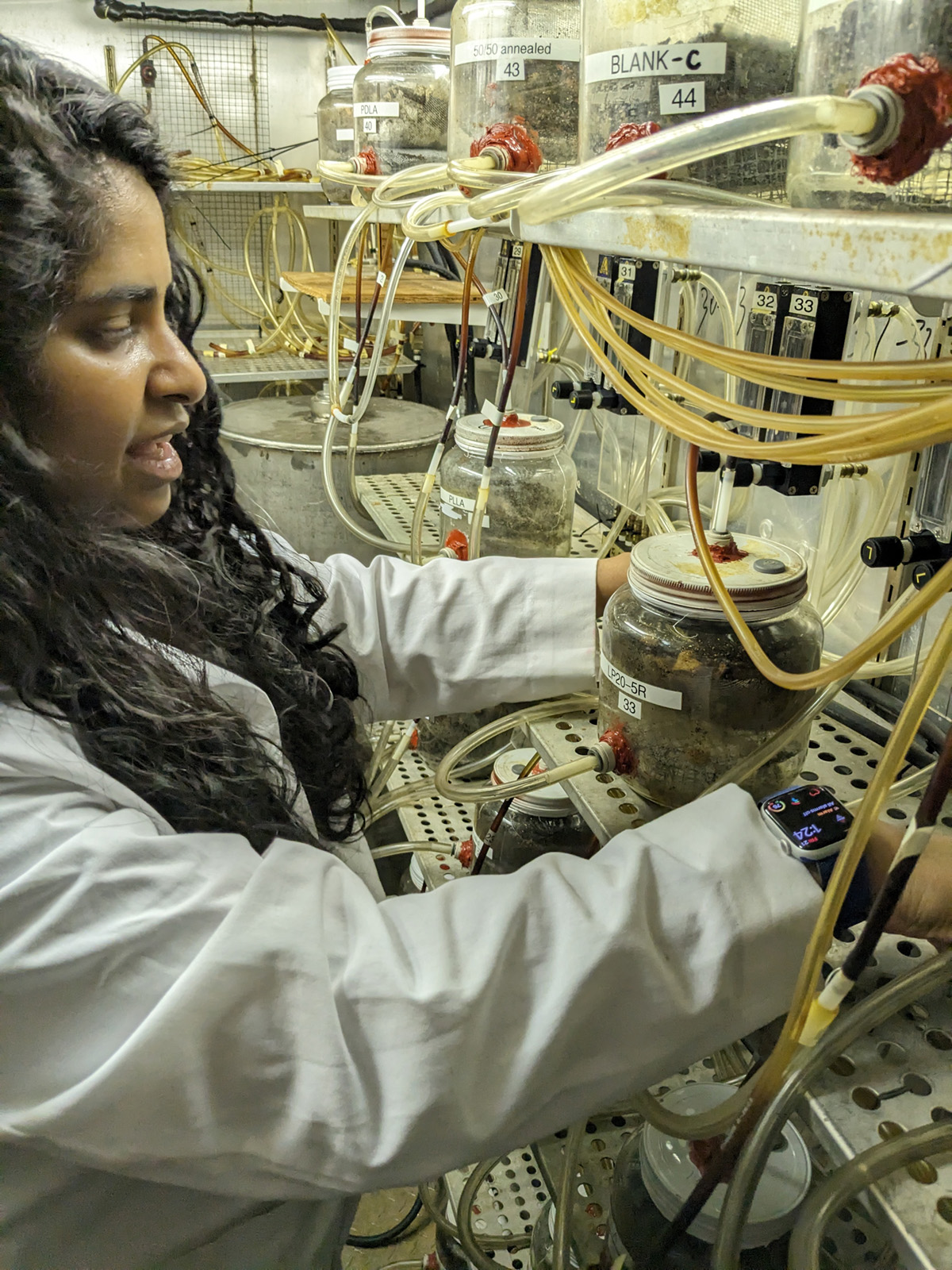
 

Pooja Mayekar stands in front of a bioreactor, a clear glass jar filled with composting material. She’s in a small, conditioned chamber where several of these reactors line metal shelves, all connected to rubber tubing.
Michigan State University doctoral student Pooja Mayekar explains the experiments the team conducted to show how well its compostable polymers composted. Credit: Matt Davenport/MSU

When managed properly, PLA’s waste byproducts are all natural: water, carbon dioxide and lactic acid.


Plus, researchers know that PLA can biodegrade in industrial composters. These composters create conditions, such as higher temperatures, that are more conducive to breaking down bioplastics than home composters.


Yet, the idea of making PLA compostable at home seemed impossible to some people.


“I remember people laughing at the idea of developing PLA home composting as an option,” said Pooja Mayekar, a doctoral student in Auras’ lab group and the first author of the new report. “That’s because microbes can’t attack and consume PLA normally. It has to be broken down to a point where they can utilize it as food.”


Although industrial compost settings can get PLA to that point, that doesn’t mean they do it quickly or entirely.


“In fact, many industrial composters still shy away from accepting bioplastics like PLA,” Auras said.


In its experiments, supported by the U.S. Department of Agriculture and MSU AgBioResearch, the team showed that PLA can sit around for 20 days before microbes start digesting it in industrial composting conditions.
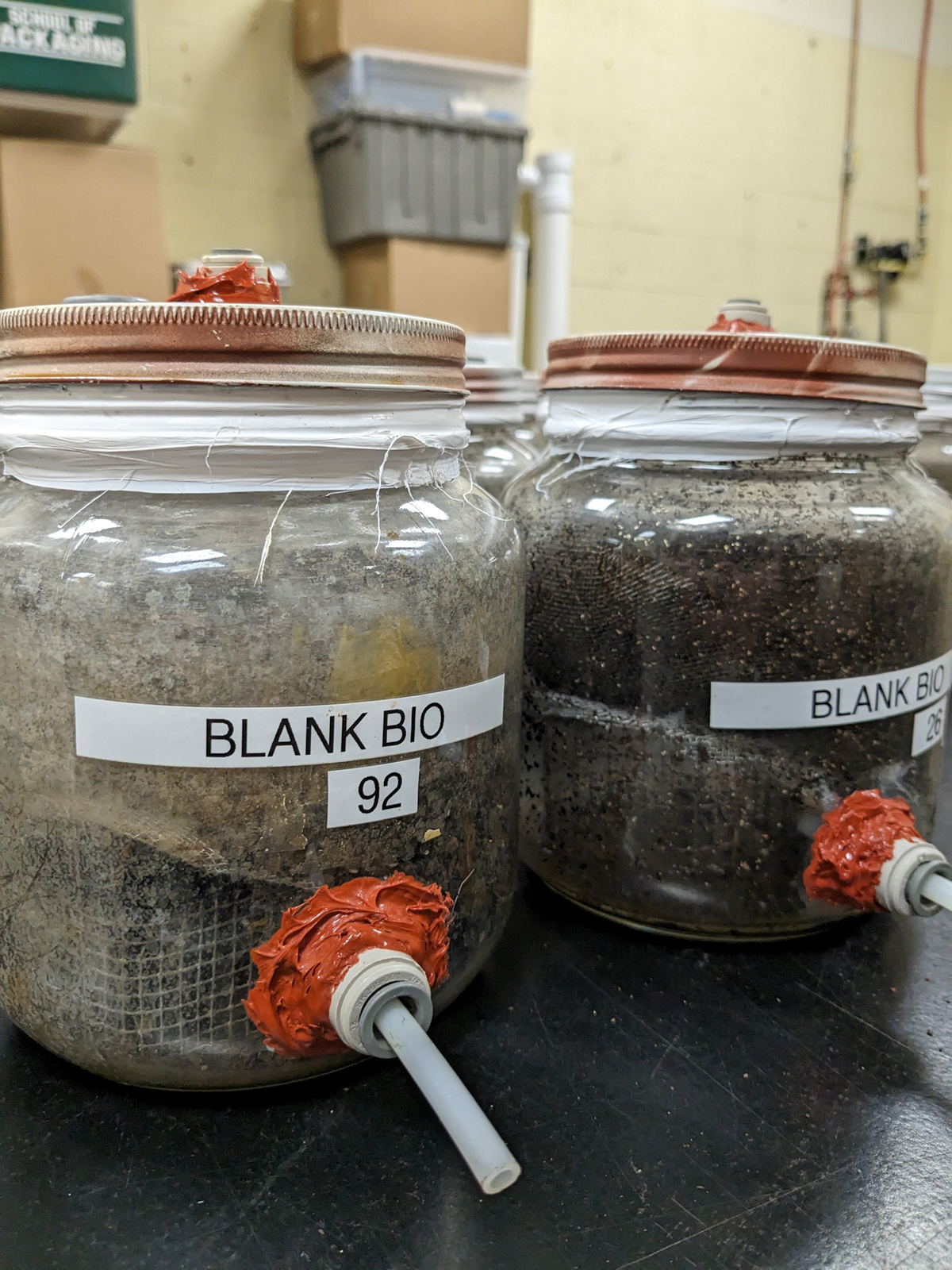
 

Two clear glass jars called bioreactors are filled with compost and plastic materials. White plastic tubes are sealed near the base of both jars and both have another tubing connection on their lid. Each jar also bears a sample ID: one reads “BLANK BIO 92” and the other “BLANK BIO 26.”
A close-up shows the bioreactors the Auras lab at Michigan State University has built to conduct biodegradation experiments. The bioreactors are essentially large glass jars with tubing to measure the gases produced during composting. Credit: Matt Davenport/MSU

To get rid of that lag time and enable the possibility of home composting, Auras and his team integrated a carbohydrate-derived material called thermoplastic starch into PLA. Among other benefits, the starch gives composting’s microbes something they can more easily chow down on while the PLA degrades.


“When we talk about the addition of starch, that doesn’t mean we just keep dumping starch in the PLA matrix,” Mayekar said. “This was about trying to find a sweet spot with starch, so the PLA degrades better without compromising its other properties.”


Fortunately, postdoctoral researcher Anibal Bher had already been formulating different PLA-thermoplastic starch blends to observe how they preserved the strength, clarity and other desirable features of regular PLA films.


Working with doctoral student Wanwarang Limsukon, Bher and Mayekar could observe how those different films broke down throughout the composting process when carried out at different conditions.


“Different materials have different ways of undergoing hydrolysis at the beginning of the process and biodegrading at the end,” Limsukon said. “We’re working on tracking the entire pathway.”


The team ran these experiments using systems that Auras and lab members, past and present, largely built from scratch during his 19 years with MSU. The equipment the researchers have access to outside their own lab in the School of Packaging also makes a difference.


“Working with Dr. Auras, the School of Packaging, MSU — it’s great,” Bher said. “Because, at some point, we want to be making actual products. We are using facilities around campus to make materials and test their properties. MSU offers a lot of resources.”


“There’s a reason why this is one of the best schools for packaging,” Mayekar said.


Changing the conversation


Using their expertise and the resources at hand, the researchers have demonstrated that completely compostable bio-based plastic packaging is possible. Yet Auras stressed that this alone won’t be enough to guarantee its commercial adoption.
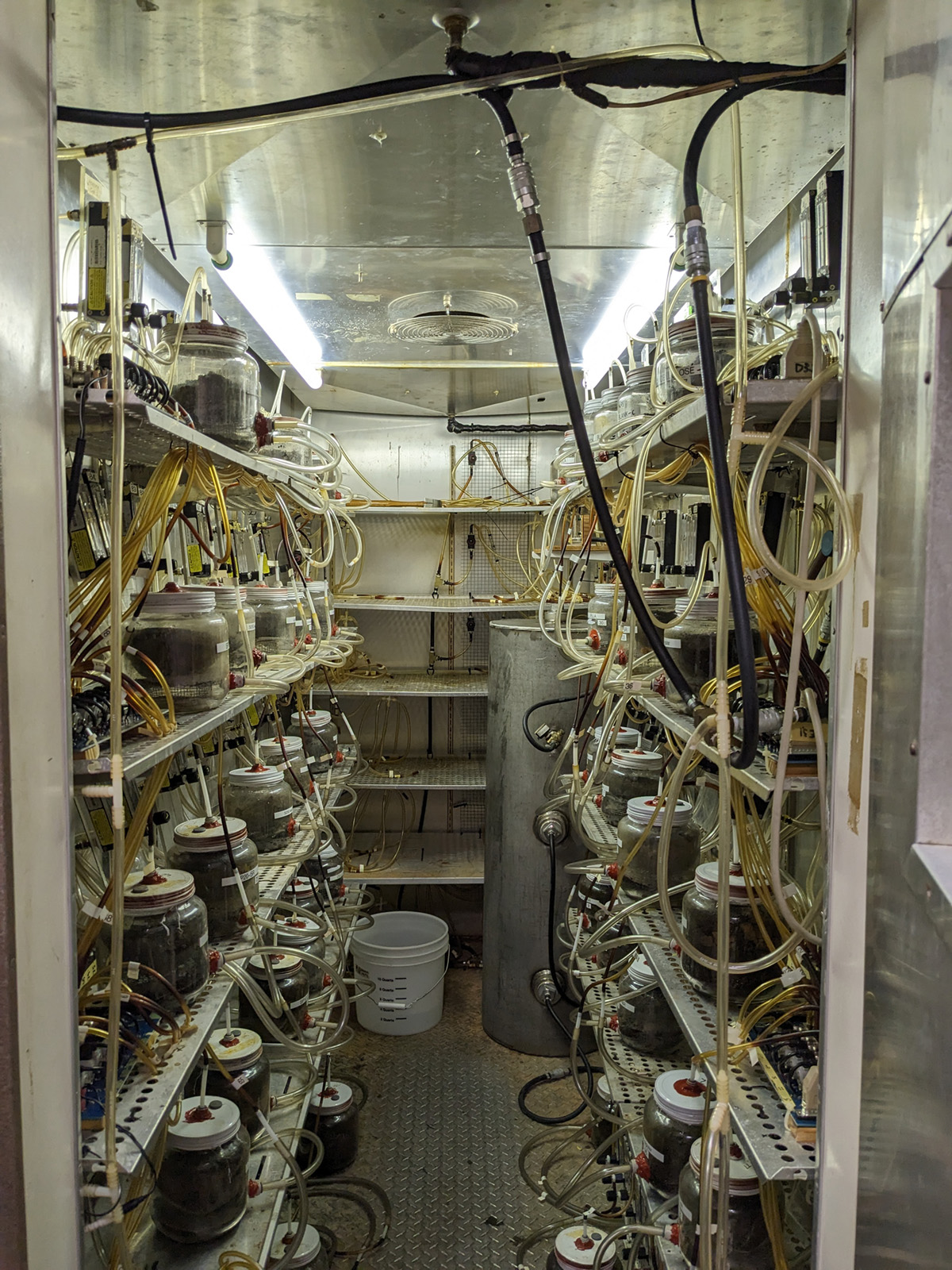
 

Eight metal shelves — four on either side of a long narrow chamber — support rows of bioreactors, clear jars filled with composting material. The bioreactors are all connected to rubber tubing.
Inside this conditioned chamber in Rafael Auras’ lab at Michigan State University, researchers can regulate composting conditions, including temperature, humidity and airflow, while measuring the carbon dioxide produced by microbes as they digest materials in the bioreactors. Credit: Matt Davenport/MSU

The challenges there aren’t solely technical. They’re social and behavioral as well.


“There’s not going to be one solution to the entire problem of plastic waste management,” Mayekar said. “What we’ve developed is one approach from the packaging side.”


Beyond industrial composters’ skepticism about plastics that Auras mentioned earlier, there’s a public misconception that biodegradable and compostable materials can break down relatively quickly anywhere in the environment.


These materials require certain conditions, like those found in an active compost, to decompose in a timely fashion. Outside of those, biodegradable plastics that are disposed of in the environment are still just litter.


“If people think we develop something biodegradable so it can be littered, that will make the problem worse,” Auras said. “The technology we develop is meant to be introduced into active waste-management scenarios.”


“We need to be conscious of how we manage waste, especially plastics,” Bher said. “Even at home, you’ll need to think about how you’re managing that small composting process.”


“It’s really easy to just blame plastic for its problems, but I think we need to change the conversation about how we manage it,” Mayekar said.


With its work, the team wants to help educate folks and raise awareness around this issue. And they have reason to believe they can change attitudes. After all, nobody’s laughing at the idea of potentially composting PLA at home anymore.

MEDIA CONTACTS

Rafael Auras, Emilie Lorditch
Business and EconomyNatural Resources and ConservationClimate and EnvironmentNatural SciencesEngineering, Science and Technology

Latest News

MSUToday Weekly Update

The MSUToday Weekly Update email showcases how Spartans are making a difference through academic excellence, research impact and community outreach. Get inspired by these stories of innovation, collaboration and determination. Plus, enjoy photos and videos of campus and more MSU content to help keep you connected to the Spartan community.

Sign UpUpdate My Information

Connect With Us

Visit our Facebook pageVisit our page on XVisit our Instagram pageVisit our LinkedIn pageVisit our YouTube pageVisit our TikTok page

Health and Safety

  • MSU Police and Public Safety
  • Olin Health Center
  • Counseling & Psychiatric Services (CAPS)
  • University Health and Wellbeing
  • MSU Health Care
  • Civil Rights and Title IX
  • Our Commitment
  • Center for Survivors
  • Security & Fire Safety Report
  • University Policy on Relationship Violence and Sexual Misconduct
  • Notice of Non-Discrimination, Anti-Harassment and Non-Retaliation
  • Health Care Non-Discrimination Notice

Support Services

  • Disability Resources
  • Supportive Services
  • Learning Resources

Working at MSU

  • Human Resources
  • EBS Login
  • Job Postings
  • Employee Assistance Program

Reports

  • CARES Act Funding
  • Student Achievement and Outcomes

Contact us

517-355-1855

Address

Michigan State University 426 Auditorium Road East Lansing, MI 48824

Follow Us

  • Visit our Facebook page
  • Visit our page on X
  • Visit our Instagram page
  • Visit our TikTok page
  • Visit our LinkedIn page
  • Visit our YouTube page

If you're having accessibility issues, please let us know.

Know More: Campus Safety Information and ResourcesTransparency Reporting: Budget & Salary/Compensation
  • Contact Information|
  • Site Map|
  • Privacy Statement|
  • Site Accessibility|
  • Call MSU: (517) 355-1855|
  • Visit: msu.edu|
  • Notice of Nondiscrimination|

SPARTANS WILL|© Michigan State University|

