Jump to HeaderJump to Main ContentJump to Footer
Michigan State University
  • Browse Stories By

    Topics

    Explore stories by subject area

    • Arts and Culture
    • Business and Economy
    • Climate and Environment
    • Education and Learning
    • Engineering, Science and Technology
    • Government and Society
    • Health and Medicine
    • Media and Communications
    • MSU Leadership and Impact
    • Sports and Recreation
    • Student and Campus Experience
    View All Stories

    Collections

    Curated story series

    • Turfgrass
    • Ask the Expert
    • Big Ideas
    • Climate solutions
    • Water at MSU
    • Mobility
    • Spartan Perspectives
    • Student views
    • Graduate voices
    • Faculty voices
    View All Collections

    Featured

    Editor's picks

    • The Spartans behind your favorite Michigan golf courses

      July 22, 2026

      The Spartans behind your favorite Michigan golf courses

    • MSU in the 1990s: 10 Spartan milestones

      July 14, 2026

      MSU in the 1990s: 10 Spartan milestones

MSUTODAY
  • Browse Stories By

< Browse Stories By

Topics

Explore stories by subject area

  • Arts and Culture
  • Business and Economy
  • Climate and Environment
  • Education and Learning
  • Engineering, Science and Technology
  • Government and Society
  • Health and Medicine
  • Media and Communications
  • MSU Leadership and Impact
  • Sports and Recreation
  • Student and Campus Experience
  • View All Stories

Collections

Curated story series

  • Turfgrass
  • Ask the Expert
  • Big Ideas
  • Climate solutions
  • Water at MSU
  • Mobility
  • Spartan Perspectives
  • Student views
  • Graduate voices
  • Faculty voices
  • View All Collections

Featured

Editor's picks

  • The Spartans behind your favorite Michigan golf courses

    July 22, 2026

    The Spartans behind your favorite Michigan golf courses

  • MSU in the 1990s: 10 Spartan milestones

    July 14, 2026

    MSU in the 1990s: 10 Spartan milestones

  • For Media
  • Experts
  • Releases and Statements
  • Sign Up
  • Update Information

Resources

  • A to Z Index
  • Find People
  • Maps
  • Email
  • Student Information System (SIS)
  • D2L
  • Libraries
  • Tech Support
  • MSU Misconduct Hotline
  • Social Media Directory
  • Events Calendar
  • For Media
Michigan State University
MSUToday
  • For Media
  • Experts
  • Releases and Statements
  • Sign Up
  • Update Information
MSUTODAY
Climate and Environment

Aug. 2, 2023

For birds, earlier springtime means fewer young

By: Mollie Newman

Rising global temperatures are making it harder for birds to know when it’s spring and time to breed according to a new study published in Proceedings of the National Academy of Sciences.

Casey Younglesh, a MSU postdoctoral fellow--a man with strawberry blonde hair and beard, smiles
Casey Younglesh, a MSU postdoctoral fellow

A large collaboration led by Michigan State University integrative biologist Casey Youngflesh in partnership with researchers at the University of California, Los Angeles, has found that birds produce fewer young if they start breeding too early or late in the season. With climate change resulting in earlier springlike weather, the researchers report, birds have been unable to keep pace.

The mismatch between the start of spring and birds’ readiness to reproduce is likely to become worse as the world warms, which could have large-scale consequences that would be catastrophic for many bird populations. Birds’ breeding seasons tend to begin when the first green plants and flowers appear (as these support insects that the birds feed on), which is happening earlier and earlier as the climate warms.

“By the end of the 21st century, spring is likely to arrive about 25 days earlier, with birds breeding only about 6.75 days earlier,” said Youngflesh, the study’s first author, who led the research as a postdoctoral researcher at UCLA and is now a postdoctoral fellow in the MSU Department of Integrative Biology in the College of Natural Science. “Our results suggest that breeding productivity may decrease about 12% for the average songbird species.”

This study is part of a larger collaboration researching the phenology — timing of natural phenomena — of plants, insects, and birds. After building the study’s analytical framework, Youngflesh worked with scientists from many other institutions as he tackled a longstanding question about birds — if timing is important for their breeding and why.

“For nearly 30 years, scientists have hypothesized that animals could become mismatched from plants as springs begin earlier,” said Morgan Tingley, a UCLA associate professor of ecology and evolutionary biology and the study’s senior author. “While there have been a few very good case studies of this phenomenon, it has remained a major mystery whether advancing springs will pose a general problem for the majority of species.”
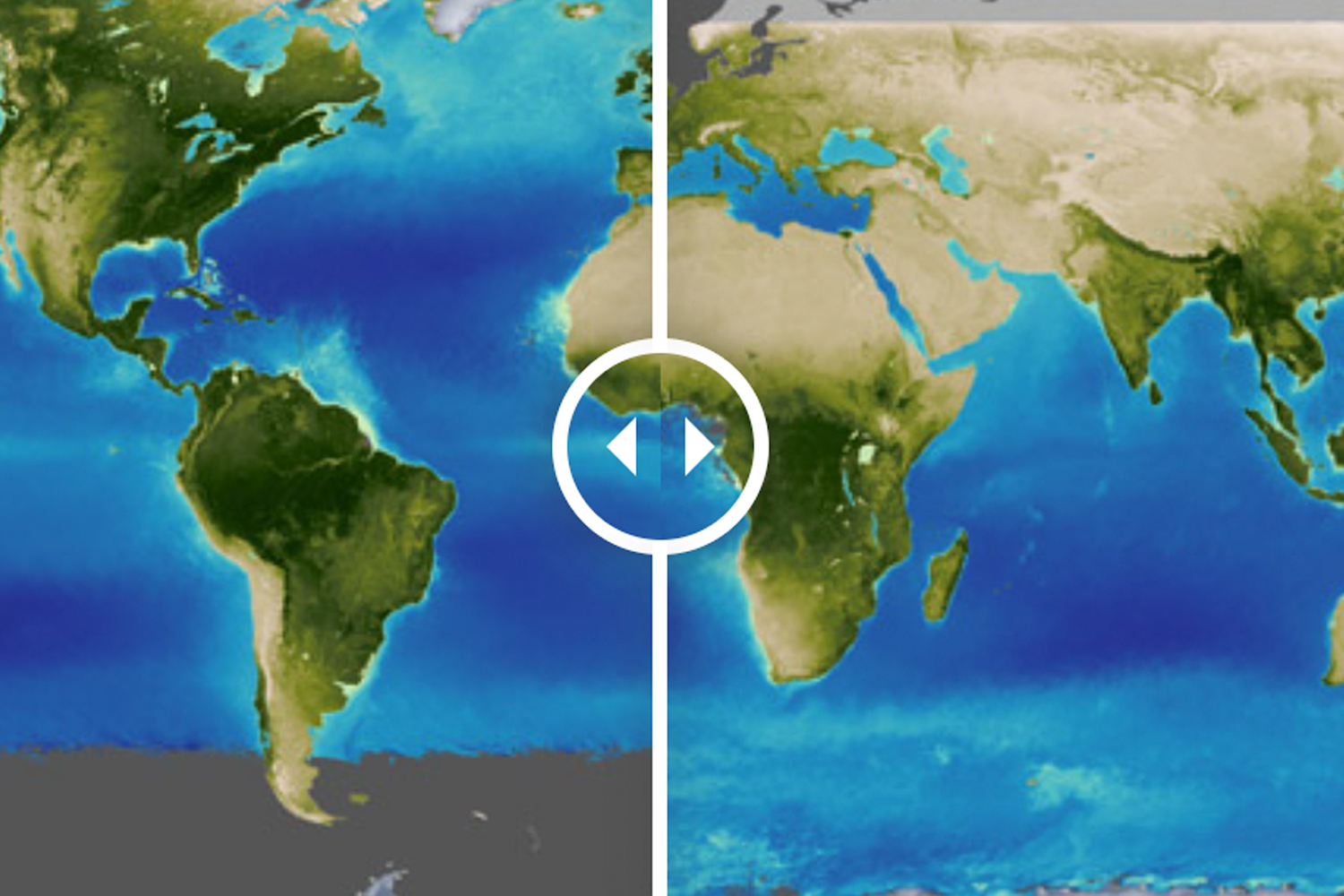
A satellite image of earth showing plant growth, as North and South America are green, and Africa and much of Asia is brown desert
Over the past 50 years, satellites orbiting Earth have unveiled a remarkably dynamic planet. This image shows how plant growth on land fluctuates with the seasons (June and December). Credit: NASA Earth Observatory image Kevin Ward, using data provided by the Ocean Color Web and MODIS Land Science Team.

Teaming up with The Institute of Bird Populations, or IBP, Youngflesh and Tingley accessed the nonprofit’s long-term collaborative bird banding dataset known as the MAPS (the Monitoring Avian Productivity and Survivorship) project. Using additional data from satellite sensors, they determined springs’ arrival and compared it with IBP’s breeding data. The results showed a clear impact on how many young birds were produced.

“One of the novelties of this paper is the large scale, which wouldn’t have been possible without the decades of work from IBP,” said Youngflesh, who is also a member of the Ecology, Evolution, and Behavior Program at MSU. “Birds are a unique group to study because of this; data resources aren’t available on the same scale for other taxonomic groups.”

According to Youngflesh, birds are not keeping up with the pace of climate change. With each passing decade, spring’s arrival is several days earlier, and for every three or four days that it comes earlier, birds are breeding only one day earlier. Using climate models and projections, he predicts that birds will produce significantly fewer young by the end of the century. Given that North American birds have declined by about a third over the last 50 years, this is particularly concerning.

“Addressing phenological change is addressing climate change,” Youngflesh said. “If we know that some species are particularly susceptible to a warming world, or we know they are producing fewer young, we can focus on conservation in other areas, like protecting their habitat. We are seeing a cumulative effect; none of this happens in isolation.”

Funding for this study came from a National Science Foundation acrosystems grant and was supported by researchers at UCLA; the University of Florida; Pennsylvania State University; University of North Carolina, Chapel Hill; and The Institute for Bird Populations.

This story originally appeared on the College of Natural Science website.

MEDIA CONTACTS

Val Osowski
Climate and EnvironmentBiodiversity and WildlifeClimate and Climate Solutions

Latest News

MSUToday Weekly Update

The MSUToday Weekly Update email showcases how Spartans are making a difference through academic excellence, research impact and community outreach. Get inspired by these stories of innovation, collaboration and determination. Plus, enjoy photos and videos of campus and more MSU content to help keep you connected to the Spartan community.

Sign UpUpdate My Information

Connect With Us

Visit our Facebook pageVisit our page on XVisit our Instagram pageVisit our LinkedIn pageVisit our YouTube pageVisit our TikTok page

Health and Safety

  • MSU Police and Public Safety
  • Olin Health Center
  • Counseling & Psychiatric Services (CAPS)
  • University Health and Wellbeing
  • MSU Health Care
  • Civil Rights and Title IX
  • Our Commitment
  • Center for Survivors
  • Security & Fire Safety Report
  • University Policy on Relationship Violence and Sexual Misconduct
  • Notice of Non-Discrimination, Anti-Harassment and Non-Retaliation
  • Health Care Non-Discrimination Notice

Support Services

  • Disability Resources
  • Supportive Services
  • Learning Resources

Working at MSU

  • Human Resources
  • EBS Login
  • Job Postings
  • Employee Assistance Program

Reports

  • CARES Act Funding
  • Student Achievement and Outcomes

Contact us

517-355-1855

Address

Michigan State University 426 Auditorium Road East Lansing, MI 48824

Follow Us

  • Visit our Facebook page
  • Visit our page on X
  • Visit our Instagram page
  • Visit our TikTok page
  • Visit our LinkedIn page
  • Visit our YouTube page

If you're having accessibility issues, please let us know.

Know More: Campus Safety Information and ResourcesTransparency Reporting: Budget & Salary/Compensation
  • Contact Information|
  • Site Map|
  • Privacy Statement|
  • Site Accessibility|
  • Call MSU: (517) 355-1855|
  • Visit: msu.edu|
  • Notice of Nondiscrimination|

SPARTANS WILL|© Michigan State University|
