Jump to HeaderJump to Main ContentJump to Footer
Michigan State University
MSUTODAY
  • Browse Stories By

    Topics

    Explore stories by subject area

    • Arts and Culture
    • Business and Economy
    • Climate and Environment
    • Education and Learning
    • Engineering, Science and Technology
    • Government and Society
    • Health and Medicine
    • Media and Communications
    • MSU Leadership and Impact
    • Sports and Recreation
    • Student and Campus Experience
    View All Stories

    Collections

    Curated story series

    • Turfgrass
    • Ask the Expert
    • Big Ideas
    • Climate solutions
    • Water at MSU
    • Mobility
    • Spartan Perspectives
    • Student views
    • Graduate voices
    • Faculty voices
    View All Collections

    Featured

    Editor's picks

    • 9 reasons to love being a Spartan

      Aug. 28, 2026

      9 reasons to love being a Spartan

    • NIH awards multi-university team over $4M to improve women’s health

      Sept. 15, 2026

      NIH awards multi-university team over $4M to improve women’s health

MSUTODAY
  • Browse Stories By

< Browse Stories By

Topics

Explore stories by subject area

  • Arts and Culture
  • Business and Economy
  • Climate and Environment
  • Education and Learning
  • Engineering, Science and Technology
  • Government and Society
  • Health and Medicine
  • Media and Communications
  • MSU Leadership and Impact
  • Sports and Recreation
  • Student and Campus Experience
  • View All Stories

Collections

Curated story series

  • Turfgrass
  • Ask the Expert
  • Big Ideas
  • Climate solutions
  • Water at MSU
  • Mobility
  • Spartan Perspectives
  • Student views
  • Graduate voices
  • Faculty voices
  • View All Collections

Featured

Editor's picks

  • 9 reasons to love being a Spartan

    Aug. 28, 2026

    9 reasons to love being a Spartan

  • NIH awards multi-university team over $4M to improve women’s health

    Sept. 15, 2026

    NIH awards multi-university team over $4M to improve women’s health

  • For Media
  • Experts
  • Releases and Statements
  • Sign Up
  • Update Information

Resources

  • A to Z Index
  • Find People
  • Maps
  • Email
  • Student Information System (SIS)
  • D2L
  • Libraries
  • Tech Support
  • MSU Misconduct Hotline
  • Social Media Directory
  • Events Calendar
  • For Media
Michigan State University
MSUToday
  • For Media
  • Experts
  • Releases and Statements
  • Sign Up
  • Update Information
Nuclear Science

July 7, 2023

FRIB hosts superconducting radio frequency conference

Hundreds of scientific and technical leaders in the superconducting radio frequency, or SRF, field converged in Michigan for the 21st International Conference on Radio-Frequency Superconductivity, or SRF 2023. The Facility for Rare Isotope Beams, or FRIB, served as host for the premier conference, which ran June 25-30 in Grand Rapids.
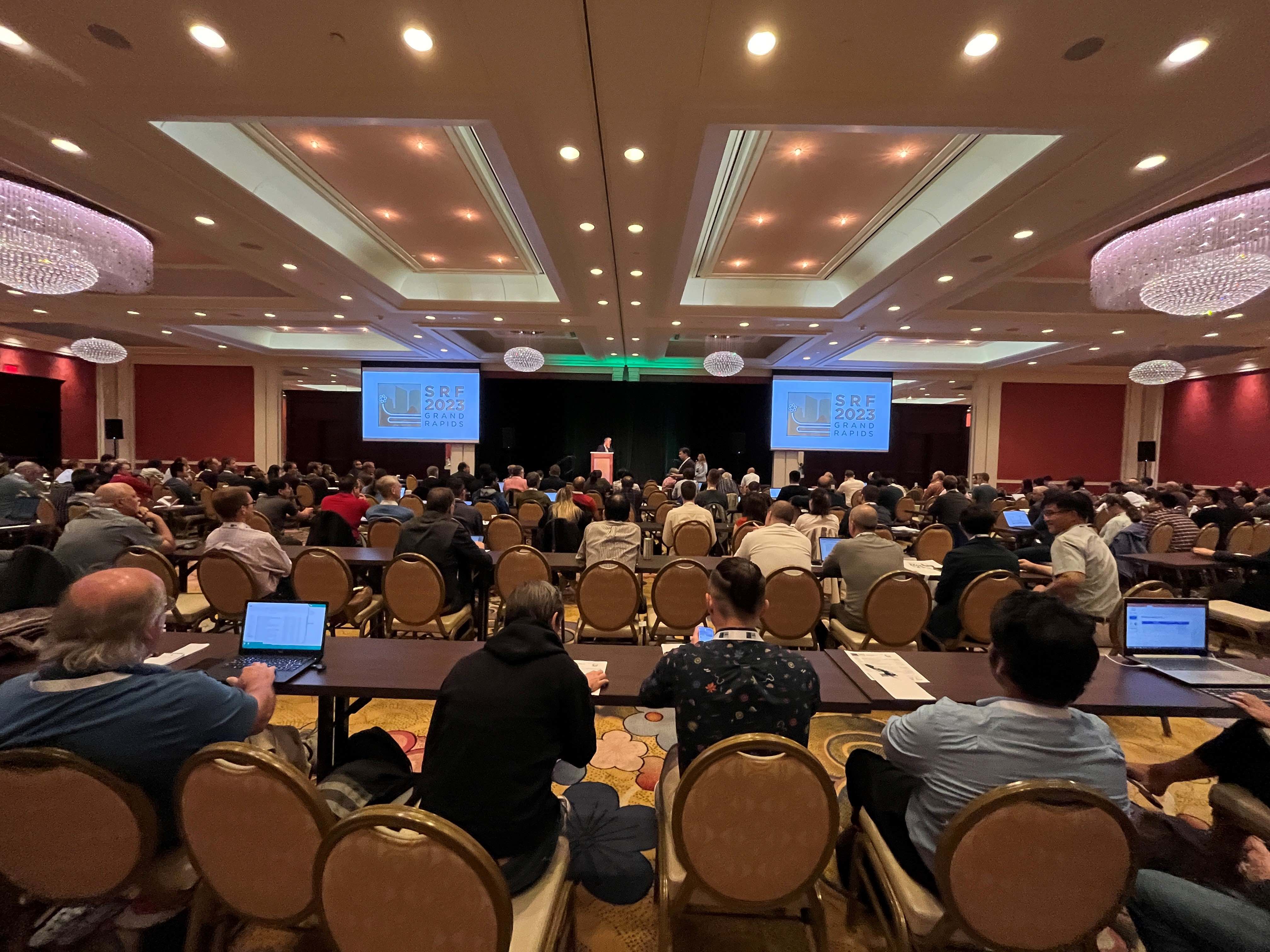
The Facility for Rare Isotope Beams (FRIB) hosted the 21st International Conference on Radio-Frequency Superconductivity (SRF 2023). The 2023 conference marks more than 60 years of SRF research and development.
The Facility for Rare Isotope Beams, or FRIB, hosted the 21st International Conference on Radio-Frequency Superconductivity, or SRF 2023. The 2023 conference marks more than 60 years of SRF research and development.

The SRF conference is held every two years, rotating between North America, Asia and Europe. In 2019, the international organizing committee chose FRIB to host the next conference. FRIB was selected as a first-time host due to its success in assembling and building — with the SRF community’s support and curation — what is designed to be the most powerful heavy-ion accelerator. Considering limitations the pandemic posed, FRIB proposed to hold the 2021 meeting virtually and postpone the in-person event to 2023.

Nearly 300 attendees participated in the conference, representing 34 countries and 80 institutions.

The conference included one keynote and three special talks, 66 oral presentations, 321 poster presentations and 154 papers.

The 2023 conference marked more than 60 years of SRF research and development. SRF technology is a part of many accelerator projects for nuclear physics, particle physics, synchrotron light sources and free-electron lasers. The SRF conference is organized by an international group of experts, who meet at a host location to discuss the latest advances in the field.

At the conference, scientists, engineers, students and industrial partners both domestic and international presented and discussed the latest developments in SRF science, technology and applications. The program included invited talks, poster sessions, a keynote talk, and a tour of FRIB. The conference also provided opportunities for students and early-career researchers to present their work.

Leaders in the SRF community from national and international facilities were well represented in the conference program, including the Institute for Rare Isotope Science, South Korea; the European Spallation Source, Sweden; the European Organization for Nuclear Research (CERN), Switzerland; Shanghai Advanced Research Institute, Chinese Academy of Sciences (SARI-CAS), China; Oak Ridge National Laboratory; RIKEN, Japan; the High Energy Accelerator Research Organization (KEK), Japan; the German Electron Synchrotron (DESY), Germany; TRIUMF, Canada; Brookhaven National Laboratory; Fermi National Accelerator Laboratory; SLAC National Accelerator Laboratory; Thomas Jefferson National Accelerator Facility; and many universities.

The international SRF community helped develop the technology that is key to operating FRIB’s high-power linear accelerator (linac). FRIB’s linac consists of 46 cryomodules of six different types. The cryomodules contain SRF resonators and superconducting solenoid magnets. Operating at cryogenic temperatures of 2 kelvin (K) and 4.5 K, the SRF resonators accelerate the beam with high voltage (> 1 million volts) while the solenoids steer and focus it to hit a target, producing rare isotopes.

In his welcome address at SRF 2023, FRIB Laboratory Director Thomas Glasmacher thanked the SRF community for its profound impact on establishing and now operating FRIB.

“At the heart of FRIB is SRF technology developed and curated by this community,” he said. “Without the SRF community, there would be no FRIB. Thank you very much for welcoming us, teaching us SRF technology, and for allowing us to host this conference.”

Michigan State University (MSU) operates the Facility for Rare Isotope Beams (FRIB) as a user facility for the U.S. Department of Energy Office of Science (DOE-SC), supporting the mission of the DOE-SC Office of Nuclear Physics. User facility operation is supported by the DOE-SC Office of Nuclear Physics as one of 28 DOE-SC user facilities.

The U.S. Department of Energy Office of Science is the single largest supporter of basic research in the physical sciences in the United States and is working to address some of today’s most pressing challenges. For more information, visit energy.gov/science.

This story originally appeared on the Facility for Rare Isotope Beams website.

MEDIA CONTACTS

Will Whelton
Nuclear ScienceEngineering, Science and TechnologyNuclear ScienceMSU ResearchMSU Leadership and Impact

Latest News

MSUToday Weekly Update

The MSUToday Weekly Update email showcases how Spartans are making a difference through academic excellence, research impact and community outreach. Get inspired by these stories of innovation, collaboration and determination. Plus, enjoy photos and videos of campus and more MSU content to help keep you connected to the Spartan community.

Sign UpUpdate My Information

Connect With Us

Visit our Facebook pageVisit our page on XVisit our Instagram pageVisit our LinkedIn pageVisit our YouTube pageVisit our TikTok page

Health and Safety

  • MSU Police and Public Safety
  • Olin Health Center
  • Counseling & Psychiatric Services (CAPS)
  • University Health and Wellbeing
  • MSU Health Care
  • Civil Rights and Title IX
  • Our Commitment
  • Center for Survivors
  • Security & Fire Safety Report
  • University Policy on Relationship Violence and Sexual Misconduct
  • Notice of Non-Discrimination, Anti-Harassment and Non-Retaliation
  • Health Care Non-Discrimination Notice

Support Services

  • Disability Resources
  • Supportive Services
  • Learning Resources

Working at MSU

  • Human Resources
  • EBS Login
  • Job Postings
  • Employee Assistance Program

Reports

  • CARES Act Funding
  • Student Achievement and Outcomes

Contact us

517-355-1855

Address

Michigan State University 426 Auditorium Road East Lansing, MI 48824

Follow Us

  • Visit our Facebook page
  • Visit our page on X
  • Visit our Instagram page
  • Visit our TikTok page
  • Visit our LinkedIn page
  • Visit our YouTube page

If you're having accessibility issues, please let us know.

Know More: Campus Safety Information and ResourcesTransparency Reporting: Budget & Salary/Compensation
  • Contact Information|
  • Site Map|
  • Privacy Statement|
  • Site Accessibility|
  • Call MSU: (517) 355-1855|
  • Visit: msu.edu|
  • Notice of Nondiscrimination|

SPARTANS WILL|© Michigan State University|
