Jump to HeaderJump to Main ContentJump to Footer
Michigan State University
MSUTODAY
  • Browse Stories By

    Topics

    Explore stories by subject area

    • Arts and Culture
    • Business and Economy
    • Climate and Environment
    • Education and Learning
    • Engineering, Science and Technology
    • Government and Society
    • Health and Medicine
    • Media and Communications
    • MSU Leadership and Impact
    • Sports and Recreation
    • Student and Campus Experience
    View All Stories

    Collections

    Curated story series

    • Turfgrass
    • Ask the Expert
    • Big Ideas
    • Climate solutions
    • Water at MSU
    • Mobility
    • Spartan Perspectives
    • Student views
    • Graduate voices
    • Faculty voices
    View All Collections

    Featured

    Editor's picks

    • 9 reasons to love being a Spartan

      Aug. 28, 2026

      9 reasons to love being a Spartan

    • NIH awards multi-university team over $4M to improve women’s health

      Sept. 15, 2026

      NIH awards multi-university team over $4M to improve women’s health

MSUTODAY
  • Browse Stories By

< Browse Stories By

Topics

Explore stories by subject area

  • Arts and Culture
  • Business and Economy
  • Climate and Environment
  • Education and Learning
  • Engineering, Science and Technology
  • Government and Society
  • Health and Medicine
  • Media and Communications
  • MSU Leadership and Impact
  • Sports and Recreation
  • Student and Campus Experience
  • View All Stories

Collections

Curated story series

  • Turfgrass
  • Ask the Expert
  • Big Ideas
  • Climate solutions
  • Water at MSU
  • Mobility
  • Spartan Perspectives
  • Student views
  • Graduate voices
  • Faculty voices
  • View All Collections

Featured

Editor's picks

  • 9 reasons to love being a Spartan

    Aug. 28, 2026

    9 reasons to love being a Spartan

  • NIH awards multi-university team over $4M to improve women’s health

    Sept. 15, 2026

    NIH awards multi-university team over $4M to improve women’s health

  • For Media
  • Experts
  • Releases and Statements
  • Sign Up
  • Update Information

Resources

  • A to Z Index
  • Find People
  • Maps
  • Email
  • Student Information System (SIS)
  • D2L
  • Libraries
  • Tech Support
  • MSU Misconduct Hotline
  • Social Media Directory
  • Events Calendar
  • For Media
Michigan State University
MSUToday
  • For Media
  • Experts
  • Releases and Statements
  • Sign Up
  • Update Information
Public Health

Feb. 10, 2021

1918 influenza provides warning for potential future pandemic reemergence

By: Emilie Lorditch
The 1918 influenza pandemic provides a cautionary tale for what the future may hold for COVID-19, says a Michigan State University researcher.

After a decade studying a flu virus that killed approximately 15,000 Michigan residents, Siddharth Chandra, a professor in MSU’s James Madison College, saw his research come to life as he watched the spread of the COVID-19 pandemic. 


“It was so surreal,” said Chandra, who has a courtesy appointment in epidemiology and biostatistics. “All of a sudden, I was living my research.”


Chandra’s research was published online Feb. 10 in the American Journal of Public Health with co-authors Julia Christensen, a graduate of James Madison College; Madhur Chandra, Senior Community Epidemiologist with the Ingham County Health Department and graduate of the Department of Epidemiology and Biostatistics at MSU; and Nigel Paneth, professor of epidemiology and biostatistics and pediatrics at MSU.

Using influenza infection and mortality data on Michigan from 1918-1920, Chandra identified four distinct waves. The first large peak was in March 1918. “After a second spike in cases in October 1918, the governor instituted a statewide ban on public gatherings,” Chandra said. “Much like the restrictions that were put in place during the COVID-19 pandemic.”
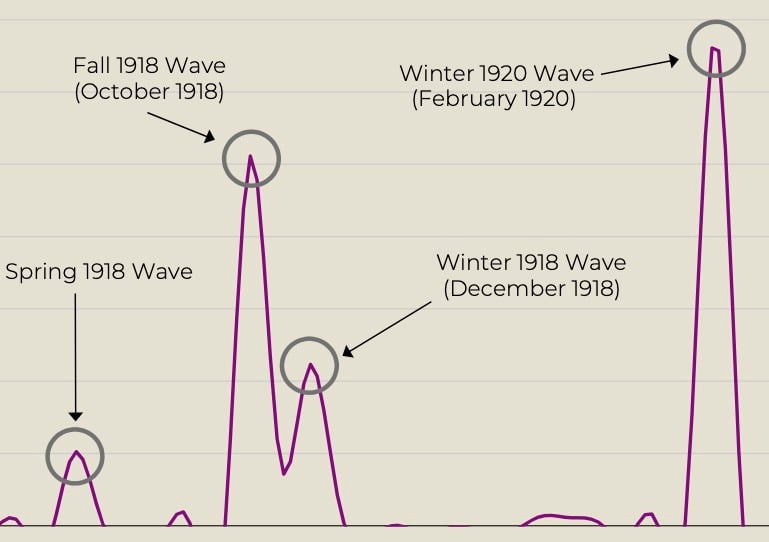
Siddharth Chandra - Graph of 1918 flu peaks This graph shows the four distinct waves. Wave #1 March 1918 (Spring 1918 Wave), #2 October 1918 (Fall 1918 Wave), #3 December 1918 (Winter 1918 Wave) and #4 February 2020 (Winter 1920 Wave)

After three weeks, the number of cases decreased and the ban was lifted, which led to another peak in December 1918. “The ban didn’t stop the spread of the flu. It just delayed the spike in cases,” he said.
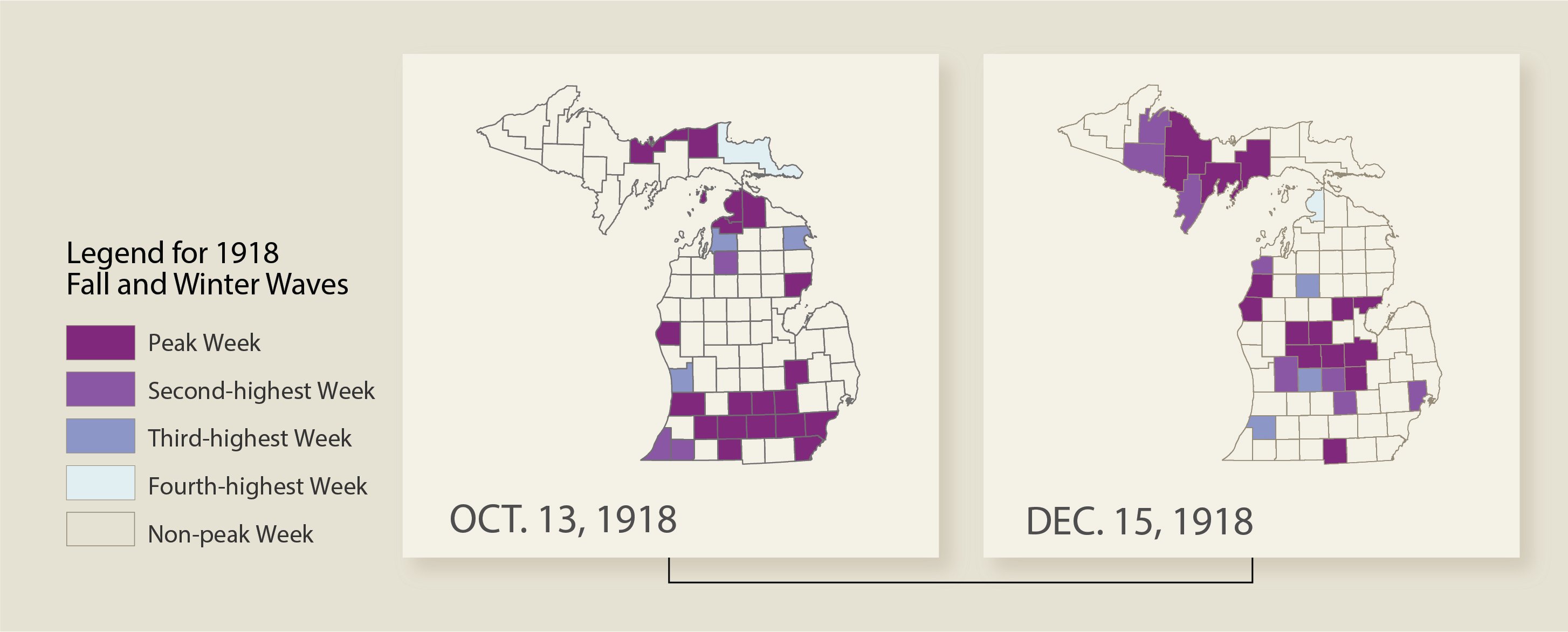
 

Siddharth Chandra map Oct and Dec 1918 flu in MichiganThis map shows the counties in Michigan with the highest numbers of flu cases during the spike and peak in cases for October and December 1918

Chandra mapped the data showing the peaks and spikes in cases from October 1918 and December 1918 and tracked flu virus case growth by county over time. In October, counties in the southern part of the state and near the Mackinac Straits had the highest numbers but by December, the highest numbers of cases were in the heart of the state.
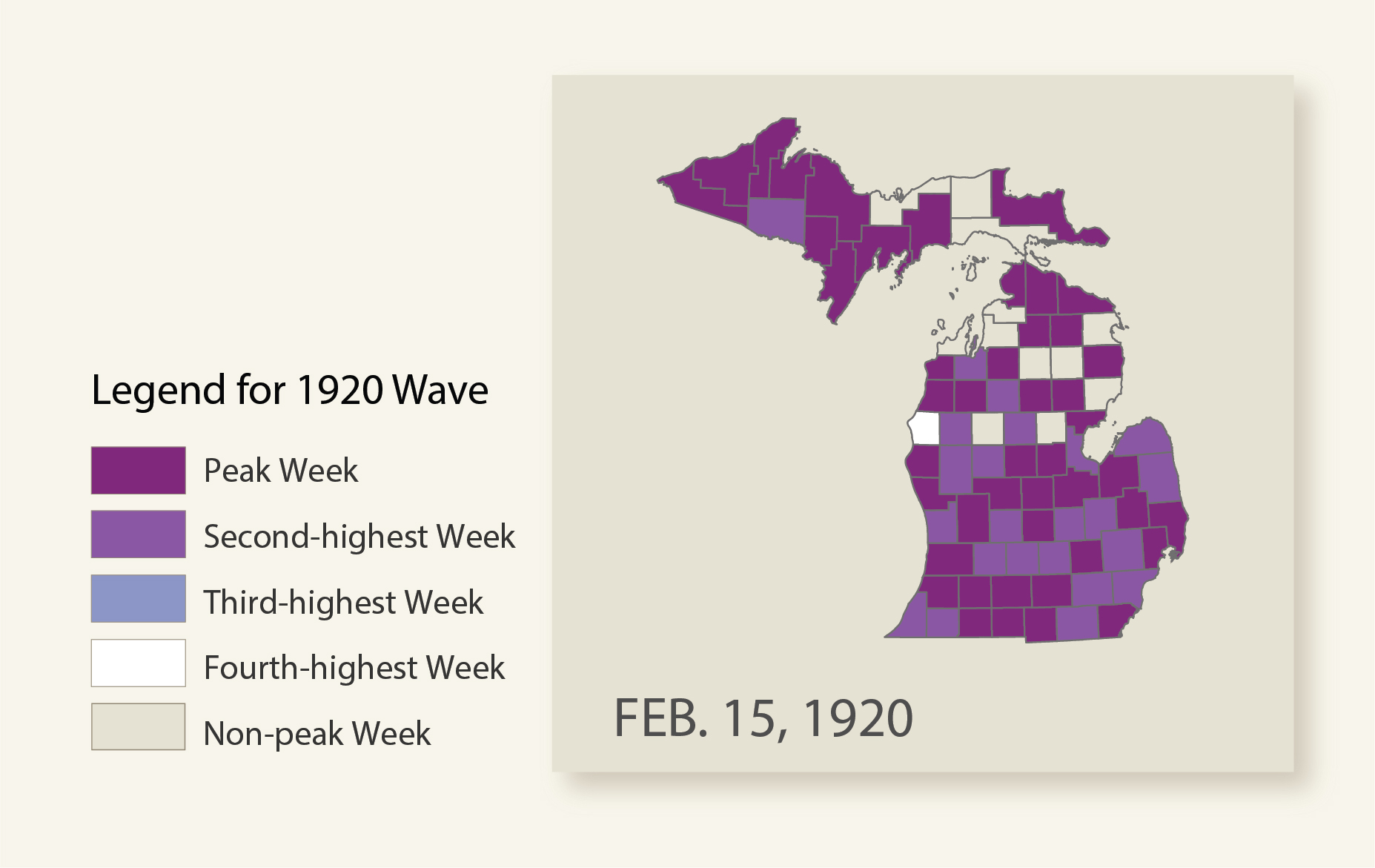
Siddharth Chandra map 1920 spike flu in MichiganThis map shows the counties in Michigan with the highest number of flu cases during the spike in cases in February 1920

The most surprising piece of data came 18 months later in February 1920, when a statewide explosion of cases created a massive spike even larger than the one in October 1918. For Chandra, it is an educated guess as to the reasons for this delayed increase. 


“Assuming it’s the same influenza virus, World War I ended in 1918 and the men were coming home to their families,” he said. “We had a mobile agent that brought the virus home to infect family members, which would explain the increase in cases among children and the elderly.”

Unfortunately, there is not a way to confirm this, Chandra noted. “We would need samples from patients in 1920 from across the state. Then, we would need to compare those with samples from patients in 1918 from across the state, and that’s not likely to happen.”


The weather may have also been a factor since cool temperatures with low humidity likely provided optimal conditions for the virus to live and spread. Another factor that played a role was the absence of a vaccine. 


“In 1918, there was no hope for a vaccine. In 2021, we have a vaccine available,” he said.


One of the key insights from the 1918 pandemic that can inform the public health response to the 2020 COVID-19 pandemic is the number of people who are susceptible to the virus. Which means that it is possible that a spike like the February 1920 one will occur in late 2021 or early 2022. 

“So many people will remain susceptible until they get vaccinated,” Chandra said. “Bad things can still happen a year or two from now even if we see a decrease in the number of cases now. We still have over 200 million people walking around who are susceptible to the virus, including myself.”




MEDIA CONTACTS

Caroline Brooks
Public HealthHealth and MedicinePublic Health

Latest News

MSUToday Weekly Update

The MSUToday Weekly Update email showcases how Spartans are making a difference through academic excellence, research impact and community outreach. Get inspired by these stories of innovation, collaboration and determination. Plus, enjoy photos and videos of campus and more MSU content to help keep you connected to the Spartan community.

Sign UpUpdate My Information

Connect With Us

Visit our Facebook pageVisit our page on XVisit our Instagram pageVisit our LinkedIn pageVisit our YouTube pageVisit our TikTok page

Health and Safety

  • MSU Police and Public Safety
  • Olin Health Center
  • Counseling & Psychiatric Services (CAPS)
  • University Health and Wellbeing
  • MSU Health Care
  • Civil Rights and Title IX
  • Our Commitment
  • Center for Survivors
  • Security & Fire Safety Report
  • University Policy on Relationship Violence and Sexual Misconduct
  • Notice of Non-Discrimination, Anti-Harassment and Non-Retaliation
  • Health Care Non-Discrimination Notice

Support Services

  • Disability Resources
  • Supportive Services
  • Learning Resources

Working at MSU

  • Human Resources
  • EBS Login
  • Job Postings
  • Employee Assistance Program

Reports

  • CARES Act Funding
  • Student Achievement and Outcomes

Contact us

517-355-1855

Address

Michigan State University 426 Auditorium Road East Lansing, MI 48824

Follow Us

  • Visit our Facebook page
  • Visit our page on X
  • Visit our Instagram page
  • Visit our TikTok page
  • Visit our LinkedIn page
  • Visit our YouTube page

If you're having accessibility issues, please let us know.

Know More: Campus Safety Information and ResourcesTransparency Reporting: Budget & Salary/Compensation
  • Contact Information|
  • Site Map|
  • Privacy Statement|
  • Site Accessibility|
  • Call MSU: (517) 355-1855|
  • Visit: msu.edu|
  • Notice of Nondiscrimination|

SPARTANS WILL|© Michigan State University|