
Jump to HeaderJump to Main ContentJump to Footer
Michigan State University
  • Browse Stories By

    Topics

    Explore stories by subject area

    • Arts and Culture
    • Business and Economy
    • Climate and Environment
    • Education and Learning
    • Engineering, Science and Technology
    • Government and Society
    • Health and Medicine
    • Media and Communications
    • MSU Leadership and Impact
    • Sports and Recreation
    • Student and Campus Experience
    View All Stories

    Collections

    Curated story series

    • Turfgrass
    • Ask the Expert
    • Big Ideas
    • Climate solutions
    • Water at MSU
    • Mobility
    • Spartan Perspectives
    • Student views
    • Graduate voices
    • Faculty voices
    View All Collections

    Featured

    Editor's picks

    • The Spartans behind your favorite Michigan golf courses

      July 22, 2026

      The Spartans behind your favorite Michigan golf courses

    • MSU in the 1990s: 10 Spartan milestones

      July 14, 2026

      MSU in the 1990s: 10 Spartan milestones

MSUTODAY
  • Browse Stories By

< Browse Stories By

Topics

Explore stories by subject area

  • Arts and Culture
  • Business and Economy
  • Climate and Environment
  • Education and Learning
  • Engineering, Science and Technology
  • Government and Society
  • Health and Medicine
  • Media and Communications
  • MSU Leadership and Impact
  • Sports and Recreation
  • Student and Campus Experience
  • View All Stories

Collections

Curated story series

  • Turfgrass
  • Ask the Expert
  • Big Ideas
  • Climate solutions
  • Water at MSU
  • Mobility
  • Spartan Perspectives
  • Student views
  • Graduate voices
  • Faculty voices
  • View All Collections

Featured

Editor's picks

  • The Spartans behind your favorite Michigan golf courses

    July 22, 2026

    The Spartans behind your favorite Michigan golf courses

  • MSU in the 1990s: 10 Spartan milestones

    July 14, 2026

    MSU in the 1990s: 10 Spartan milestones

  • For Media
  • Experts
  • Releases and Statements
  • Sign Up
  • Update Information

Resources

  • A to Z Index
  • Find People
  • Maps
  • Email
  • Student Information System (SIS)
  • D2L
  • Libraries
  • Tech Support
  • MSU Misconduct Hotline
  • Social Media Directory
  • Events Calendar
  • For Media
Michigan State University
MSUToday
  • For Media
  • Experts
  • Releases and Statements
  • Sign Up
  • Update Information
MSUTODAY
Diseases, Conditions and Treatments

Jan. 25, 2021

Nanomedicine’s ‘crown’ is ready for its close-up

New techniques are showing how tiny diagnostics, therapeutics interact with human biomolecules like never before

By: Matt Davenport
MSU Assistant Professor Morteza Mahmoudi

An international team of researchers led by Michigan State University’s Morteza Mahmoudi has developed a new method to better understand how nanomedicines — emerging diagnostics and therapies that are very small yet very intricate — interact with patients’ biomolecules.


Medicines based on nanoscopic particles have the promise to be more effective than current therapies while reducing side effects. But subtle complexities have confined most of these particles to research labs and out of clinical use, said Mahmoudi, an assistant professor in the Department of Radiology and the Precision Health Program.


“There’s been a considerable investment of taxpayer money in cancer nanomedicine research, but that research hasn’t successfully translated to the clinic,” Mahmoudi said. “The biological effects of nanoparticles, how the body interacts with nanoparticles, remain poorly understood. And they need to be considered in detail.”


Mahmoudi’s team has now introduced a unique combination of microscopy techniques to enable more detailed consideration of those biological effects, which the researchers described in the journal Nature Communications, published online on Jan. 25.


The team’s methods let researchers see important differences between particles exposed to human plasma, the cell-free part of blood that contains biomolecules including proteins, enzymes and antibodies.


These biological bits latch onto a nanoparticle, creating a coating referred to as a corona (not to be confused with the novel coronavirus), the Latin word for crown. This corona contains clues about how nanoparticles interact with a patient’s biology. Now, Mahmoudi and his colleagues have shown how to get an unprecedented view of that corona.
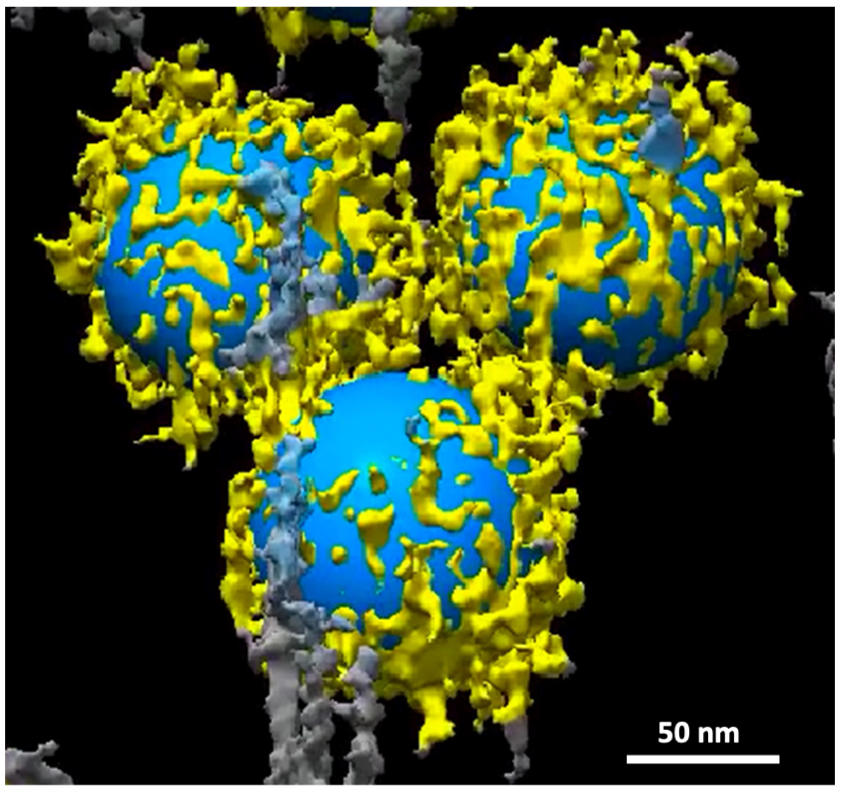
 

A micrograph shows three spherical nanoparticles, which have been colorized in blue, coated with confetti-like yellow strands that are biomolecules the particles have collected from human plasma.
A new combination of advanced microscopy techniques reveal the biomolecules (yellow) that nanoparticles (blue) collect when exposed to human plasma. Image courtesy of Nature Communications.

“For the first time, we can image the 3-D structure of the particles coated with biomolecules at the nano level,” Mahmoudi said. “This is a useful approach to get helpful and robust data for nanomedicines, to get the kind of data that can affect scientists’ decisions about the safety and efficacy of nanoparticles.”


Although work like this is ultimately helping move therapeutic nanomedicines into the clinic, Mahmoudi is not optimistic that broad approval will happen any time soon. There’s still much to learn about the particles. Furthermore, one of the things that researchers do understand very well — that minute variations in these diminutive drugs can have outsized impact — was underscored by this study.


The researchers saw that the coronas of nanoparticles from the same batch, exposed to the same human plasma, could provoke a variety of reactions by a patient to a single dose.


Still, Mahmoudi sees an opportunity in this. He believes these particles could shine as diagnostics tools instead of drugs. Rather than trying to treat diseases with nanoscale medicine, he believes that persnickety particles would be well suited for the early detection of disease. For example, Mahmoudi’s group has previously shown this diagnostic potential for cancers and neurodegenerative diseases.


“We could become more proactive if we used nanoparticles as a diagnostic,” he said. “When you can detect disease at the earlier stages, it becomes easier to treat them.”


(Note for media: In online coverage, please include a link to the original paper: http://dx.doi.org/10.1038/s41467-020-20884-9)


MEDIA CONTACTS

Morteza Mahmoudi
Diseases, Conditions and TreatmentsHealth and MedicineHealth and MedicineNatural SciencesEngineering, Science and Technology

Latest News

MSUToday Weekly Update

The MSUToday Weekly Update email showcases how Spartans are making a difference through academic excellence, research impact and community outreach. Get inspired by these stories of innovation, collaboration and determination. Plus, enjoy photos and videos of campus and more MSU content to help keep you connected to the Spartan community.

Sign UpUpdate My Information

Connect With Us

Visit our Facebook pageVisit our page on XVisit our Instagram pageVisit our LinkedIn pageVisit our YouTube pageVisit our TikTok page

Health and Safety

  • MSU Police and Public Safety
  • Olin Health Center
  • Counseling & Psychiatric Services (CAPS)
  • University Health and Wellbeing
  • MSU Health Care
  • Civil Rights and Title IX
  • Our Commitment
  • Center for Survivors
  • Security & Fire Safety Report
  • University Policy on Relationship Violence and Sexual Misconduct
  • Notice of Non-Discrimination, Anti-Harassment and Non-Retaliation
  • Health Care Non-Discrimination Notice

Support Services

  • Disability Resources
  • Supportive Services
  • Learning Resources

Working at MSU

  • Human Resources
  • EBS Login
  • Job Postings
  • Employee Assistance Program

Reports

  • CARES Act Funding
  • Student Achievement and Outcomes

Contact us

517-355-1855

Address

Michigan State University 426 Auditorium Road East Lansing, MI 48824

Follow Us

  • Visit our Facebook page
  • Visit our page on X
  • Visit our Instagram page
  • Visit our TikTok page
  • Visit our LinkedIn page
  • Visit our YouTube page

If you're having accessibility issues, please let us know.

Know More: Campus Safety Information and ResourcesTransparency Reporting: Budget & Salary/Compensation
  • Contact Information|
  • Site Map|
  • Privacy Statement|
  • Site Accessibility|
  • Call MSU: (517) 355-1855|
  • Visit: msu.edu|
  • Notice of Nondiscrimination|

SPARTANS WILL|© Michigan State University|