Jump to HeaderJump to Main ContentJump to Footer
Michigan State University
  • Browse Stories By

    Topics

    Explore stories by subject area

    • Arts and Culture
    • Business and Economy
    • Climate and Environment
    • Education and Learning
    • Engineering, Science and Technology
    • Government and Society
    • Health and Medicine
    • Media and Communications
    • MSU Leadership and Impact
    • Sports and Recreation
    • Student and Campus Experience
    View All Stories

    Collections

    Curated story series

    • Turfgrass
    • Ask the Expert
    • Big Ideas
    • Climate solutions
    • Water at MSU
    • Mobility
    • Spartan Perspectives
    • Student views
    • Graduate voices
    • Faculty voices
    View All Collections

    Featured

    Editor's picks

    • The Spartans behind your favorite Michigan golf courses

      July 22, 2026

      The Spartans behind your favorite Michigan golf courses

    • MSU in the 1990s: 10 Spartan milestones

      July 14, 2026

      MSU in the 1990s: 10 Spartan milestones

MSUTODAY
  • Browse Stories By

< Browse Stories By

Topics

Explore stories by subject area

  • Arts and Culture
  • Business and Economy
  • Climate and Environment
  • Education and Learning
  • Engineering, Science and Technology
  • Government and Society
  • Health and Medicine
  • Media and Communications
  • MSU Leadership and Impact
  • Sports and Recreation
  • Student and Campus Experience
  • View All Stories

Collections

Curated story series

  • Turfgrass
  • Ask the Expert
  • Big Ideas
  • Climate solutions
  • Water at MSU
  • Mobility
  • Spartan Perspectives
  • Student views
  • Graduate voices
  • Faculty voices
  • View All Collections

Featured

Editor's picks

  • The Spartans behind your favorite Michigan golf courses

    July 22, 2026

    The Spartans behind your favorite Michigan golf courses

  • MSU in the 1990s: 10 Spartan milestones

    July 14, 2026

    MSU in the 1990s: 10 Spartan milestones

  • For Media
  • Experts
  • Releases and Statements
  • Sign Up
  • Update Information

Resources

  • A to Z Index
  • Find People
  • Maps
  • Email
  • Student Information System (SIS)
  • D2L
  • Libraries
  • Tech Support
  • MSU Misconduct Hotline
  • Social Media Directory
  • Events Calendar
  • For Media
Michigan State University
MSUToday
  • For Media
  • Experts
  • Releases and Statements
  • Sign Up
  • Update Information
MSUTODAY
Natural Sciences

Jan. 8, 2021

How ‘Iron Man’ bacteria could help protect the environment

MSU researchers show how microbes stand up to a toxic metal, opening the door for applications in recycling and remediation

By: Matt Davenport

When Michigan State University’s Gemma Reguera first proposed her new research project to the National Science Foundation, one grant reviewer responded that the idea was not “environmentally relevant.”


As other reviewers and the program manager didn’t share this sentiment, NSF funded the proposal. And, now, Reguera’s team has shown that microbes are capable of an incredible feat that could help reclaim a valuable natural resource and soak up toxic pollutants.

 

MSU Professor Gemma Reguera

“The lesson is that we really need to think outside the box, especially in biology. We just know the tip of the iceberg. Microbes have been on earth for billions of years, and to think that they can’t do something precludes us from so many ideas and applications,” said Reguera, a professor in the Department of Microbiology and Molecular Genetics.


Reguera’s team works with bacteria found in soil and sediment known as Geobacter. In its latest project, the team investigated what happened to the bacteria when they encounter cobalt.


Cobalt is a valuable but increasingly scarce metal used in batteries for electric vehicles and alloys for spacecraft. It’s also highly toxic to livings things, including humans and bacteria.


“It kills a lot of microbes,” Reguera said. “Cobalt penetrates their cells and wreaks havoc.”


But the team suspected Geobacter might be able to escape that fate. These microbes are a hardy bunch. They can block uranium contaminants from getting into groundwater, and they can power themselves by pulling energy from minerals containing iron oxide. “They respire rust,” Reguera said.


Scientists know little about how microbes interact with cobalt in the environment, but many researchers — including one grant reviewer — believed that the toxic metal would be too much for the microbes.


But Reguera’s team challenged that thinking and found Geobacter to be effective cobalt “miners,” extracting the metal from rust without letting it penetrate their cells and kill them. Rather, the bacteria essentially coat themselves with the metal.


“They form cobalt nanoparticles on their surface. They metallize themselves and it’s like a shield that protects them,” Reguera said. “It’s like Iron Man when he puts on the suit.”
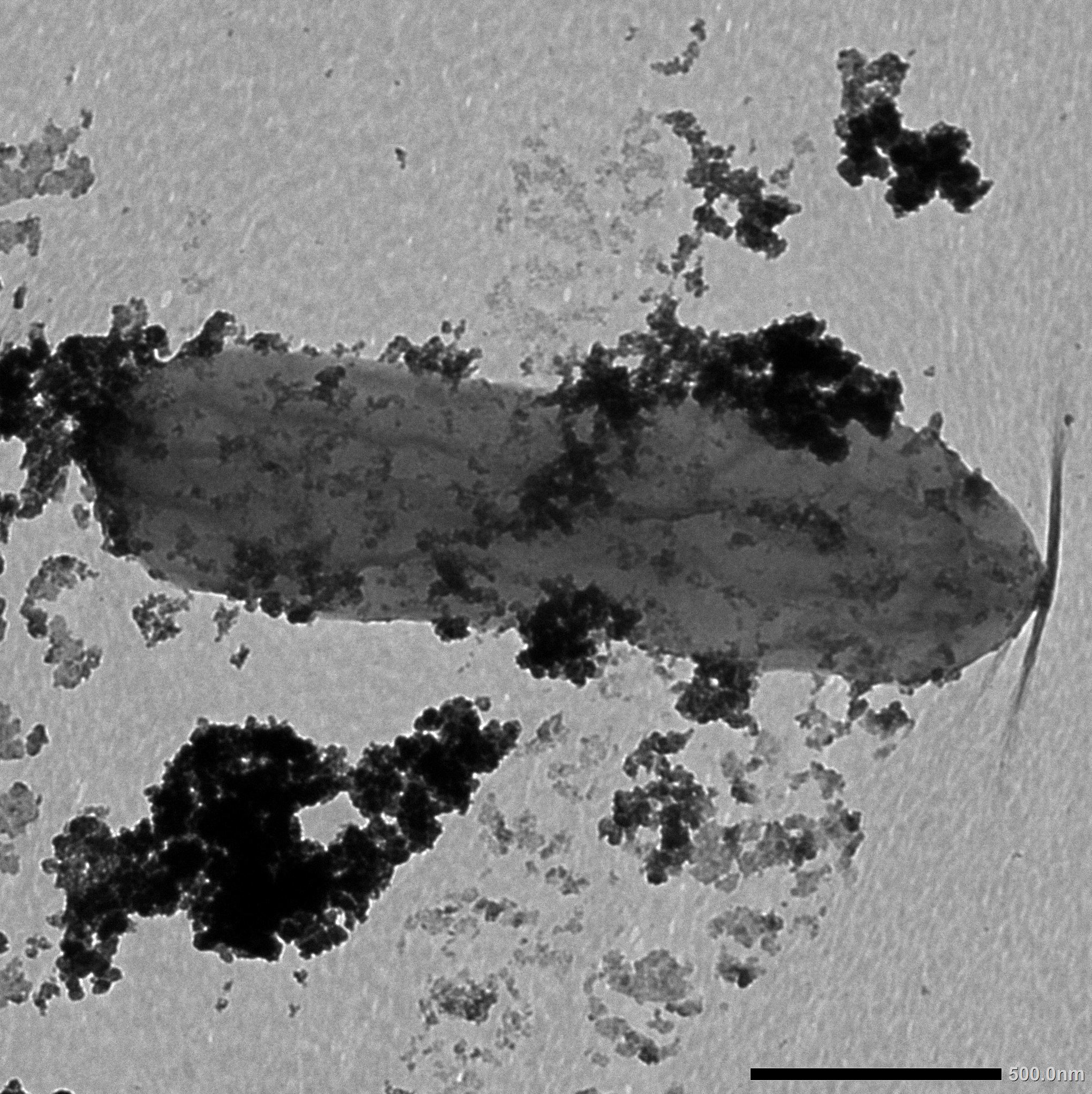
A microscope image shows an oblong, gray bacterial cell coated with clumps of dark speckles, which are mineral particles containing cobalt.
This Geobacter cell — which looks a bit like a gray peanut in this microscope image — is speckled with a dark coating of cobalt minerals that would be toxic to many organisms. Image courtesy of Hunter Dulay.


The team published its discovery in the journal Frontiers in Microbiology, with the research article first appearing online in late November, 2020. The Spartan team included Kazem Kashefi, an assistant professor in the Department of Microbiology and Molecular Genetics, and graduate students Hunter Dulay and Marcela Tabares, who are “two amazing and relatively junior investigators,” Reguera said.


She sees this discovery as a proof-of-concept that opens the door to a number of exciting possibilities. For example, Geobacter could form the basis of new biotechnology built to reclaim and recycle cobalt from lithium-ion batteries, reducing the nation’s dependence on foreign cobalt mines.


It also invites researchers to study Geobacter as a means to soak up other toxic metals that were previously believed to be death sentences for the bacteria. Reguera is particularly interested in seeing if Geobacter could help clean up cadmium, a metal that’s found in industrial pollution that disproportionately affects America’s most disadvantaged communities.


“This is a reminder to be creative and not limited in the possibilities. Research is the freedom to explore, to search and search and search,” Reguera said. “We have textbook opinions about what microbes can and should do, but life is so diverse and colorful. There are other processes out there waiting to be discovered.”


This work was supported by the NSF’s Geobiology and Low-Temperature Geochemistry Program, as well as a Hatch project grant from the United States Department of Agriculture’s National Institute of Food and Agriculture.


(Note for media: Please include a link to the original paper in online coverage: https://doi.org/10.3389/fmicb.2020.600463)


MEDIA CONTACTS

Caroline Brooks, Gemma Reguera
Natural SciencesEngineering, Science and TechnologyClimate and EnvironmentNatural Sciences

Latest News

MSUToday Weekly Update

The MSUToday Weekly Update email showcases how Spartans are making a difference through academic excellence, research impact and community outreach. Get inspired by these stories of innovation, collaboration and determination. Plus, enjoy photos and videos of campus and more MSU content to help keep you connected to the Spartan community.

Sign UpUpdate My Information

Connect With Us

Visit our Facebook pageVisit our page on XVisit our Instagram pageVisit our LinkedIn pageVisit our YouTube pageVisit our TikTok page

Health and Safety

  • MSU Police and Public Safety
  • Olin Health Center
  • Counseling & Psychiatric Services (CAPS)
  • University Health and Wellbeing
  • MSU Health Care
  • Civil Rights and Title IX
  • Our Commitment
  • Center for Survivors
  • Security & Fire Safety Report
  • University Policy on Relationship Violence and Sexual Misconduct
  • Notice of Non-Discrimination, Anti-Harassment and Non-Retaliation
  • Health Care Non-Discrimination Notice

Support Services

  • Disability Resources
  • Supportive Services
  • Learning Resources

Working at MSU

  • Human Resources
  • EBS Login
  • Job Postings
  • Employee Assistance Program

Reports

  • CARES Act Funding
  • Student Achievement and Outcomes

Contact us

517-355-1855

Address

Michigan State University 426 Auditorium Road East Lansing, MI 48824

Follow Us

  • Visit our Facebook page
  • Visit our page on X
  • Visit our Instagram page
  • Visit our TikTok page
  • Visit our LinkedIn page
  • Visit our YouTube page

If you're having accessibility issues, please let us know.

Know More: Campus Safety Information and ResourcesTransparency Reporting: Budget & Salary/Compensation
  • Contact Information|
  • Site Map|
  • Privacy Statement|
  • Site Accessibility|
  • Call MSU: (517) 355-1855|
  • Visit: msu.edu|
  • Notice of Nondiscrimination|

SPARTANS WILL|© Michigan State University|