Jump to HeaderJump to Main ContentJump to Footer
Michigan State University
  • Browse Stories By

    Topics

    Explore stories by subject area

    • Arts and Culture
    • Business and Economy
    • Climate and Environment
    • Education and Learning
    • Engineering, Science and Technology
    • Government and Society
    • Health and Medicine
    • Media and Communications
    • MSU Leadership and Impact
    • Sports and Recreation
    • Student and Campus Experience
    View All Stories

    Collections

    Curated story series

    • Turfgrass
    • Ask the Expert
    • Big Ideas
    • Climate solutions
    • Water at MSU
    • Mobility
    • Spartan Perspectives
    • Student views
    • Graduate voices
    • Faculty voices
    View All Collections

    Featured

    Editor's picks

    • The Spartans behind your favorite Michigan golf courses

      July 22, 2026

      The Spartans behind your favorite Michigan golf courses

    • MSU in the 1990s: 10 Spartan milestones

      July 14, 2026

      MSU in the 1990s: 10 Spartan milestones

MSUTODAY
  • Browse Stories By

< Browse Stories By

Topics

Explore stories by subject area

  • Arts and Culture
  • Business and Economy
  • Climate and Environment
  • Education and Learning
  • Engineering, Science and Technology
  • Government and Society
  • Health and Medicine
  • Media and Communications
  • MSU Leadership and Impact
  • Sports and Recreation
  • Student and Campus Experience
  • View All Stories

Collections

Curated story series

  • Turfgrass
  • Ask the Expert
  • Big Ideas
  • Climate solutions
  • Water at MSU
  • Mobility
  • Spartan Perspectives
  • Student views
  • Graduate voices
  • Faculty voices
  • View All Collections

Featured

Editor's picks

  • The Spartans behind your favorite Michigan golf courses

    July 22, 2026

    The Spartans behind your favorite Michigan golf courses

  • MSU in the 1990s: 10 Spartan milestones

    July 14, 2026

    MSU in the 1990s: 10 Spartan milestones

  • For Media
  • Experts
  • Releases and Statements
  • Sign Up
  • Update Information

Resources

  • A to Z Index
  • Find People
  • Maps
  • Email
  • Student Information System (SIS)
  • D2L
  • Libraries
  • Tech Support
  • MSU Misconduct Hotline
  • Social Media Directory
  • Events Calendar
  • For Media
Michigan State University
MSUToday
  • For Media
  • Experts
  • Releases and Statements
  • Sign Up
  • Update Information
MSUTODAY
Diseases, Conditions and Treatments

Aug. 9, 2021

Spotting — and hearing — heart attacks before they strike

A new imaging technique developed by a Spartan-led team uses light, sound and nanoparticles to detect plaques that cause strokes and heart attacks

By: Matt Davenport

If heart attacks blared a warning signal, patients would have a better chance of avoiding them. That’s the idea behind a new imaging technique developed by a Spartan-led team of researchers.

 

MSU Associate Professor Bryan Smith

“We shine light into an artery where we’ve delivered certain types of particles that can absorb that light,” said Bryan Smith, an associate professor in Michigan State University’s College of Engineering. “As a product of the release of that energy, they can literally shout back at us in ways that we can detect and use to create 3D images.”


To be clear, the sound signal isn’t audible to human ears, but it’s easily captured by an ultrasound’s transducer. Thanks to Smith and his colleagues, this technique can now be used to directly image atherosclerotic plaques, the medical term for fatty clumps that accumulate in arteries that can lead to strokes and heart attacks.


The researchers showcased the new technique in mice, the first step towards advancing the technology for use in humans. The team published its results in an article that's now available online in the journal Advanced Functional Materials. The journal also featured the work on the inside cover of its Sept. 9 issue.
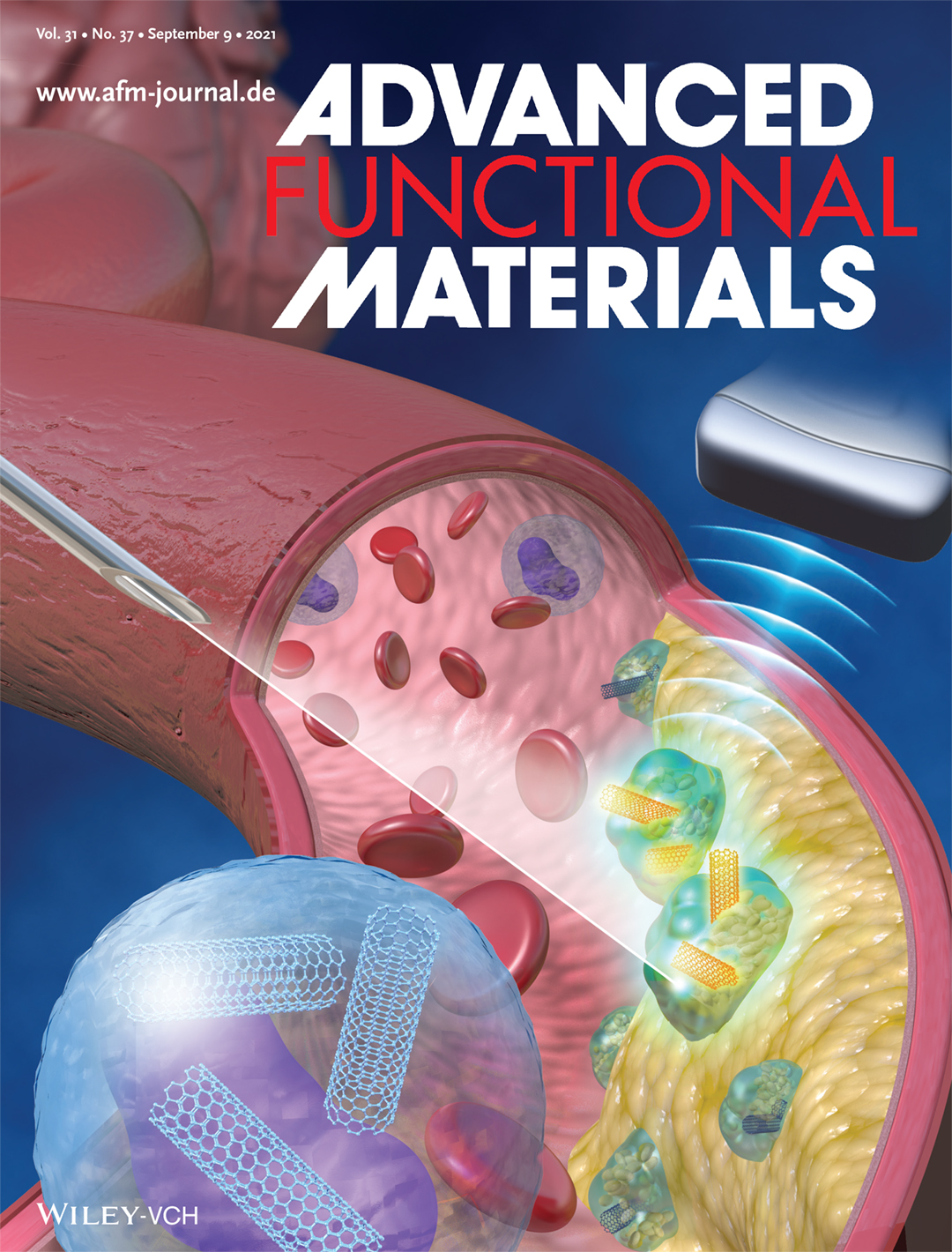
 

An illustration used as the inside cover of the journal Advanced Functional Materials shows a blood vessel filled with blood cells and little orbs containing tubes that have been injected with a syringe. Some of the tubes have become lodged in a fatty plaque in the blood vessel and these tubes glow yellow when struck with sound waves from an ultrasound. This glowing signal lets researchers
The scientific journal Advanced Functional Materials featured the work of MSU's Bryan Smith and his team on the inside cover of its Sept. 9 issue.

“The power of our new technique is in its selectivity,” said Smith, who is the director of the Translational NanoImmunoEngineering Lab located at MSU’s Institute for Quantitative Health Science and Engineering, or IQ.


“There are certainly other methods to image plaques, but what distinguishes this strategy is that it’s cellular,” Smith said. “We’re specifically looking at the cells — called macrophages and monocytes — that are most responsible for making a plaque vulnerable in the first place.”


Although it’s difficult to prove whether a particular plaque is responsible for a stroke or heart attack in a patient, the prevailing idea is that vulnerable plaques are the most dangerous, Smith said. These are inflammatory plaques that can rupture and consequently block blood vessels.


In addition to fatty deposits, vulnerable plaques also contain lots of immune cells, including many macrophages and monocytes. Smith and his colleague have developed nanoparticles — tiny tubules made of carbon atoms — that naturally and specifically seek out these cells.
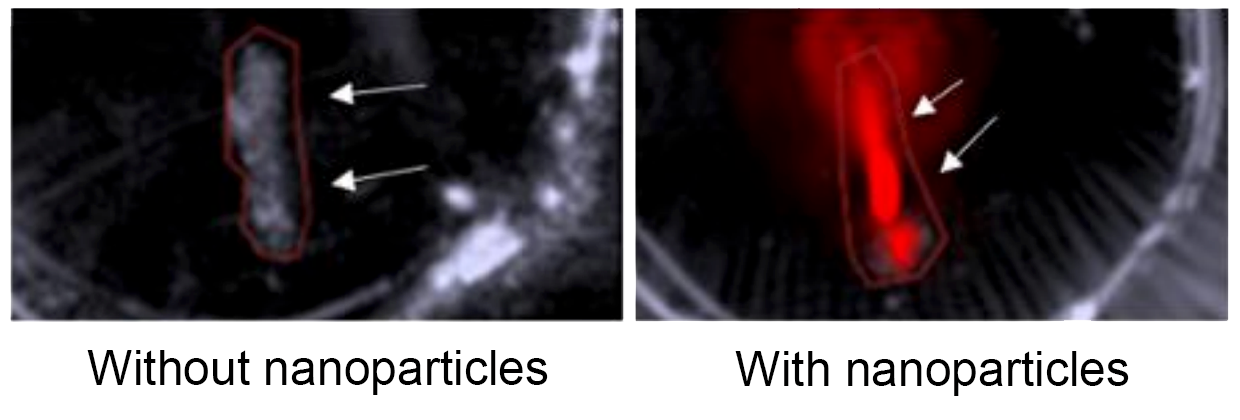
 

A black-and-white ultrasound image on the left shows a gray rod, which is a mouse’s artery. Two white arrows and a red outline have been added to the image to highlight the blood vessel. In the image on the right, a different artery is shown and it’s glowing red in the otherwise grayscale ultrasound image. This red signal comes from the new photoacoustic imaging, aided by nanoparticles
A new imaging technique uses nanoparticles to help reveal vulnerable plaques in arteries that can lead to strokes and heart attacks. Immune cells in the plaque attract the nanoparticles, which can then emit a signal that’s seen in red in the image on the right, taken from a mouse artery. That signal is absent — meaning a plaque goes undetected — in the artery shown on the left, which shows a mouse that did not receive the nanoparticles. Credit: Adv. Funct. Mater.

In injecting the particles into mice, researchers send the tubes searching for specific immune cells that congregate in plaques. The researchers can then shine laser light into the arteries. If there is a plaque present, the particles will absorb the light and emit sound waves. The researchers then use this acoustic signal to locate and visualize the plaque.


“If you look at a normal blood vessel versus one with a plaque, there’re a lot more macrophages and monocytes in the one with the plaque,” Smith said. “And our method is really looking at the monocytes and macrophages. Virtually no other cell type takes up the nanoparticles.”


The idea behind coupling light and sound, known as the photoacoustic effect, dates back to Alexander Graham Bell in the late 1800s, Smith said. Still, to go from that idea to a medical diagnostic, it required the development of crucial technologies such as lasers and ultrasounds. The technique is now coming of age with the Food and Drug Administration approving a photoacoustic imaging machine for detecting breast cancer earlier this year.


In the future, doctors may image arterial plaques in a precise and noninvasive way through Smith and his team’s innovations with nanoparticles. Joining Smith on the project were researchers from Stanford and Emory universities.


“This exciting progress in nanomedicine was only possible because of our multi-disciplinary team of experts,” said Eliver Ghosn, a collaborator on the project and an assistant professor at the Emory University School of Medicine and its Lowance Center for Human Immunology.


“Currently, there is no effective way to accurately locate and treat vulnerable plaques before they lead to a heart attack or stroke,” Ghosn said. “We hope our studies will help change that.”


From a treatment standpoint, Smith’s lab has also already shown that it can pack their nanoparticles with a drug used to fight plaques. Moving forward, the team will explore using these particles to aid with imaging and delivering a therapeutic.


“So you might ask, can you connect those ideas, develop a combination of a therapy and a diagnostic? I think the answer is absolutely yes,” Smith said. “There is a lot of potential in that realm. It’s in the pipeline.”


This story was updated on Sept. 15 to include the data and cover art from the issue of Advanced Functional Materials that features this research.


MEDIA CONTACTS

Bryan Smith, Caroline Brooks
Diseases, Conditions and TreatmentsHealth and MedicineFitness and ExerciseEngineeringEngineering, Science and Technology

Latest News

MSUToday Weekly Update

The MSUToday Weekly Update email showcases how Spartans are making a difference through academic excellence, research impact and community outreach. Get inspired by these stories of innovation, collaboration and determination. Plus, enjoy photos and videos of campus and more MSU content to help keep you connected to the Spartan community.

Sign UpUpdate My Information

Connect With Us

Visit our Facebook pageVisit our page on XVisit our Instagram pageVisit our LinkedIn pageVisit our YouTube pageVisit our TikTok page

Health and Safety

  • MSU Police and Public Safety
  • Olin Health Center
  • Counseling & Psychiatric Services (CAPS)
  • University Health and Wellbeing
  • MSU Health Care
  • Civil Rights and Title IX
  • Our Commitment
  • Center for Survivors
  • Security & Fire Safety Report
  • University Policy on Relationship Violence and Sexual Misconduct
  • Notice of Non-Discrimination, Anti-Harassment and Non-Retaliation
  • Health Care Non-Discrimination Notice

Support Services

  • Disability Resources
  • Supportive Services
  • Learning Resources

Working at MSU

  • Human Resources
  • EBS Login
  • Job Postings
  • Employee Assistance Program

Reports

  • CARES Act Funding
  • Student Achievement and Outcomes

Contact us

517-355-1855

Address

Michigan State University 426 Auditorium Road East Lansing, MI 48824

Follow Us

  • Visit our Facebook page
  • Visit our page on X
  • Visit our Instagram page
  • Visit our TikTok page
  • Visit our LinkedIn page
  • Visit our YouTube page

If you're having accessibility issues, please let us know.

Know More: Campus Safety Information and ResourcesTransparency Reporting: Budget & Salary/Compensation
  • Contact Information|
  • Site Map|
  • Privacy Statement|
  • Site Accessibility|
  • Call MSU: (517) 355-1855|
  • Visit: msu.edu|
  • Notice of Nondiscrimination|

SPARTANS WILL|© Michigan State University|