Michele Brock is the community programs director for the MSU School of Social Work. Describing her work as social justice in action, Michele oversees five of the school's social service programs: Chance at Childhood, Continuing Education, FAME, the Kinship Care Resource Center and Veterinary Social Work Services. The following article is repurposed content from the College of Social Science website.
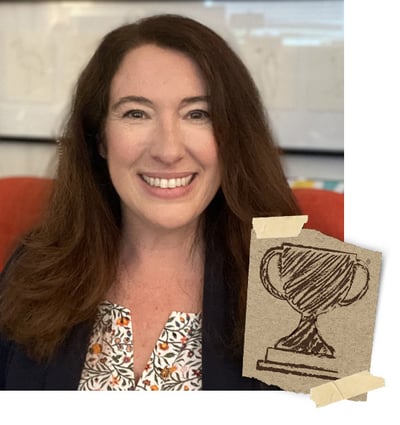
Having started the first decade of my professional social work career as a clinician and administrator working with survivors of trauma, I witnessed deeply problematic institutional and systemic challenges to individual, family, and community healing. This ignited my desire to pursue systems change. In 2004, I was provided the opportunity to create and direct the MSU School of Social Work Continuing Education Program.
There are over 20,000 licensed social workers in Michigan and the School of Social Work has been at the forefront of developing and delivering innovative programming. In 2015, I was promoted to the director of community programs, providing new and additional opportunities for community engagement and macro intervention. To have the opportunity to partner, co-create and equip people with the knowledge, skills and tools to grow stronger is a dream for me.
Fueled by my personal experiences with disability, including having a daughter with a rare genetic syndrome, I know disability to be a natural expression of the human experience. In 2016, I began working with a community partner and leader in the pursuit of disability justice, Michigan Disability Rights Coalition. Our vision was to develop more inclusive communities with a focus on developing youth leaders with and without intellectual and developmental disabilities, learning together how to create positive social change in their schools and communities. This vision became known as Youth Engaged in Leading and Learning, or YELL, a grant project funded by the Michigan Developmental Disabilities Council. My partnership resulted in a contract with MSU to coordinate project efforts including evaluation for which I am the principal investigator.
YELL is a curriculum-based program that includes experiential learning modules on disability history, disability leaders, disability identity and pride, advocacy, leadership and activism, and it culminates in the implementation of youth-led advocacy projects. In addition, the content addresses the impact of ableism, and internalized ableism and how youth without disabilities can serve as allies.
Alongside this experience, it assists faculty/staff/service providers in building capacity for inclusion. Many people with disabilities have not been taught about their shared history of the fight for equal rights done by people with disabilities and their allies, and the pride that is possible from celebrating one’s disability or had opportunity to view people with disabilities in leadership roles. A core element of YELL is that it was developed and facilitated by people with intellectual and developmental disabilities.
This past year, we recruited and trained a cohort of established disability leaders to be YELL Ambassadors. Together, we are developing outreach plans, and the Ambassadors will deliver the curriculum as a way to influence the next generation of leaders in the disability community. YELL Ambassadors are regionally located and can be hired to present the full curriculum throughout the State of Michigan and, virtually, can train anywhere.
There are many negative stereotypes and myths that harm people with disabilities, often undermining their dignity and personhood.
-
People with disabilities are special or inspiring because they face such adversity. It is not uncommon to see news features and social media posts highlighting the kindness of a schoolmate asking a person with a disability to prom, giving a disabled person awards for no reason and the like. I’d encourage people to be informed media consumers and storytellers by asking, who is telling the story? Why is this story being told? Did the person with the disability give consent? Famous disability writer and advocate, Stella Young, delivered an exceptional Ted Talk about how this “inspirational” narrative is infantilizing, objectifies people with disabilities and perpetuates stigma and pity. So often disability is relegated to a medical diagnosis that no one wants, or to loss when, in fact, disability is far more complex a journey. While the condition causing the disability may cause pain and discomfort for many, it is often the negative social attitudes and assumptions, unrelenting systemic oppression and ongoing physical barriers to full participation in life that cause greater harm and isolation.
-
Guardianship is crucial to protect people with disabilities. All of us deserve the dignity of risk, the right to make choices about our life experiences and to succeed or fail. However, many families of children with disabilities are taught to seek guardianship or conservatorship as their children reach the age eighteen without being provided with what alternatives to guardianship might look like. This has been referred to as the school-to-guardianship pipeline. These guardianships and conservatorships allow for others to make fundamental decisions about all aspects of one’s life, from voting to reproduction to residence, and as Britney Spears’ public experience illustrates — they can be dangerous. There are less restrictive legal tools and options such as Supported Decision-Making that allow people to maintain their dignity, independence, and rights.
-
People with disabilities are asexual. As with most people, sexuality is a basic inherent need. It is often assumed people with disabilities are asexual or hypersexual. This is no truer than it is for non-disabled people. People with disabilities have the same desires for physical intimacy, relationships and romantic love as anyone else but are often not provided with proper education, opportunity to date, safer sex information and accommodations to support this personal expression.
Like any skill, allyship takes practice. Here are some practical tips to be an ally to those with disabilities in our day-to-day lives:
- Presume competence. People with disabilities deserve to be treated as people first and foremost. Presuming competence means believing people with disabilities can think, learn and understand the world around them even if it looks different than your experience. It is the mindset that all people have a right to live, learn, work, love and play and when provided with the right accommodations and support, everybody benefits. It also means, adults like to be treated as adults, teens like teens and children like children, regardless of disability.
- Use inclusive language. When in doubt about how to refer to a person, ask! Some individuals prefer person first (“person with autism”), while others prefer identity first (“autistic person”). Avoid words like “handicap,” “special needs,” “handicapable,” and “differently-abled.” Special needs are human needs. These words reinforce ableism and are often used by non-disabled people to describe disabled people. Consider focusing on your impact rather than your intent. Don’t let fear of saying the wrong thing stop you from engaging with people with disabilities. Challenge ableist language when you hear it. For example, I just learned it's preferable to say “wheelchair user” instead of “wheelchair bound.” Finally, when you make a mistake, be accountable and apologize.
- Relentlessly pursue access. We all benefit from universally designed spaces. I certainly am thankful for automatic doors when I’m taking my full grocery cart to my car. I appreciate being able to assume chairs will be available when I attend a meeting or a conference. Wherever you go, observe door functionality and size, elevators, bathrooms, seating, doorways, visual and hearing accommodation equipment, ramps, transportation access. When you see a barrier or omission, consider what you can do, or identify the decision makers who can make change. Alternatively, where access is not feasible, consider where you take your business. People with disabilities cannot participate, cannot be at the table, if they cannot physically get there or, once there, are not provided reasonable accommodations.
- Learn more. Stay curious and engaged. Challenge what you may have been taught about disability. Read or watch films and videos about and by people with disabilities. On campus, we can invite Spartan Project Search interns into our departments, attend MSU C-RAIND events, advocate with consent alongside students and colleagues to have the accommodations to be successful using services such as those offered by RCPD. Ask if someone needs assistance prior to assuming assistance is necessary. Teach children to say “hi” when they are curious about a visible disability. Buy products from businesses owned by people with disabilities. There are abundant resources to learn more about disability history, justice and culture, and creating more equitable and inclusive communities.

